Richie Culver
Seizing the Unresolved, Preserving the Moment
Richie Culver’s work emerges from a compulsion to make, to repeat, to test the limits of a gesture. Across painting, collage, sound, and performance, his practice resists resolution, unfolding through cycles of construction and erasure where intention is often recognized only after the fact.
What appears as fragmentation is a sustained negotiation with control. Works are not composed as much as they are encountered, shaped by accident, material resistance, and the persistence of past forms. The boundaries between mediums dissolve into a continuous state of production, where meaning remains provisional.
In The Builder’s Daughter, these tensions converge. The exhibition draws from personal memory while refusing sentimentality, grounding itself in gestures of rebuilding. Meaning is deferred, held between abstraction and lived experience, where the work remains within the void, always leaving room for chance, accident, and the unspoken logic of materials. For Culver, that state of flow “is the only thing that really makes sense,” where a minute turns into hours and he is still there inside it.
In this conversation with NR Magazine, Richie Culver maps a practice grounded in uncertainty, where making precedes meaning. Moving between sound and image, control and chance, he traces a language that is never fixed, only continuously negotiated.
Curated by PASSAGE, The Builder’s Daughter will be on view at All-U-Re, Tsar Kaloyan, 1000 Sofia, Bulgaria, from 15th–18th May 2026, with the opening on Friday 15th May, from 7pm.
Your entry into the art world was almost accidental, walking into Tate Modern at 17 with a magazine and a cutout. How did that moment shape everything that followed?
I was making work in a really naive way, for the sake of doing something. It felt very natural to make things at that point. There was an exhibition at Tate Modern for outsider artists, and someone suggested I take one of my works to the curators. I did, and it got exhibited. That was the first time I had something shown. After that, I started to take things more seriously. I began experimenting with different mediums and just continued making. I had always been making things, DJing, producing, writing poetry, but I had been more scared to make paintings or collage. I think I overthink things. It is quite normal now. People either have short attention spans or they overthink everything, especially with social media. Even though I had not been to art school, I was obsessed with making, but I would always ask myself what the concept was. For a long time I was just making things to quiet my head, but I kept questioning it. What does it mean, why have I made it. To not fall into something decorative, I felt everything had to have meaning. I did not think I had that much to say.
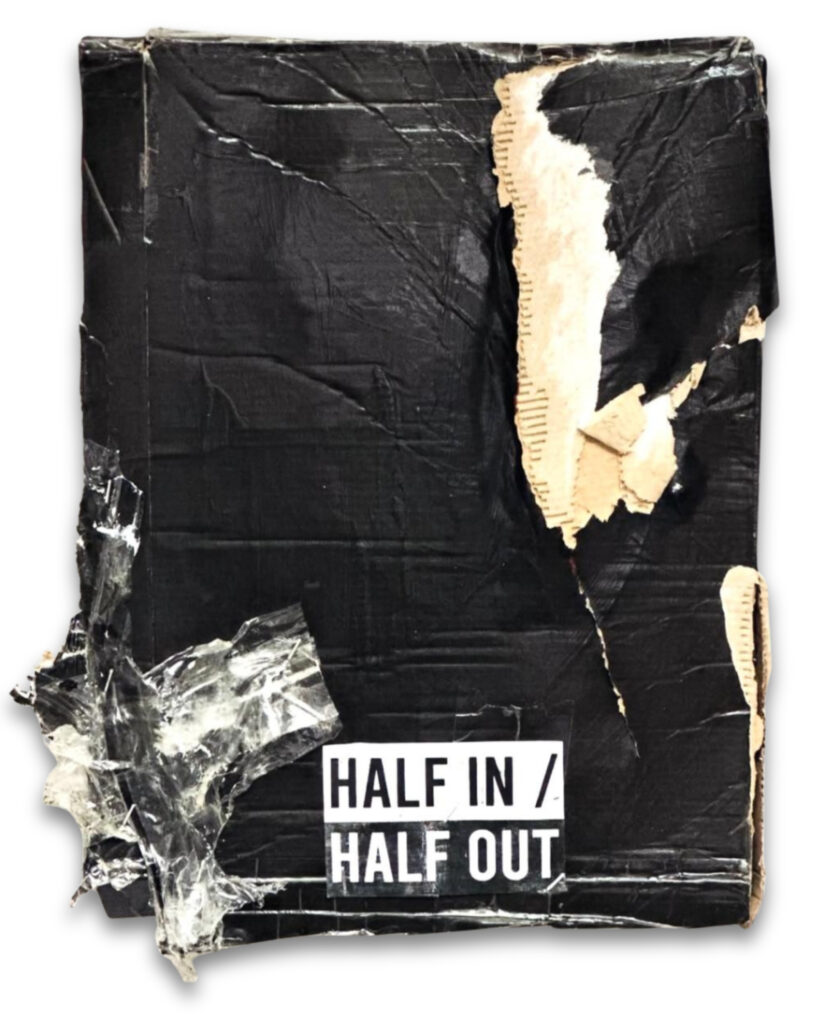
Mixed media on canvas
38 x 29 cm
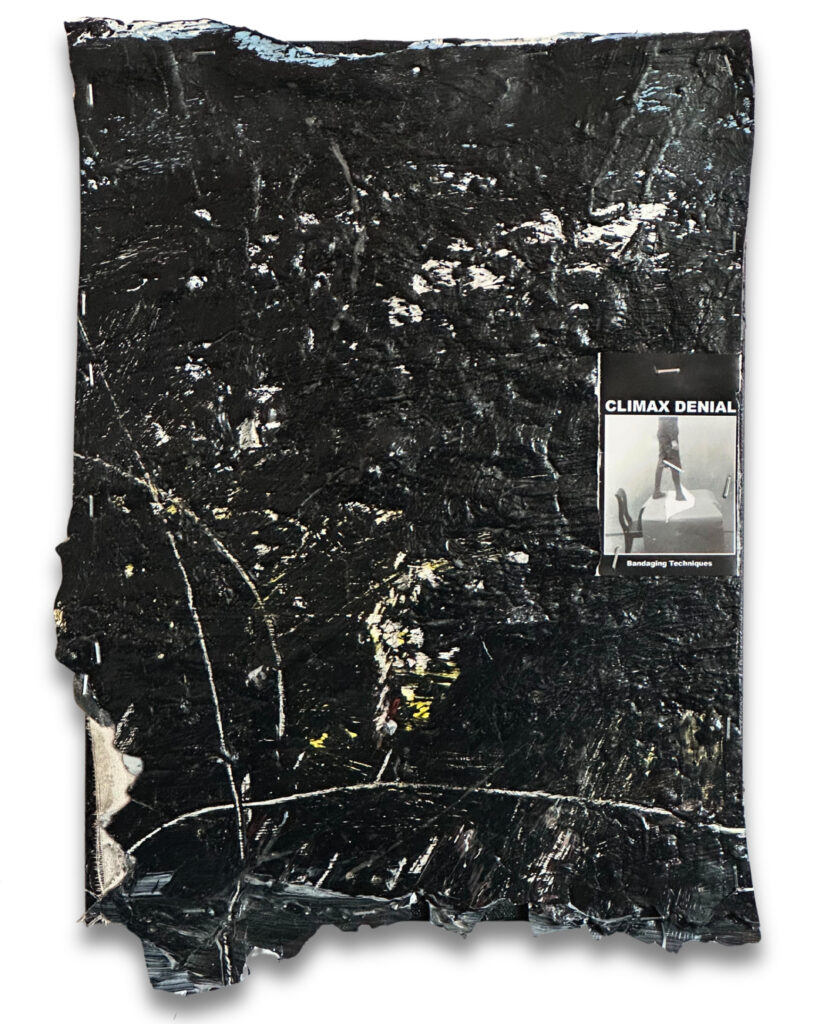
Oil, acrylic, paper, gel, staples on canvas
43 x 33 cm
You have spoken about being scared to make paintings. Did that ever shift, or is it still something you carry?
I still struggle with it. That is why I constantly have to make things. I see a DJ set as painting anyway. When I play at places like Berghain or Tresor, it feels exactly the same as being in the studio. There is a thousand people in front of you, but it is still about curating something, shaping a journey. The tracks become colours. It is all feeling. That state of flow is the only thing that really makes sense to me. Something where a minute turns into four hours and you are still there inside it. Because of that, the concept almost comes after. I make something first, then I figure out why I did it, what it is, what sits behind it. If I try to begin with meaning, it breaks that state. It stops feeling honest. You have to be careful not to lie to yourself.
Your relationship with sound started very early, in quite a physical way. What stayed with you from those first experiences?
I remember being six or seven on the waltzers at a funfair, getting thrown around with happy hardcore and an MC. There were all these airbrushed images everywhere, Freddie Mercury, horror characters, all these strange combinations. I remember losing myself slightly. It felt like a small glimpse into something underground, something you did not fully understand but could feel. Then when I went to my first rave at fourteen or fifteen, it felt familiar. That same feeling that you should not be there, that something secret is happening, that you are part of something without fully knowing why. From very early on I was obsessed with the extreme. What is the darkest, weirdest music, how far into the grey area you can go without it collapsing or being pushed too far. That is still what excites me.
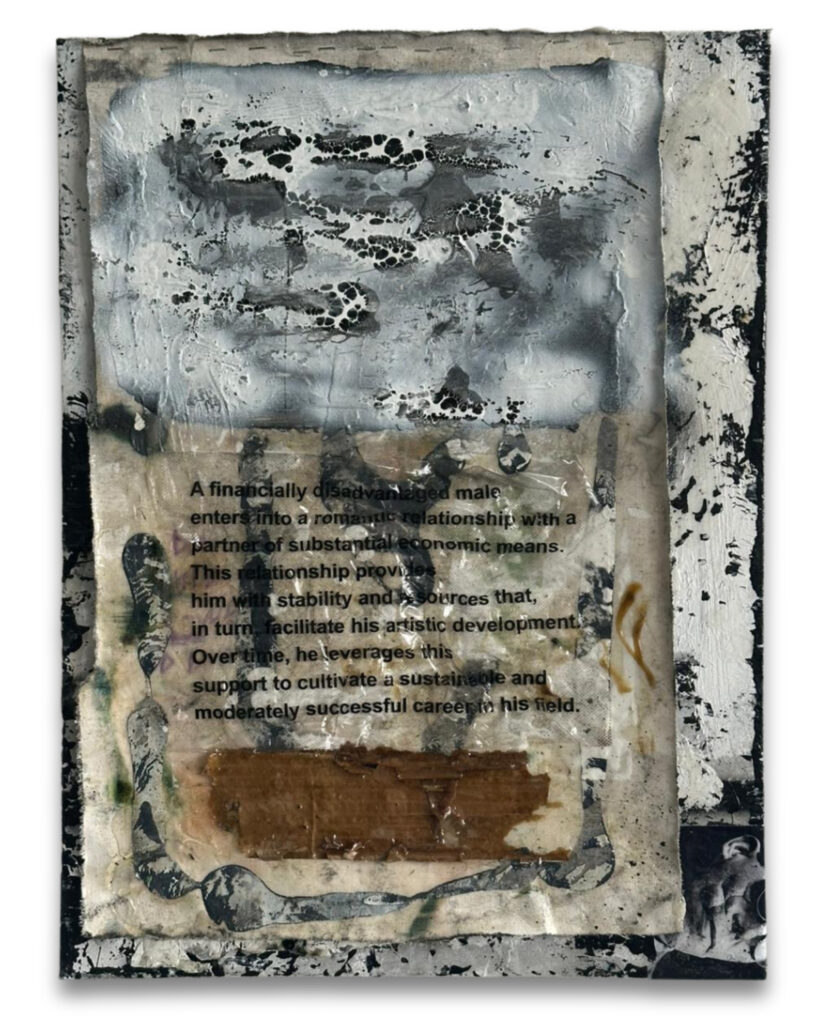
Mixed media on canvas
80 x 60 cm
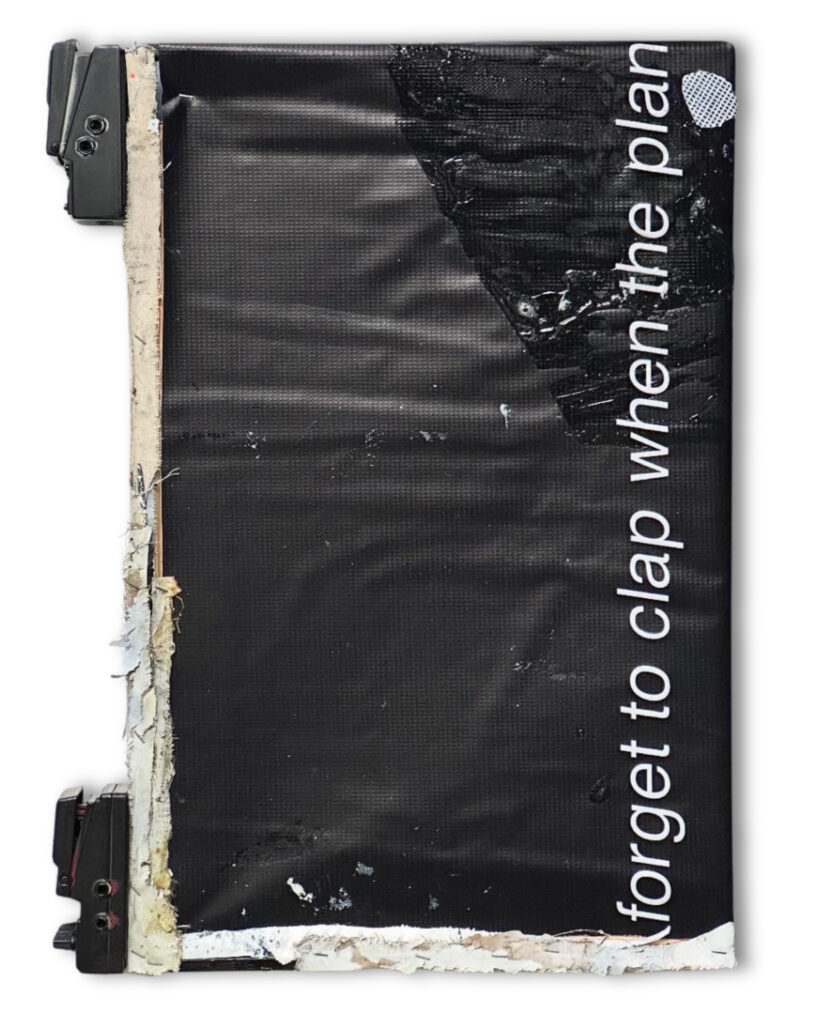
Acrylic, PVC, Guitar Pedals on Canvas
You often return to abstraction and nothingness. What is it that holds you there?
I have always been into abstraction. It is the work I am most drawn to, the kind of work I look at and wish I had made. More recently I have started questioning it. Seeing my kids get into abstraction made me think about it more. Why am I so interested in nothingness. Why do I not respond in the same way to a figurative painting that took years to make. What I make visually has to match what I make in music. There is nothing figurative in my noise and techno world, so it makes sense that it carries through. I have also been thinking about why there have been so many male abstract painters. Maybe it is because men do not want to look deeper, or do not know how to. Maybe it is easier to stay within something that appears to mean nothing. But at the same time I see it as something very academic. If you can stand in front of a Mark Rothko painting and feel something, then you can sit and listen to harsh noise in exactly the same way. It is either nothing at all, or it is the highest level of thinking. Either it means absolutely nothing and we are all kind of laughing, or it becomes something very intense, where you are forced to go through your own mind and sit with it.
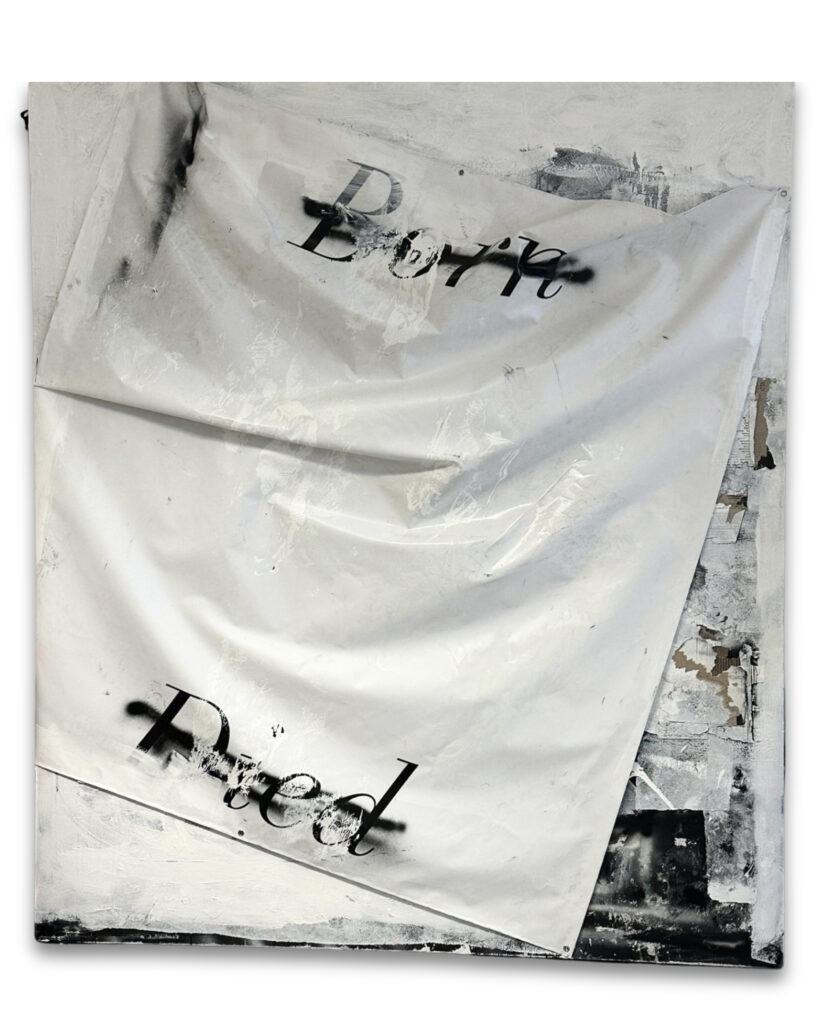
Acrylic, pvc, lacquer on canvas
220 x 190 cm
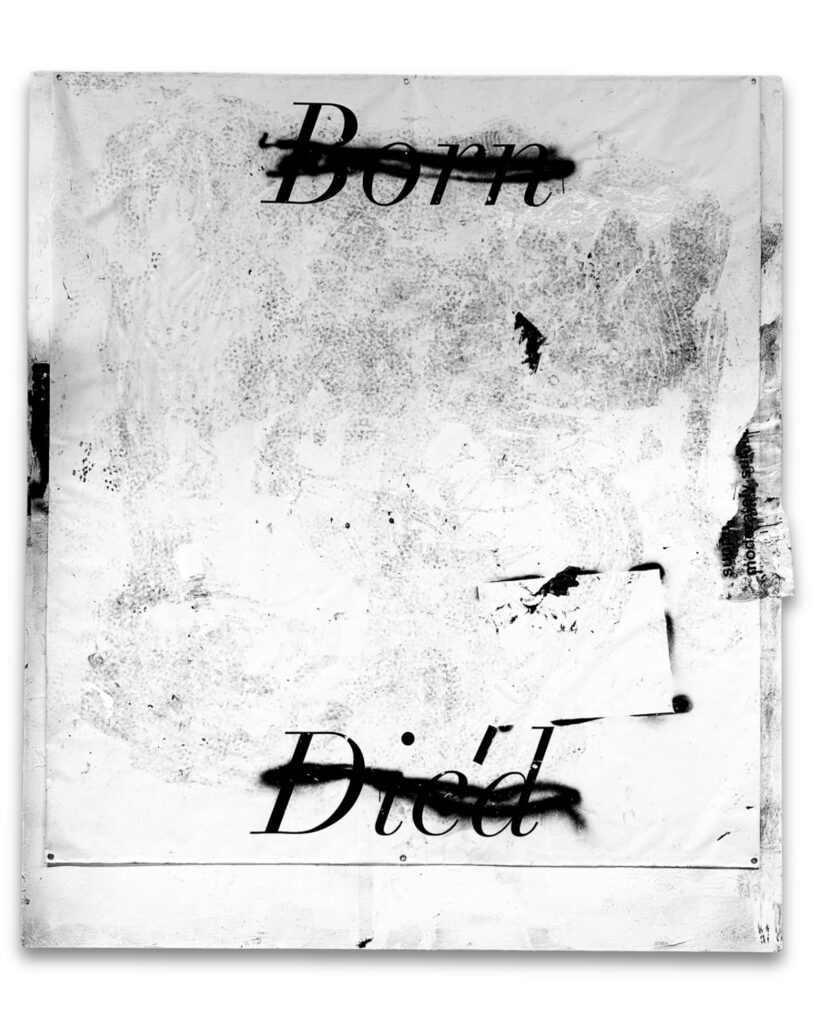
Acrylic, oil, lacquer, pvc, dirt on canvas
220 x 190 cm
During your time at the RCA, you began thinking about how we look at a painting. What changed for you?
I started asking myself how long you can look at a painting. If you do not know anything about the artist, can you just stand there and accept it for what it is. Or do you need the background, the story, the context to make sense of it. I try now to go into galleries without reading the text, without informing myself too much, just to look at the work as it is. But at some point you learn about the artist and everything shifts. You feel something different, you read it differently. It is something I am still battling with, that balance between looking and knowing.
Your recent works come from destroying older pieces and rebuilding them. What drives that process?
I was stuck between different directions, whether to paint, to photograph, to perform. So I started destroying old work in the studio. Then I went back to where I started, just putting things together in a very naive way. They became very physical, layered, almost sculptural. I also started bringing in my musical work and collaborations. I had always tried to keep everything separate, but eventually it all comes back together. I try not to control it too much, to let it happen rather than forcing it.
You once described earlier collages as suicide notes. What did that refer to?
That was from a much younger version of myself. Something from a long time ago. But like most artists, death is an interesting topic. It is something inevitable, something you think about at different points.
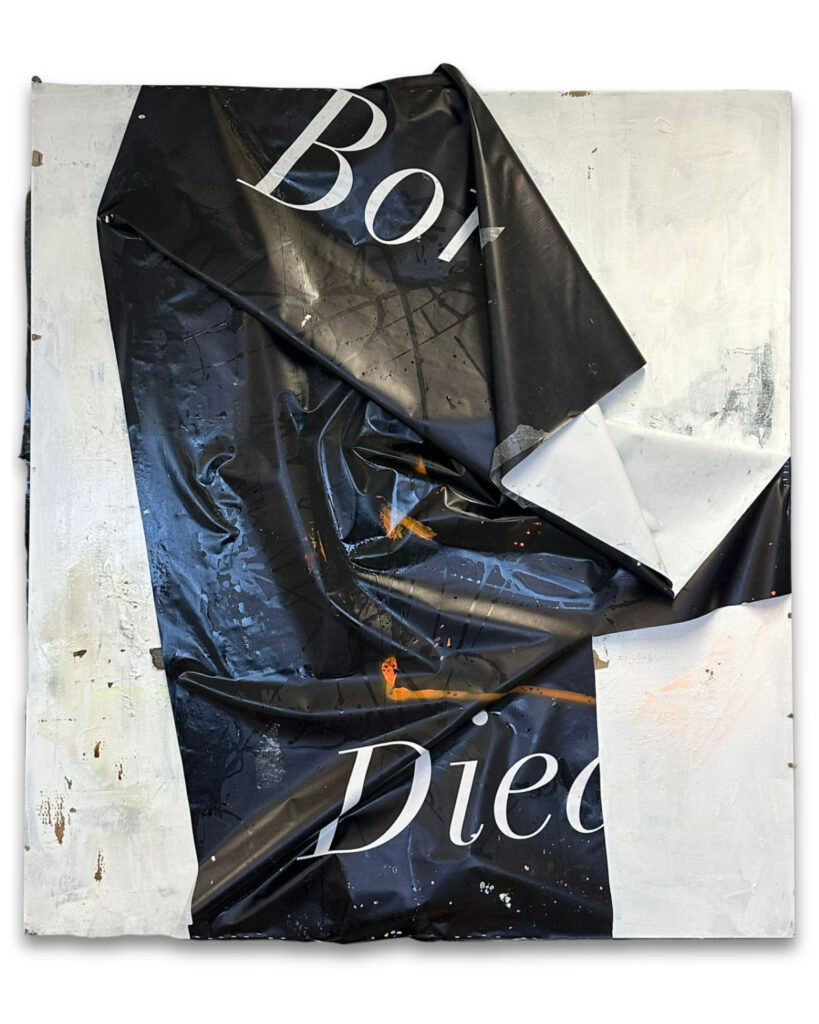
Acrylic, lacquer, pvc on canvas
200 x 180 cm
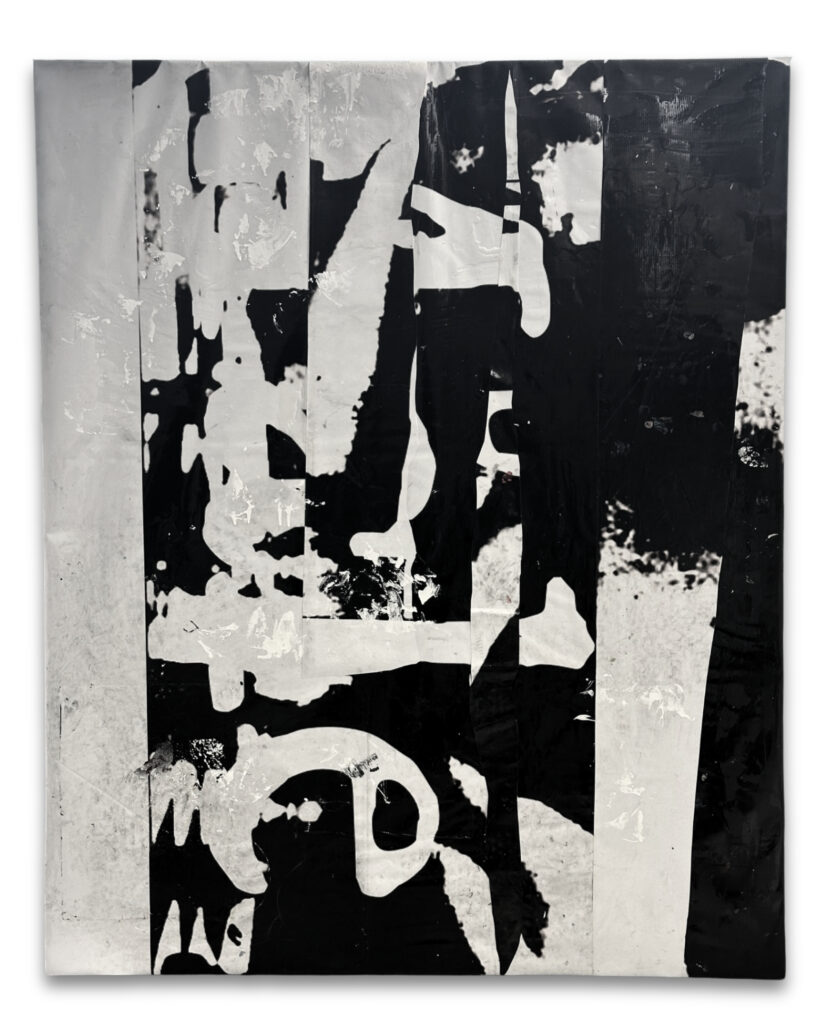
Acrylic, PVC on Canvas
The Builder’s Daughter comes from a very specific personal story. How did that become the anchor of the work?
It comes from where my mum lives in Hull. After my stepdad passed away, she was still there, and the community around her really came together. There was this woman, the builder’s daughter, who became very close to her. Someone I do not really know, but who stepped in and became like family. The works came first, rebuilding old pieces, and then the title made sense. It tied everything together in a way that I had not planned.
When did you feel the title was right?
The title felt right straight away. It was quite immediate. The work, I still go back and forth on it. I have lived with it for a long time now. But it feels honest. It connects to everything I am doing, music, performance, photography. If I can perform with the works on the wall and it makes sense together, then I am happy with that.
Your studio process seems to leave a lot open to chance. How do you think about control in your work?
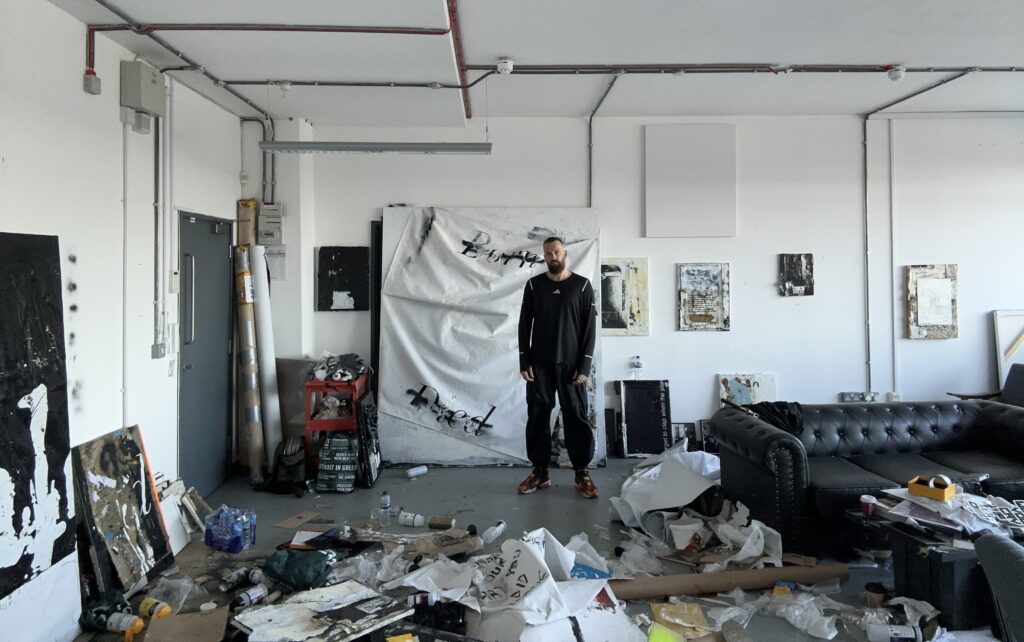
My studio is chaos. There is nowhere to put your feet. I will use something, put it down, forget where it is. If I cannot find a stapler, I will use tape. Things happen in a way that is not planned, not controlled. I like luck being part of it. I like not being fully in control of what is happening. When something is finished, it is not about whether I am happy with it or whether it is perfect. It is just what happened in that time. It almost feels like someone else’s hand is in it, like there were easier ways to do it but something else happened instead.
You move between the art world and the noise world. Do they feel separate to you?
They are far apart but also very close. You look at people like Genesis P Orridge or Cosey Fanni Tutti from Throbbing Gristle. They come from underground noise but end up in major exhibitions. So there is always crossover. They are closer than people think.
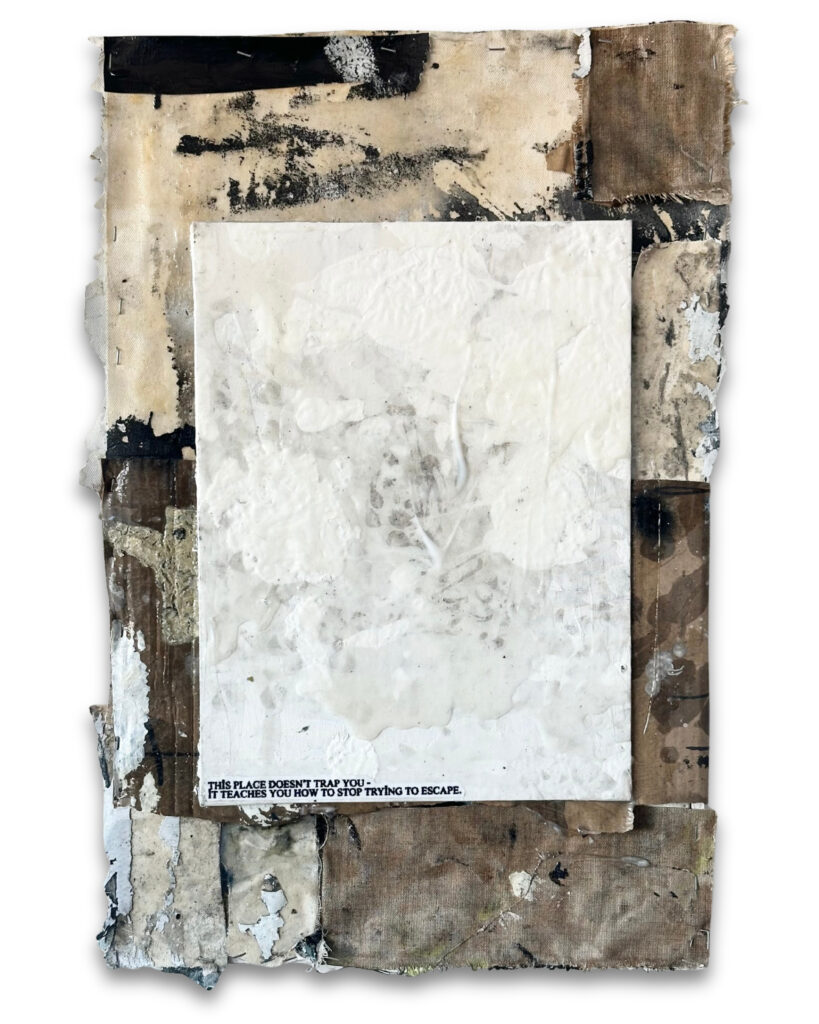
Mixed media on wood
66 x 45 cm
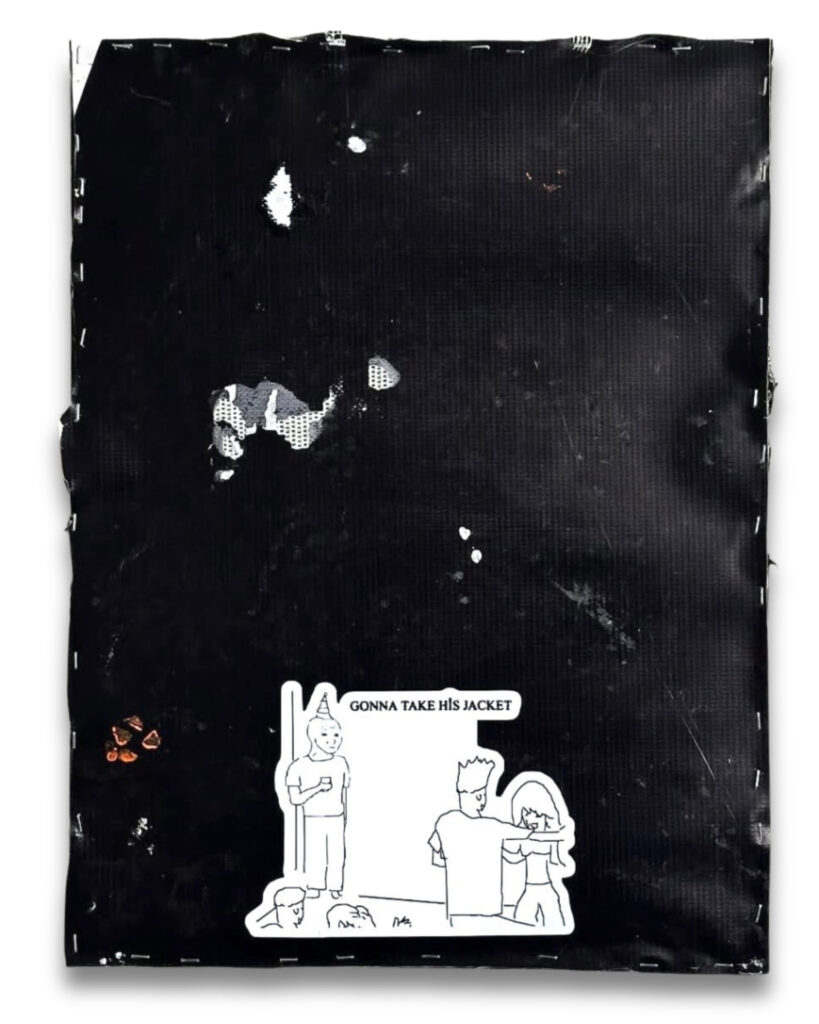
Mixed media on wood
43 x 56 cm
Your work moves between working class references and high fashion. Where does that tension come from?
I grew up around markets, car boot sales, working class environments in the north. That stays with you. At the same time I have always been really into fashion. From these environments to designers like Carol Christian Poell. For me that is the end point, in the same way that noise is the end point in music. I like everything. Fake, expensive, it does not matter. I am interested in how things look, how they are worn, how they exist.
Your sculptural works, embedding Nike sneakers in cement or preserving worn Reebok Classics, feel like archives of lived experience. What is it that you are preserving within them?
When I used to go raving every week, I kept my shoes. They had been in places that are hard to explain. If you know, you know. So I started turning them into objects. Putting them in cement, melting them, preserving them. They become relics. It is like collecting moments from people’s feet. Traces of collective movement and embodied experience.
The underground now circulates almost instantly. Do you think it can still remain protected?
I do not really know anymore. Everything becomes mainstream at some point. You have to survive, you have to put your work out there.The real underground probably exists in places we do not see, because it is not on our phones. But it is still there. It just looks different now.
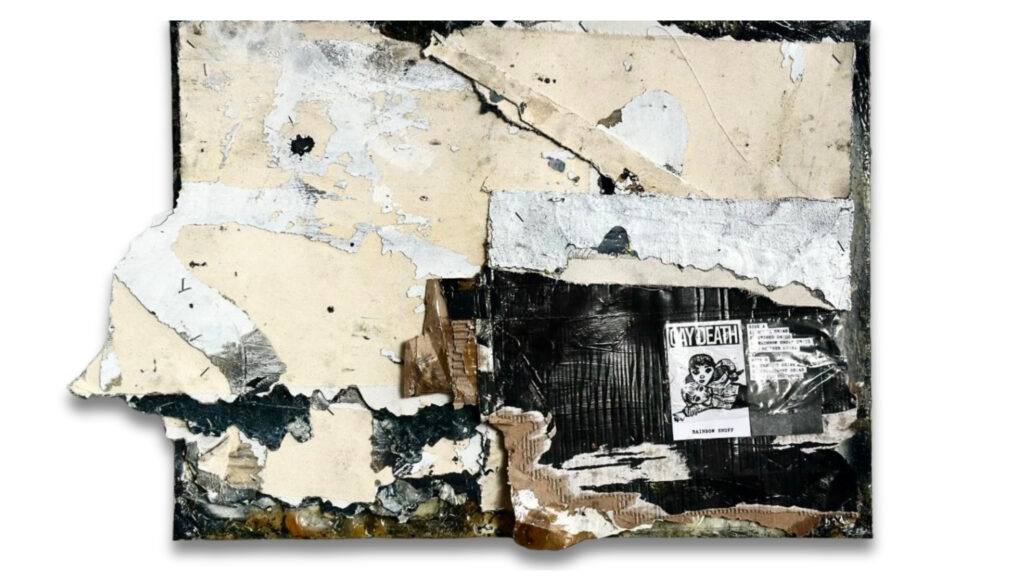
Your work resists being pinned down to one language or style. Is that something you aim for?
I do not think I will ever be that artist where you can instantly recognise the work. I have too many different things going on. This body of work feels like a step towards abstraction again. Towards making work about nothing. Falling into the void.
What still feels unresolved for you?
A lot of things. I have a new record coming out as Quiet Husband, more shows, more work. But unresolved, we would be here for a long time. I am one of those people where the glass is always half empty. I want less screen time. I wish that whole thing would just disappear. Being in the moment is the goal. That is where the work comes from. Or at least I hope so.