Archive page:


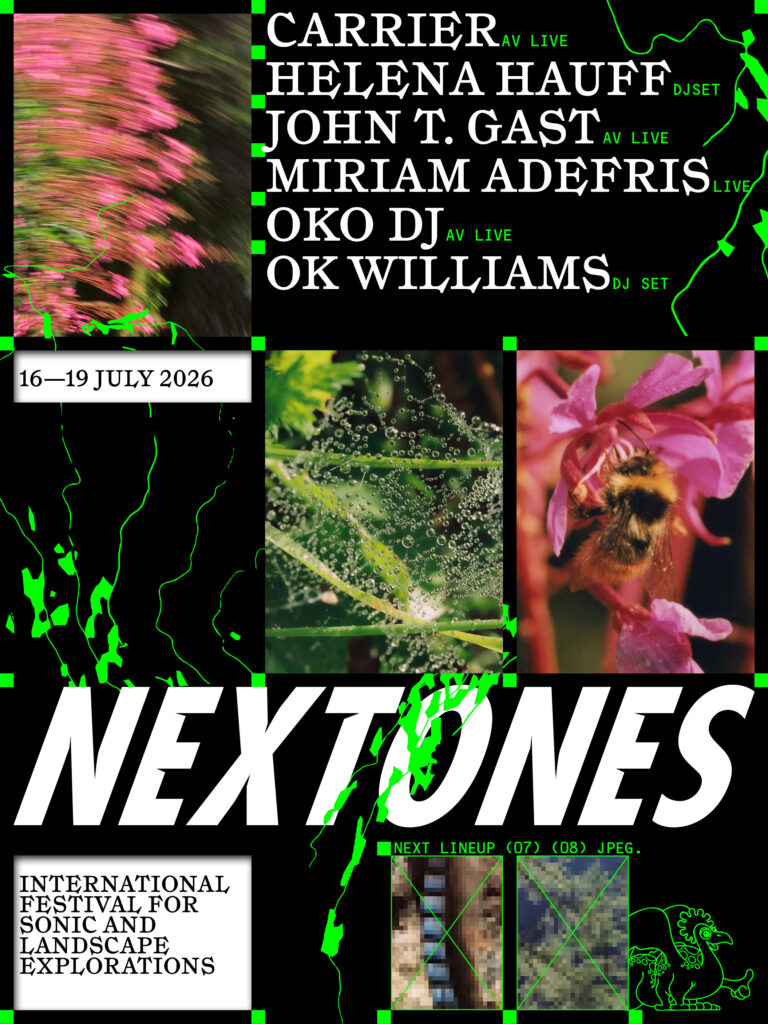
Nextones 2026

Inhabiting Sound: Finding Ourselves in Places

In the Ossola Valley, a former granite quarry operates as one of Italy’s recognised music production centres. Tones Teatro Natura, redeveloped during the pandemic years, transformed a site of extraction into permanent cultural infrastructure. Two stages are embedded directly into rock.

Since 2019, the collaboration between Tones on the Stones Foundation and Threes Productions has positioned Nextones within this terrain as a research-driven platform for electronic and audiovisual practices. The festival does not circulate through neutral venues; it develops in response to geological scale and acoustic conditions.

This trajectory of immersive research follows a legacy of site-specific milestones at the quarry, including previous iterations by Richie Hawtin, Caterina Barbieri, and Nicolas Jaar, which established the site as a premier European stage for audiovisual dialogue. 

In a world that scatters us outward, NEXTONES demands we turn inward. The experience is anchored by sound that roots the body, landscapes that hush the mind, and a shared presence that reclaims our essence. This is a defiant return to what has always waited: ourselves, embodied and alive in the listening.

Nextones, in its thirteenth edition from 16 to 19 July 2026, reframes electronic and experimental music as a re-entry into the body, the mind, and the living organism of place.

The valley already carries its own rhythm, defined by granite quarries marked by labour, gorges shaped by water, and medieval hamlets suspended in partial restoration. Tones Teatro Natura remains the festival’s core. The site’s vertical rock walls shape acoustics in a way no temporary stage could replicate, allowing sound to amplify the body’s innate resonance with the earth.

Nextones has evolved into a recurring ecosystem. With a footprint that has grown to 5,000 attendees, the festival’s core is defined by 600 campers who treat the four-day itinerary as a collective immersion. The community moves from the early-morning radio broadcasts of the Nextones Camp to the narrow, rock-hewn corridors of the Orridi di Uriezzo.

The 2026 program unfolds across multiple sites. The festival’s inaugural ritual on Thursday, 16 July, centers on the fluidity of the Terme di Premia. Here, Miriam Adefris’s harp solo operates in tension with the baths’ acoustics, creating an immersive dialogue where water and humidity warp perception. This is a spatial ritual reclaiming our deepest pursuit: pure, unfiltered being.

On Friday and Saturday, the focus shifts to the Tones Teatro Natura, a former site of industrial extraction transformed into a permanent cultural forge. Embedded directly into the vertical granite, the stages amplify the audiovisual weight of the program: Carrier’s rhythmic minimalism expands against the rock’s mass, while John T. Gast’s site-specific set utilizes the quarry’s sheer scale as a physical instrument. OKO DJ develops an A/V performance drawing from As Above, So Below (Stroom, 2025), integrating electronics, acoustic instrumentation and film by Hajj.

Helena Hauff and OK Williams extend the club dimension of the festival with DJ sets grounded in acid, EBM, jungle and house, maintaining physical intensity within the open-air setting.

Sunday 19 July shifts toward the Nextones Camp, animated by Radio Banda Larga’s stage. The day includes live sets, broadcasts and shared activities, reinforcing the camp as daily meeting point.

Threshold sites expand the geography. Performances at the Orridi di Uriezzo integrate sound within narrow rock formations, while live sets at the abandoned village of Ghesc engage with architectural remains and historical memory.

By focusing on the micro-textures of the sediment rather than the panoramic spectacle, the 2026 visual identity, captured by Rachele Daminelli, underscores the festival’s true intent. The valley is not a backdrop, but a living organism. At Nextones, sound meets stone to redefine the map of Italian contemporary culture, proving that the most forward-thinking frequencies are often found in the most ancient foundations.

As one of the first Italian festivals to achieve ISO 20124 certification for sustainable management, the project views environmental stewardship not as a constraint, but as a core component of the artistic experience. 

Produced by Tones on the Stones Foundation and Threes Productions, and supported by national and regional institutions, Nextones continues to operate as a music production centre rooted in specific terrain. Here, in the Ossola Valley, sound meets stone. The encounter defines the experience.

Further artists to be announced.

Discover more information on tonesteatronatura.com
Tickets can be purchased via Dice.

Suzanne Ciani

LFO Spirituality

A true pioneer of electronic music, Suzanne Ciani has spent over five decades shaping the sonic landscape with her groundbreaking approach to synthesizers. From composing in the late ’60s to redefining live performance with her immersive quadraphonic shows, her artistry transcends time. In this conversation, she reflects on her journey—from breaking barriers in a male-dominated field to finding her voice in modular synthesis, the impact of the ocean on her compositions, and the evolving relationship between technology and human expression. Ciani shares insights into the fluidity of sound, the importance of creative freedom, and the enduring resonance of her music in a rapidly changing world. 

Gaia Grisanti Hello Suzanne. How are you?

Suzanne Ciani Good morning. Just about to wake up, but everything is good! What about you?

GG Excited for this interview to begin, I am a big fan of your artistic production. It all started when you curated the live music performance at the Acne Studios’ Fall Winter 2023 Show in Paris. It really seemed like the sound was threading through the flow of the fabrics, almost establishing the textures, the weight, music became almost a physical presence. How did this collaboration start?

SC I got a call from Acne Studios, asking me to produce a soundtrack for their new collection. They gave me complete freedom. I was excited because I find freedom to be a fundamental ingredient for my performance, plus the fact that I love playing live because I really like to stay in the moment. One of my missions has always been to demonstrate the performability of electronic instruments without using a keyboard and to impact the design of these instruments. I can easily adapt to sudden things, following and pacing the flow. I played with the Moog where I have a module that allows me to move the sound in quadraphonic space.

GG After being a piano student and a composer for some years, you approached the world of electronic music in a period where women were not really allowed to experiment with that. 

SC In the Sixties, women composers were not really seen as credible and composing music was quite an intimidating prospect. In those years, composing meant mainly working with an orchestra. And that involved conducting: standing and getting the result you want. My teacher was an Italian man who firmly told me that women basically had no right to be on the podium and conduct. Hearing that wasn’t easy, but that moment was what channeled me towards a new door. 

GG What happened after?

SC Every time you meet a closed door you have to pivot and look for a different path, until you find your unique one. You have to invent new possibilities. So I instinctively adopted electronic instruments as my own voice. Then my goal was to get enough money to buy a new Buchla 200 for myself in a period when institutions and not individuals were owning these instruments and in a field where women were not commonly involved. 

GG As human beings, we tend to focus too much on the past and get stuck with regrets or nostalgia. Likewise, when we focus too much on the future, we can feel overwhelmed by feelings of anxiety or anticipation. In the meantime we forget the now. How did you find your own voice and learn to stay in the present moment?

SC Back in the Sixties in California, I started working with Don Buchla (pioneer in the field of sound synthesis. Ed.). I called him the Leonardo Da Vinci of electronic music instrument design. He didn’t use the word “synthesizer” because it had a connotation of being related to a keyboard instrument, but Don Buchla was more interested in the more elaborate voltage control of all parameters of the sound. I fell in love with a new possibility that gave me the freedom to be on my own and experiment independently..

GG You have always considered the synthesizers almost as living beings, defining them as “machines with a brain”. Tell us more about your relationship with these mechanical humans you have always been surrounded by.

SC Well, I grew up with them. Actually I grew up with the piano, when I was a composer of classical music. That is until I met Don Buchla. When Don Buchla and I started working together, he made a distinction about the machines: those instruments have an inside and an outside. I was in charge of the outside, moving the Knobs and dials, while an engineer was in charge of the inside. Technology was collaborative: it involved the artist that worked on the sound/performance and the technician who took care of the circuit board inside of the machine. In the end, every analog modular instrument is unique and you have the option of curating your own configuration of modules.

GG How crucial was it to find the right mentor at the right time?

SC You know, Don Buchla wasn’t very friendly at the beginning. He fired me the first day. 

But I just came back the day after saying that it wasn’t fair. And I stayed. Don Buchla was also very shy, he wasn’t really sharing his thoughts with me, but he found his way of expression through the instruments. We found our common ground in the machines. 

GG I guess spending time alone and really getting to know your personal self has been important for your personal development. And it is especially nowadays with all this pressure of sharing and showing, of having to attend everywhere to prove oneself relevant.

SC When you are making music it really comes from a private place and then it goes out into the world. If you respond to what people like, you are lost. Don Buchla, the designer of my instruments, never ever bent his ideas to the market.

GG Was there a moment or a place that represented a turning point in your career?

SC Japan played a big role in my career. Back in the Sixties , a musician couldn’t publish any music independently and you had to have a record company to release your music. I went to all the record companies in the US and in Europe but they didn’t understand what my music was. They thought I should sing because I am a woman. Then I went to Japan and they listened to the music. There I got my first record deal; that was a launching moment. When I went back to the US there was still no place for my music in the music store, because they couldn’t really find a category for this electronic instrumental sound.

GG After some time though, your music was ultimately labeled as New-Age.

SC In my second album I had a song called “The Velocity of Love” and when it was played on the radio it got a huge response even if nobody knew what it was. Some radio people started to sponsor my concerts and did a lot of airplay. Finally that genre took off and was labeled as “New Age”.

GG What made this genre special at that time?

SC New Age was a very controversial name, it could be massage music, meditation music, relaxation music or simply instrumental music. It seemed to be part of a cultural shift towards healthiness and “spirituality.”

GG Has the process of producing music been working as a therapeutic form for you?

SC The stepping stone for my music was the ocean and that immense space that is unpolluted by human inventions and noise. The ocean was my canvas.  My first album was called “Seven Waves.” Now, at last,  I’m living on the ocean and so there is some kind of happiness going on here.

GG In recent times AI is taking over our lives, leading to new explorations and forms of relationships. Looking at fashion and art, a Neo Space Age is approaching and space travel is expected to be booming again. You have explored this symbiosis of the organic and the artificial several years ago. Where do you think this fascination for futuristic, escaping scenarios comes from?

SC I think there is no replacement for human relationships, I believe AI is going to cause a lot of misery and desperation if you unlearn how to communicate.

In the Sixties and Seventies live performance and technology were not in a good place, the audience didn’t know that the instruments were producing the sound, they were asking where the sound was coming from, where the tape recorder was. To them there was no reference point.

Now the audience sees and understands what is going on when I play because I have a video camera focused on the instruments and also my young fans own and play these analog modular instruments. I believe technology has to be a support but not a replacement.

GG In your latest album “Golden Apples of the Sun” you used synthesizers like Buchla 200e and Moog One, but the addition of your voice and whispers makes it a truly immersive experience. You really get to meet with your inner senses, feeling some sort of deep fulfillment. Does all this come from a deeper connection with your inner nature?

SC In my previous album “Seven Waves” I also used an instrument called the Vocoder to loop in my breath because I found the vocal presence very personal and I wanted to put part of myself into it. My voice has been used a lot in sound design, I even had a tool called the Voice Box that is used for processing voices and other sounds. But I am glad that you appreciated it.

GG Are there any composers that you like at the moment?

SC Yes there are quite few and there are a lot of women dedicated to this instrument. I met Caterina Barbieri several years ago who is performing live on analog modulars and I like her a lot. Also Lisa Belladonna and Floating Points. 

GG I believe you are one of the most contemporary artists playing nowadays, although your first album “Seven waves” was released in 1982. You said that most of the instruments on Seven Waves no longer exist and that that recording is an historic footprint in the evolution of music, unique to its time yet still valid today. 

SC When I was growing up in the music industry the main idea was that if you turned 40 it was all over. But, you know, I believe that there is no clock.

Credits

Talent · Suzanne Ciani wears BOTTEGA VENETA.
Photography · Yudo Kurita
Styling · Shaojun Chen

Subscribe to our
Newsletter