The Trace We Leave in the Dark
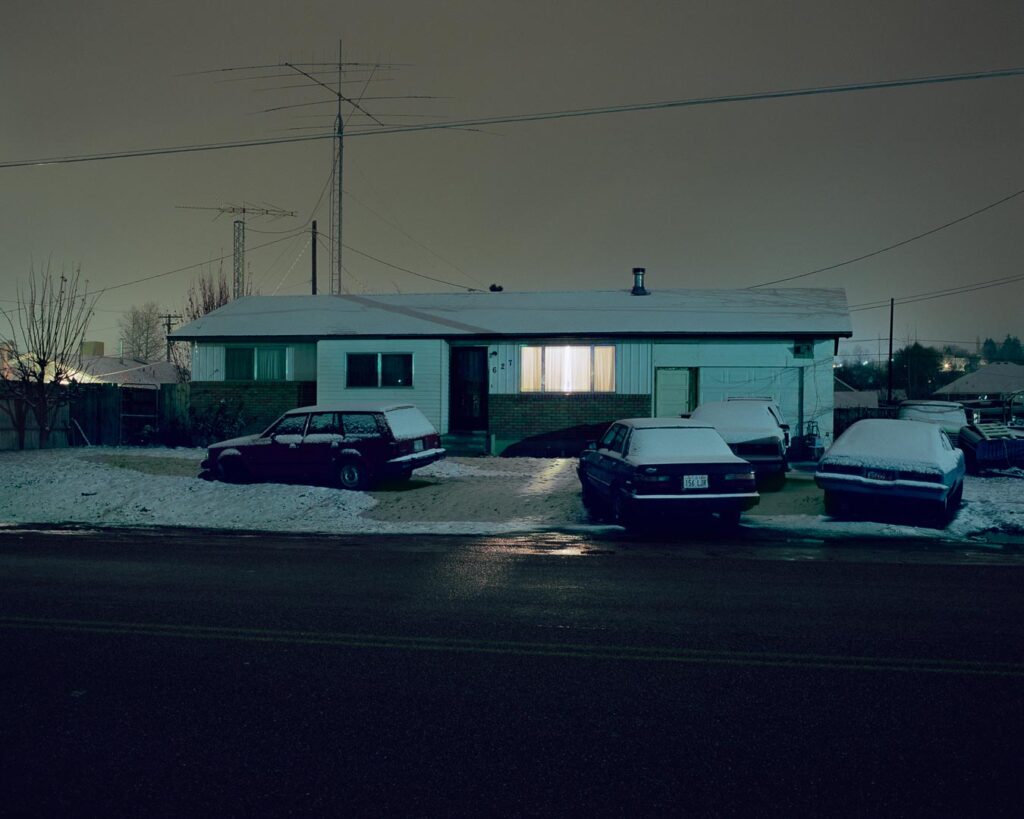
The work of Todd Hido captures the held breath of a moment, a cinematic suspension where the past seeps into the present through the soft glow of a television screen or the blur of a rain-streaked windshield. To look at a Hido photograph is to confront a specific kind of American solitude, one that feels less like an absence and more like an active, breathing presence.
In this conversation with NR Magazine, Hido reflects on the long arc of his practice, from the fast-paced BMX culture of his youth in Ohio to his current preoccupation with the changing global landscape. What emerges is a philosophy of the trace: the belief that an image is a physical artifact of human existence, quiet evidence that we were once here, peering out from the light of a window into the dark.
You’ve said that wanting to “capture a second or two of something cool” is what first pulled you toward photography. Coming from the world of BMX and street culture, how did that instinct evolve into the slower, more deliberate way of working we see today?
My first experience with photography came from racing BMX bikes as a teenager in Kent, Ohio. Back in 1984, if you wanted to capture something—much like a kid with an iPhone and a skateboard today—you had to use a real camera. That is how I learned the craft, and it simply stuck with me.
I discovered the darkroom in high school. I feel incredibly lucky to have bridged the gap between the analog world I started in and the digital world we occupy now. Those early experiences absolutely inform my process. Because my first serious camera was a medium-format camera, I only had ten pictures on a roll and I worked on a tripod. You had to be very deliberate and slow because you did not want to waste those ten frames. To this day, I still do not “snap” my photos; I learned the analog way.
There is a sense that your lens acts as a form of reconciliation. Does the camera provide a way to revisit those early environments?
I had a difficult childhood growing up in suburban America. When I was in school learning photography—eventually assisting in Boston and then moving to California—I found many photographers I admired who were photographing their families, such as Sally Mann or Nan Goldin, who created her own community as family.
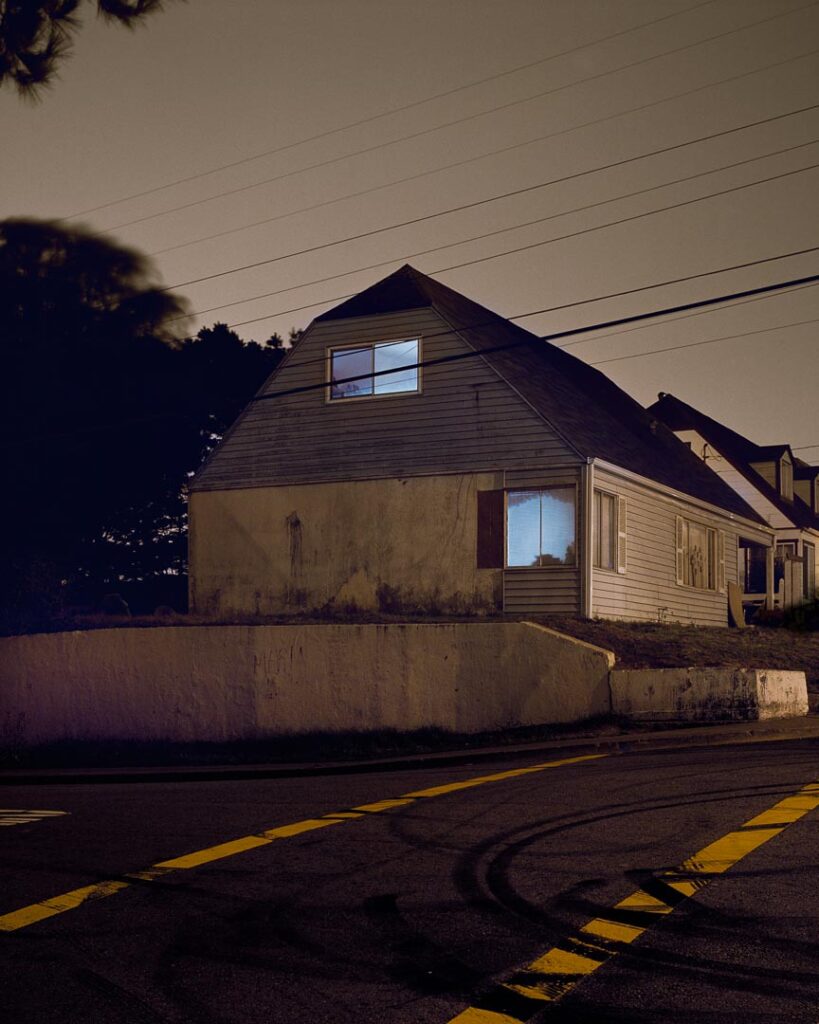
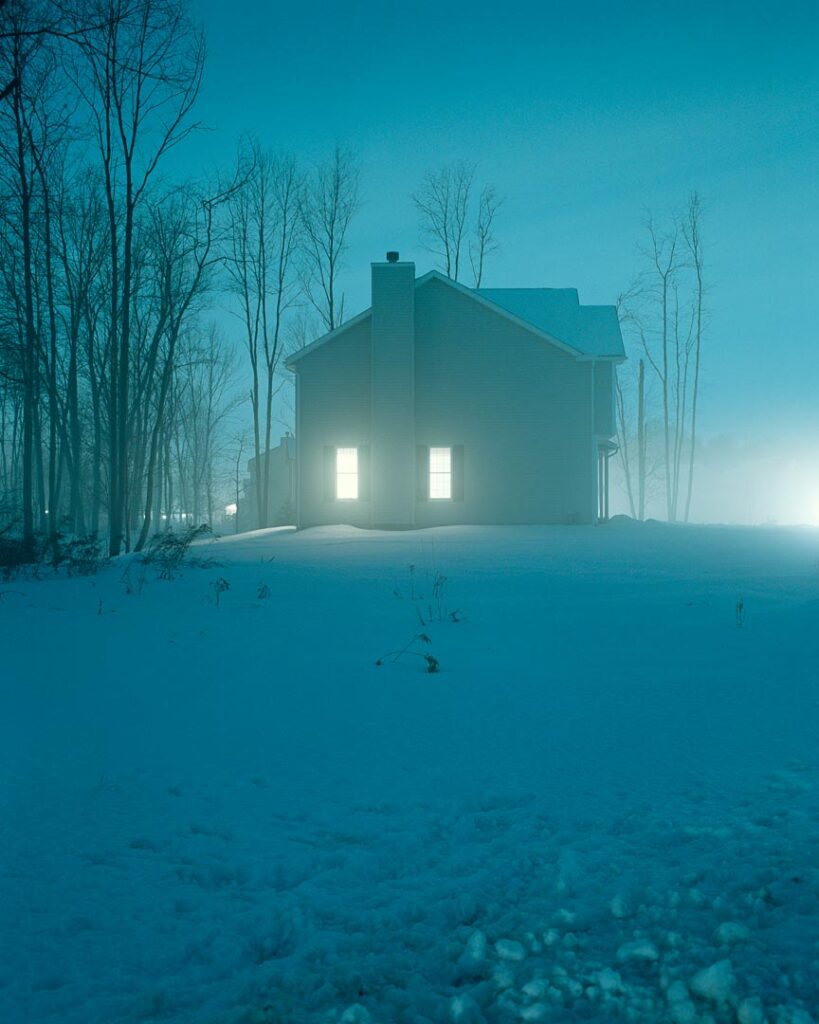
When I moved to California, I became a student of Larry Sultan. That is when I first discovered that photography could be a whole lot more than just making beautiful pictures. There was a personal content to the work. For me, the exploration of homes at night is very much about retracing and re-figuring parts of my childhood. It is a way of meditating on the concept of home as a psychological space.
There is something deeply instinctive in the way you see. Do you think that perspective comes from maintaining a certain kind of childhood curiosity?
Curiosity, definitely. It is that constant questioning that stays with you. I see it with my own kids—that relentless “Why?” they ask until they get to the very bottom of something. As an artist, you have to keep that. You have to keep asking why a certain light being lit in a home matters or why a certain house draws you in. You never stop being that curious child.
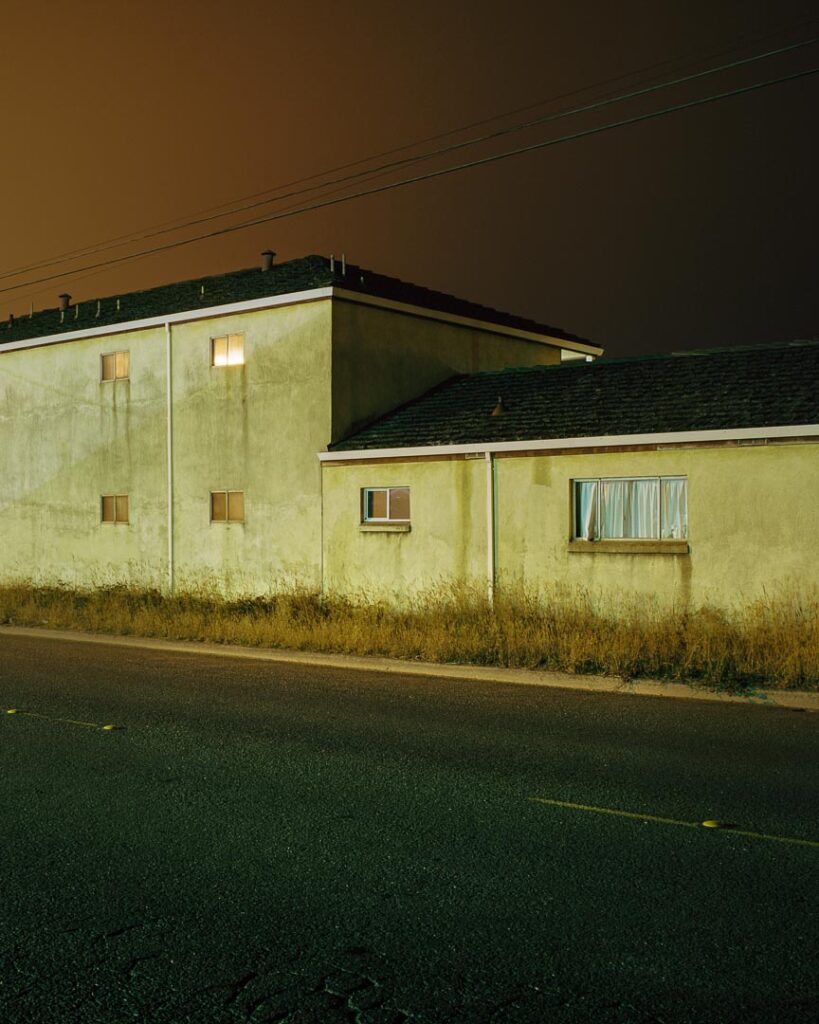
Your work often feels like the “middle” of a story, where the beginning and end are absent. Why are you drawn to the power of the unresolved?
I feel like my images are open-ended narratives that do not have a fixed meaning. I believe the meaning of the image resides in the viewer. We complete the stories when we look at them, and everyone does that in their own way. In that form, they are like short, ambiguous stories. I feel ambiguity is an important thing for art, at least for me. I do not like to be told exactly what something means. I prefer to perceive things in my own way, and that is how I treat the people who view my photographs.
This narrative impulse extends to your collecting of found imagery. How does the act of recontextualizing the anonymous past shape your own narrative?
In the beginning, I had an assignment called the narrative workshop with Larry Sultan and filmmaker Lynn Kirby. We had to create a story out of images without using any words. That was a pivotal moment for me. I realized I could use photographs I did not make—from an old family album or things found from the past—and pair them with my own images to make the story deeper and the plot thicker.
Now, my wife Marina and I actively look for those things. If we are out shooting and waiting for the light to get better, we will drive through a town and stop at an antique store or a thrift shop. We frequently find photographs that are deeply meaningful. I especially love school-day portraits. My grandfather once put together an album of his children that I used and there is one of my mother at different points of her life, covering six or seven years with a new photo for every year. I love the idea of seeing someone change through photography like that.
There is a specific kind of solitude at night that feels more like a presence than an absence. What is it about standing in the dark that allows you to focus?
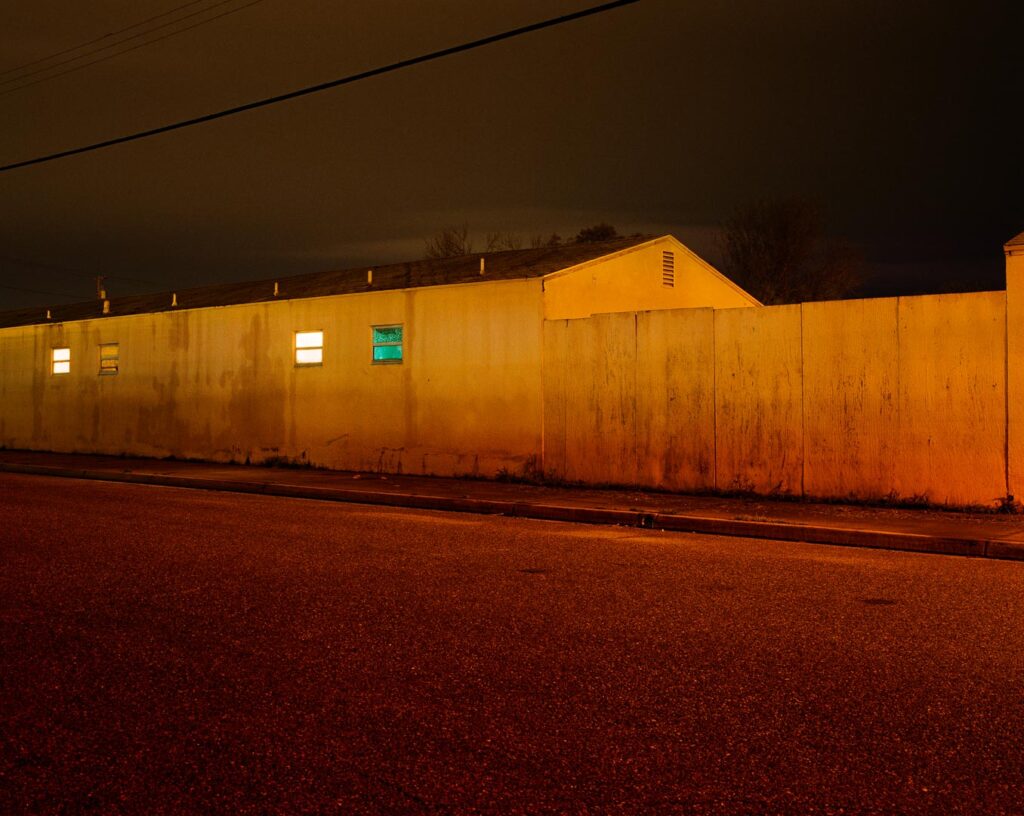
There is something about the mystery of the night. It provides a quiet time to work with a sense of solitude. The busyness of the day has passed, there is nobody emailing you, and you can truly focus. I also love that the night does not always look the same. As you notice in my photographs, there might be a green glow from a fluorescent light. I love mixing those colors together, which does not really happen so clearly during the day. You have to wait for the dark to arrive to receive the different ways light works.
In your house images, you’ve mentioned interiority. Is the light in the window a signal of life, or a barrier between the observer and the observed?
I learned early on that you could make a picture of something that is actually about something else entirely. For instance, I wanted to work with the theme of family, but I did not want to photograph my own family. They lived in Ohio and I live in California.
I made one photograph of a small house with two TVs on—one upstairs and one downstairs. Back then, blue light in a window meant someone was watching TV in the dark. I could not help but wonder why they were not watching TV together in such a small house. I realized that the image might say something about their relationship or a desire to be apart. It is the idea that a home is about interiority, not architecture. When the lights come on, the inside seeps to the outside.
You once mentioned that the first time you photographed through a car windshield, it was a mistake. Do you find that these “accidents” are actually the moments where memory is most accurately captured?
My influences are always shifting. The first time I photographed through a windshield, it was raining and the wipers were not working properly, so the image came out fuzzy. However, I realized it felt like memory. Sometimes memory is sharp, and sometimes it is distorted or unclear.
I decide what to release very carefully. I have shot at least 11,000 rolls of film, creating a vast archive that is starting to age beautifully. It is almost like the aging of wine or cheese; it reaches a point where it finally becomes ready. Something I disliked in a photo before, such as a part of the inage being out of focus, might be exactly what I find interesting now. Even after 35 years, I still set up the tripod to see what happens. Photography is unpredictable. There is a reason people used to say, “I hope it turns out.” That is where the pleasure is.
Digital photography offers an instant, disposable gratification, yet you speak about the “trace” of existence. How do you view the modern disconnection from the physical image?
It is fascinating to watch how people photograph now. I recently saw a young woman and her boyfriend at the Duomo, and earlier at the Shibuya Scramble in Tokyo. They were snapping hundreds of throwaway images for Instagram, deleting whatever they did not like. I believe there is something fundamentally important about being deliberate.
However, your generation is seeing the value of slowness again. The fact that Kodak returned to 24-hour film production is remarkable. Seeing people shoot motion pictures on 70mm film is very exciting. I feel lucky to have started with analog because I understand color. I used to produce all my own prints in a color darkroom, and I still print my own work today. I work hard to capture that exact analog feeling I remember with a digital camera and printer.
How has your understanding of privacy shifted as the “expectation of solitude” in public has diminished?
The expectation of privacy in public has diminished because everyone has a camera now. My book, Intimate Distance, carries that title for a reason. When I make those pictures, I never want to encroach on anyone’s space. I always stayed across the street in a public area, being very obvious with my tripod.
If anyone ever asked me to stop, I would simply pack up and leave. I remember the very first time I photographed a home at night. There was a light on in a window, and after I had been there for ten minutes, the person turned it off. That light actually was the point of the picture, because I was photographing the imagined presence of someone inside a space. When that light goes out, the picture disappears. To avoid that—sometimes when I am making an exposure I will point my camera one way but pay attention somewhere else—because I’ve learned people can truly feel the gaze of someone looking their way.
That brings us to Bright Black World. How did your focus shift from the domestic American suburb to a more global, climatic landscape?
My earlier books, House Hunting and Outskirts, were focused on houses at night. Bright Black World was the first time I focused on landscapes outside of the United States. After publishing my mid-career survey, I realized I wanted to move beyond my previous boundaries and respond to the world more broadly.
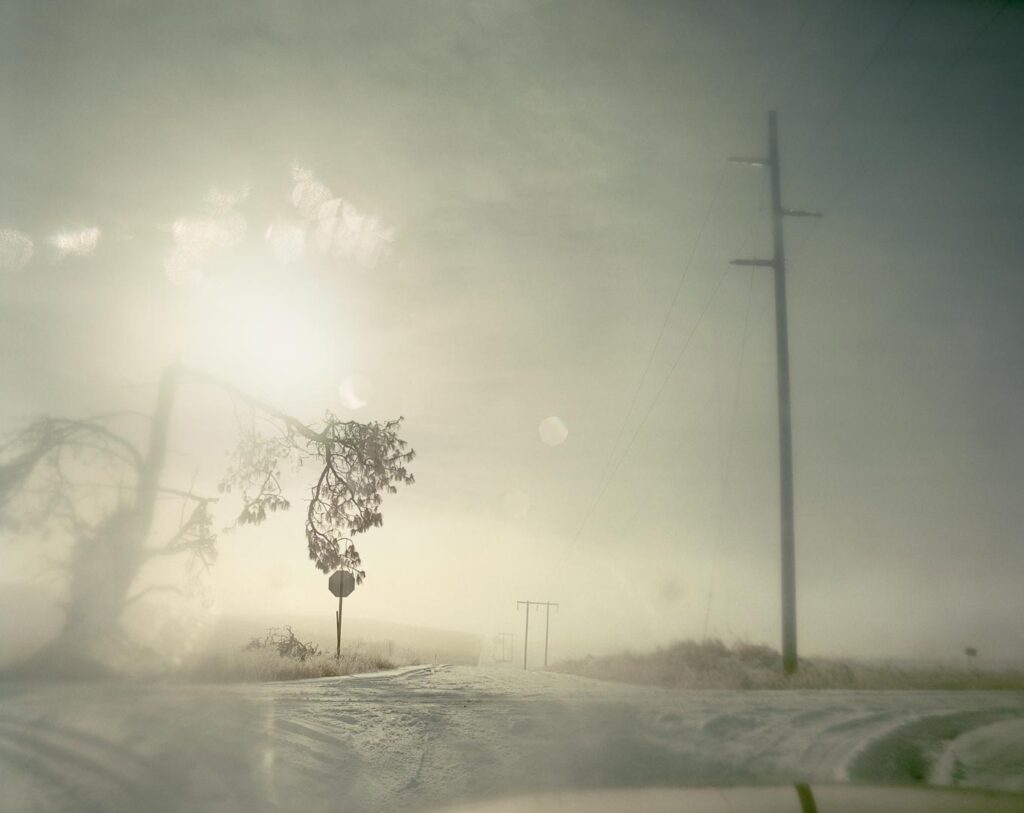
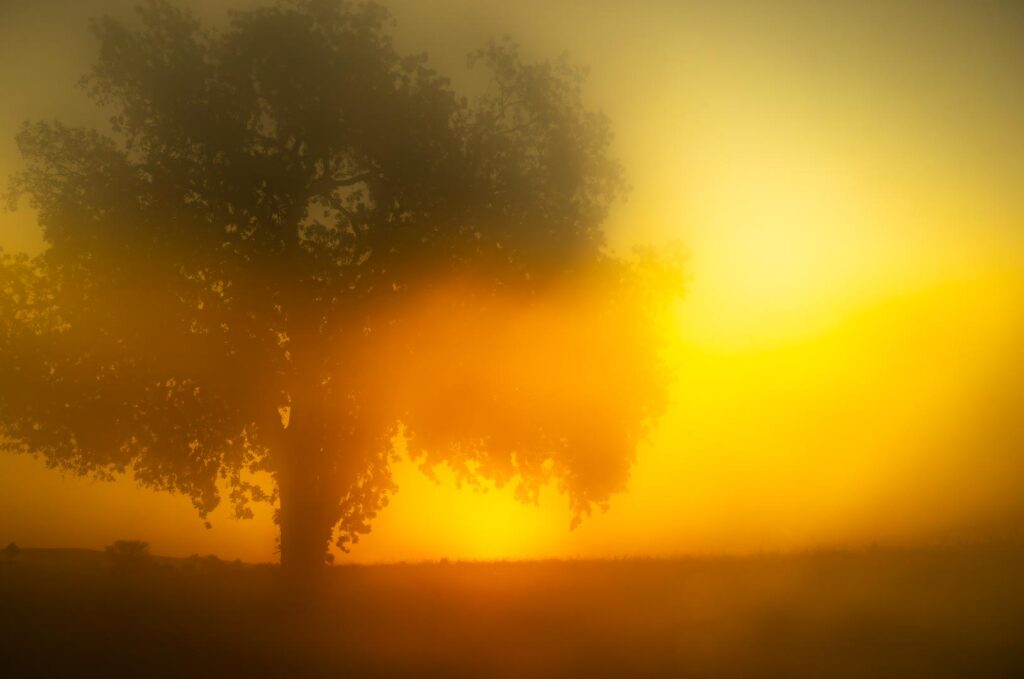
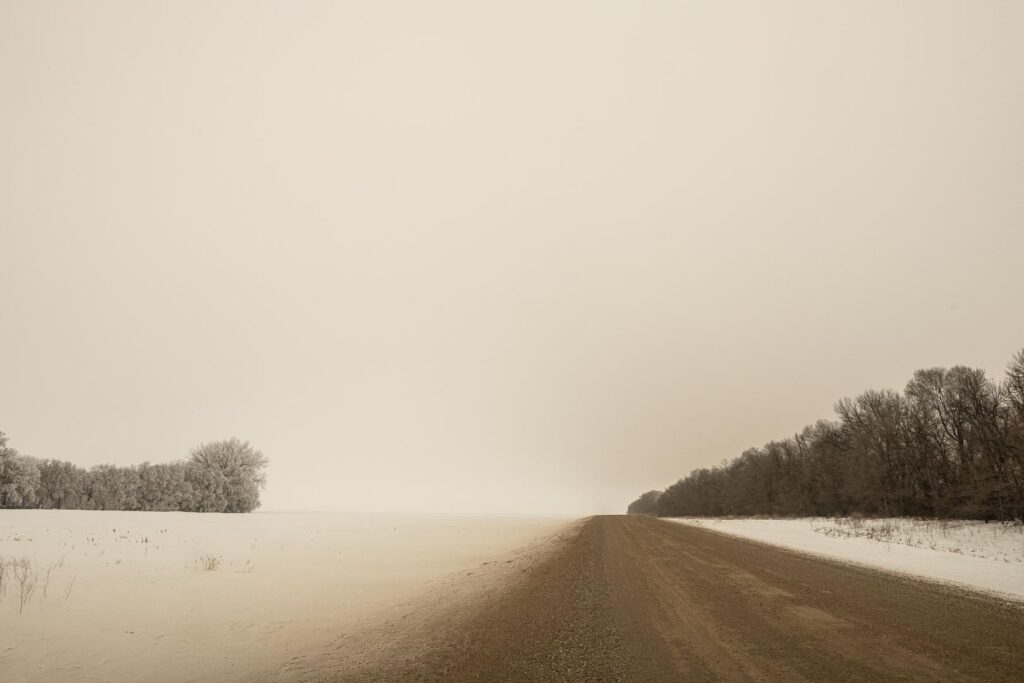
Marina and I began traveling to Iceland, Norway, and the Sea of Japan. I became very interested in weather, specifically preferring rain or snow over clear skies. It is very poetic. At the same time, the world was changing climatically and politically. Marina was reading a book called Ragnarok, which describes an endless winter called Fimbulwinter. The description of that “bright black world” stayed with me. Because I am dyslexic, I connect strongly to certain words, and that phrase became the anchor for the book. That work moves from darkness toward light because you cannot remain in darkness. You need to hold onto hope.
Looking back at your start in Kent, Ohio, did you realize then that photography would be your way of documenting your own trace on the earth?
I was not good in school, and photography felt like the only thing I could do. I was likely in my junior year of high school. I knew it could take me out of my small town. There was a local Ohio magazine shop called International News and Tobacco that was my access to the world. I would read Andy Warhol’s Interview when he was still involved. That was my internet. My father was a plumber and my mother worked in a drugstore, and I knew I wanted something different.
In a world where memories are increasingly ephemeral, what is the risk of losing the photograph as a physical artifact?
You cannot control how a viewer feels, but seeing the work physically as a print and an object is important. My advice to emerging artists is to follow your passion, but be realistic. You need to sustain yourself. Most importantly, make things yourself. To start making a book you do not need a publisher; you can make your own small editions.
And print your pictures. It saddens me when you find a family album in a thrift store where the lineage is gone or nobody cared for it. Prints are a lasting record of your existence. They are a trace of who you were. In a world where everything is digital, that matters. Not as legacy in a grand sense, but as a trace of your existence upon the earth.
That feels like a deeper kind of legacy.
I feel that too.