
Weighing Forgiveness, in Light Of
Dozie Kanu hoards finds in his rural Portuguese warehouse, tractor seats, bronze crucifixes, translucent fiberglass tests, until exhibition deadlines force them into shape: not decorative, but defiant actors in a space that demands you live with them. He fled the collectible design market’s custom color requests for this isolation, where looking inward clarified a voice too multidisciplinary to cage: sculpture bleeding into film direction, photography framing soundscapes, vinyl records with Shirt Lifters pulling pop culture closer as an artist testing its edges, against the scripted life handed down, against the poverty traps and dematerialized escapes of athletics or music.
Born from production design and runway props with Bureau Betak, his path pivots on moments like Valentin Caron’s reupholstered bar stools in a quiet Chelsea gallery, functional objects speaking beyond utility. Function becomes lure here too, drawing outsiders past art world gates into racialized capital’s undercurrents, inheritance’s distortions. It’s existential defiance at work: create the life you want, not the one prescribed, mirrors thinking longer before they reflect.
At Fondazione ICA Milano, The Second Shadow casts this all forward: light works shadowing Marc Camille Chaimowicz’s interiors and Jean Cocteau’s celebrity multidisciplinary, domestic fragments refracting architecture, a weighing scale titled Forgiveness, in Light Of leaving its blank for you to fill. Weighing scale from the junkyard, Jesus face cut away, instinct, not prescription. Isolation forged it; now it lingers, urgent enough for word-of-mouth: “You have to see it.”
In this conversation with NR Magazine, Kanu maps the evolution of a practice that refuses to sit still, bridging the grit of warehouses with the high-design heritage of Knoll for Salone del Mobile 2026. A vehicle for social entry, a physical manifestation of a life built by hand in open defiance of the scripts usually written for creators.
Your practice comes from such a rich and diverse set of mediums. You even worked with Bureau Betak, for instance, on runway shows. Looking back, what did those experiences reveal to you that shifted your approach into what you do today?
I would say the foundation of what I do exists as exhibition making, as opposed to being an artist, because within the space of exhibition making, so many different mediums and disciplines can exist. Even though I’m most known for the work that I do as an artist, as a designer, sculptor, or someone who works as a sculptural designer, within the space of exhibition making, I can insert my photography work, film work, and my interest in architecture, which takes the shape, usually, of architectural installations, as you can see downstairs. I think my background definitely informed my approach there, because I did study production design for film and theater, so spatial design was always the way that I was thinking about my creative input. And within that came prop making, which led to object making, which led to thinking about objects in this conceptual and sculptural sense, and that’s how it all came into what it is now.
You have such an intimate relationship with products. Was there a moment when the object shifted for you, from prop, from background, to a protagonist?
It happened very naturally. Most of the objects that I make, I think of as actors or performers within a narrative, or within a theme of an exhibition. So I don’t know if there was an aha moment, but there was an exhibition in particular that I saw while I was working at an interior design studio located in Chelsea, New York. During that time, I was able to see a lot of shows before work, during my lunch break, after work, just going around that neighborhood and walking into galleries. Usually it was during the slow hours of the day, so it was just me and the work. And there was a show by Valentin Caron, who is now in the show, and he was showing a bunch of reupholstered bar stools, and that was kind of an aha moment where I became aware of the idea that functional objects could exist within the context of art in a way that didn’t dilute the object down to just its function specifically, but the object could speak in many ways outside of its original function. So that’s where I operate.
I’m curious about how this pull toward a multidisciplinary practice first began, beyond the fine arts education you received. Was there an earlier moment, in childhood, in your background, in the way you were looking at the world, that first drew you toward this way of working?
That’s a good question. I don’t think that there was a moment where I decided that I wanted to be multidisciplinary. I just knew that I had things to say in multiple disciplines, and I didn’t want to limit myself to only operating within one discipline. I do think that artists need to be careful, because it can be very difficult if you haven’t established yourself in one discipline to move on to another one. And I think I was lucky enough to start to make a name for myself within the collectible design context, which was good and bad, because I knew immediately, once I was placed within that context, that it was not correct for me.
Why did it feel incorrect?
I started getting requests from certain buyers of my work to make things in different colors or different sizes. It was very much a kind of work-for-hire, or this is decorative for a specific client home, which I felt was not the way that I wanted to operate. Like I said, exhibition making was where I felt like I wanted my foundation to be. So getting out of that context took a little bit of time, and it took a little bit of a drastic move, which meant relocating to an area where it was a little bit hard to reach me, which was the countryside of Portugal, where I was then able to really examine the projects that were being brought to me and decide which ones were appropriate for the direction that I wanted to go in, as opposed to taking on projects just because I needed to make money.
I’d like to stay with that move for a moment, because it feels like more than a geographical shift. How did relocating change your relationship to your work, not only in terms of what you were making, but in terms of recognizing what you actually wanted your work to hold, beyond the commercial requests that had been shaping it before?
It wasn’t so much the art that I was seeing there. It was more the looking inward, the forcing to look inward, the forcing to not see anything else and to see what do I really want to make. And I wasn’t aware that that would be the case at the time. I was just trying to get away from this context that I didn’t really agree with. And then once I got away, I was forced, in a way, to really try to figure out, wow, okay, what is it exactly that I want to say? What do I want to make? What do I want to see? It was isolation that forced me to be myself, which I think is one of the smartest decisions that I’ve made, unknowingly.
It sounds like isolation became a way of arriving more fully at your own voice.
But I will say there was a privilege, though, because I had made a little bit of a name for myself already. I think for younger artists who are still trying to make a name for themselves, making a drastic move like that might not be the smartest thing, because I don’t think Portugal really has the right infrastructure to give a proper platform for a young artist to then become international. So I will say that a lot of the right conditions were ready for me to do that move already.

And if you were to speak directly to emerging artists who want to create with intention, and stay close to what they actually want to make, what would you tell them?
Try to keep your overhead as low as possible. So if you’re struggling with rent for your apartment, or you’re struggling for rent for your studio, maybe it’s smart to consolidate those two things, but for sculptors, it’s much more difficult, because you need space. So what I did was I found an abandoned warehouse and I renovated it into a living-working space, which financially came out to be the same cost as renting an apartment. There are all these different strategies that you can come up with so that you’re not burdened by the need to make sales or the need to make art for the market, even though I think some people might criticize my approach, because there is a function attached to a lot of the work that I make. And some might say, “Oh, he’s making functional work, or work that can operate domestically, so how can he say that he’s not making work for the market?” But I definitely try to keep the work as close to my interests as possible, and I’m also using function as a conceptual tool to lure or bring people into the art world who might not be interested in the art world. For me, as a black person, I’m fully aware of the fact that the art world is run by a sort of privileged white, elitist class, and I’m fully aware of the fact that if I make an object that’s recognizable, you already have the attention of someone who doesn’t know about art, but then within that, you can bring them deeper into all of the other conversations happening within art.
Seems connected to the elusive quality in your work, the fact that it remains open, while still drawing the viewer in. Before we move fully into The Second Shadow, I also want to return to some of the earlier works and to your use of materials more broadly. Works like Headboard Chair, Electric Chair, or Unconsoled Soul from Yesterday, Yesteryear, YesterLife. When a certain object enters the work, what guides that decision? Is it the history embedded in it, or something more instinctive in its form?
What I tend to do is, let me backtrack and say what having my space in Portugal allowed me to do was to collect a lot of objects that I found because I had space to hoard all of these things that I would find in junkyards or antique shops or on the side of the road or anywhere really. I built up a long list of different places where I knew that I could find interesting things. And then I spend a lot of time looking at things that people would consider junk, and trying to find forms within them that resonate with me, and this is a very visceral thing. It’s not something that I can really just say I have an answer for. It’s just a feeling. It’s something that you try to get a sense of, what speaks to you. And then over time, I found that I just built a large collection of objects, and slowly they start to take shape. I would actually say that having exhibition deadlines forces you to start looking through what you have and putting the pieces of the puzzle together, and trying to meet those deadlines. And then you realize that, “Oh, I’ve collected a lot of things that I really find interesting.” And when you start to put things together, changing the orientation of them, something that’s meant to be upright, changing it upside down, finding a way for it to stand, that can become a component of this, and then you can add this to it, and things start to take shape naturally. And then it’s underlined by the idea that it performs a specific function. So that’s how I operate.
There is also a political charge that many viewers may feel in the work, even if it resists being reduced to one reading. Is that something that enters later in the process, or is it already present in the way you approach the work from the beginning? Maybe “political” is too fixed a word, and perhaps that’s exactly the point. But even within that openness, the work can still carry a social or political resonance for the viewer. Is that dimension something you consciously hold in mind, or does it emerge more naturally through the work itself?
I think it’s natural, because I think what it is that I’m doing automatically goes against the kind of life that was prescribed for me. To go against that is already a political antagonism. So that aspect is just inherent in the work. And, yeah, I try to encourage that. I try to encourage everyone to figure out exactly what it is that they would like their life to be and create that life, as opposed to just accepting the life that was given to them.
In your conception of The Second Shadow, the shadow is not an absence, but something closer to refraction and anticipation. To quote Cocteau, “Mirrors should think longer before they reflect.” At the center of the exhibition is this reflection on the double, inheritance, and the transmission of forms. Traditionally, a shadow is a consequence, a trace of where the body has already been, but here it seems to become a condition of visibility that almost precedes the object. How did this transmission of forms begin for you, and how has it evolved through your dialogue with the legacies of Cocteau and Chaimowicz? What does it mean, for you, to inherit a form? And what does the shadow mean to you here?
The shadow? I think the way I looked at the word “shadow” for this show was just something that’s coming after something that existed already. I mean, even with my approach to most of the objects that I made for the show, it’s mostly light works which cast shadows. But more than anything, it’s just the idea of something coming after. Among Marc Camille Chaimowicz and Cocteau there’s a shadow, but there’s also the idea of mirroring them as well. So there’s this weird kind of mirroring of them, but then the fact that I came after them makes it a shadow. There’s a lot going on in this show, and I think that’s what thrills me. I wanted to be an exhibition maker, and this is an exhibition. It’s not a show of paintings. You’re not moving from one painting to the next. It’s not a show of sculptures, where you’re moving from one sculpture to the next. It’s an exhibition. It’s a full experience. And that’s really what I think is the foundation of how I want to exist as a creative person. Because within that, you can do everything.
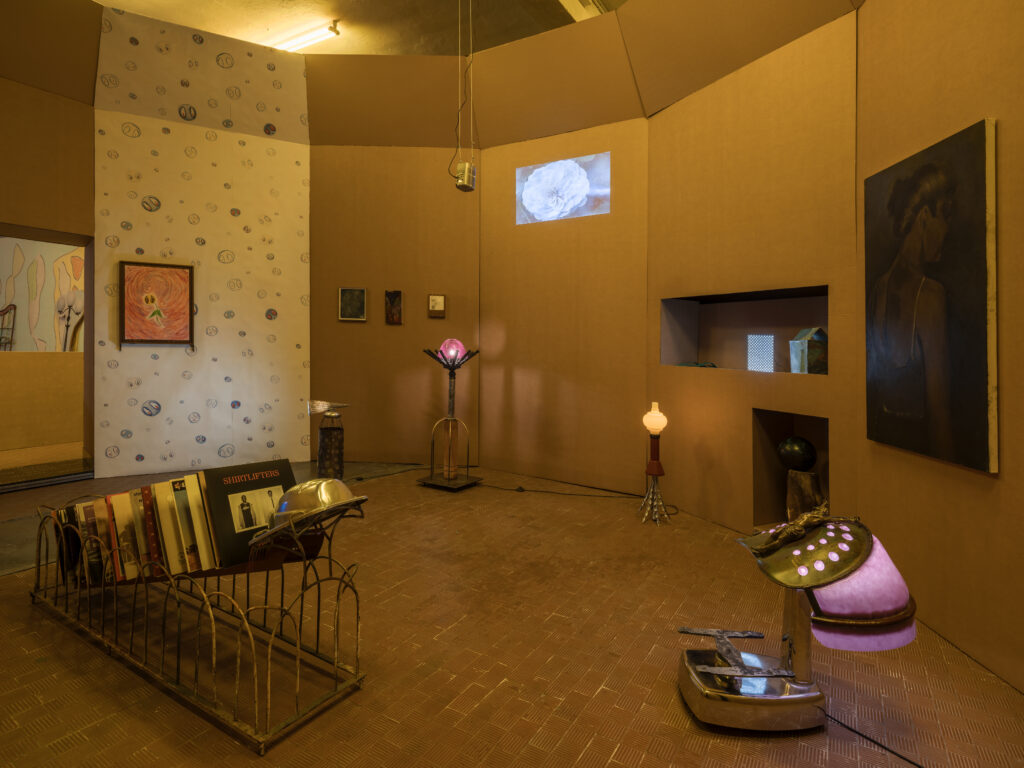
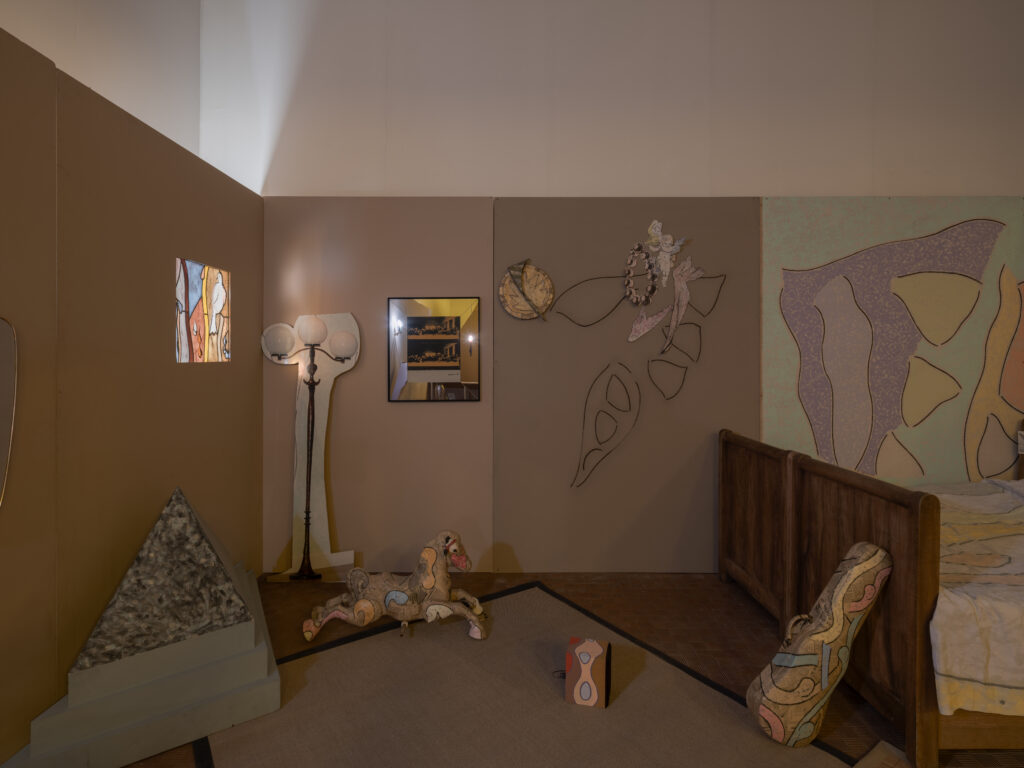
I think Mark Camille Chaimowicz is an artist that was very much interested in interiors. And as someone who was working in an interior design studio and doing stage work, I was naturally drawn to him and his practice. He made a lot of chairs, side tables. He even has a bed in the show. Interior objects were something he was very much interested in. And so, as I started to study artists that were working in the same mode as me, he was one of the artists that I just naturally came to admire. And then Rita came to one of the openings of my exhibition at Federico Vavassori and proposed this idea of a show, a two-person show, with myself and Mark Camille, which I was really excited about. But I did not know so much about Jean Cocteau, and I did not know so much about this installation that he dedicated to Jean Cocteau, which, when I found out about the reasons why he admired Cocteau, it made so much sense, because what he really admired about Cocteau was his multidisciplinary attitude. And this might come off the wrong way, but he admired his celebrity in Paris, and as someone who has had such close proximity to celebrity culture through a lot of my friends who are superstars, I’m not exaggerating. I am fully aware of the society we live in and how people want to emulate what they see, because I do. And I’m fully aware of the fact that the way that I move through the world isn’t often seen. So I do try and make it a point to push myself more towards the forefront, exist a little bit closer to popular culture in an attempt to open people’s minds up to the different ways that you can exist in this world, because American society doesn’t really offer too many options for black men, black people in general, to escape intergenerational poverty. I’m not saying that I have yet, but I do feel as though it’s important to show other avenues and other ways of expressing your true self, outside of just athletics and music, which to me are dematerialised forms of expression, which makes total sense, because in order to work within materialised forms of expression, you need capital. You need investment. So it makes total sense that black people excel mostly in dematerialized forms of expression, because we don’t have access to capital typically. So as things shift and things become more fair in society, I think my presence, or the presence of the ones that came before me as well, I’m talking about David Hammons, Melvin Edwards, Booker, so many black artists that work with material, but, yeah, to continue to push that narrative and push that position.
Jean Cocteau being a celebrity and being multidisciplinary was the reason why Mark Camille decided to dedicate an installation to him, and so on the contrary side, as a shadow, I think, showing my multidisciplinary attitude was important. I even recorded music, which is going to be part of one of the sculptures in the show. It’s going to be a vinyl record, which I recorded in a group titled Shirt Lifters, our demo, and we already have a booking agent now.

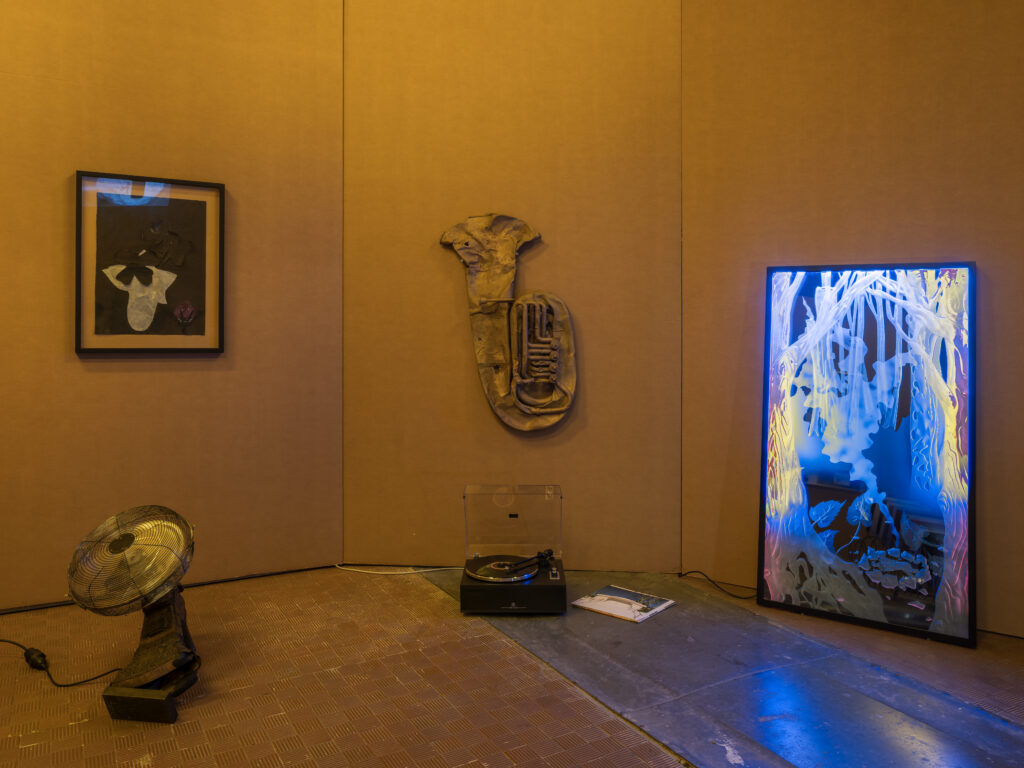
Why Shirt Lifters?
I actually don’t want to say too much about why. We do know why, but I don’t want to obscure anyone’s judgment of the word. But if you look at it literally, taking off your shirt.
We’ll leave the rest open for viewers to decode. You mentioned something else that’s very interesting: this desire to move closer to pop culture. Has existing in proximity to that realm changed your perception of it at all, both in terms of the culture itself and the way your work can move through it?
Pop culture is a mountain. It is what it is. My perception of it has always kind of been the same. It’s just what’s the most popular. And I think increasingly it’s become easier for marginalized voices to exist within popular culture. I would even say avant-garde marginalized voices, because before you kind of had to be Michael Jackson to exist within popular culture, which is like, I wouldn’t say Michael Jackson was avant-garde. He was just really good at making things that people loved. Now, you have someone like Frank Ocean who can make something that people love that’s a bit strange, if that makes sense. I’m taking a little bit from that. How can I push things into popular culture that maybe shouldn’t exist there?
The exhibition becomes almost a living archive, one that refracts rather than simply reflects. How did that process of building it begin? And how did you choose the artists, references, music, and sensory elements that now shape the space?
I tried to choose artists that I felt represented elements of my practice, whether it be a focus on the object making, whether it be a focus on racialized capitalism, whether it be a focus on architecture with Le Corbusier. It’s like all these extensions of my interests existing in this space. And then, obviously, I had to include Valentin Caron, because he was kind of the spark that I mentioned earlier, and then the idea of music existing within this show was important to me just to highlight another sensory element, sound. I’m not a sound artist, but I do think that the music that I was able to create, which is actually over there on a vinyl record, I’m going to pick up the sleeves later today, excited about it, is kind of a noise record, even though I am singing and I am doing a lot of vocals. I worked with a sound engineer named Caleb Levin, super, super talented, and was able to really create a soundscape that represents me and my partner in this. His name is Matt Hilvers. He’s a performance artist. So it’s me and him, executive produced by Caleb Levin, who also works quite often with Frank Ocean and various other artists.
We’re going to be very careful about how we put ourselves out there in the music space, because I don’t think that signing to a label is something we’re interested in. It’s more so going to be very close-to-the-heart kind of music projects. And then also, I created a bookshelf that would be populated by a bunch of different books that inform the exhibition, and inform a lot of my different interests, black critical theory and art and architecture’s combination and different things of that nature. I don’t know if that answers your question, but just try to keep the exhibition
dynamic, in a sense, so that it’s not just something that you’re looking at, but it’s something that you’re living with.
If we were to unpack the installation a little for our readers, there are so many details within it, sound, domestic references, sculptural fragments, material tensions. Could you take us a little into how these objects came together, and what kinds of conversations they are holding?
I have to remember, they kind of blur sometimes. I just look up in my studio, and there are these objects that I made, and I don’t even remember exactly how. You just start playing around and things start coming together. But the piece that I’m most proud about in this exhibition is the piece that’s titled Weighing Forgiveness, in Light Of, which is, it’s a weighing scale that I had found in the junkyard and the seat of a tractor.
In the bottom of the seat of this tractor are a bunch of holes, and I took them to a fabrication studio that specializes in fiberglass, and I had them make a bunch of tests to get the right color of a kind of translucent fiberglass that could push through the holes and create these bubbles, these kind of pockets. And then I also found this heavy bronze Jesus crucifix, and I cut the face off of Jesus. I’m not sure what that gesture was really signaling. It just felt right to not give Jesus a face.
Very instinctive.
It’s a dimmable lamp where you can sort of change the strength of the light inside, and the light comes through these translucent purple holes, and it creates this pinkish color. And then that, coupled with the title of the work, Weighing Forgiveness, in Light Of, it just all kind of smoothly made sense. And this is an example of how I just look around my studio, and I find things and they end up becoming works that end up being really meaningful.
I guess, the idea of weighing forgiveness, forgiveness in light of a situation, you leave it blank. There’s no word after “of.” It’s like weighing forgiveness in light of what?
Your titles often work in that way: they point us toward a source, but they also leave space for the viewer…
To then decide where to take it, which is great. I think I do go back and forth between pointing the viewer towards understanding the work and then pointing them away from understanding the work. I like, I think the works typically tell me whether or not they should be more understood or more confusing. And for that work in particular, I think it was very much easy to play with the words, but then leaving that blank statement at the end gives you autonomy to choose what you’re weighing.
Moving outward from The Second Shadow, I’d also like to touch on your collaboration with Salone del Mobile 2026. This year, Salone revolves around the question of what matters most. How have you approached that collaboration, especially in relation to working with such an iconic brand such as Knoll, while still bringing your own priorities, your own values, into the space?
Understanding that what I’m doing needs to exist more within popular culture, and collaborating with such an iconic brand with such a rich history is a step in that direction. Them giving me the freedom to really do not everything I wanted, but most of what I wanted, that’s definitely following the theme of what matters most.
When viewers step into The Second Shadow, is there a particular feeling, tension, or afterthought you hope they leave with? They’re moving out of the rhythm of the city and into this very layered emotional and spatial dialogue. What do you hope stays with them when they leave?
Well, one thing that I definitely want this show to bring is the idea of word-of-mouth marketing. I want it to be one of those shows where you go and see it, and you have to go tell someone, like, “You have to go see that show.”
I don’t necessarily have any required feelings that I want people to feel, but I do know that I want them to feel something that makes them have to tell someone to go and see it. That’s kind of how I like to, I mean, to me, that’s a successful show, a show that someone has to tell someone to go and see: “Don’t miss that.”
Beautifully put. With The Second Shadow, the Knoll collaboration, and also the screening at Fondazione Prada bringing another historical layer into view, what comes next for you? Is there already another form, another project, beginning to emerge?
I am directing my first feature-length film that I’ve written, and I will be directing, but I can’t say too much more than that. We are very, very, very close to starting pre-production, and hopefully we start shooting it this year, but it will be a really giant step within the film industry, which is where I kind of started, studying set design for film and theater, but now really being at the center, in the driver’s seat, of making a film, and within that, I will get to exercise a lot of my interests when it comes to sound design, when it comes to cinematography, visuals. I take a lot of pictures. I do have a photography practice as well, so I get to frame a lot of images within this project, working with a costume designer. It’s going to be fun. I’m really, really, really stepping into the multidisciplinary idea of being an artist.
It feels like a very natural convergence of everything you’ve done so far. Your practice is so diverse, but none of it feels separate, photography, cinematography, objects, exhibition-making, it all seems to be in dialogue.
I’m really curious, because I don’t necessarily think about them all together, but when they all come together, it works. I’m curious to see what a retrospective of my work, maybe 20 years or 30 years down the line, might look like, because everything just seems to kind of work together no matter what discipline it is in. So I don’t know, I don’t want to think too far ahead, but it’s just something that I’m curious about.
I wish I could say more about what I have coming up, but a lot of it isn’t completely confirmed yet, so I would like to keep some secrets for now. But let’s just say I’m going to be working with some new galleries soon, and I have some gallery shows coming up. I will be showing a piece at the miart fair with Trautwein Herleth Gallery in Berlin. It seems like they will be representing me moving forward, along with a gallery in New York, Anonymous Gallery, who have helped me tremendously as I’ve restructured my whole art practice after Project Native Informant, my gallery in London, closed, and Francesca Pia in Zurich also closed. So I was going through a period of a lot of uncertainty and trying to figure out which way to go in the art business, but these two galleries kind of emerged and gave me a restructuring. Two new galleries who are more active are necessary for someone like me, who is very active, and I just need a deadline, really. It’s true. The more deadlines I have, the more work I produce.
Credits
The Second Shadow. Dozie Kanu Mirroring Marc Camille Chaimowicz, with Shared Echoes and Kindred Spirits, Fondazione ICA Milano, curated by Rita Selvaggio with the support of Giulia Civardi, March – May 2026. Courtesy of Fondazione ICA Milano, Nicoletta Fiorucci Foundation and the artists. Photography Alessandro Zambianchi.


