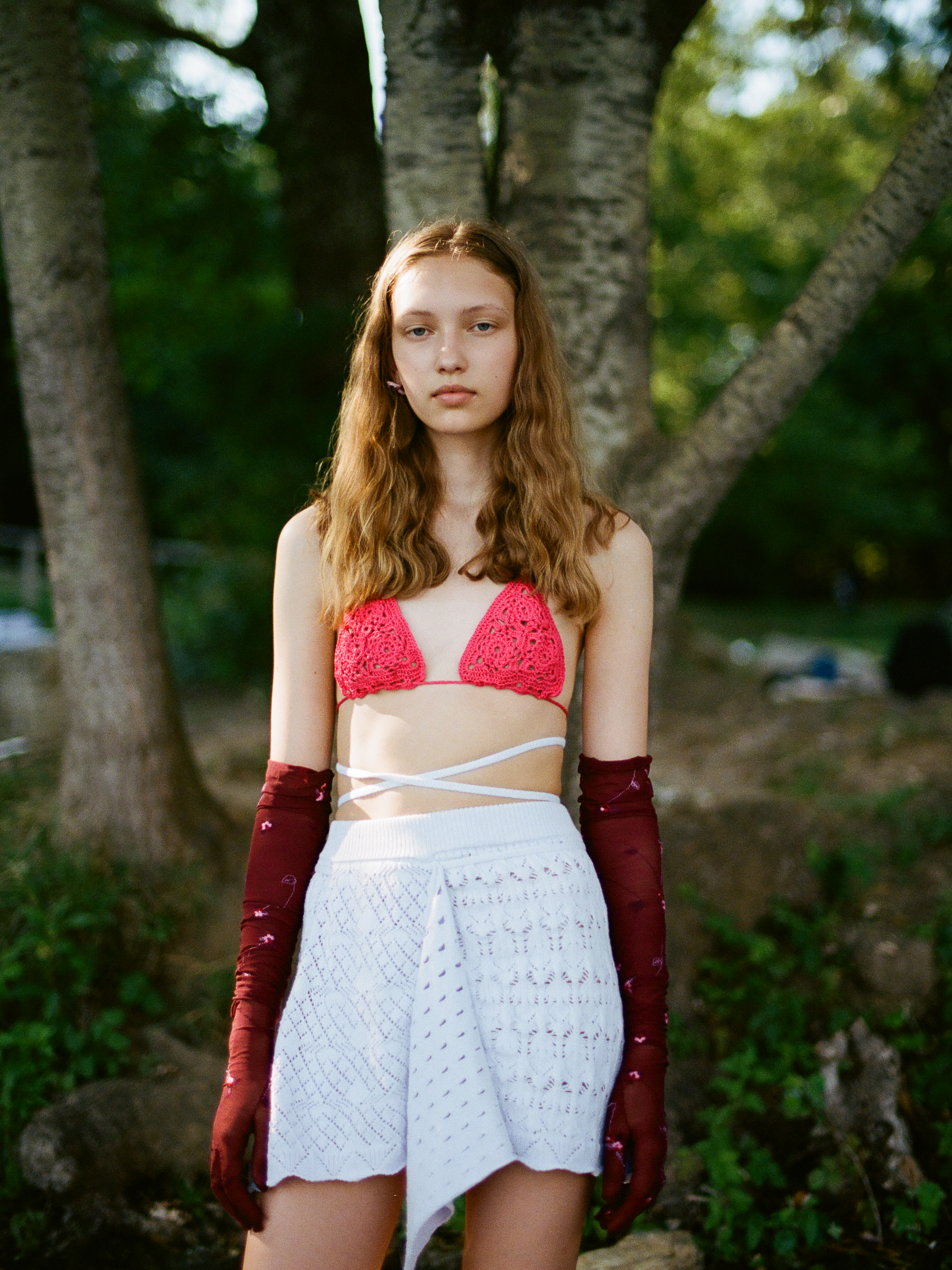
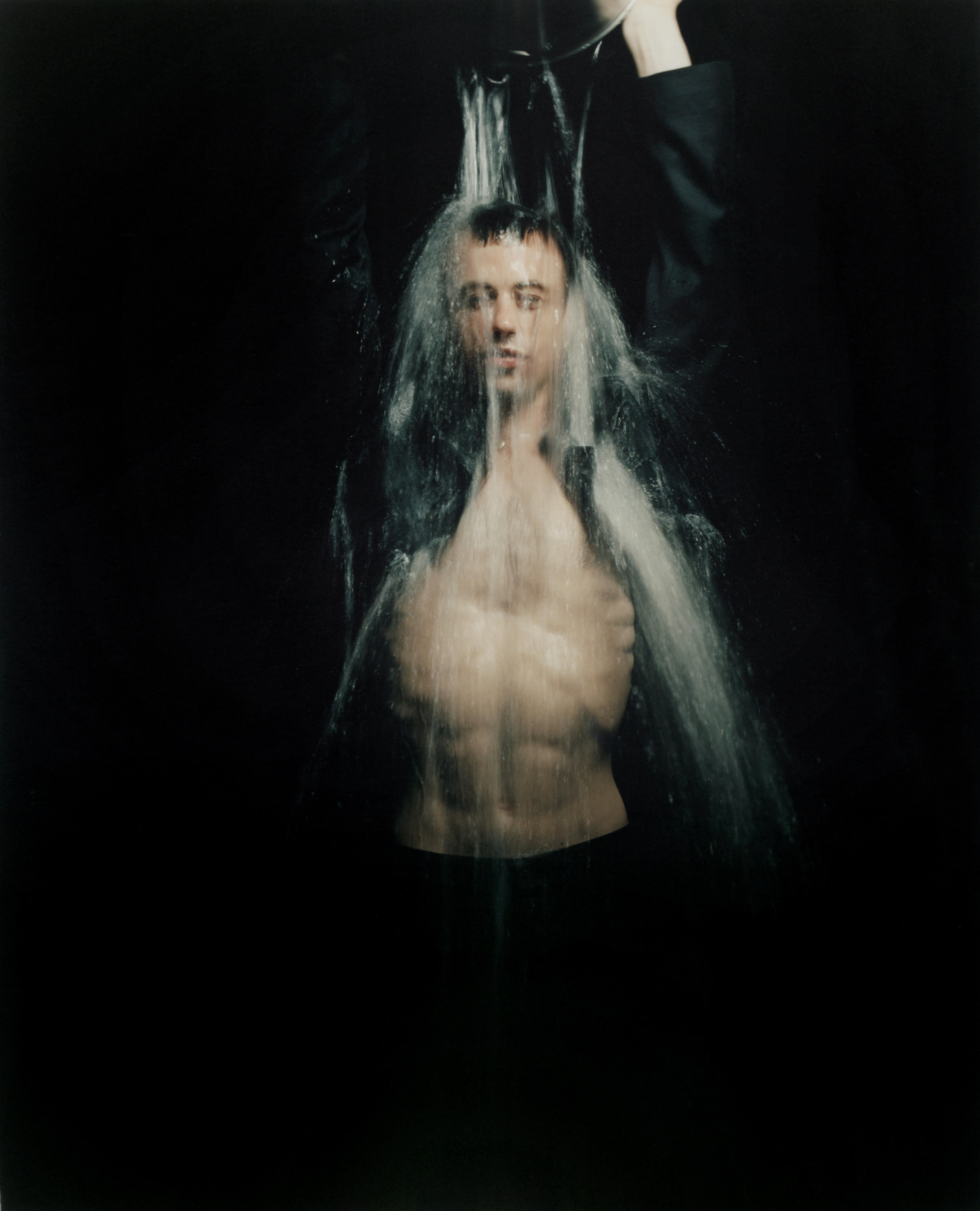
NR Vol. 16 In Our World · Autumn Winter 2022 Published · Print Page 162
Feature · Bianca Fields Words · Jade Removille
“What inspires me to create at this time is finding a way to articulate the nature of noise in America;”
Bianca Fields (born 1995, Cleveland, Ohio) is a contemporary artist, currently based in Kansas City, Missouri. Fields is one to watch in the contemporary at world scene as she strikes with her highly charged paintings. NR had the pleasure of conversing with Fields, delving further into the influences behind her deeply-emotional body of work, the process supporting her craft as well as her future endeavours in Seoul and London.
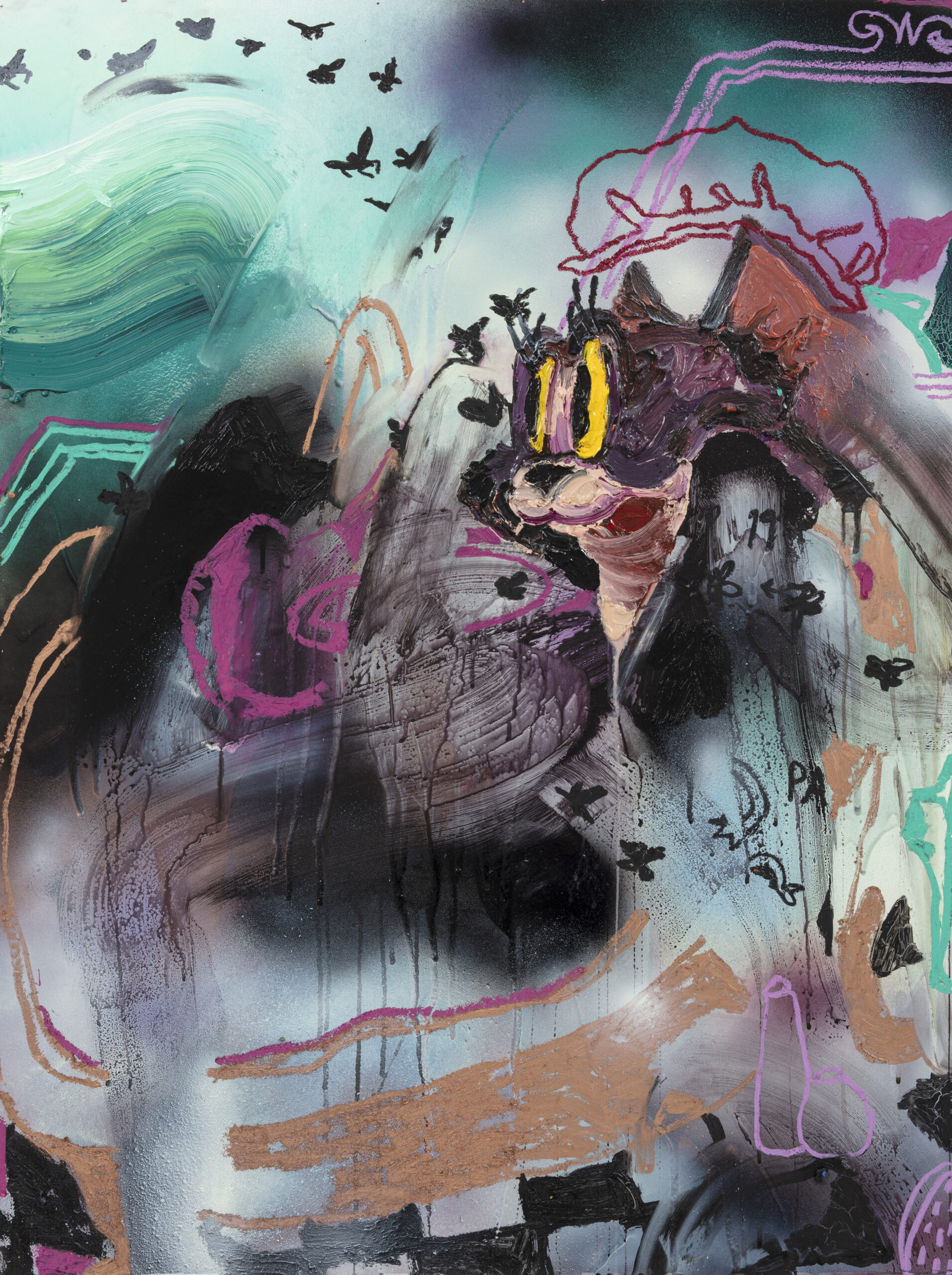
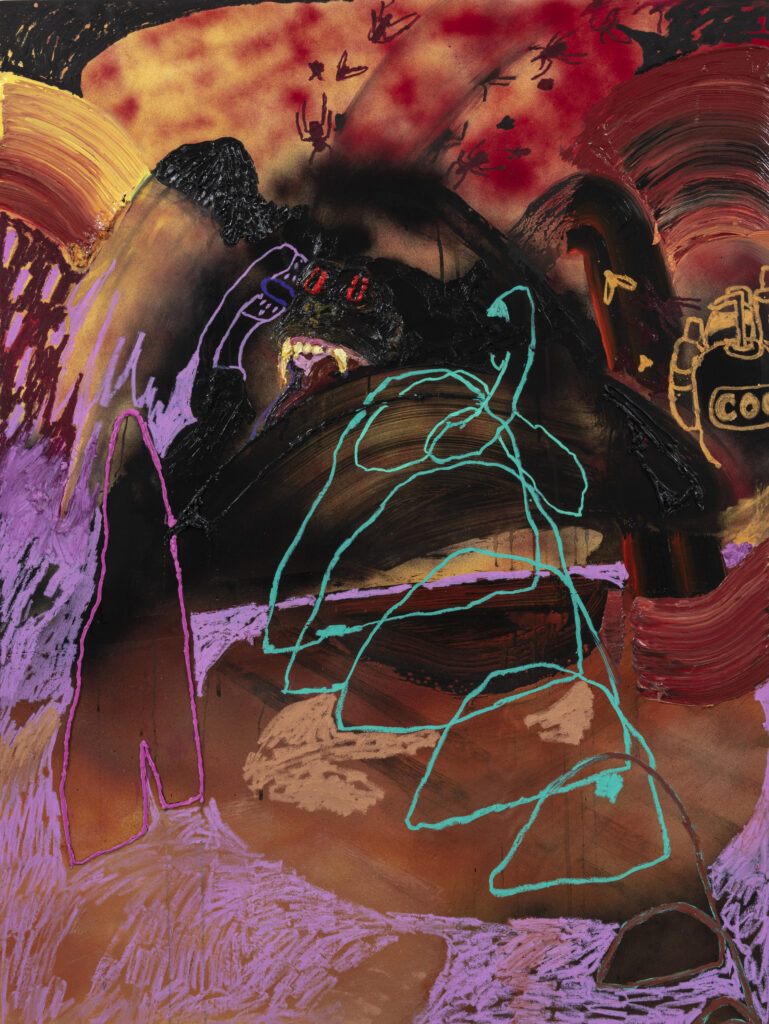
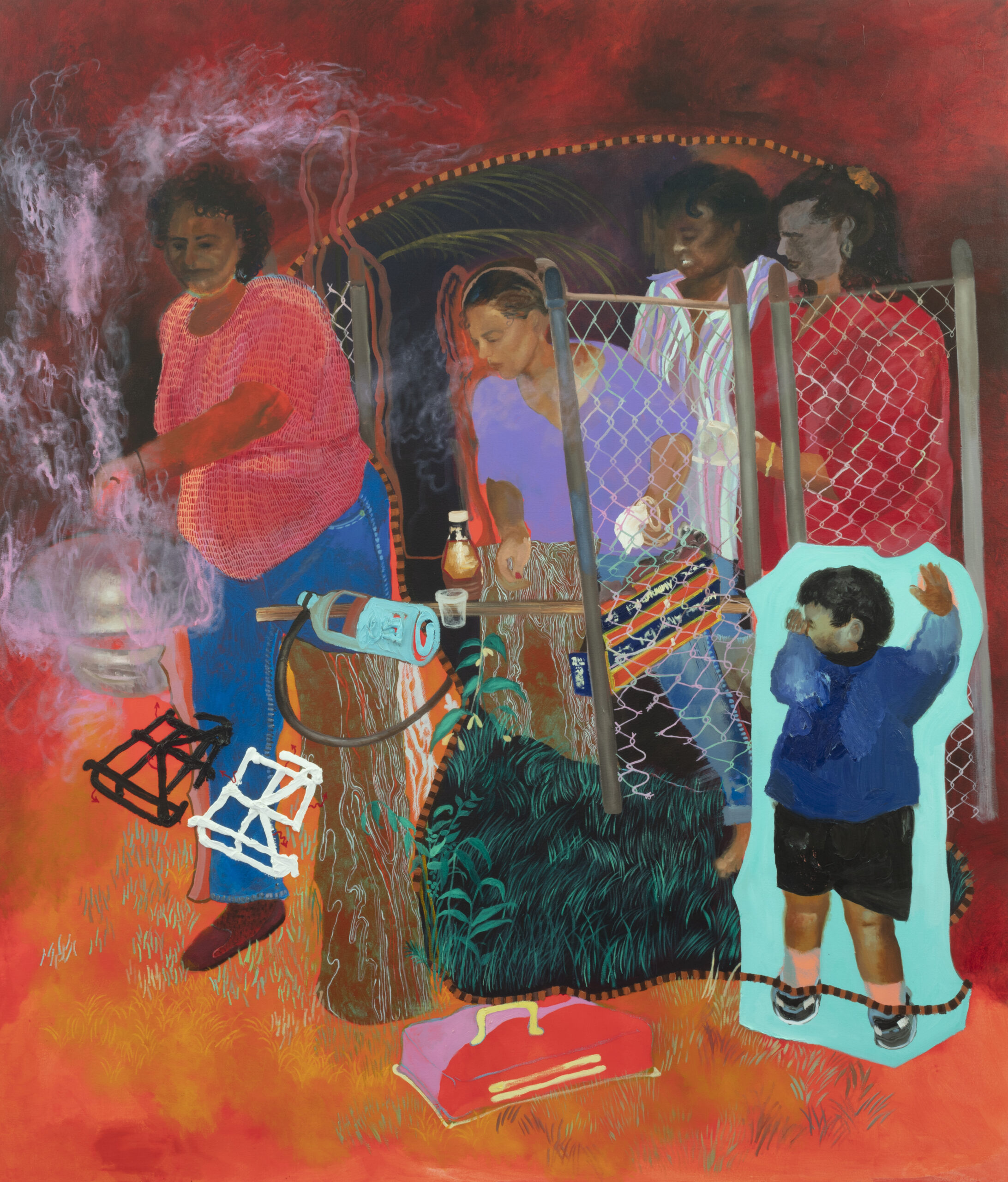
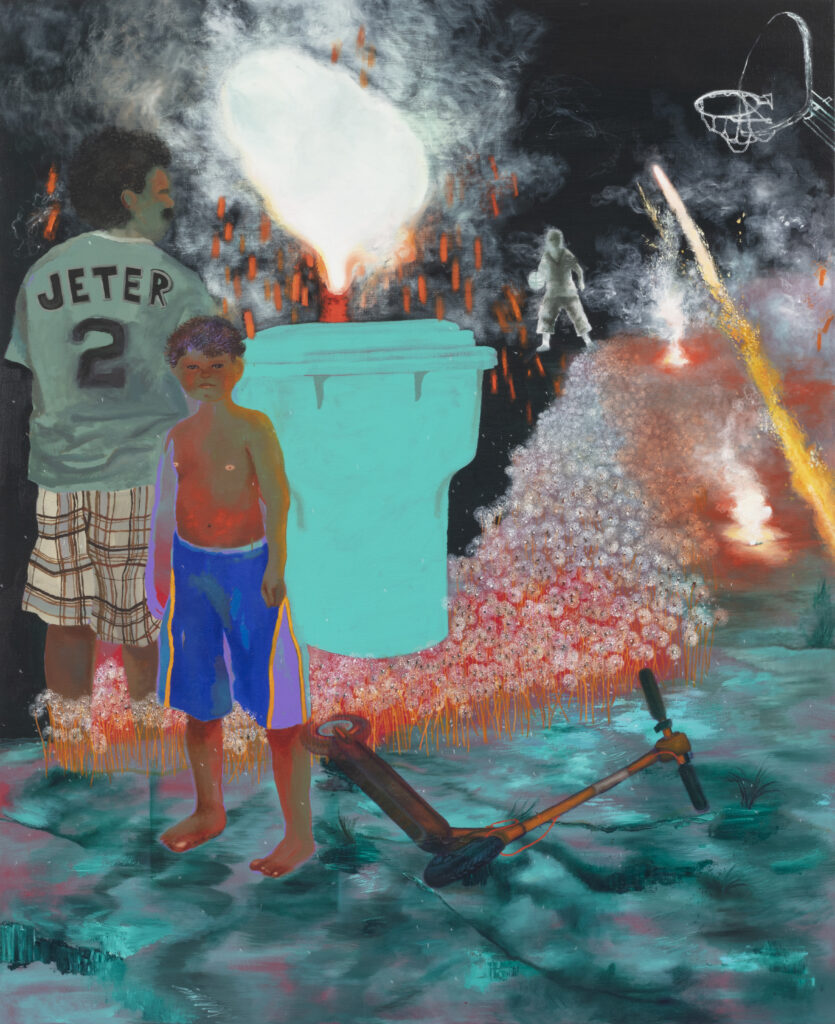
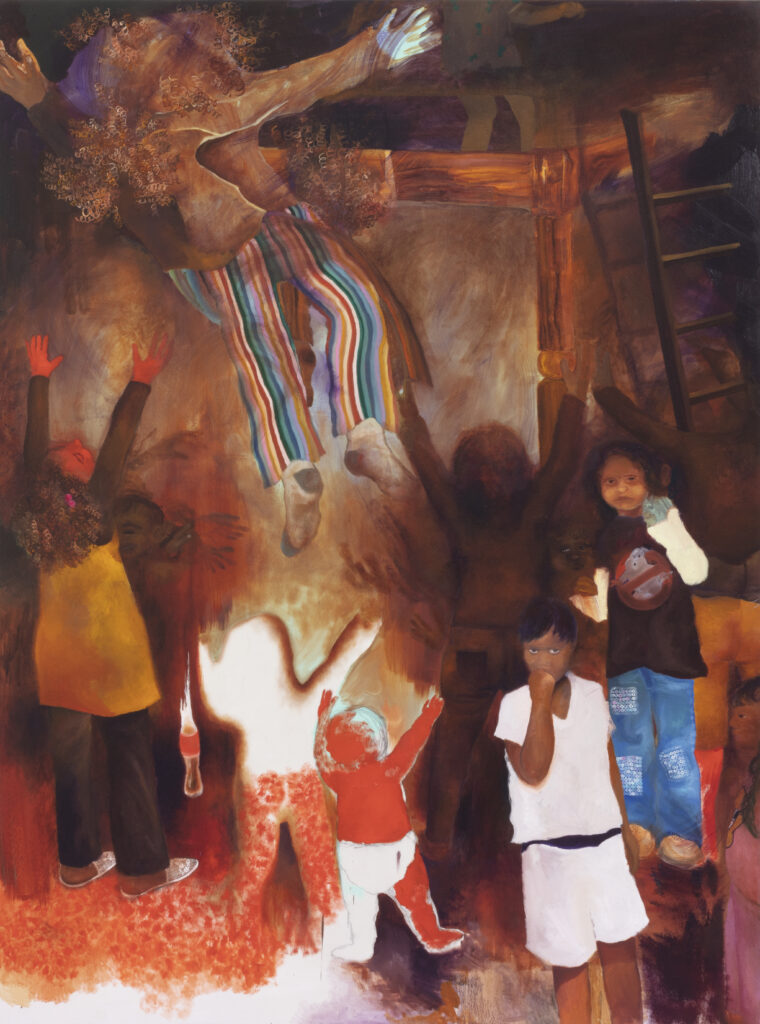
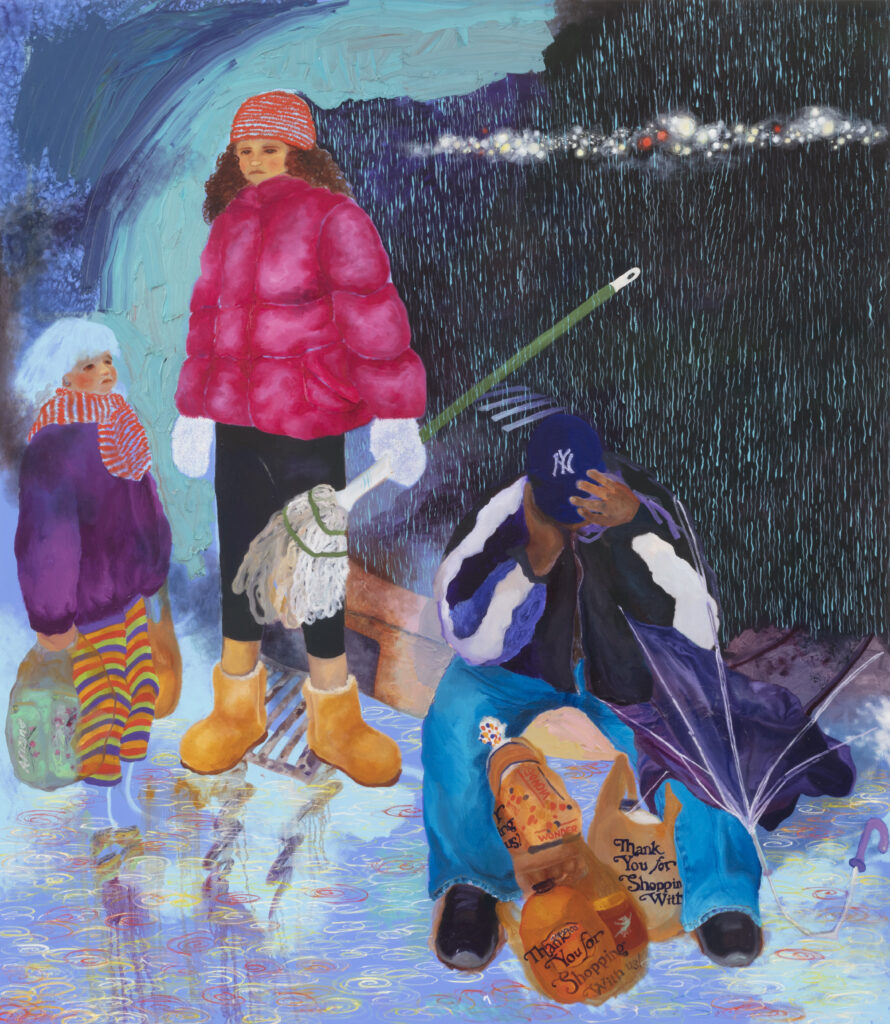
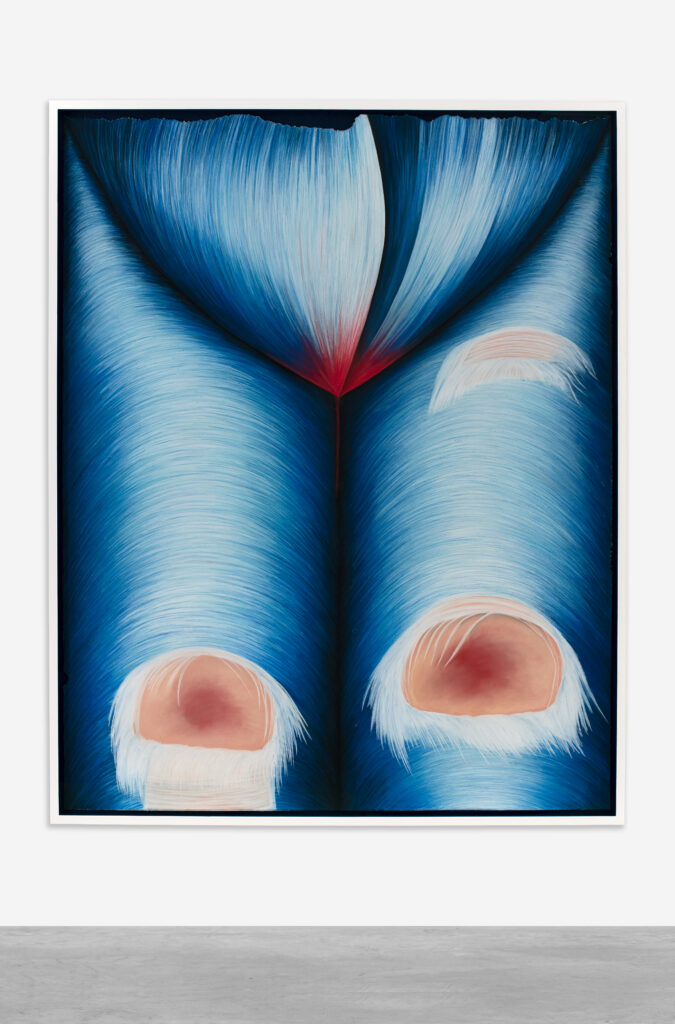
Bianca Fields, Grip Getting, 2022
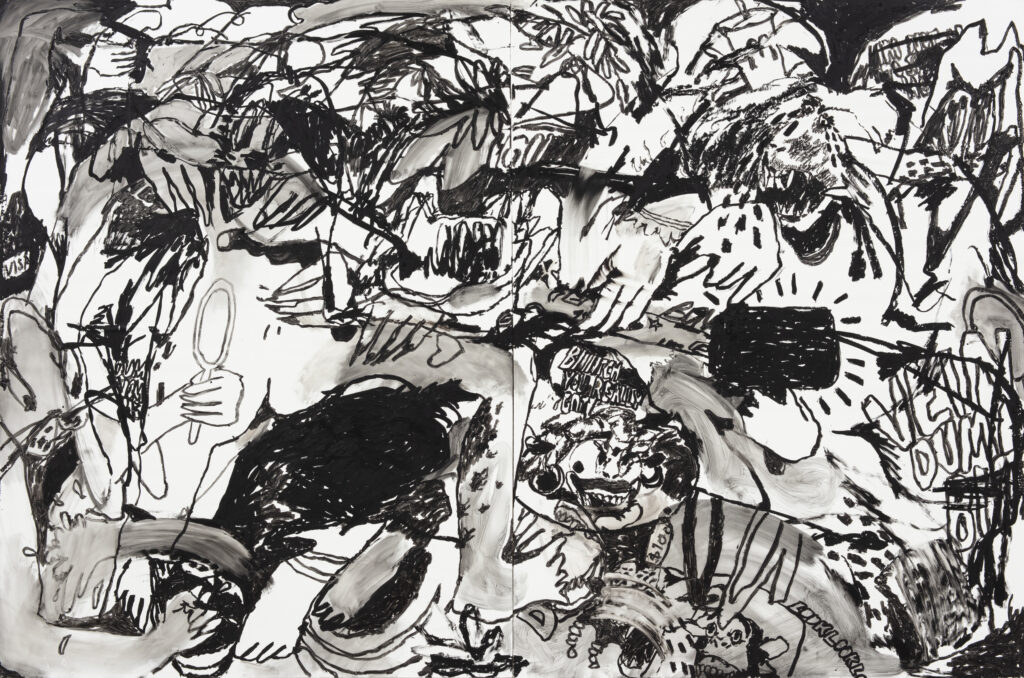
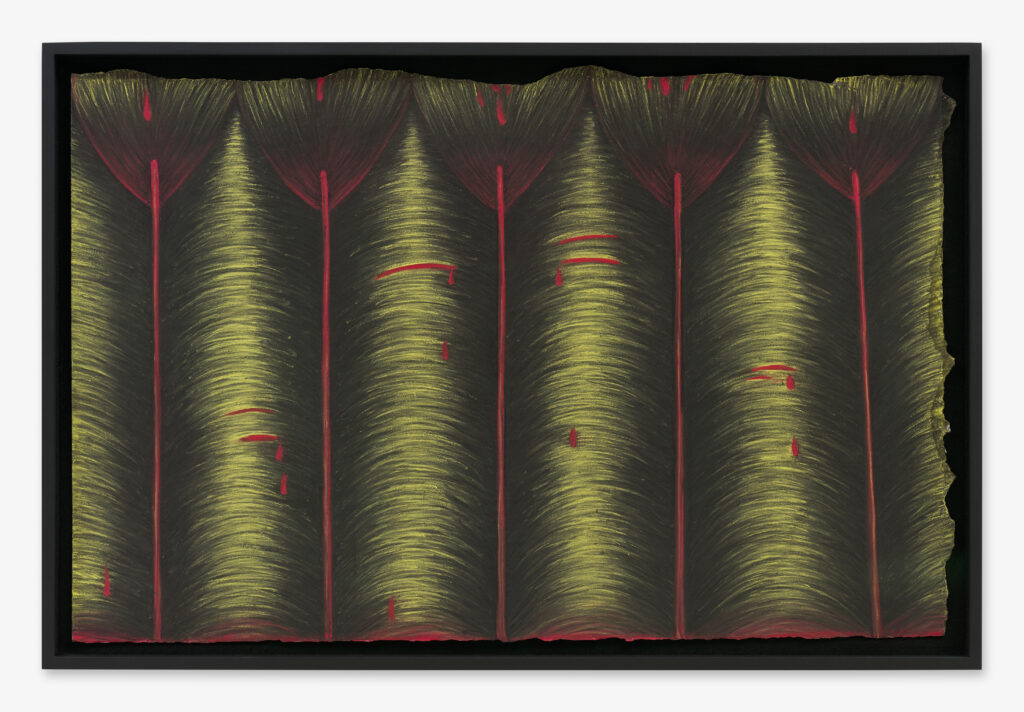
Bianca Fields, Princess of Proms, 2021
When did you start creating? When did you realise this was something you wanted to purse?
I have always been musically inclined, since about 6 years old. Once I learned the transcendental process of painting/mixing colours in high school, I became interested in painting — practically obsessed. I never had the intention of pursuing it as my career. I started off at a community college with high hopes of weakening this idea of pursing art, but shortly after was confronted by my painting professor, saying “he suggest I not come back next semester,” following that I should apply to the Cleveland Institute of Art, using the computers on the floor above us.
You are originally from Cleveland, Ohio but moved to Kansas, Missouri after graduating in painting at the Cleveland Institute of Art College in 2019. Why the relocation and how does your background inform your practice?
I met my partner who is also native to Cleveland, in art school. He is also an artist; a product designer. Prior to me graduating, he moved around a bit with designer jobs. By the time I received my BFA, he had settled at Garmin International in Kansas City. I love the midwest. Being from the midwest and living even closer to the center of America is very odd. It’s also very wholesome. The culture is like a big bowl of warm, wholesome soup. I spent a lot of time in art school hanging out with my friends who didn’t attend art school. I still would consider them some of the most creative, complex and innovative artists i have ever met. Because I’ve spent the vast majority of the pandemic in Kansas city, I’d still consider it an offbeat, yet fulfilling journey. I think it has forced me to turn within a bit in my work — it’s become a bit more introspective.
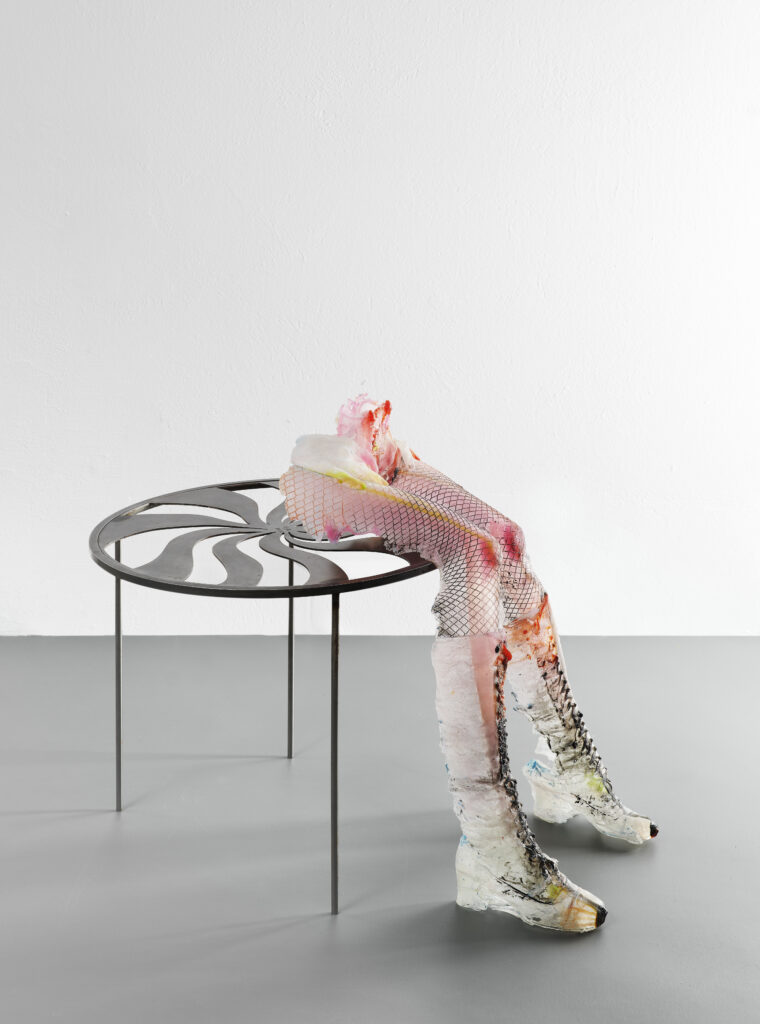
Bianca Fields, I told you, you wasn’t gone b in the mood, 2022
One thing that is striking at first sight in your artworks is their powerful yet youthful energy within the colours, lines, text and texture. How did you discover and fine tune your craft?
As a young girl, I spent countless hours watching the American Animated TV show, Tom and Jerry. “Tom,” the fictional character from Tom and Jerry, has become a protagonist in my work that contribute to this series of highly charged paintings.
“I always think about how his character was limited to words, practically mute. It remained up to me as a viewer, as a young girl, to put sound, color and imagination in order to make sense of this anxiety-inducing show.”
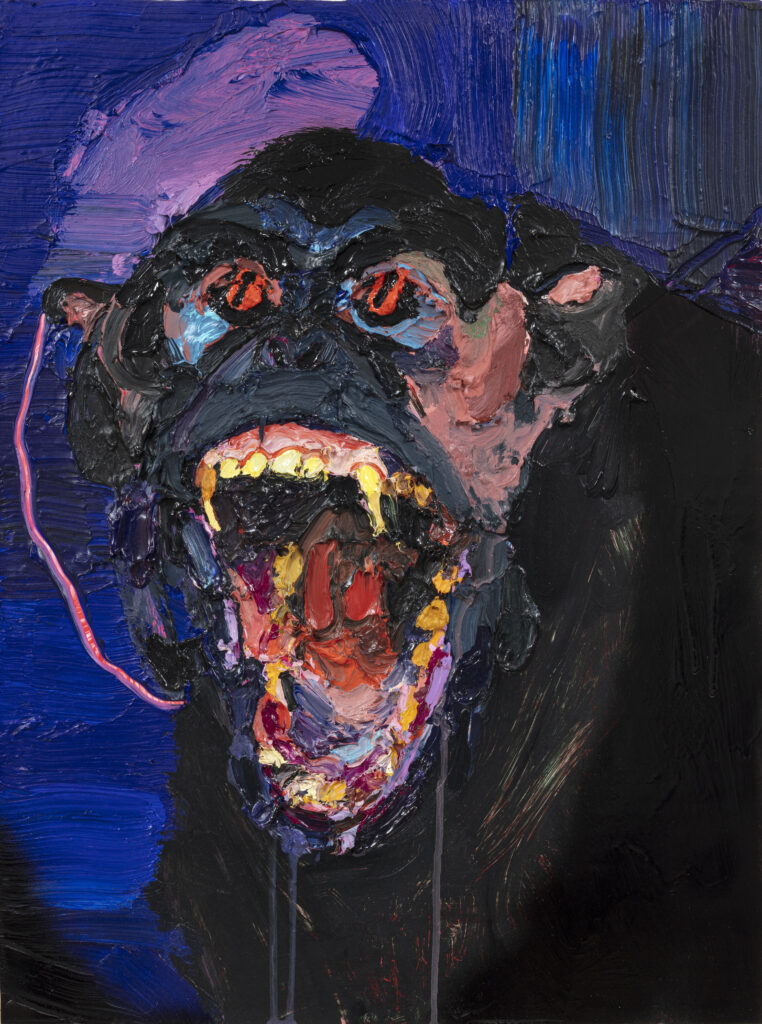
Bianca Fields, Moofie, 2022
Bianca Fields, A Gift for my Snitch, 2022
What was the first piece of art you saw that left an impression on you?
The works of Allison Shulnik. It seemed like something funny or absurd to do, but when I found myself working in this fashion, I couldn’t imagine painting in any other way.
Although your body of work bursts with vibrant colours and is almost cartoon-ish (with ‘Soul Tap’, ‘Rejected Rep’) I find myself exposed to artworks presenting a deep palette of emotions. It may also be because of a certain way I feel in this present moment whilst looking at your artworks, but there is a particular mirror effect to them. As the artist, how is your relationship with your work?
I refer to a vast majority of the 36” x 24,” (medium to small sized pieces) as my “Mirror” pieces. These paintings particularly recall being a 6 year old girl and simultaneously looking at/through myself. The copper-chrome works are also that of my complexion — bringing damage, curiosity and vulnerability into the indestructible space that holds my world of paintings together. It also brings the metaphysical power and urge to come closer to the glistening; unusual but captivating. An overwhelming presence that I often experience as a black female artist.
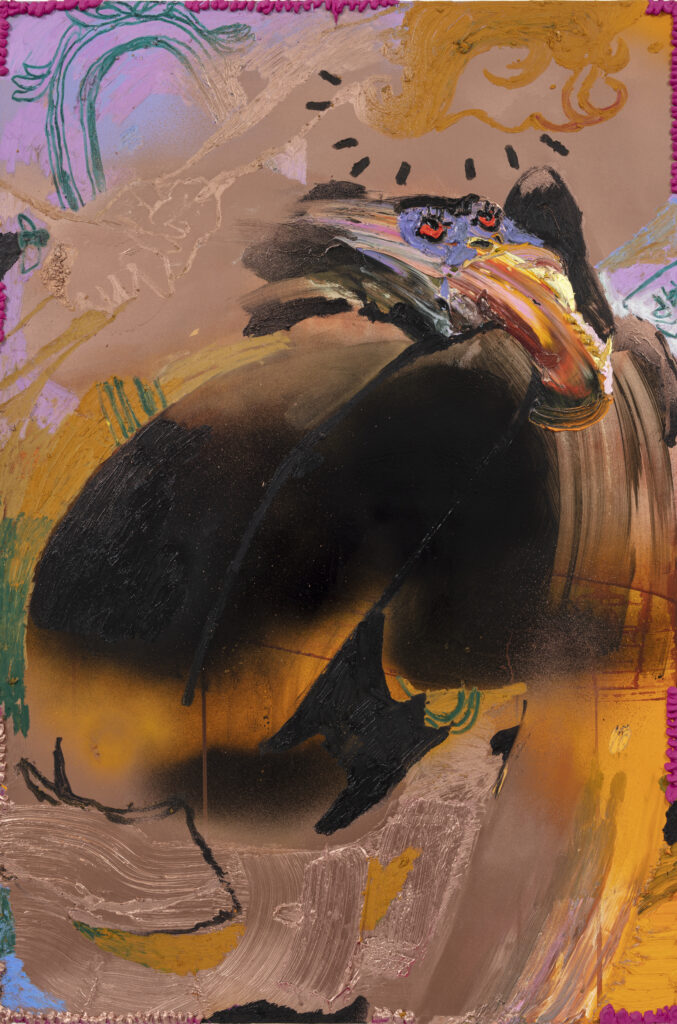
Bianca Fields, Booked and Busy, Beneath You, 2022
Bianca Fields, Proud and In Doubt, 2022
I also like to think of the palettes for my paintings as a subconscious strive for a “bruise” quality. bruises are beautiful, but I find it very frustrating to replicate the palette in an almost artificial way; challenging this idea with electrifying colors. I will always take risks in my palette and will continue to fearlessly allow the decayed rotten colors to seep through the cracks of the work.
Would you consider your pieces therapeutic? How do you engage with your work and vice versa?
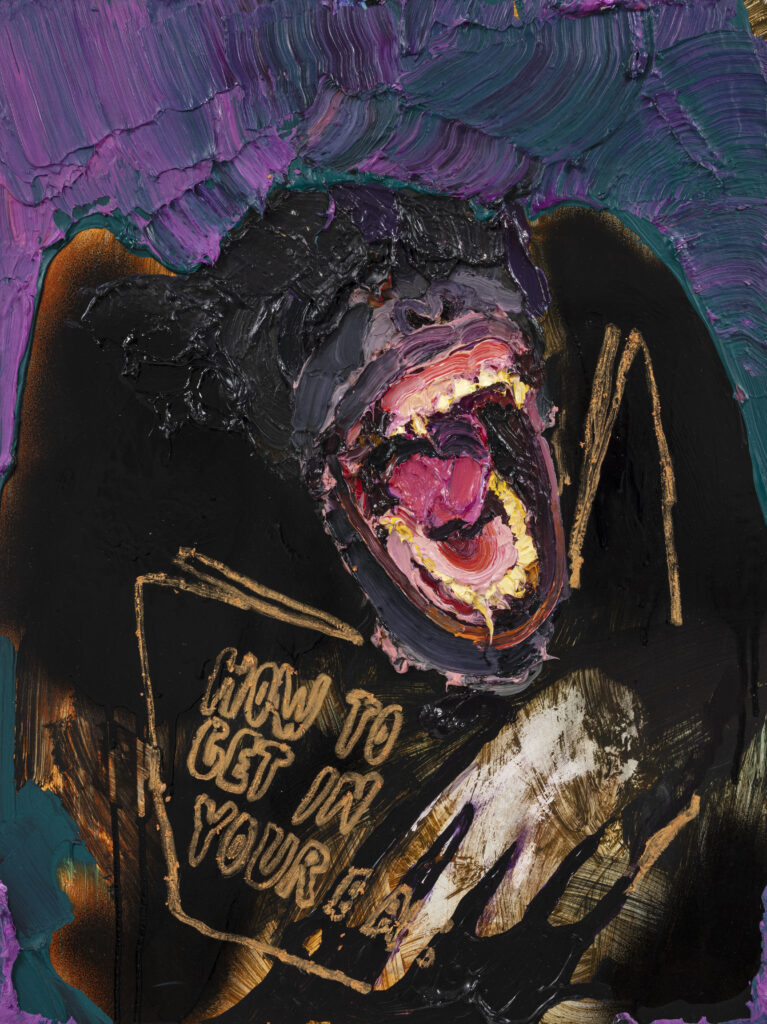
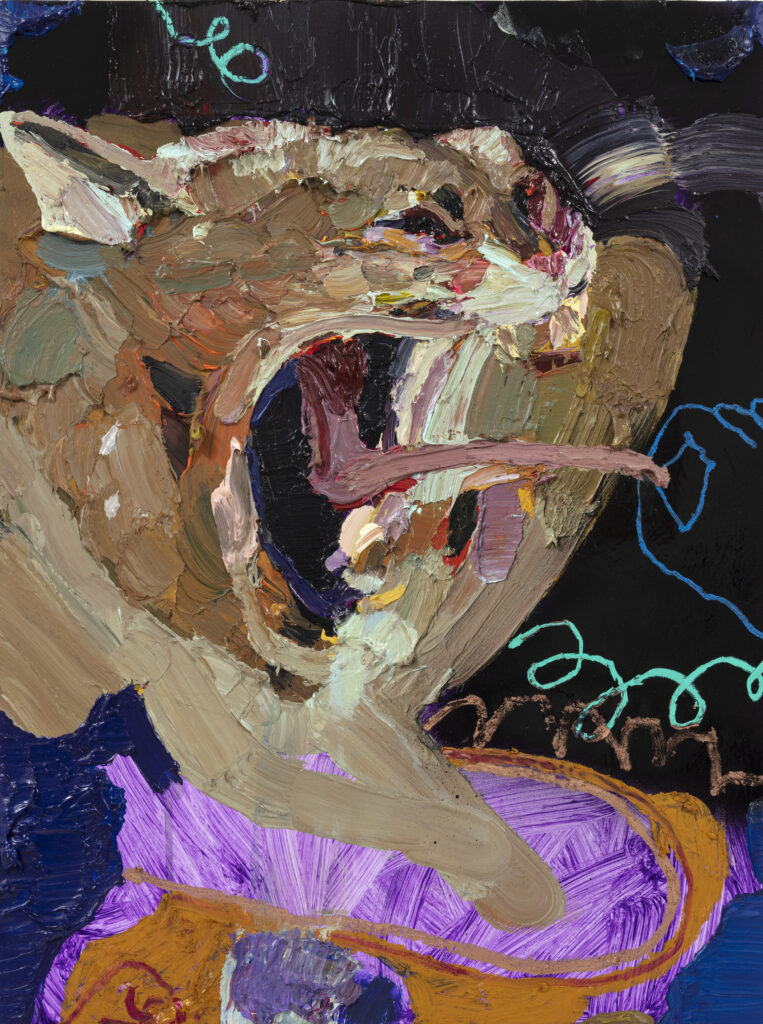
“Even though these works may appear as haywire or almost deafening, I experienced a paradoxical state of extreme silence and fragility when creating these paintings.”
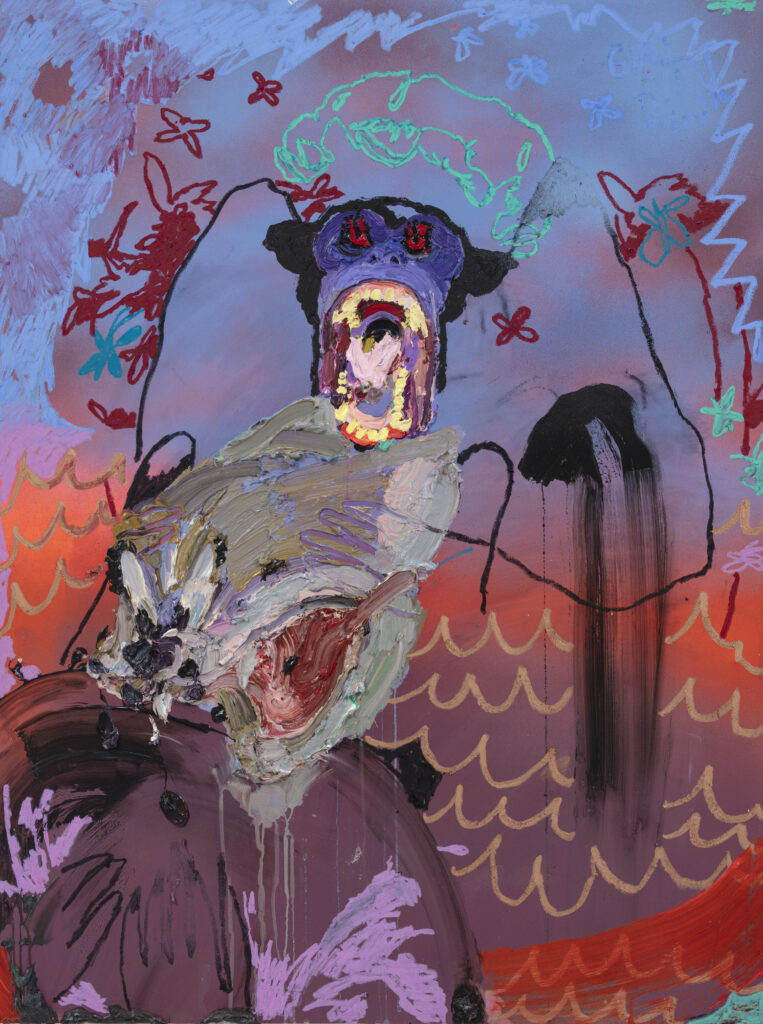
The thick, obliterated rendering of the mouths of these yelping creatures are slow and silent. Working in a more (expressionistic/intuitive fashion) the mouths are where I slow down the process of rendering. ‘Pressed out like Peanut Butter’ and ‘Smeary Eyed’ were made pretty close in time to each other. I think this is when I started examining the process of what the depiction of the yelping mouths meant to me. I started to see them as portraits of myself; laying within the screams of these creatures.
“I started to feel like I could truly see myself during that era of making. “
Bianca Fields, Hold My Purse, 2022
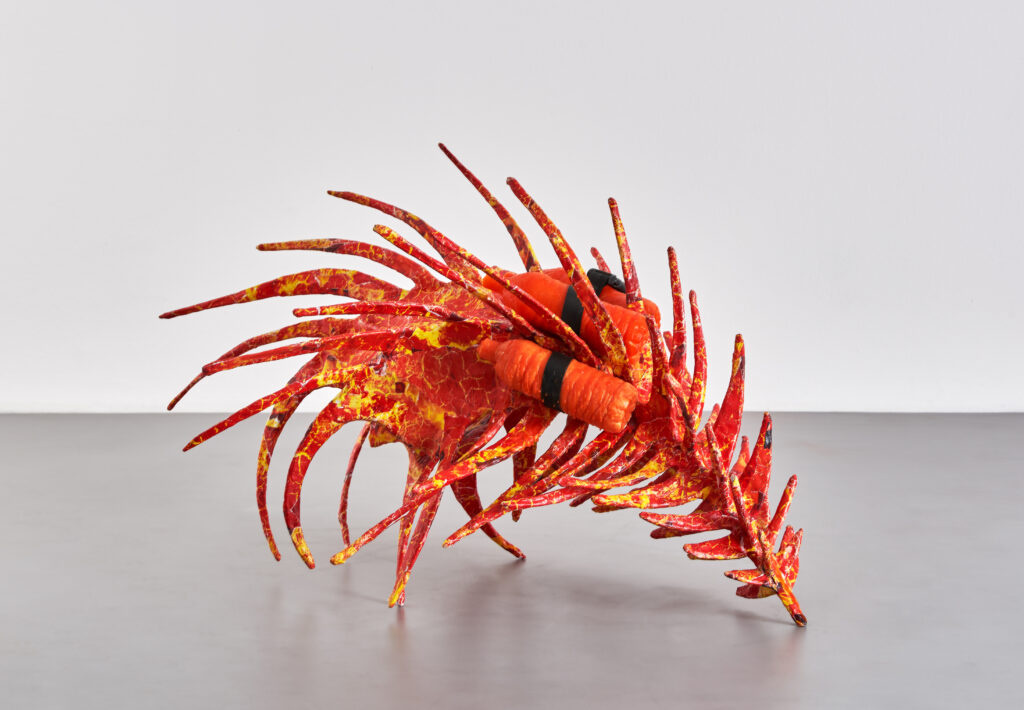
You have also done some sculpture work such as ’Five and Below’, in foam, resin and papier maché, with a weaving comb on top. It reminds me of how the afro comb was worn in the hair as a symbol of union against oppression during the Civil Rights Movement. Was it something you had in mind when creating this piece? Could you talk about its significance?
This idea certainly came to mind. I very much view this specific character within the realm of my work, as a caricature/symbol of black femininity. Pairing this sculpture work with the painting, “rejected rep,” had me thinking about the representation of the athletic black female body and the process of stripping femininity away. I consider myself a very active person who works out on a daily basis. Adding elements like the comb and wig feel like “ornaments” to the subject; signifiers of non conformity.
What is your favorite part of your practice?
I would probably say when i reach the end of the painting; where i start to slow down. There is a lot of chaotic, fast mark making in the process of making these works, but I think the viewer is actually left with more of my slowed down, brutal process of covering it all up. I will usually take a large brush and completely close the subject in with thick walls of paint. I will also take whatever leftover paint on my palette, scrape it into one large wad, and intricately place it somewhere inside the work.
The theme of this issue is IN OUR WORLD. What is it in our world that inspire you to create? Who/What are your influences?
I think what inspires me to create at this time is finding a way to articulate the nature of noise in America; essentially operating in a regimented social environment.
“The tropes of the internet world also inspire me and affect the way that I see/process. I find it a challenge to think about the spaces between language, images and culture— and where representation of the black female body fits in between.”
I’ve recently started to reread Julia Kristeva’s essay on abjection, ‘Powers of Horror.’ The last time I’ve thoroughly read it was in undergrad. Her writings inspire me to unpack a bit of tension that I’ve yet to bring to the surface in my work. Actualizing different pieces and part of my body that I have once neglected. It also helps me compartmentalise my symbolic realm of thought when making these paintings. In other terms, things that are very close and fragile to me.
Bianca Fields Social Grooming Me, 2022
Bianca Fields, Grip of the Lip, 2021
You have had your first solo exhibition with Steve Turner, Los Angeles. What did this mean to you and what can we expect from you in the forthcoming months?
It has been a pleasure working with Steve Turner; they truly have great trust and faith in my visions and processes. We have such a great system. The turnout of my most recent solo show has me super eager to flesh out further ideas within this realm. Next I have untitled art fair Miami (Steve Turner), KIAF art fair Seoul, Korea (Steve Turner), and Frieze London (Carl Freedman gallery) .
Credits
Artworks · Courtesy of Bianca Fields and Steve Turner LA
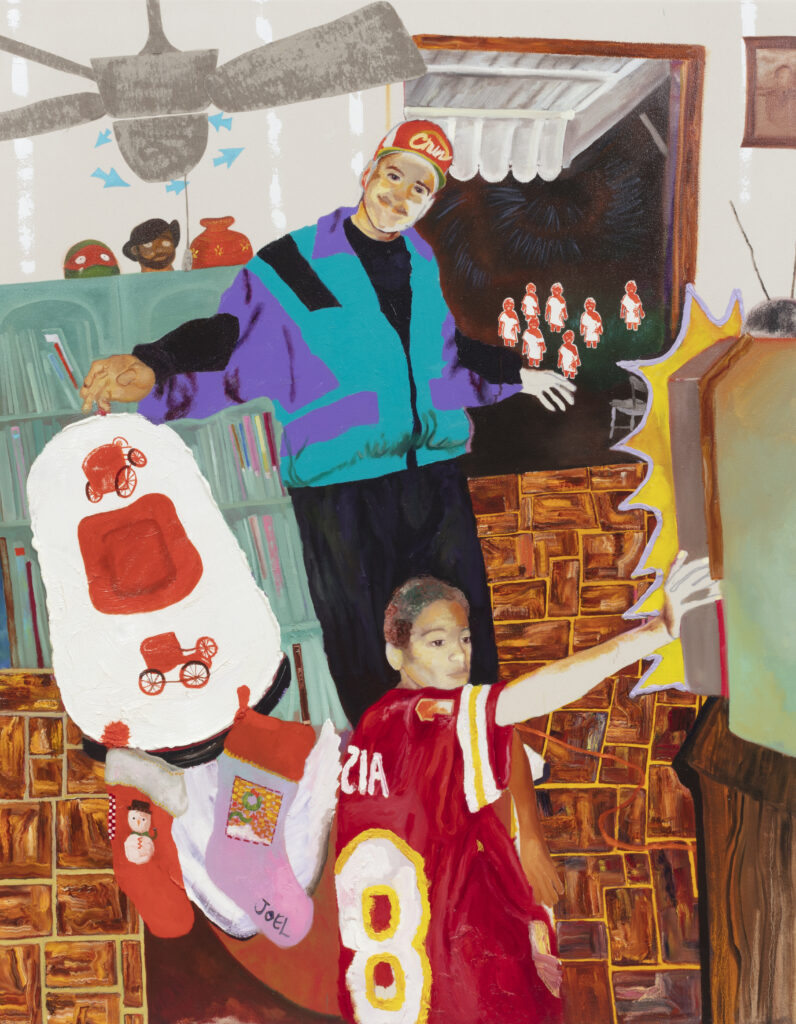
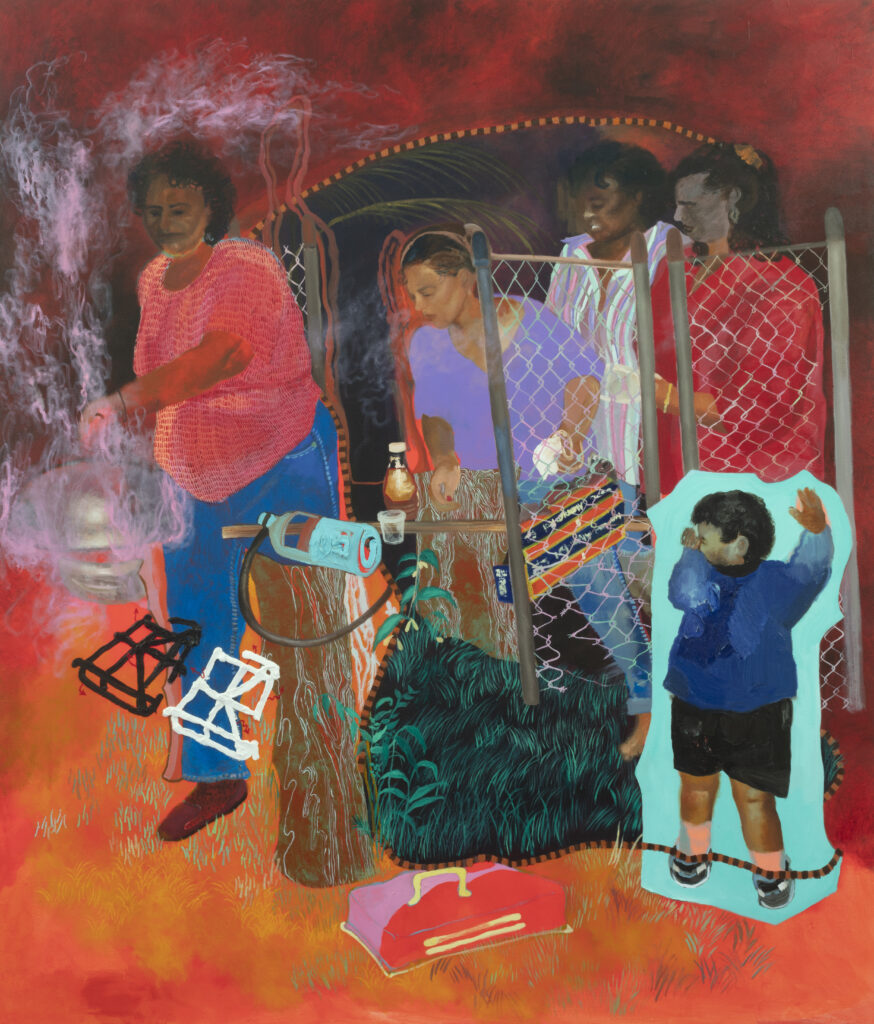
Veronica Fernandez, Before I’ve Existed, Now I’ve Lived
NR 16 In Our World · Autumn Winter 2022 Published · Print Page 156
Feature · Veronica Fernandez Words · Sara Van Bussel
Collective intimacy and the impermanence of emotions
Veronica Fernandez (b. 1998) is a mixed media artist from New Jersey, who is currently working in Los Angeles, California.
Fernandez’s work investigates relationships between people and their environments: drawing from her own memories, she attempts to illustrate the complexities of domestic life, giving space to intimate moments of the everyday. Pulling from a variety of source material – from images of family members taken from photo albums to art historical references – Fernandez blurs personal recollections into emotive scenes that evoke a shared nostalgia, or a sense of colelctive recognition. She purposely reworks aspects that feel familiar into unfamiliar territory, taking what is hers and morphing it to better relate to a general consciousness. Drawing attention to the impermanence of emotions, Fernandez imbues her work with a sense of unfinishedness, allowing the narratives to remain open-ended for the viewer to make their own. This sharing of experience allows her to speak to a community and discuss our foundations as human beings: where we come from, what shapes us, and how we interact with one another.
Veronica Fernandez, Trustfall
If you had to describe your body of work and what drives you to paint, what would you say?
“My body of work I would say is a form of storytelling about people and the places their bodies live through, depicting the impermanence of emotions.”
My initial drive to paint came from unpacking my own experiences growing up and spiraled really into these conversations about the human experience and how we adapt to change and the different moments in our lives, in the attempt to capture a fragment of intimacy and explore how it engages with others.
When looking at your work from a first glance two things hit immediately: size and color. Going back to this idea of intimacy and its actual space, could you tell me whether there is a link between the size of your works and this concept of entering one’s world?
I have always been in love with large scales. I started working on large scales in my New Jersey bedroom in 2019, testing wether I could transpose smaller sketches into larger surfaces. The intimacy that comes with a larger piece is different as opposed to when I work on my sketches and smaller pieces, which serve more as a form of personal release, like a page in a diary.
“My larger paintings deliver a sense of intimacy, of acceptance, that I feel absorbs people, almost as if it were a portal.”
Space is something that I never had growing up, it was never something set in stone, so for me, it was exciting to create art that could take up actual space when I finally had a little to take advantage of. I want others to become absorbed in these works about people that want to be heard, understood, and seen, so they can also see themselves and feel to some extent that they’re taking up space too.
Take me through your working process: how do you select a moment in time that you want to depict? Does it always start from a family album or is it also a moment you experienced, or the impression of someone you recently met?
My paintings primarily stem from my experiences, then most of the time I’ll find which photographs I think work best that I can deconstruct or pull from. When I think about starting a painting, there’s usually an essence, a general sense I want it to have, which then drives me to search for poses, gestures, facial expressions, colors, shapes, or objects from my references. The paintings usually consist of the combination of a few photographs (around 4-5), which shape the ground for a new sketch. It’s not until I get into the actual canvas that I can step back and see how to truly alter the first draft. As I work on different layers I usually incorporate different moments in time that I think will really bring a special element to the painting or change the original direction for the better.
Veronica Fernandez, Watch A Leader Cry
The only moment where my process is more directly linked to a physical photographs is when I find a picture that I think is absolutely stunning, whether it be the colors within the image, the facial expressions or the composition. Then I start from that singular element and work around it.
The role of memory and recollection is thus pivotal to your work.How is your relationship with the past, and how do you transform it to something you engage with in the present?
Throughout my work process, I try to alter the familiar into unfamiliar territory. To create the works, I do reflect on my own experiences and engage with my personal memories, captured in photographs. The final idea I work with comes from stripping down these photographs and really reconstructing them and see what they transform into in the final imagery on canvas. When I work with my personal reference material and find myself altering the original picture I feel like I can see it at a distance and really step back and comprehend it.
“What once was a memory from my past can become a person from that memory in a new environment, with a new expression or new overall depiction, possibly surrounded by new figures I’ve created.”
The original story becomes thus a new idea that can be universally absorbed. On a formal level, I love using color, texture, and other techniques to bring a new contemporary palette to the soft pastel undertones of the older photographs I have.
I have noticed that the subject matter in many of your works are children. In relation to what you talked about before, the impermanence of emotions, do you think that childhood is key in this research towards change and possibility? Because youth is change in its purest form I guess – the openness to the future in both temporal and conceptual ways.
Children are definitely representative of openness to the future and have this kind of unpredictability hovering over them in relation to what can become of them in my work. The early years of our lives shape who we become. This sort of tabula rasa at one point everyone starts off with that slowly but shortly accumulates all these perceptions is very interesting to me. Everyone has their own specific stories, experiences, struggles, wins, losses, and even when we are too young to fully grasp the totality of every situation, we still feel and live through them.
“This whirlwind of emotions that come from the earliest point of our lives really tie into how human beings can adapt to their experiences later on in their lives, and reflect the layers that make up each and everyone.”
The child’s mind creates that first layer, and I think that incorporating them in my works llows me to play with these innate curiosities human beings have and how they navigate themselves in the world over time.
Titles are always very specific in your paintings. Contrary to many contemporary artists, you always seem to describe a work with precise accuracy of words. Could you tell me more about this particular attention?
The titles of the pieces stem from many places, sometimes I’ll hear my family members say phrases as forms of life lessons that I think are special, and I’ll remember them and think about how I can alter them to make them stronger, more accurate. Recently I’ve gotten into poetry, and will take a line or two I think can really stand on their own and apply it to paintings that I am already planning on making.
I think it’s important to utilize everything I can to get closer to the viewer, I want people who see my work to be able to envision themselves in it and allow it to touch them in some way or another. I think it’s interesting that very often titles are left out in gallery displays, and sometimes it isnt until you get the information written somewhere else that you can see another side to the work. I want people to be able to experience my work right away, not simply through just a title, but through what the title is to me, which is in fact poetry. I think this purposefulness can be a tool I can offer them as a chance to express that as an artist I am trying to have a conversation about people, and I am actively reaching out beyond the image.
Veronica Fernandez, Superheroes
Talking about the viewer and ways to reach put to him/her, in which way do you try to combine the autobiographical source in your works with the outside world, in the attempt to leave space to the audience’s own gaze?
Sometimes the stories are represented through the imagery, and other times the painting evokes just the underlying emotions that come from those experiences, even though the actual source is not as recognizable. The figures in my work are depicted in different ways, some are more realistically rendered, others are recreated in odd colors, like full red, or many are altered to be irrecognizable through painterly gesture.
“Altering the identity of the figures helps me to create the distance from it that is so pivotal to its reconstruction, enough for me to continue it as anew.”
I also throw in a lot of made up elements into the paintings, to the point where the original ideas that inspired the painting become just a starting point, a vague compass, leaving the openness necessary for the viewer to incorporate his/her own elements into the story.
Veronica Fernandez, Through Steam (Lay Your Burdens Down)
In relation to the magazine’s theme –in our world – how do you think your work translates the sense of being in this time – from this current sociopolitical climate to this specific creative dimension?
We live in a strange world, where so many people feel that they are not being seen, heard, and overall understood. As I mentioned before, many of the figures in my work are asking to be understood or acknowledged in their positions too.
“I try to create an opportunity for compassion, curiosity and most importantly for conversation.”
Regardless of the way the paintings are received, I always try to make them accessible, to leave space for the other, to aknowledge the viewer and telling him/her that they are welcome, and their experiences matter.
NR 16 In Our World · Autumn Winter 2022 Published · Print Page 222
Warped Self
Team
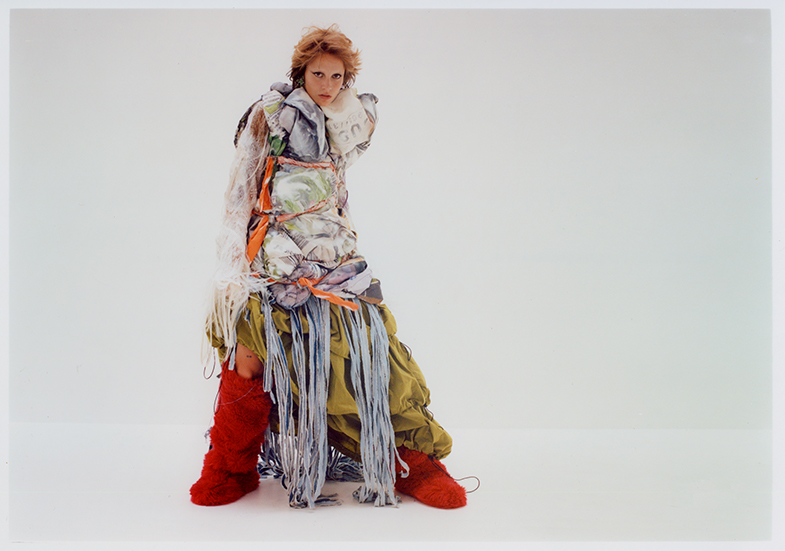
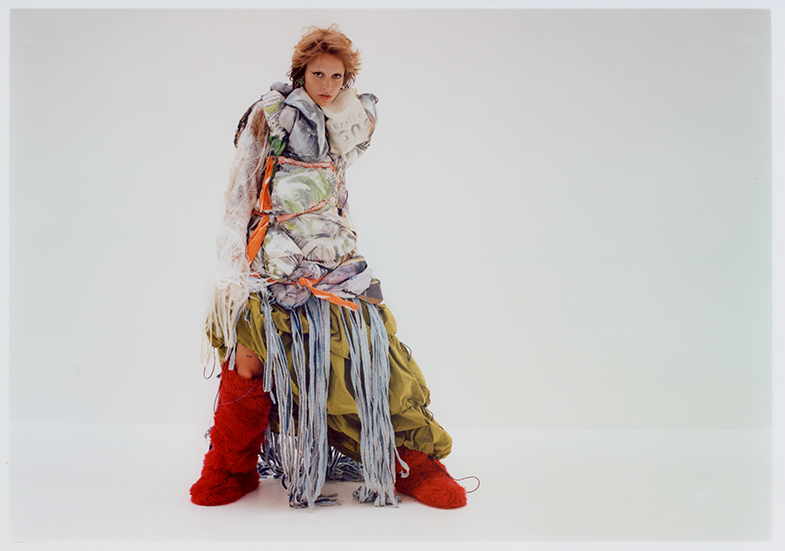
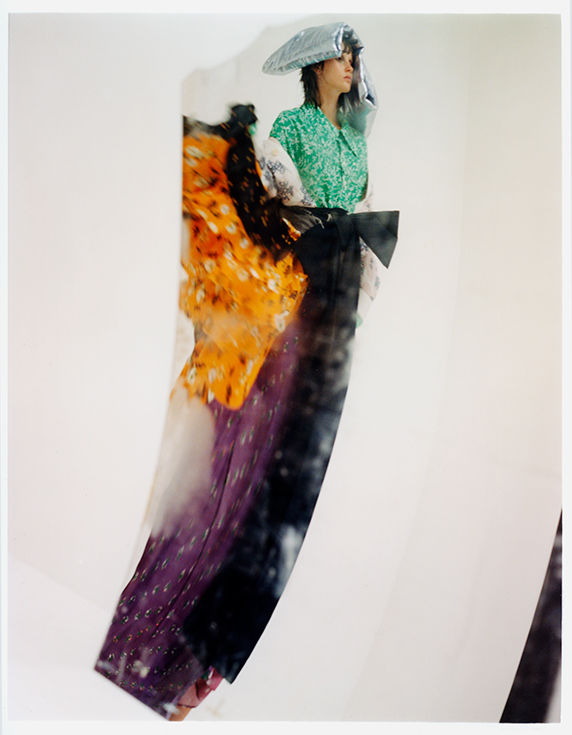
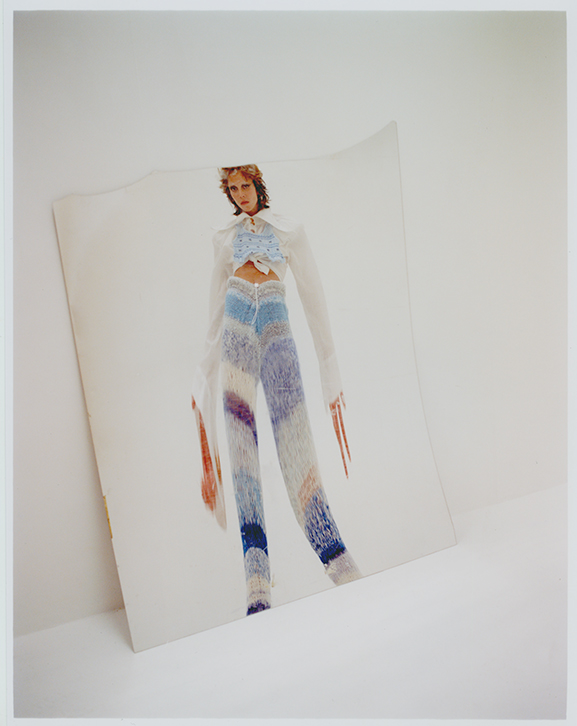
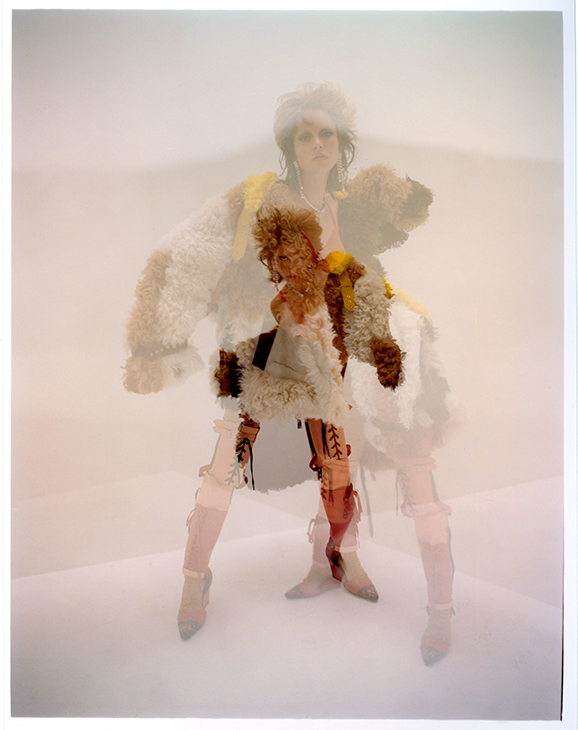
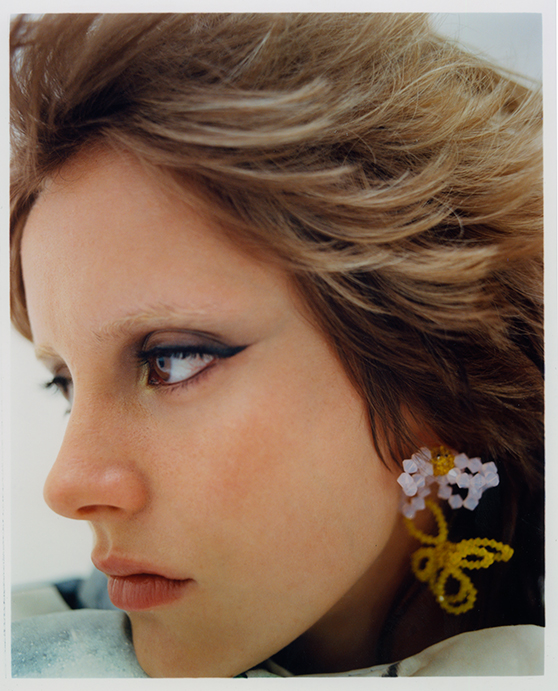
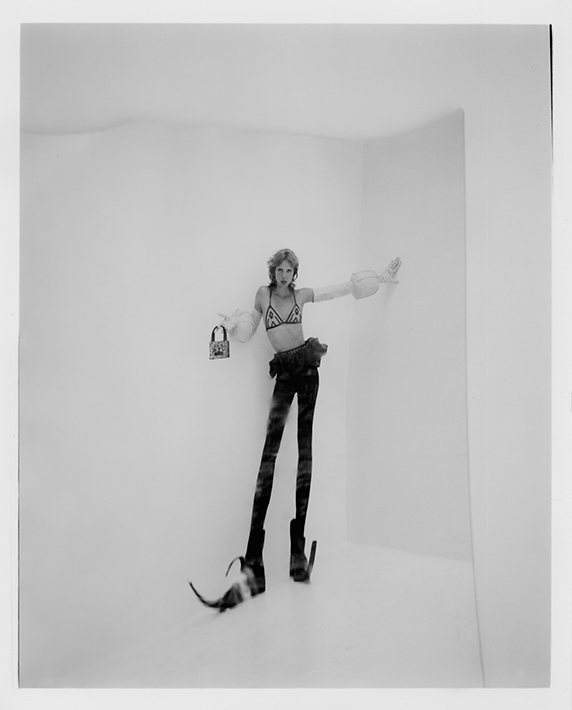
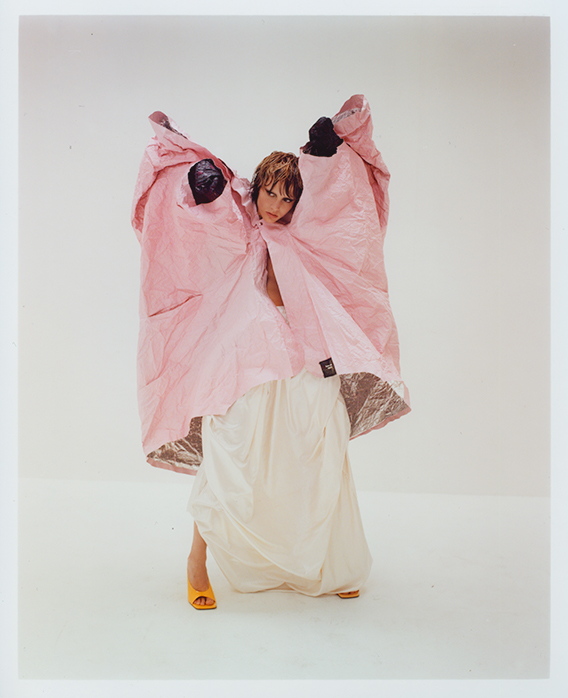
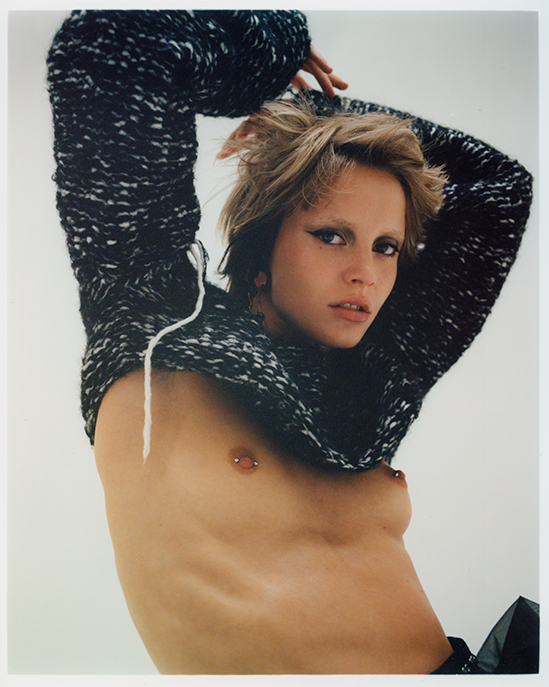
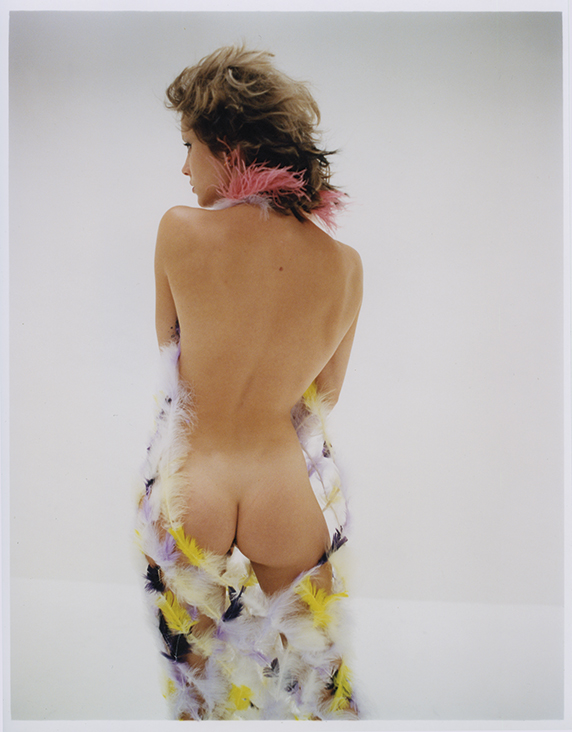
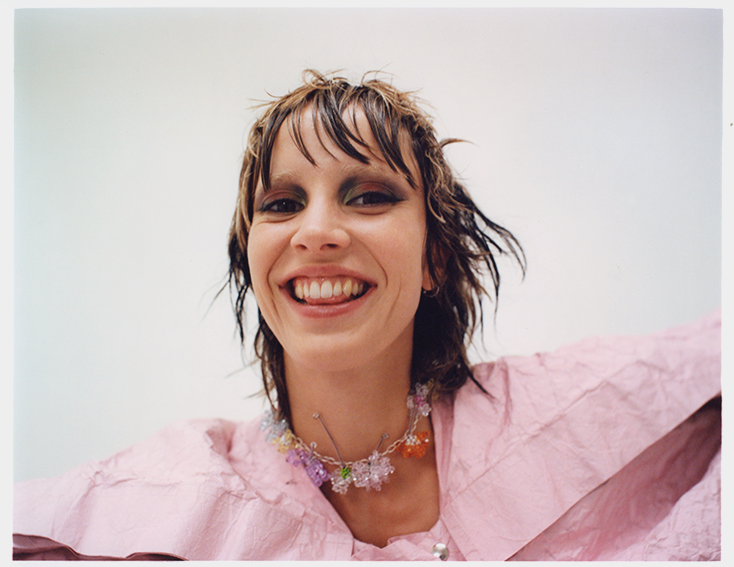
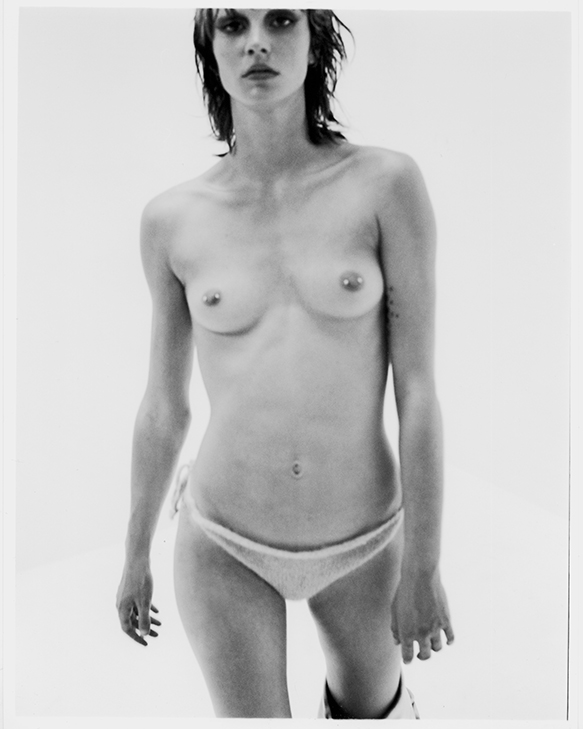
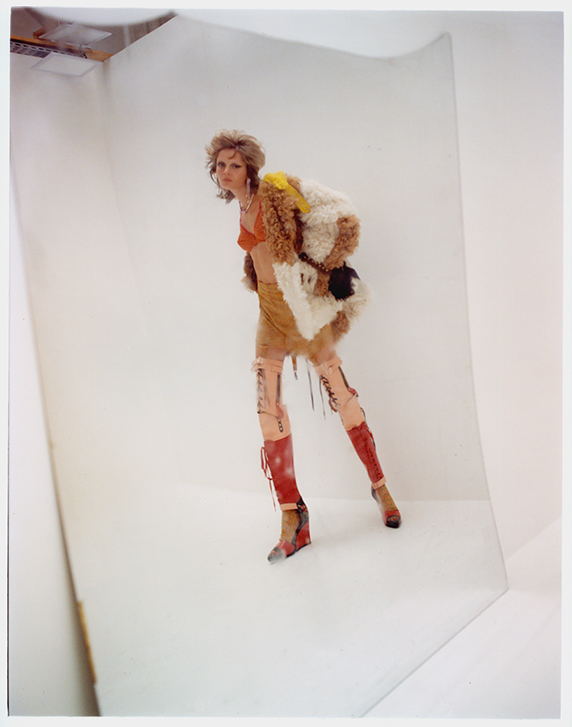
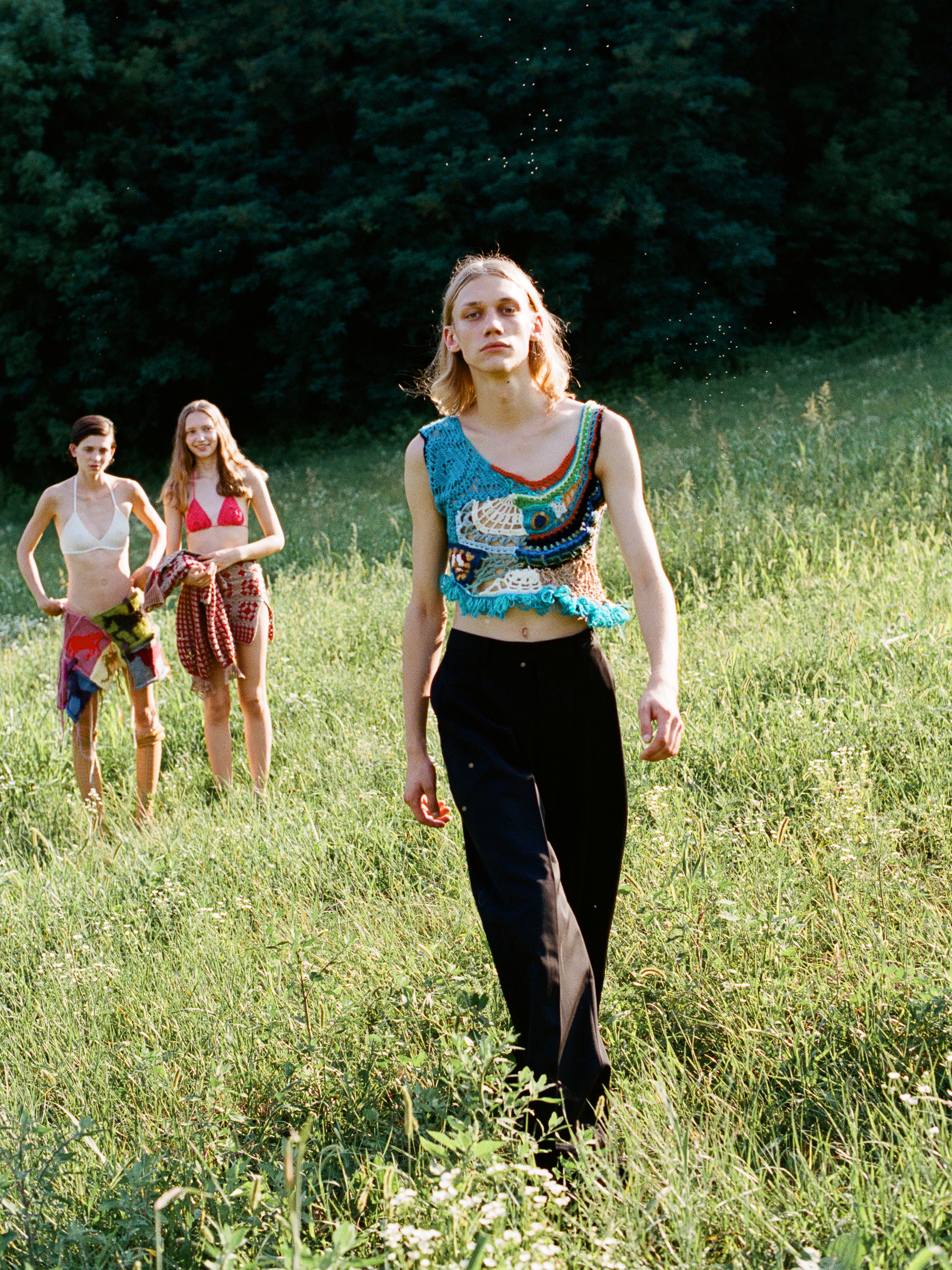
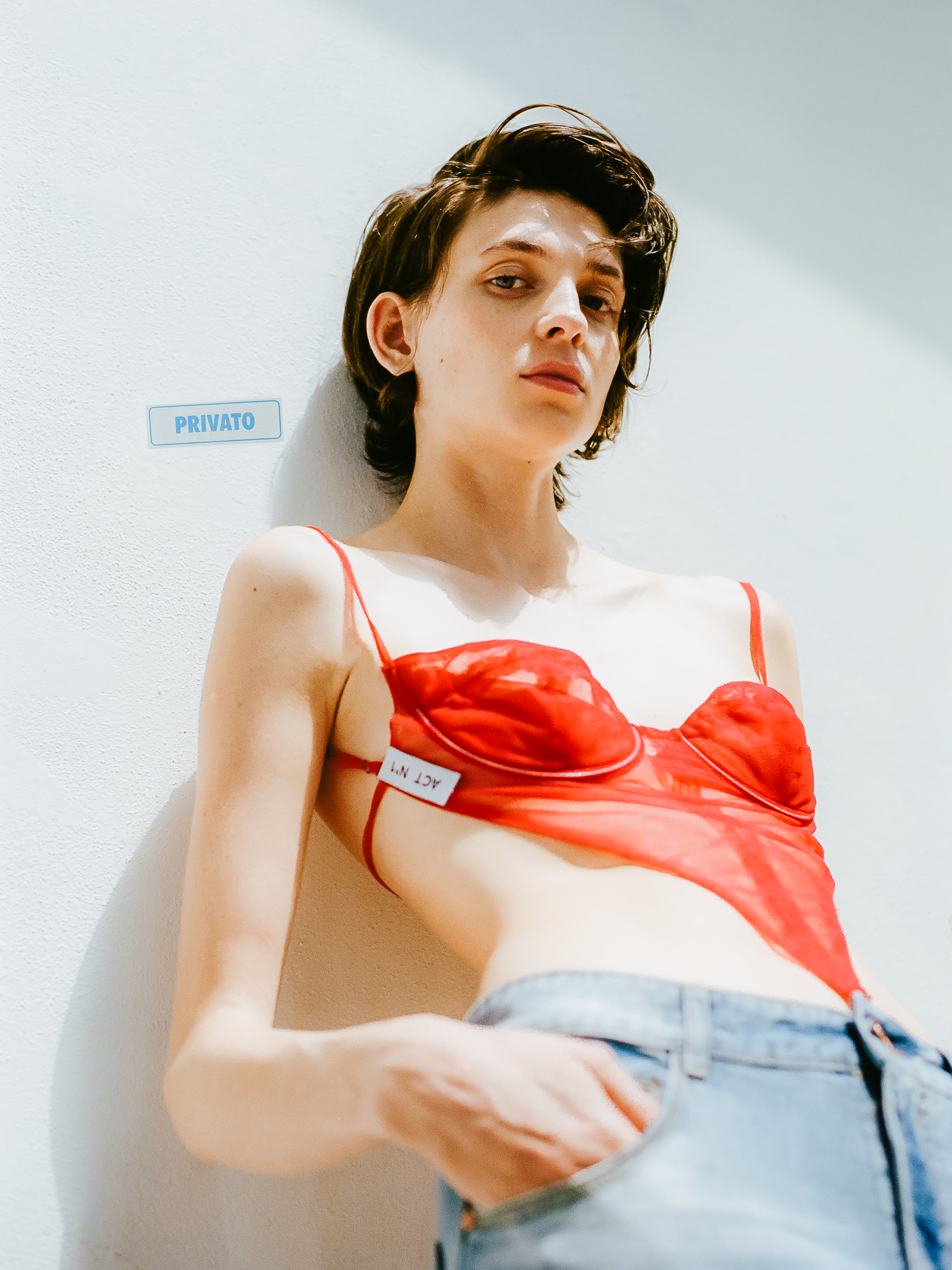
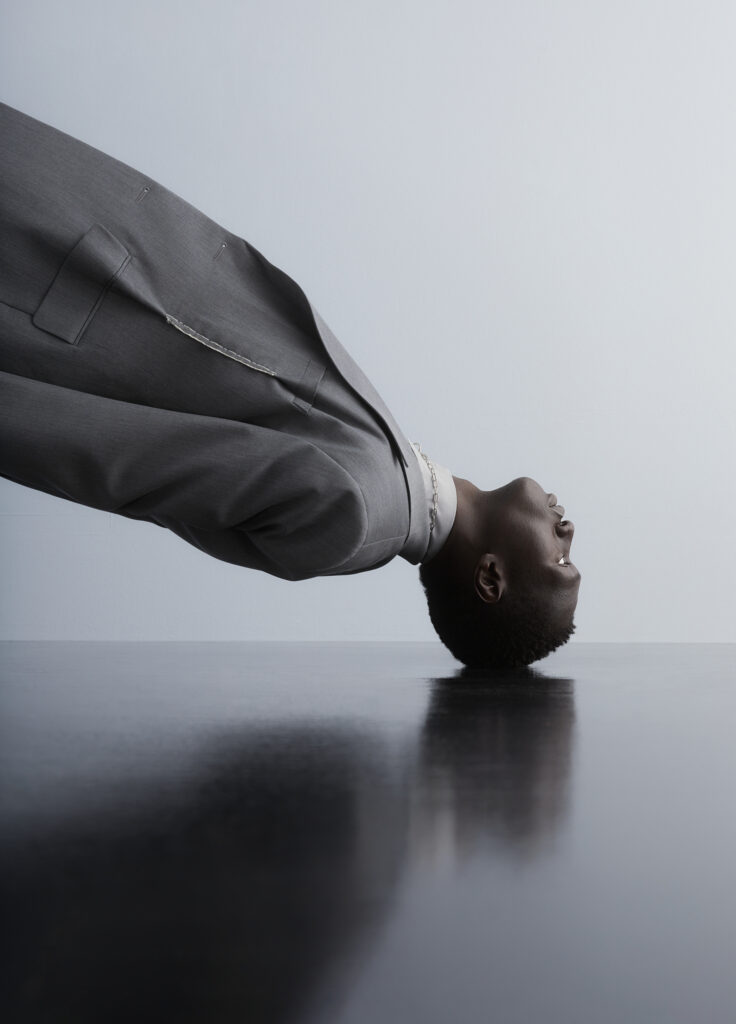
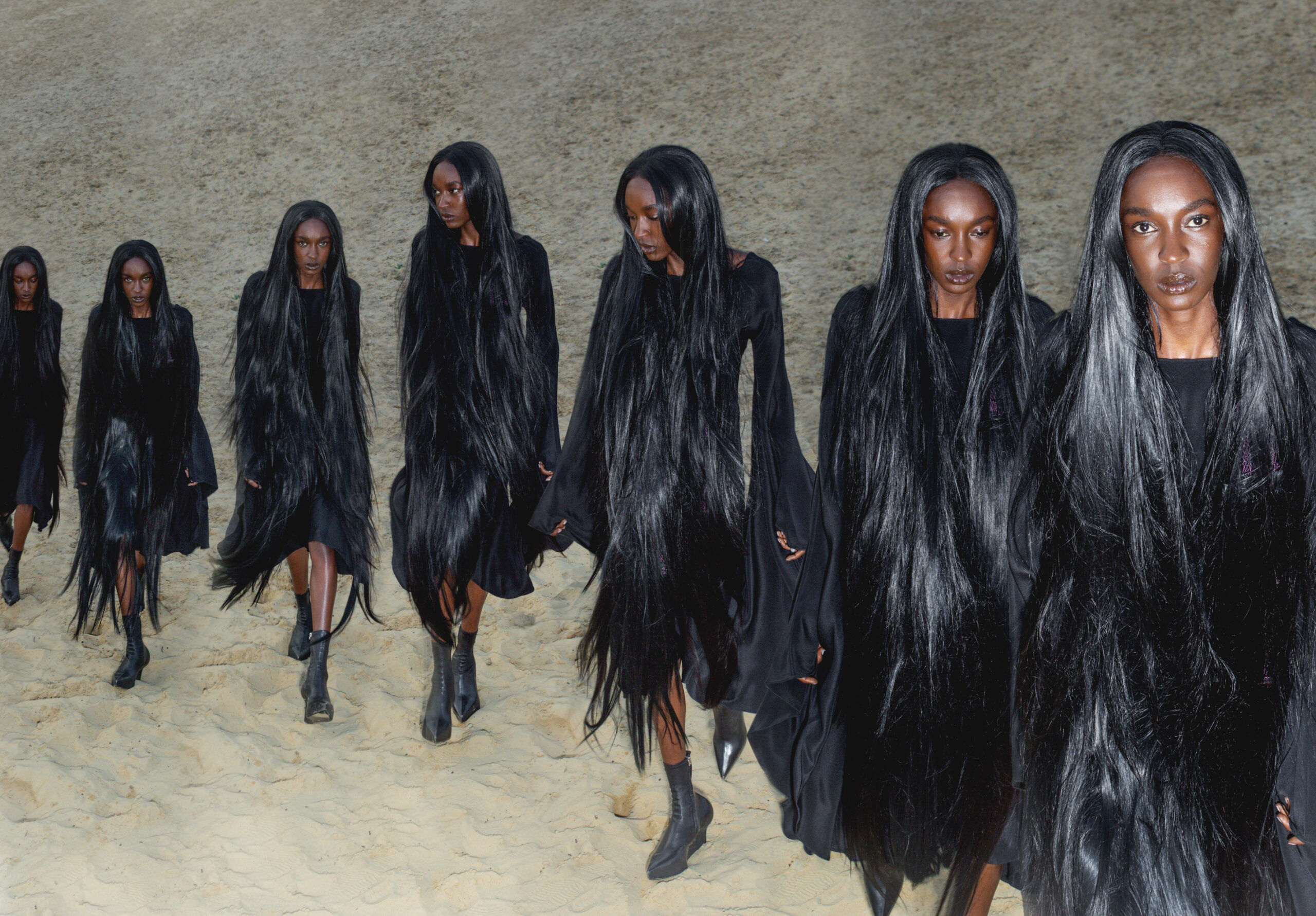
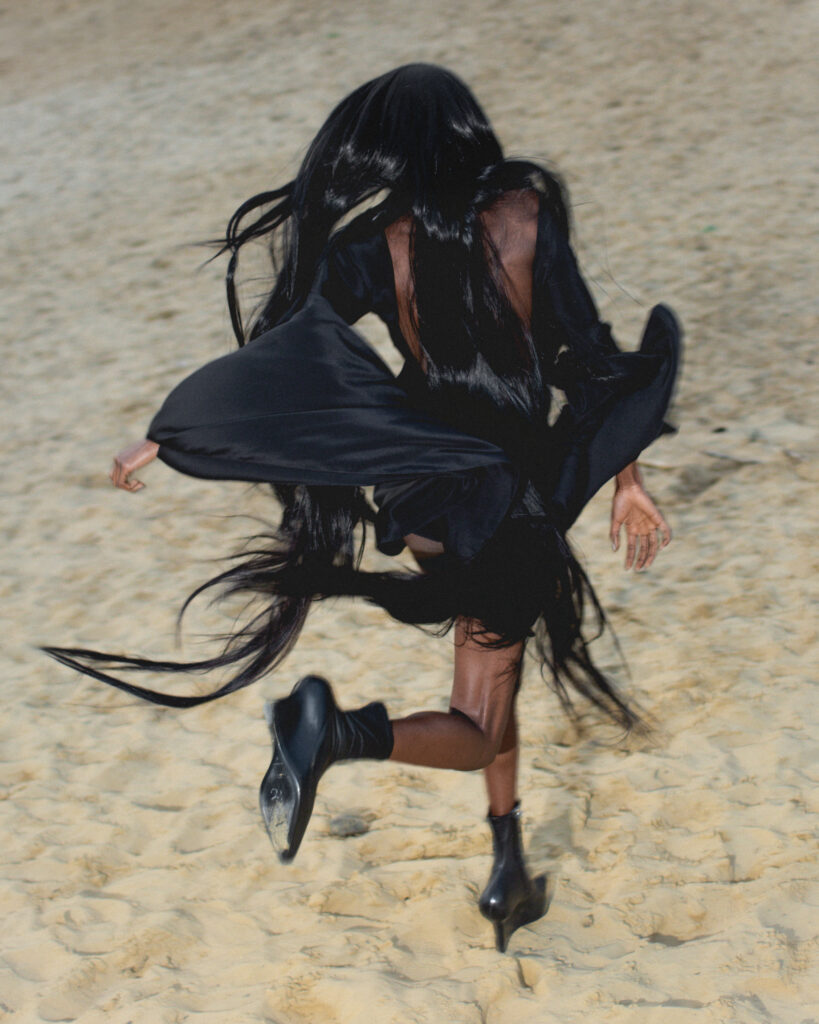
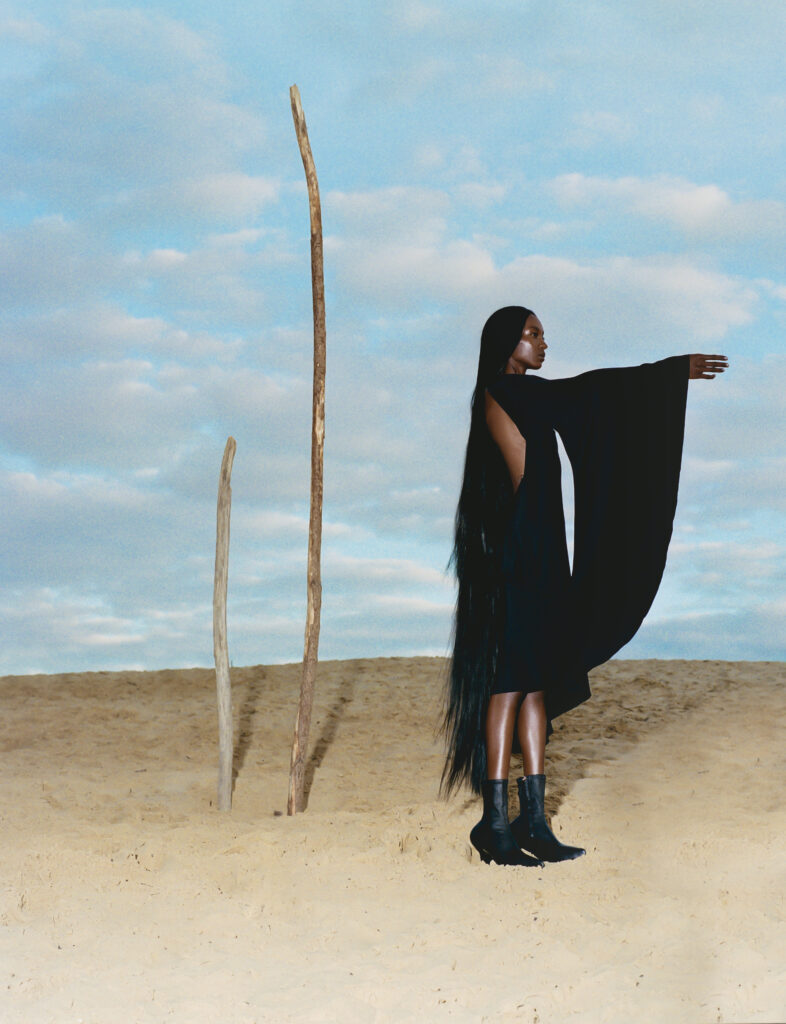
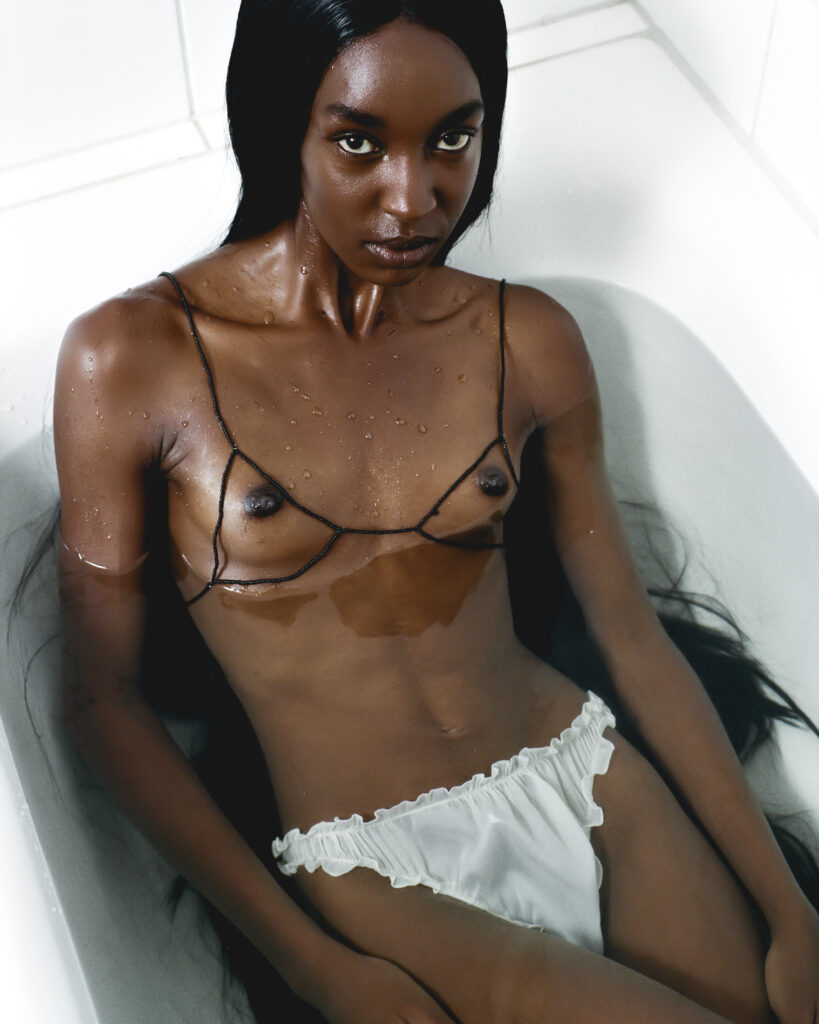
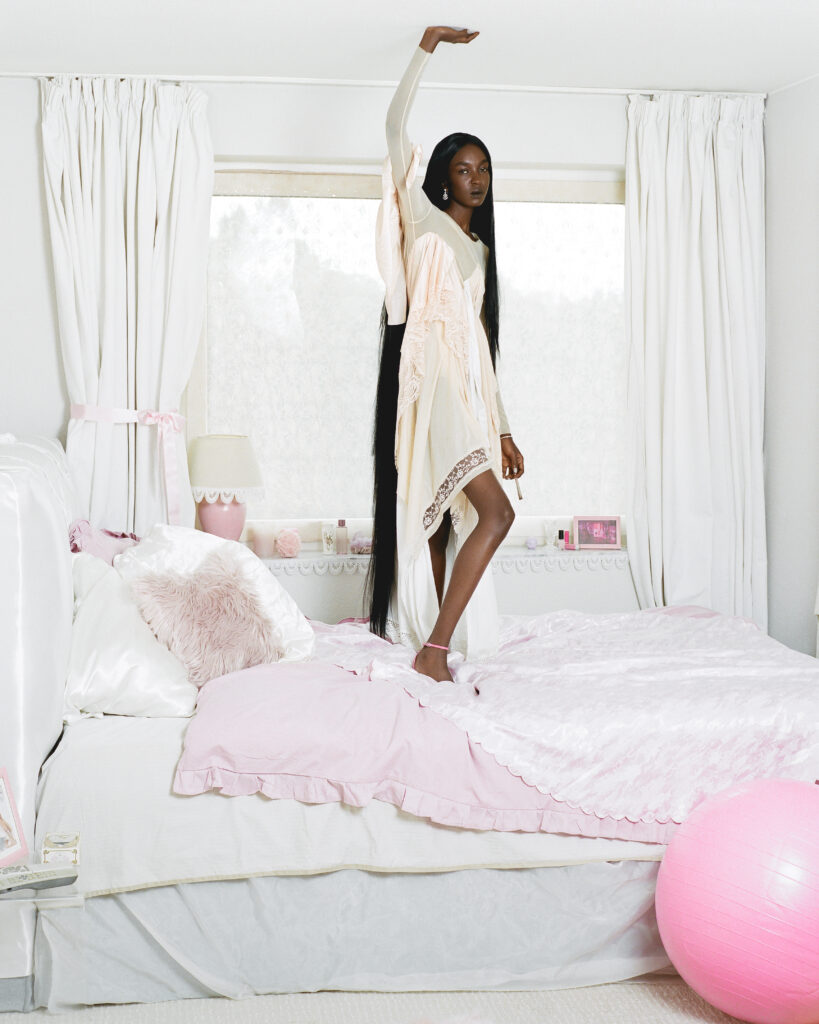
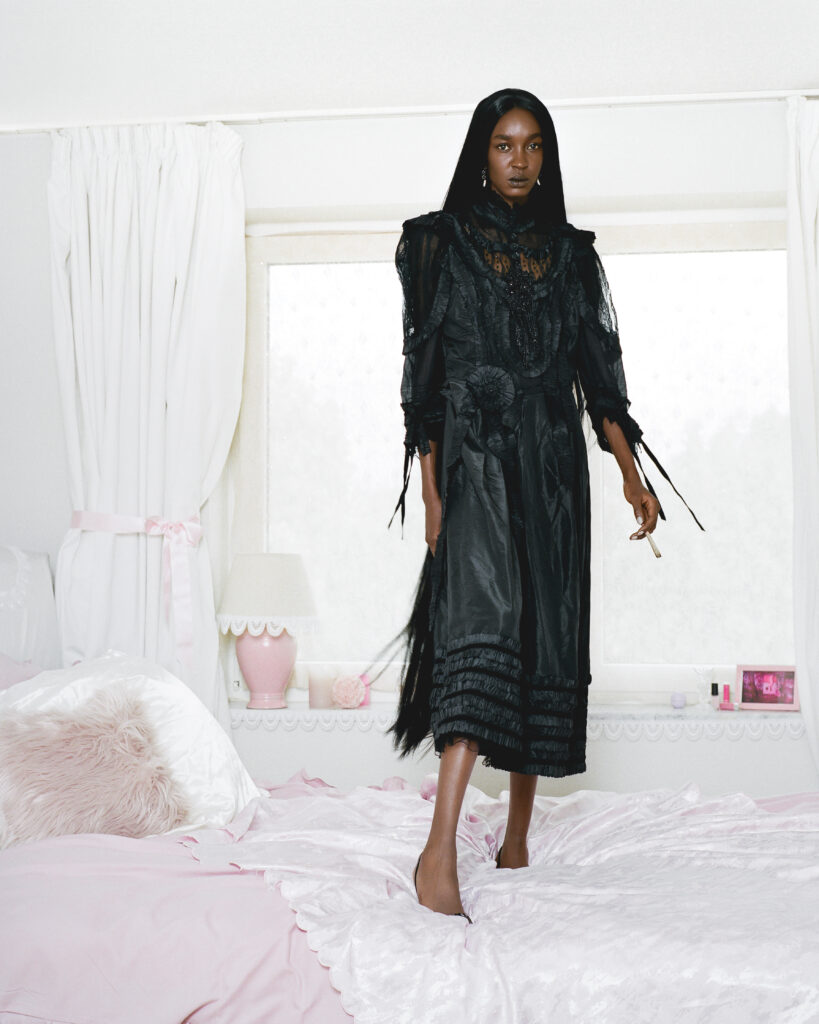
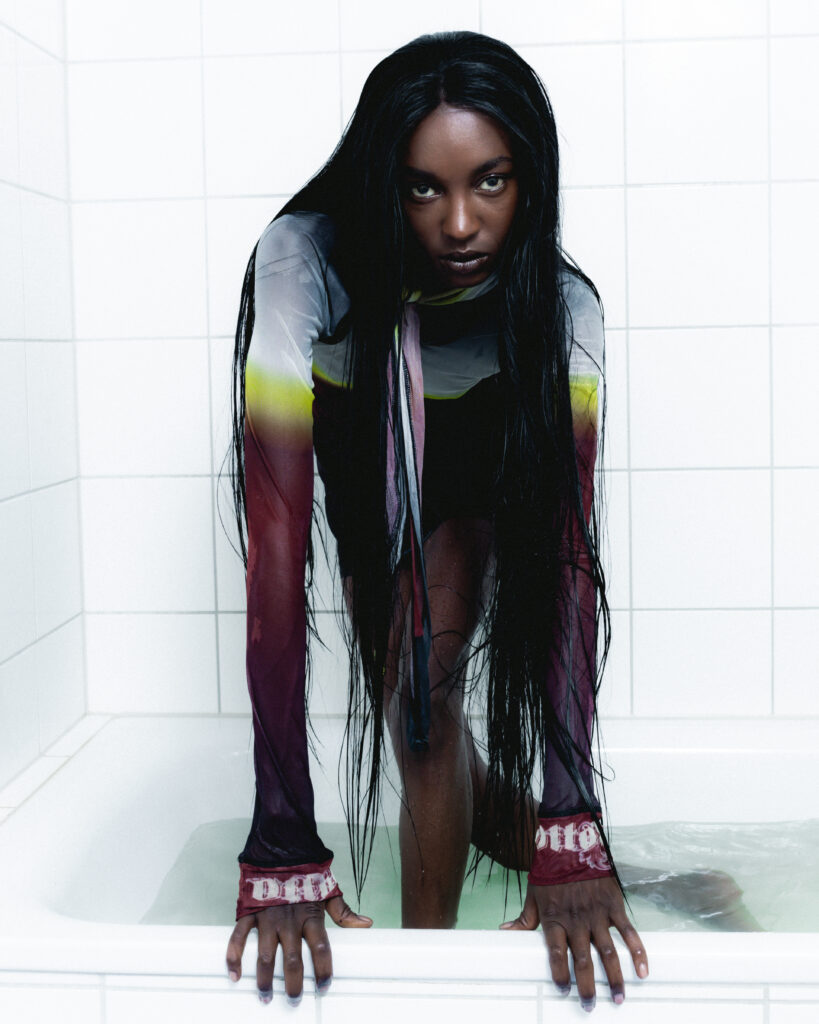
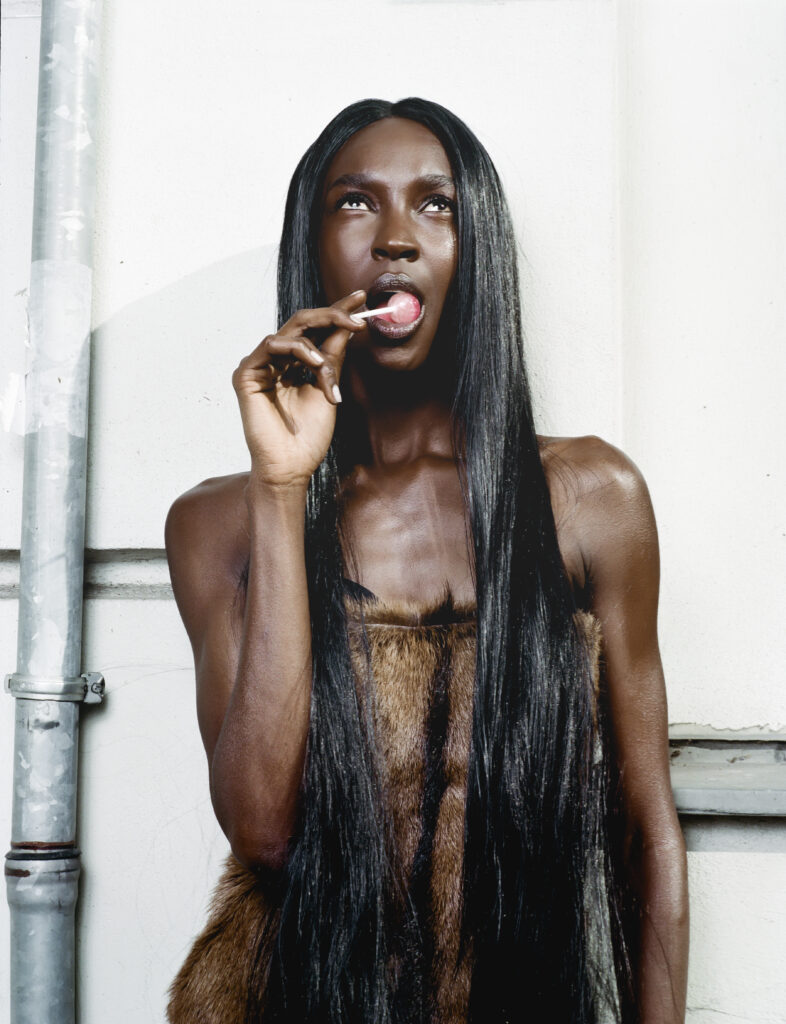
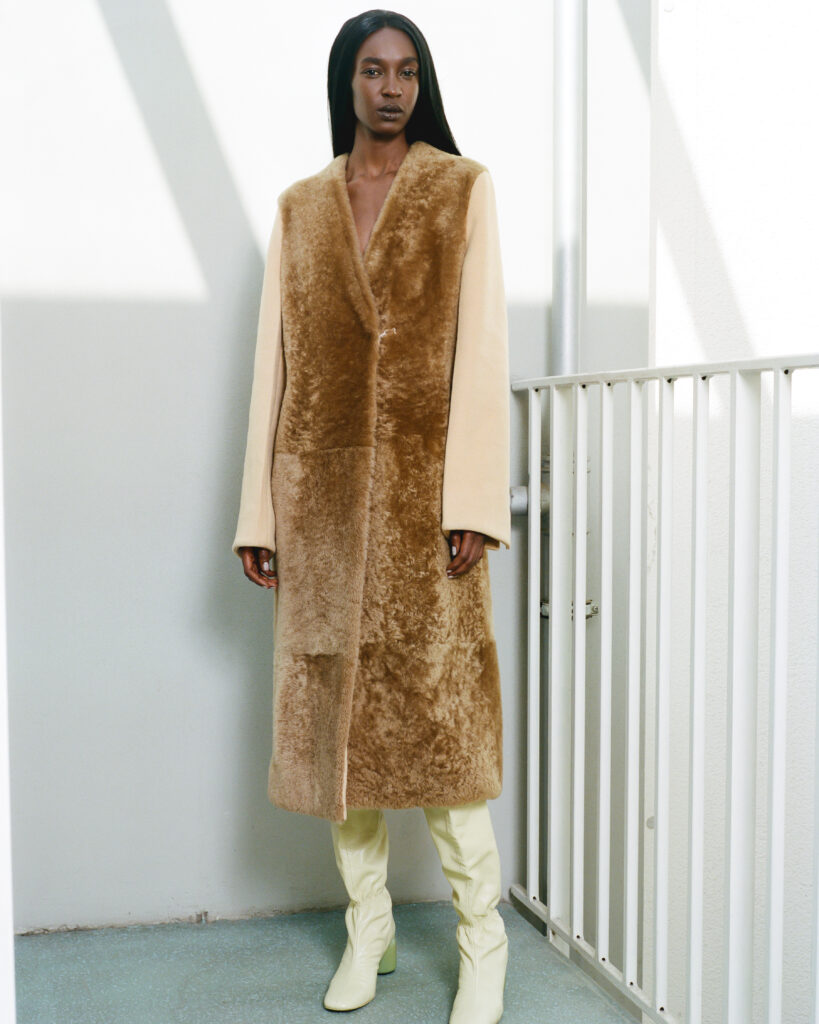
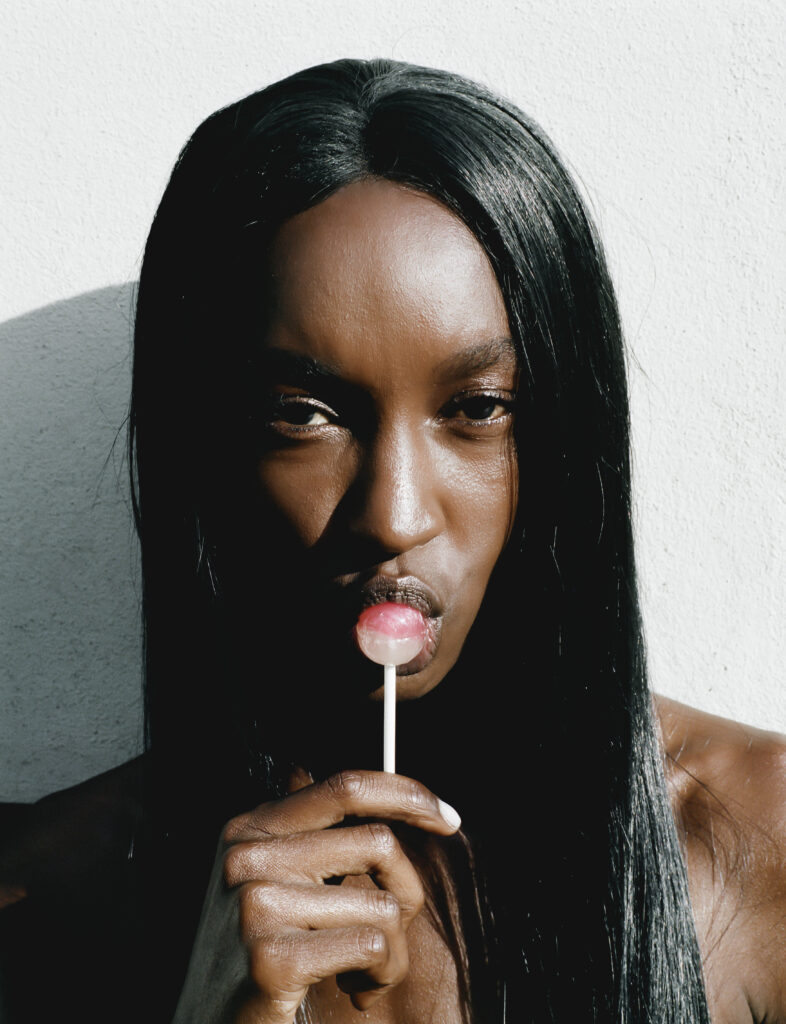
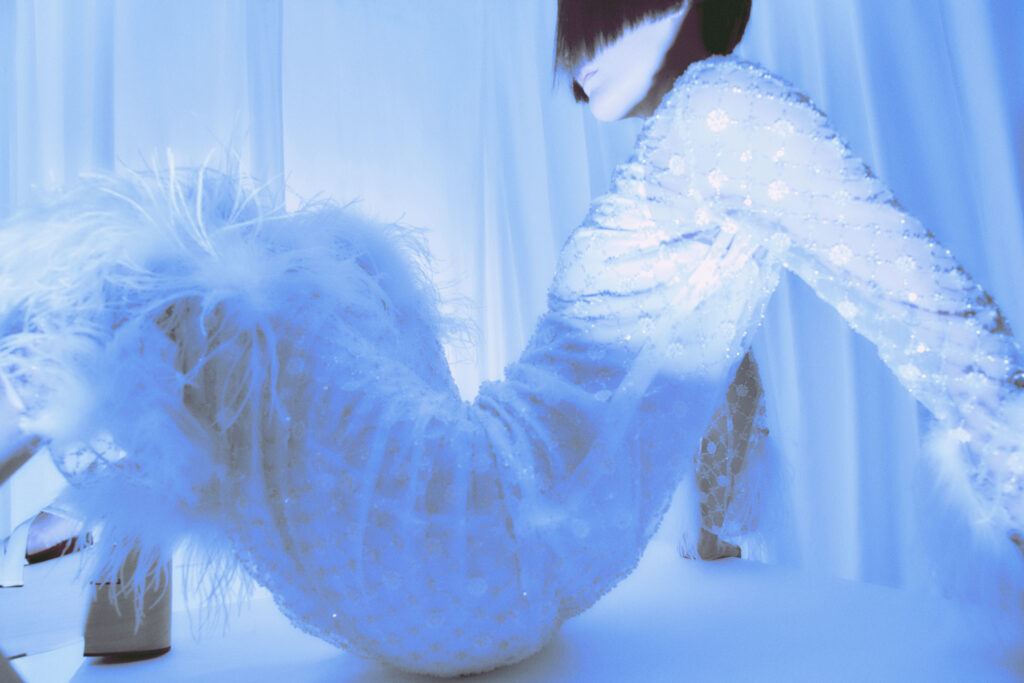
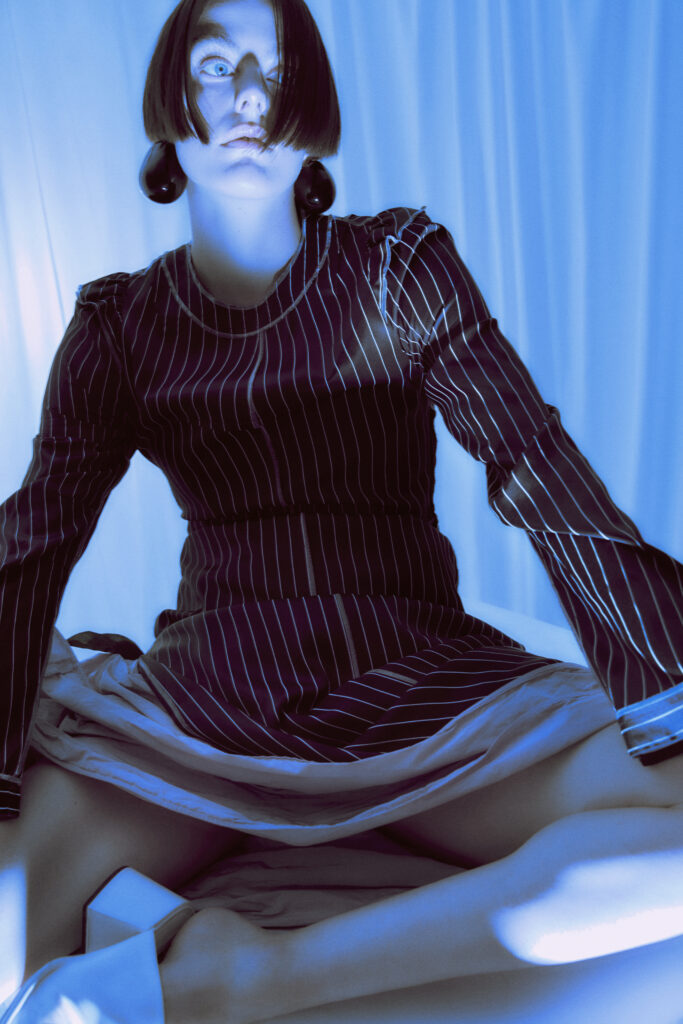
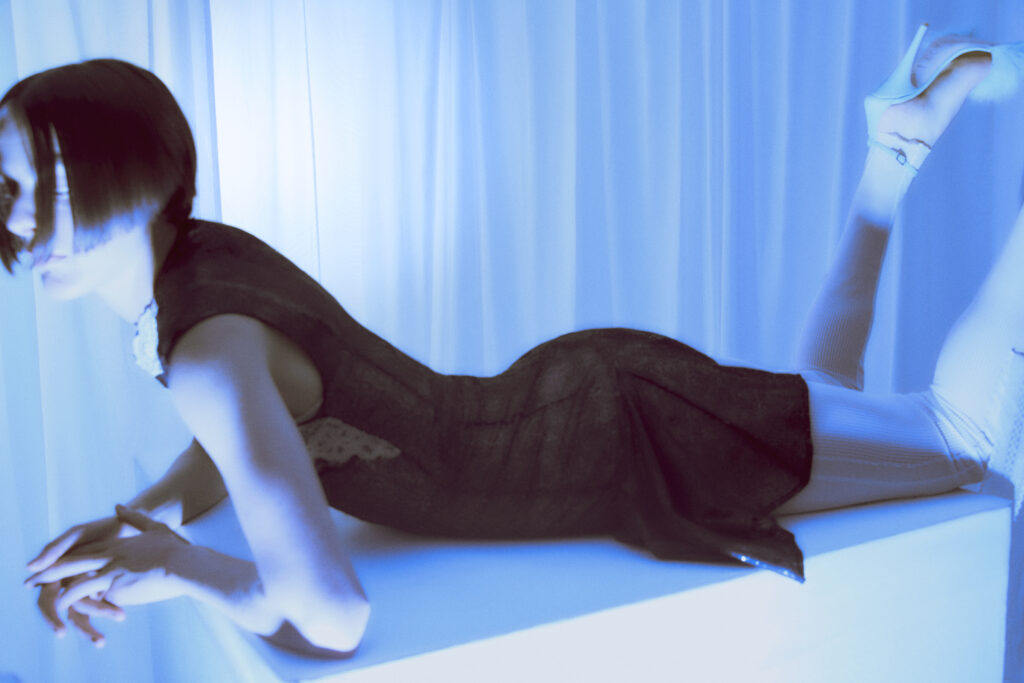
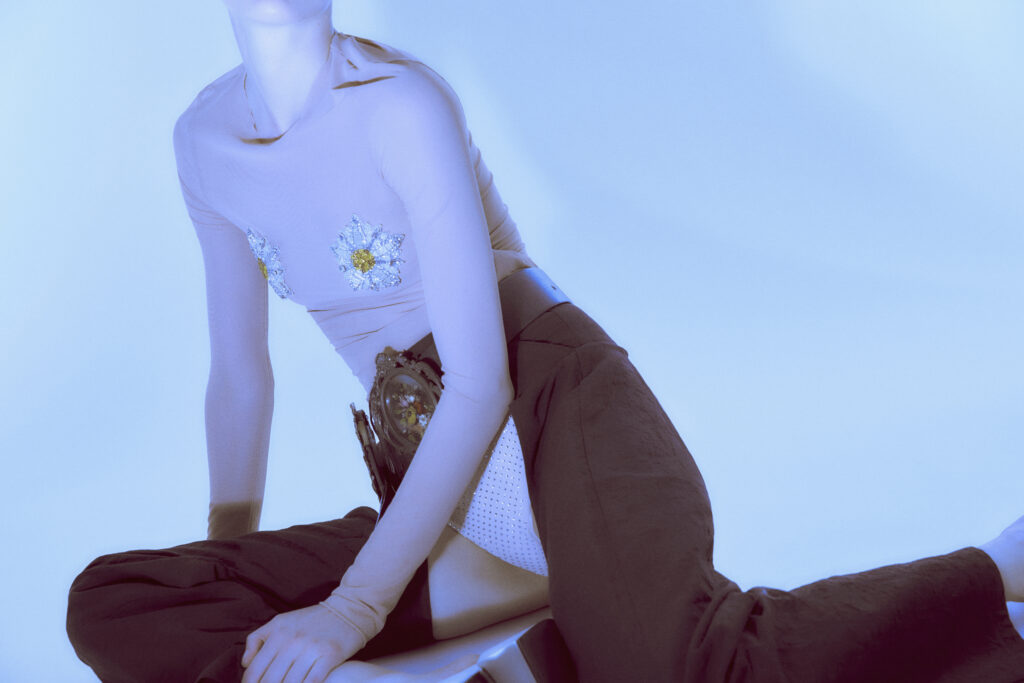
Model · Lily-Rose at Anti Agency Photography · Eugenio Intini Fashion · Giulia Meterangelis Production · Anna Baldocchi at Ro-of Casting · Giulia Filipelli Hair · Michael Thanh Bui Makeup · Alice Gabbai using Mac Cosmetics
Designers
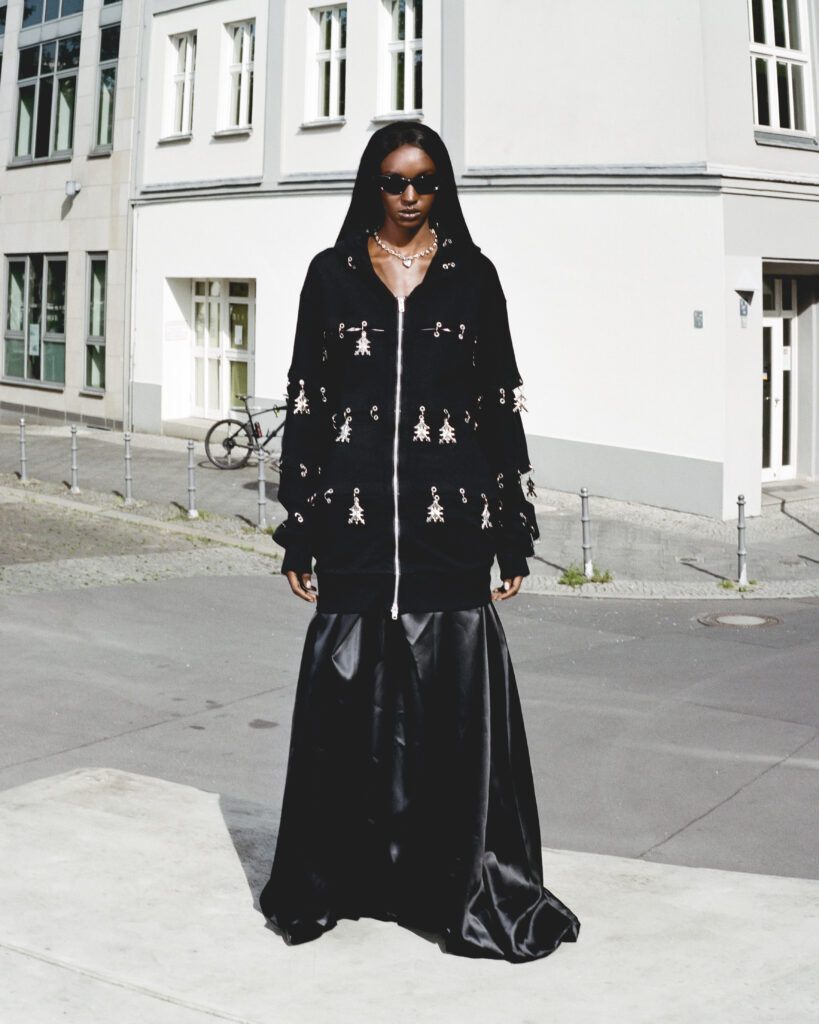
Dress BESFXXK, vest ERATO FOTOPOULOS, top AGAPORNIS, fringes MAISON DAVIDE BAZZERLA, boots FLÜFS, bag HIGHLIGHT STUDIO and earrings HELENA TULIN
Dress 022397, coat CLAUDIE PIERLOT, bow MAISON DAVIDE BAZZERLA, shoes Freelance and scarf INNANGELO
Shirt J SIMONE, trousers AOA
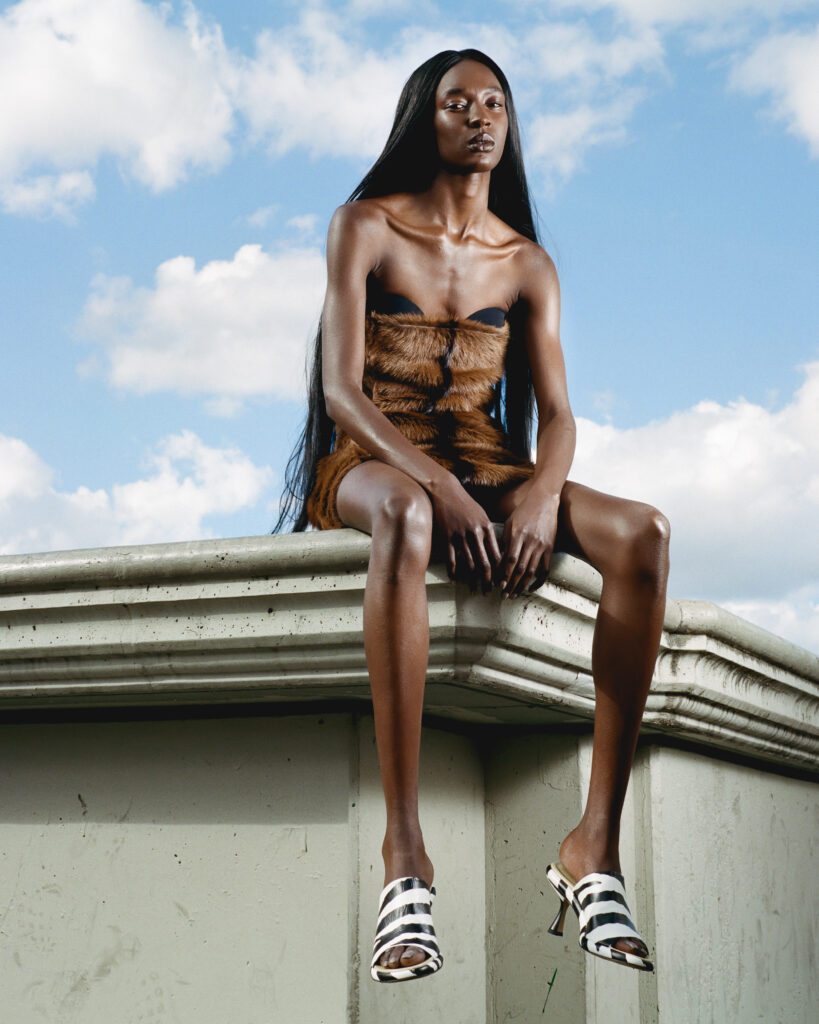
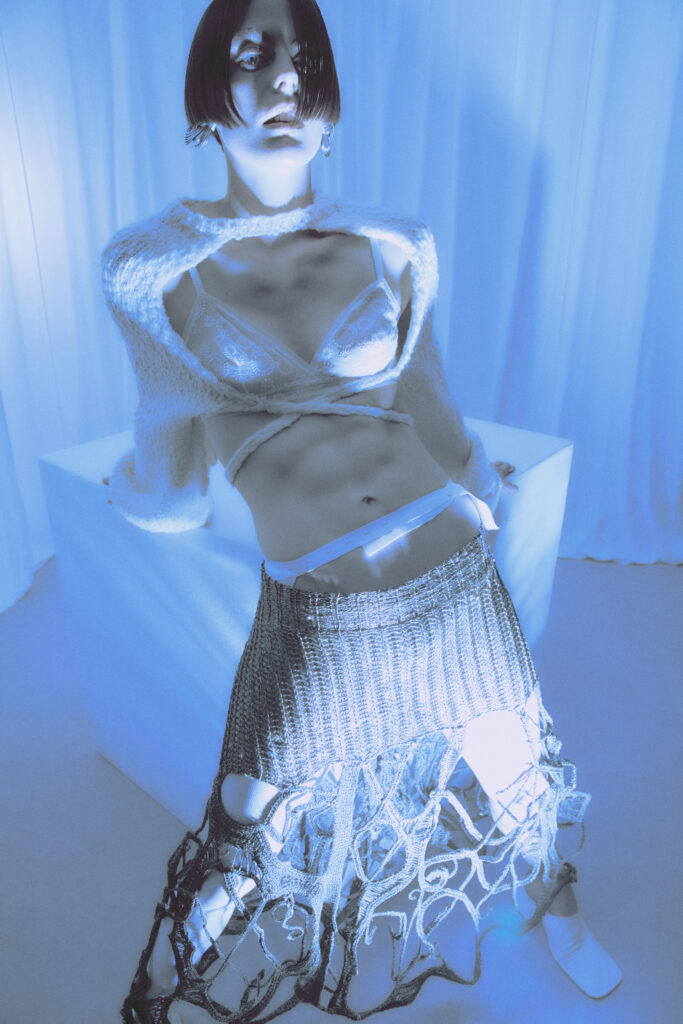
Fur MENGCHE, skirt and garters LOUISE LYNGH BJERREGAARD, bra SIMONE PERLÈ, earrings SHOUROUK, necklace GIN FROM THE PAMPA and boots 022397
Earring HELENA TULIN, vest ERATO FOTOPOULOS
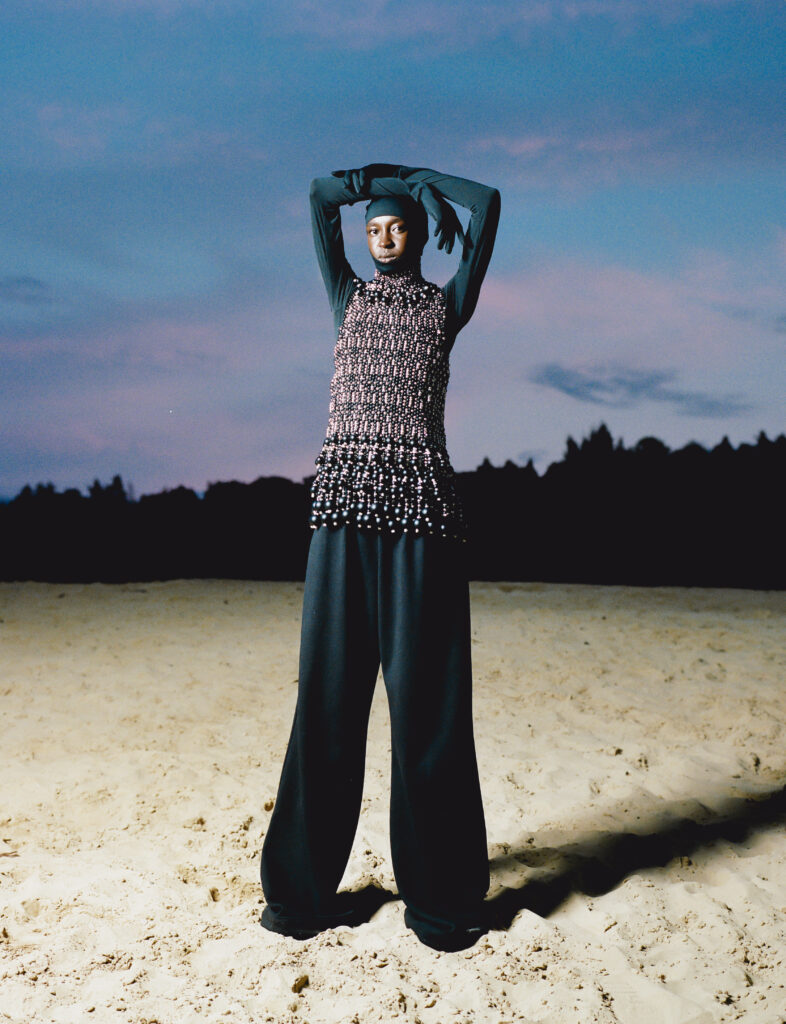
Underwear and tight DEFAIENCE, bra LIVYSTONE, gloves LEANDRO CANO, shoes MENGCHE, bag NADIA CHELLAOUI, earring SISTER MORPHINE and belt SEHNSUCHT
Full look and gloves MENGCHEN, necklace HELENA TULIN and shoes PUPCHEN
Sweater AOA, belt SEHNSUCHT ATELIER
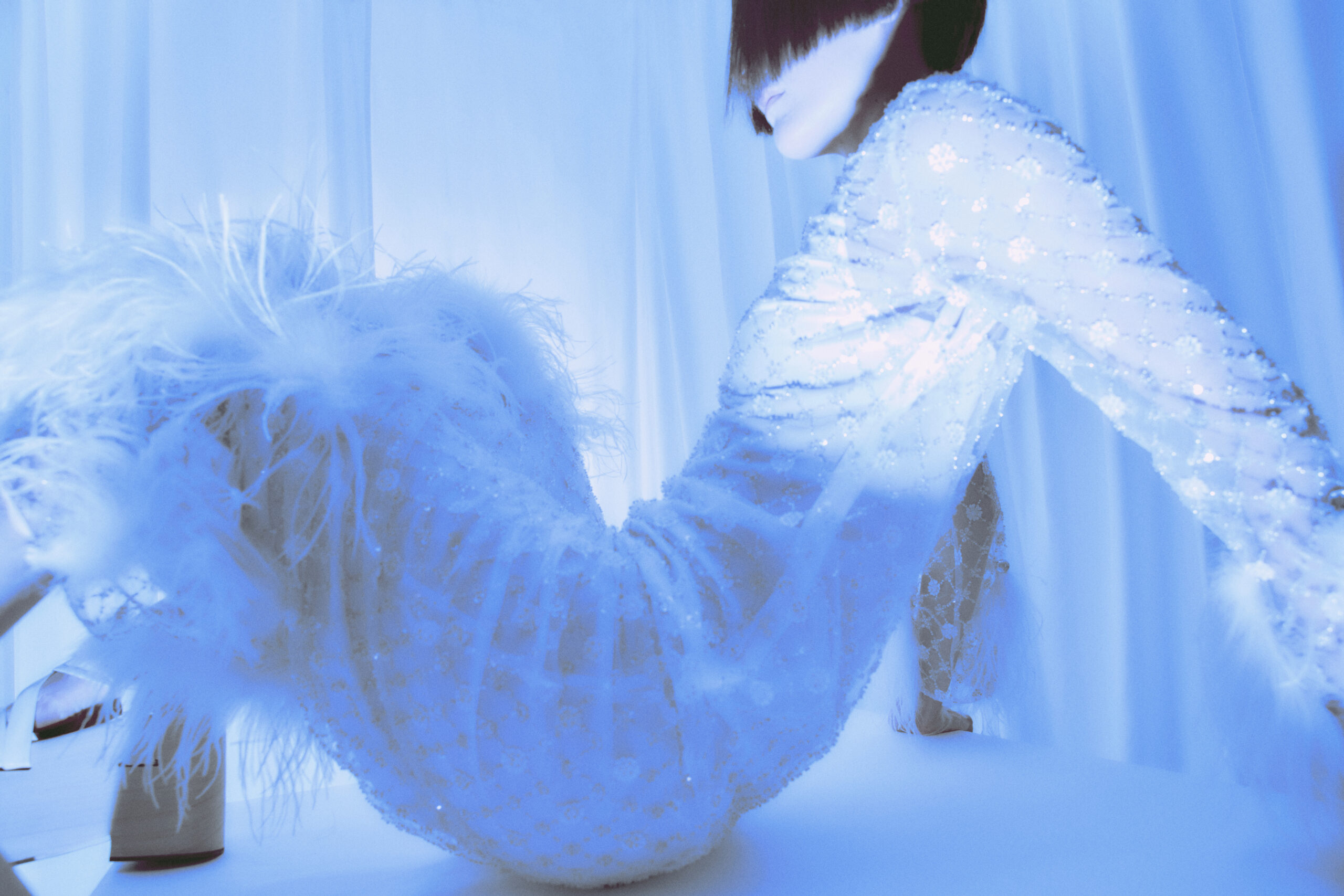
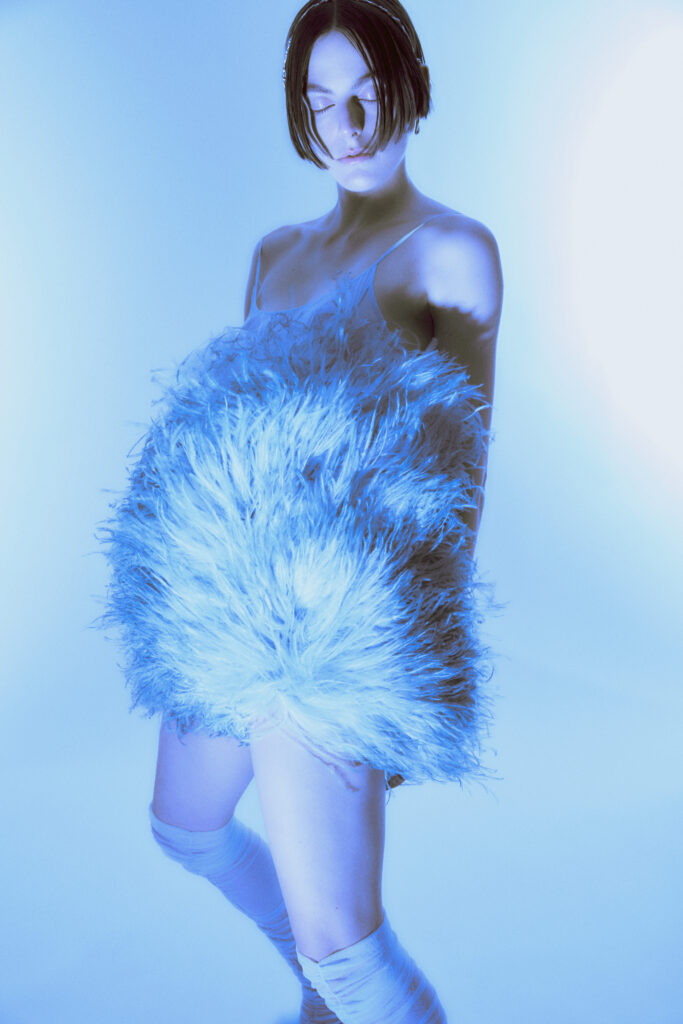
Dress AGAPORNIS, feathers ELI PEACOCK and earring RIGIDO
Dress MENGCHEN and necklace HELENA TULIN
Underwear TRANSE PARIS and boots MENGCHEN
Fur MENGCHE, skirt and garters LOUISE LYNGH BJERREGAARD, bra SIMONE PERLÈ, earrings SHOUROUK, necklace GIN FROM THE PAMPA and boots 022397
NR 16 In Our World · Autumn Winter 2022 Published · Print Page 248
Kids of Summer
Team
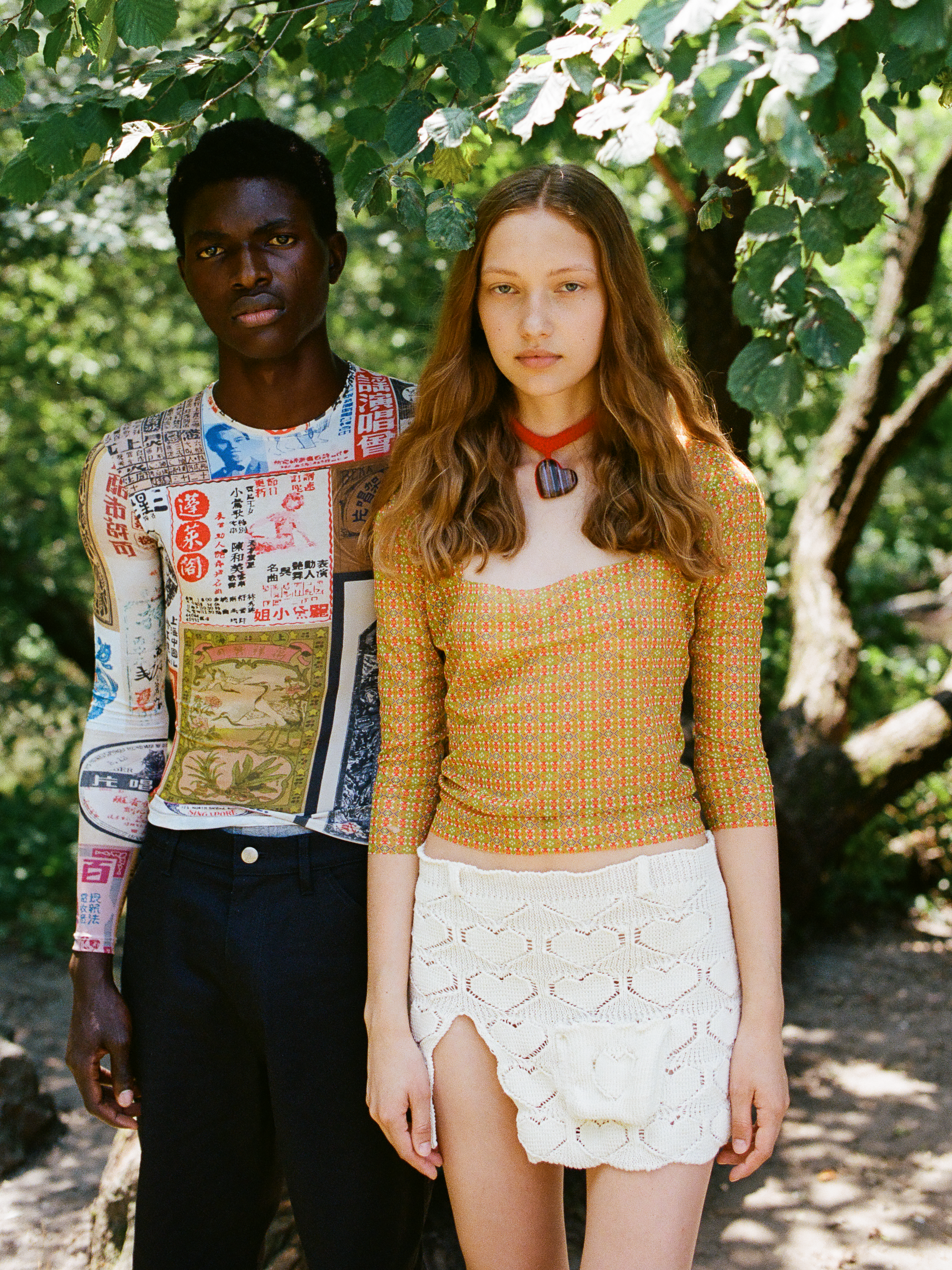
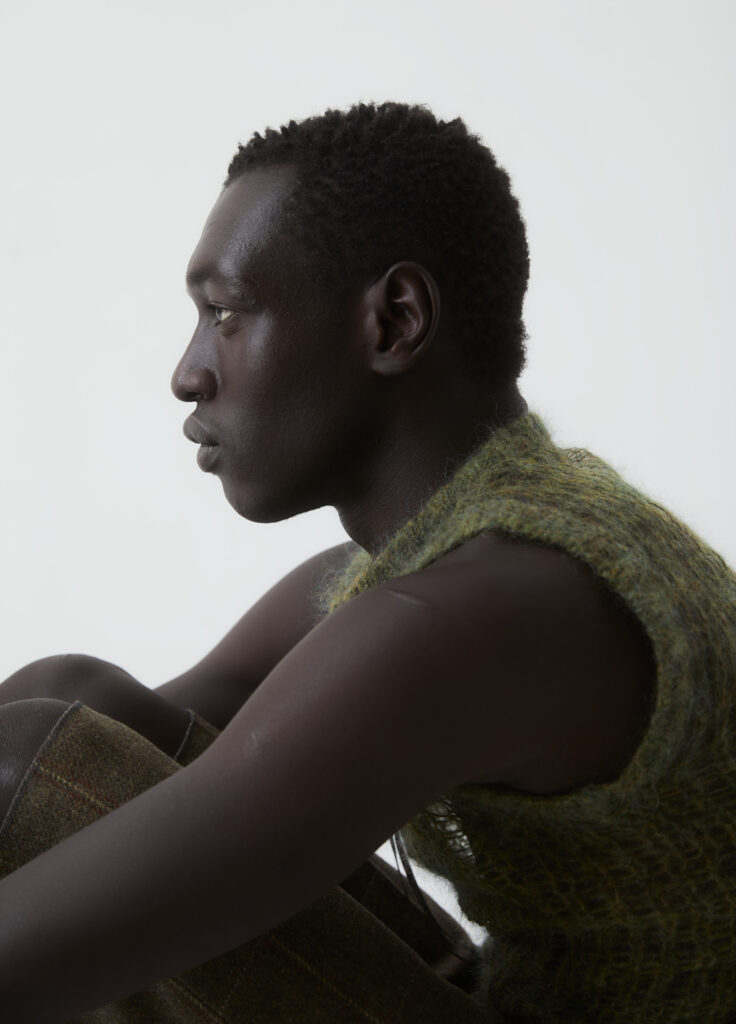
Models · Valentyn Boiko, John Godswill at the Claw Models, Gryte Kunaikaite at Women Milano and Sweia Hartmann at Wave Management Photography · Julia Morozova Fashion · Veronica Dronova Casting · Isadora Banaudi Hair · Giuseppe Paladino Makeup · Stella Grossu Fashion Assistant · Vladi Avksenenko
Designers
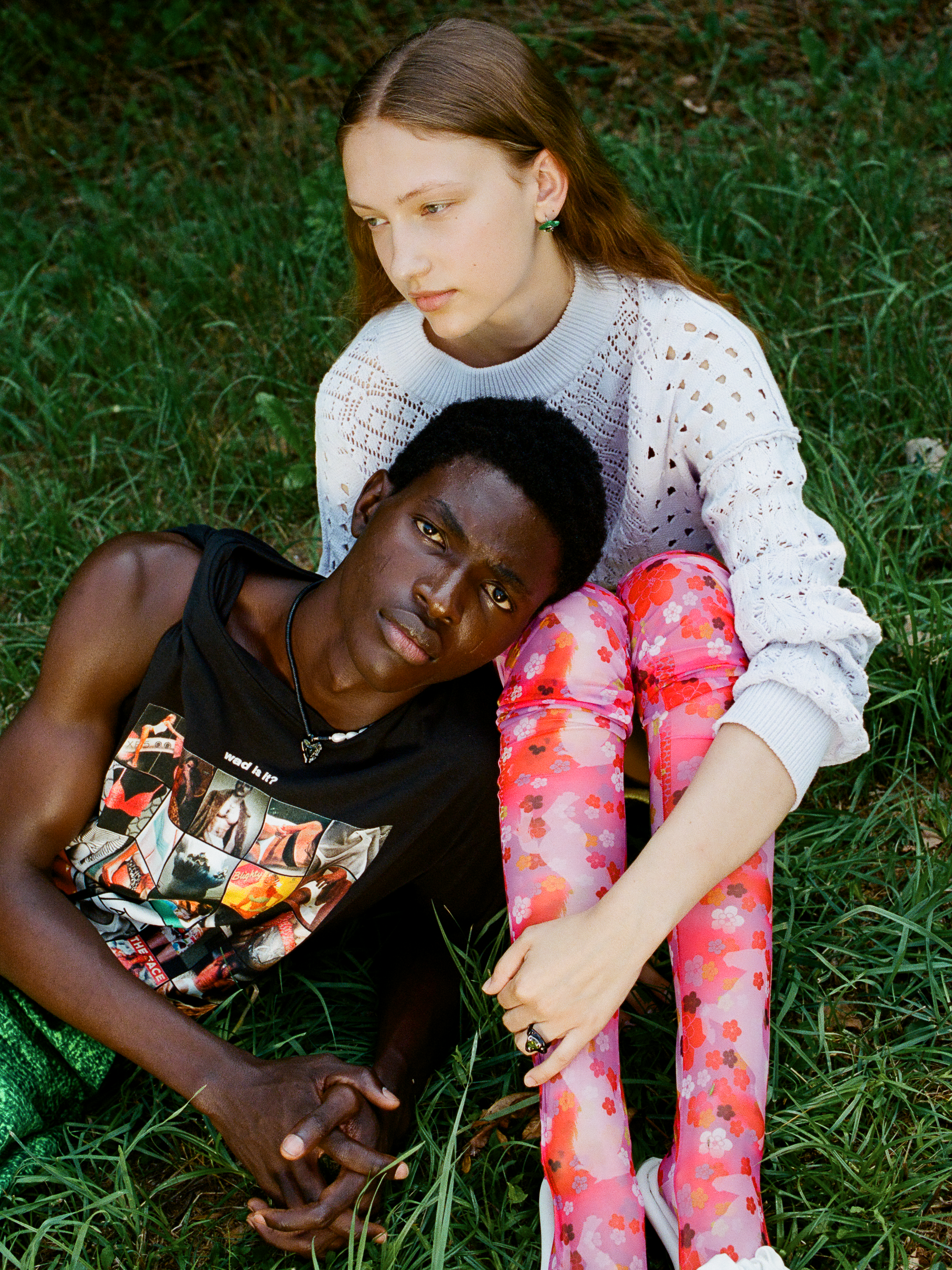
Top LOUISE LYNGH BJERREGAARD and underwear SOFT AND WET
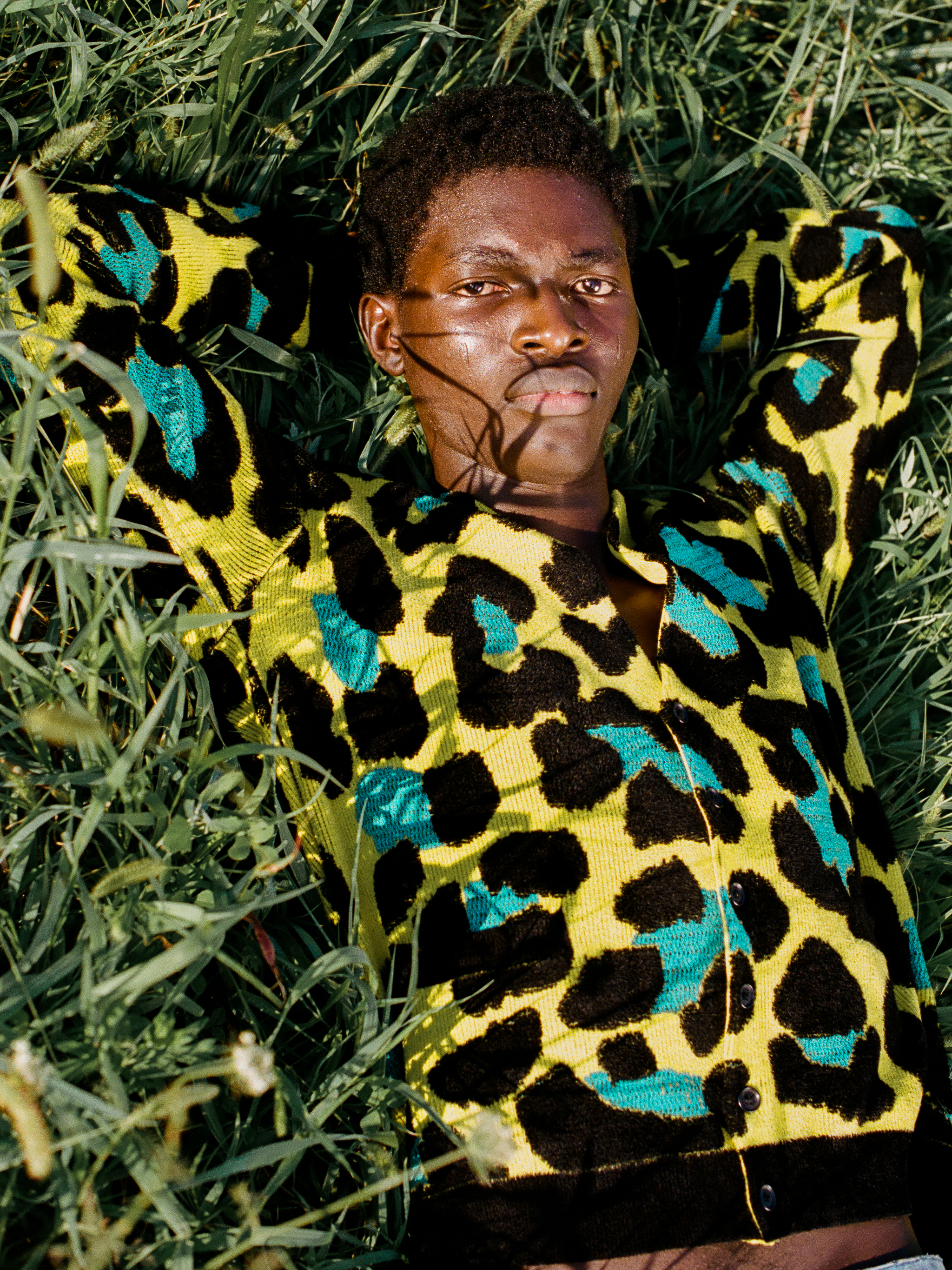
John • Cardigan VERSACE Valentyn • top UNAPE and pants VERSACE Sweia • Top SOFT AND WET, skirt and stockings LOUISE LYNGH BJERREGAARD and jacket MAISON MARGIELA MM6 Gryte • Cardigan UNAPE
Sweatshirt MONCLER JW ANDERSON and pants UNAPE
Top and swimsuit SOFT AND WET, jeans and shoes MAISON MARGIELA MM6
Sweia • Dress MARCO RAMBALDI and necklace LOST IN ECHO Gryte • Pants MARCO RAMBALDI and top VERSACE
Valentyn • Top UNAPE and pants VERSACE Sweia • Top SOFT AND WET, skirt and stockings LOUISE LYNGH BJERREGAARD Gryte • Bra, cardigan and skirt: UNAPE
Swimsuit UNAPE, cardigan MARCO RAMBALDI and necklace ETERE NEPHILIM
NR 16 In Our World · Autumn Winter 2022 Published · Print Page 378
Inner World
Team
Model · Robe at Tigers Management Photography · Shauna Summers Fashion · Elisa Schenke Casting · White Casting Hair and Makeup · Stefanie Mellin Set Design · Carina Dewhurst Post Production · RMJ Studio Photography Assistant · Nick Piesk Set Design Assistant · Michael Naughton
Designers
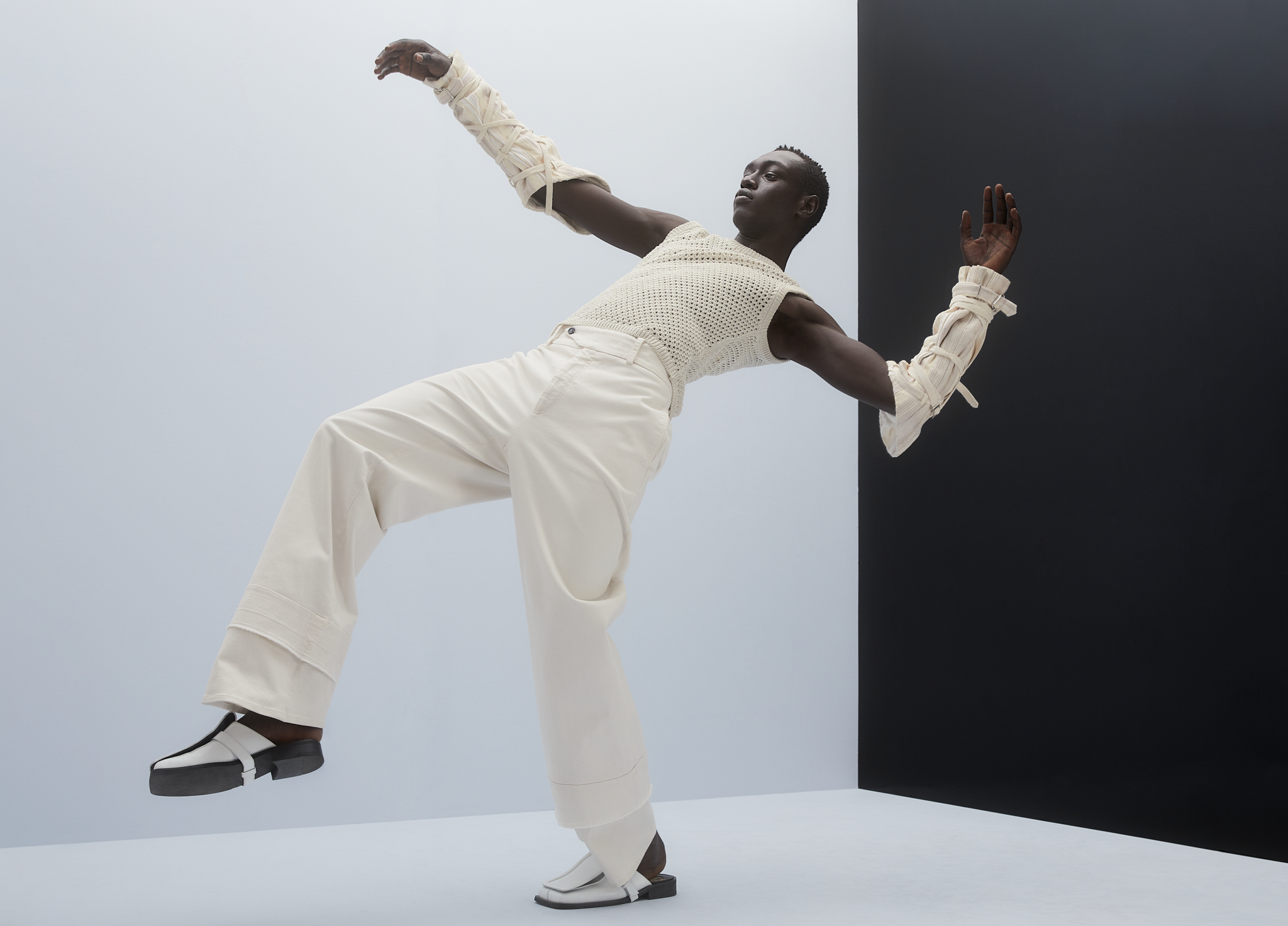
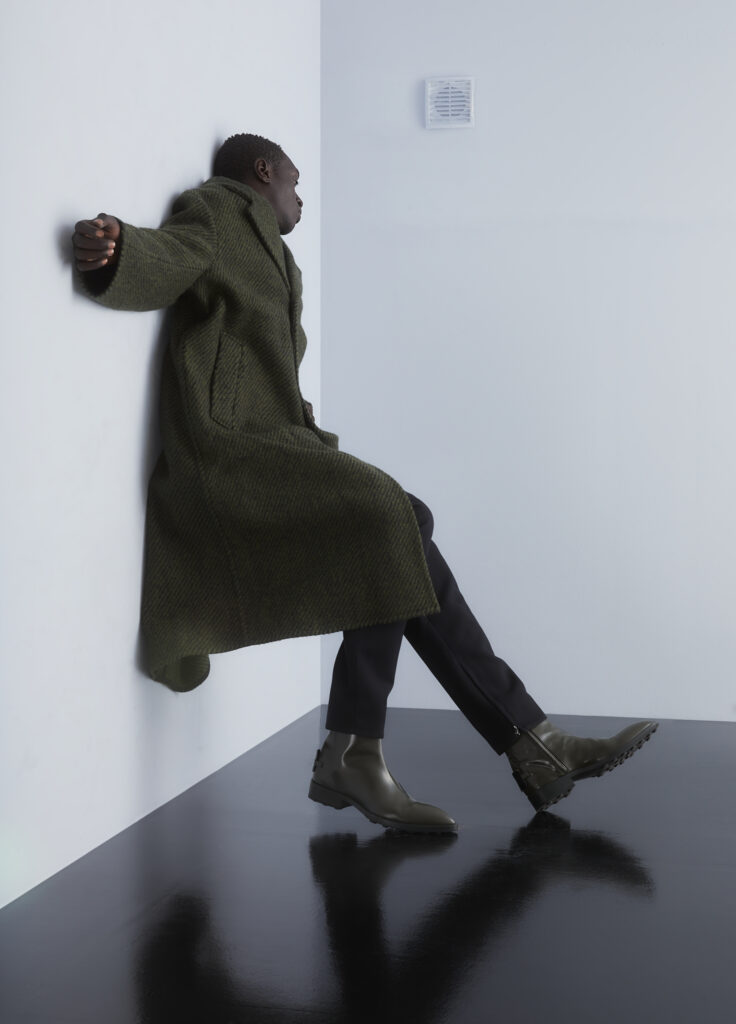
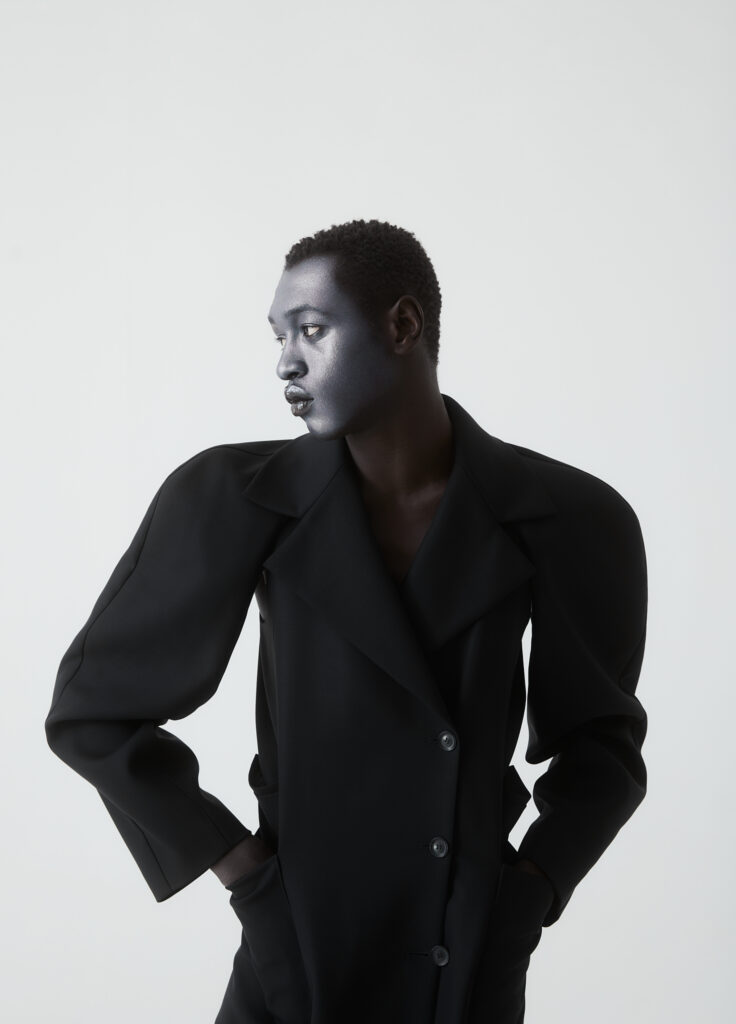
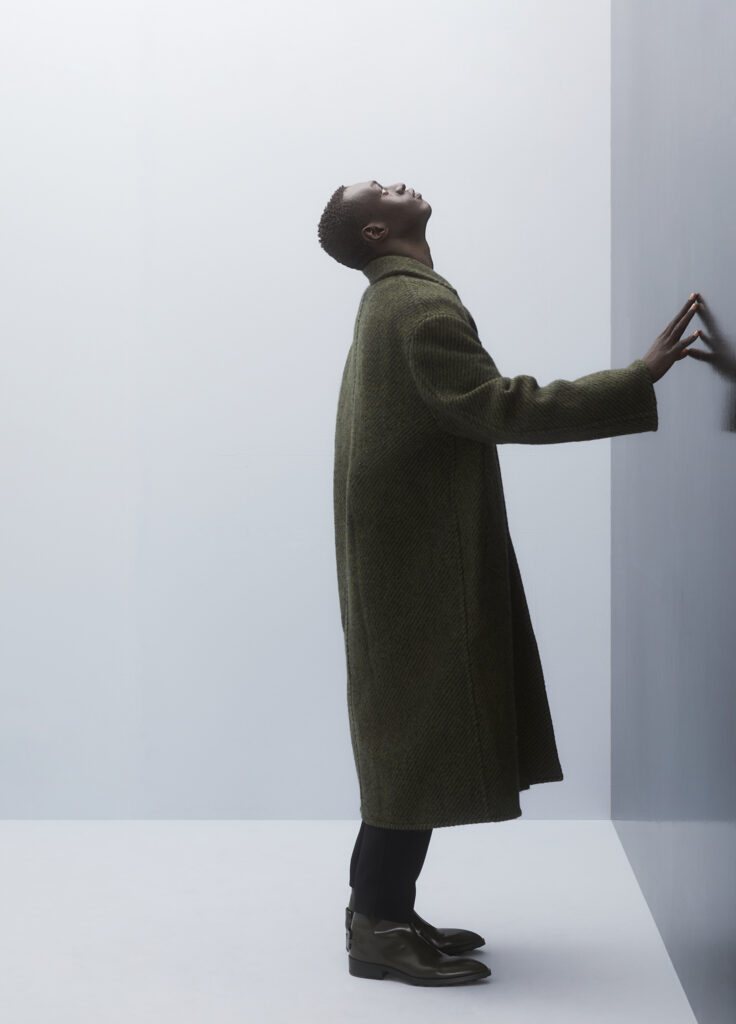
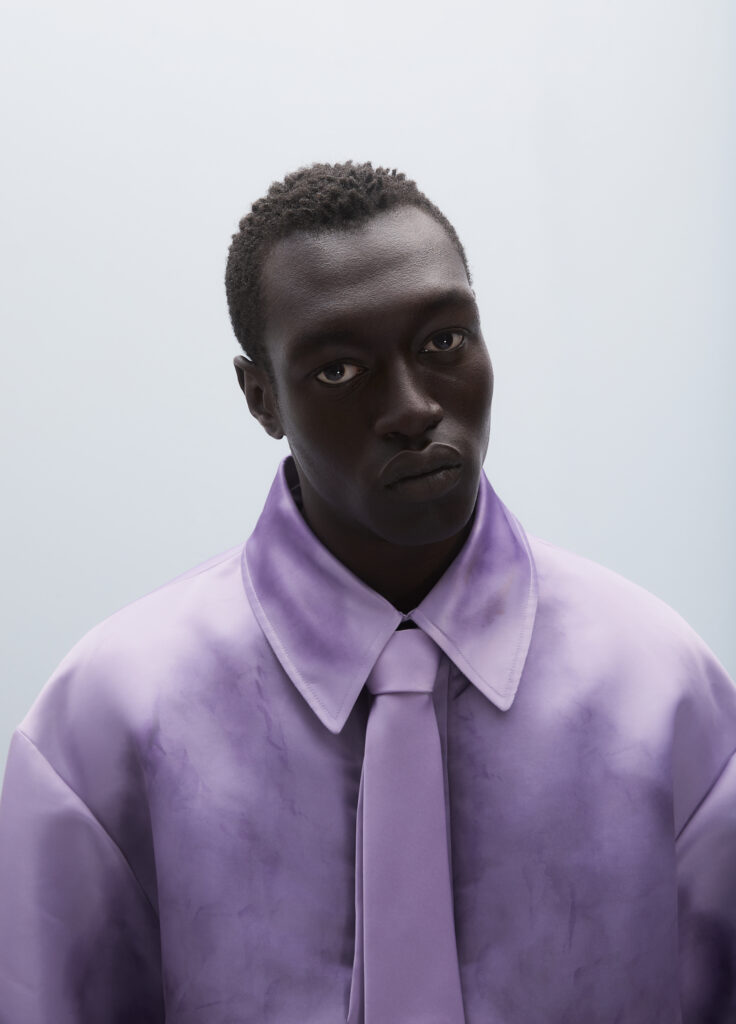
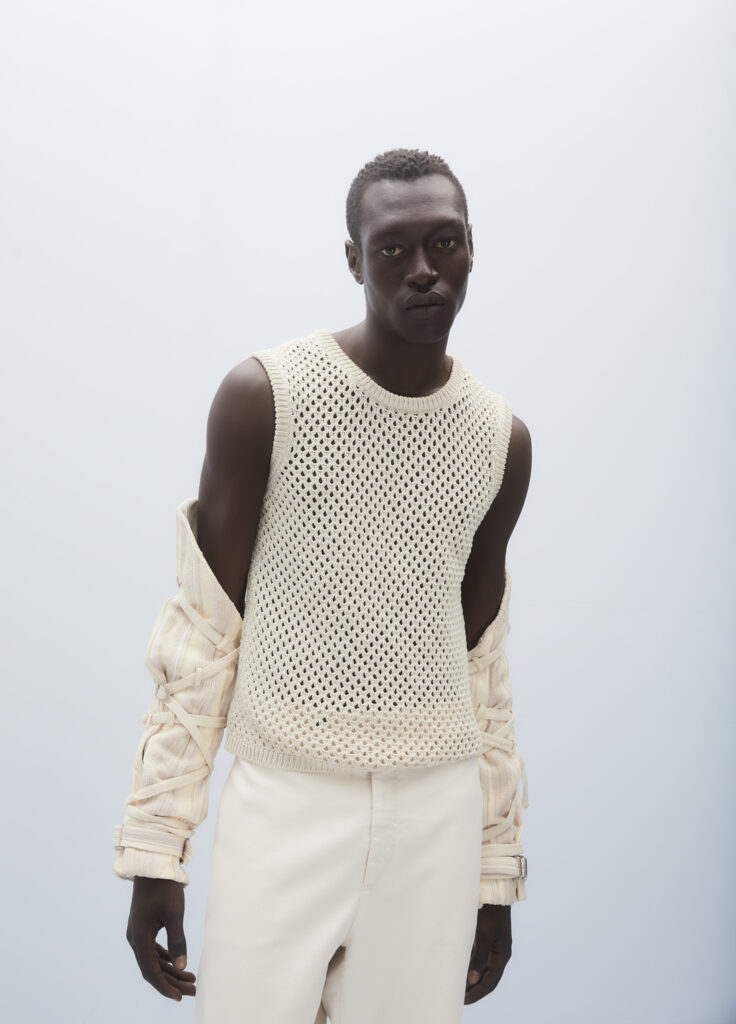
Top SANDRO via ZALANDO, pants N21, shoes NEU_IN and sleeves 30 % 70
Full look JIL SANDER
Coat RICHERT BEIL
Full look JIL SANDER
Shirt and pants LGN LOUIS GABRIEL NOUCHI and shoes CAMPERLAB
Top SANDRO via ZALANDO, pants N21, shoes NEU_IN and sleeves 30 % 70
Top MARCELL VON BERLIN, pants MM6 MAISON MARGIELA and shoes CAMPERLAB
Sweater and pants LGN LOUIS GABRIEL NOUCHI, shoes CAMPERLAB and ring JULIA BARTSCH
Shirt, pants and shoes NEU_IN and ring JULIA BARTSCH
Shirt and pants T/SEHNE, coat and shoes DIOR MEN and necklace LIRONIE
NR 16 In Our World · Autumn Winter 2022 Published · Print Page 142
Feature · Ayşe Erkmen Words · Jade Removille
Unhooked meanings transcending the worlds of architecture and spatial design
Ayşe Erkmen (born 1949, Istanbul, Turkey) is one of Turkey’s most important visual artists. Her practice has long examined the social and political implications of physical space including infrastructure, urban planning and architecture. Currently based between Istanbul and Berlin, Erkmen transcends the world of architecture and spatial design and pushes the boundaries when it comes to the transformation of both indoor and outdoor sites. On Water, 2017, a beautiful installation that debuted at the international open-air exhibition, Sculpture Projects, in Münster, Germany, is one example of Erkmen’s visually striking site-specific installations and demonstrates the importance of the audience in the completion of some of her artworks.
NR joins the sculptor and artist in conversation to discuss the influences that have informed her practice, how her work pertains both in Istanbul and Berlin and how it engages with specific histories and culture. Erkmen delves into the nature of a certain leitmotiv present in some of her work and the concepts behind Plan B, 2011, Pond to Pool to Pond, 2016 and On Water, 2017.
Ayşe Erkmen. Photo Credit: Serdar Tanyeli
Ayşe is a beautiful name. I have read that it means happily-living one. Would you say you are?
I think so too, Ayse is a beautiful name and I am grateful to my parents for giving it to me. It not only means happy but also moonshine and life, a very popular name, short and modest, shared by all generations and all social groups. Yes I am a happy person in general with lots of anxieties which strangely do not prevent me from being happy. Actually I believe that anxieties are one important ingredient of happiness. Happiness without worries would be a kitschy one.
You are recognised as one of the foremost Turkish artists. What does this mean to you?
I don’t think I understand myself as one of the foremost Turkish artists. Actually I would not like to be known as a Turkish artist but I guess one cannot escape its origin. I like the fact that I am from Istanbul though, for having had the chance to being very familiar with this amazing, vicious city, an opportunity like my name, something that happened to me. My fame is kind of strange. Young artists know me very well and they appreciate me as I also appreciate very much this fact of being popular among young generations. I had been teaching in Germany for quite some time and I am hoping that I have had some influence on this. As to the fact of being collected, earning money, being the muse of art fairs, etc.. this is not me. I guess, I have a special place in todays art context: people seem to like my work but they don’t know how to place it in their lives. I am hoping that the reason is that I am giving them something new that they have not yet known, they haven’t seen or did not think about before, therefore not confirmed yet!
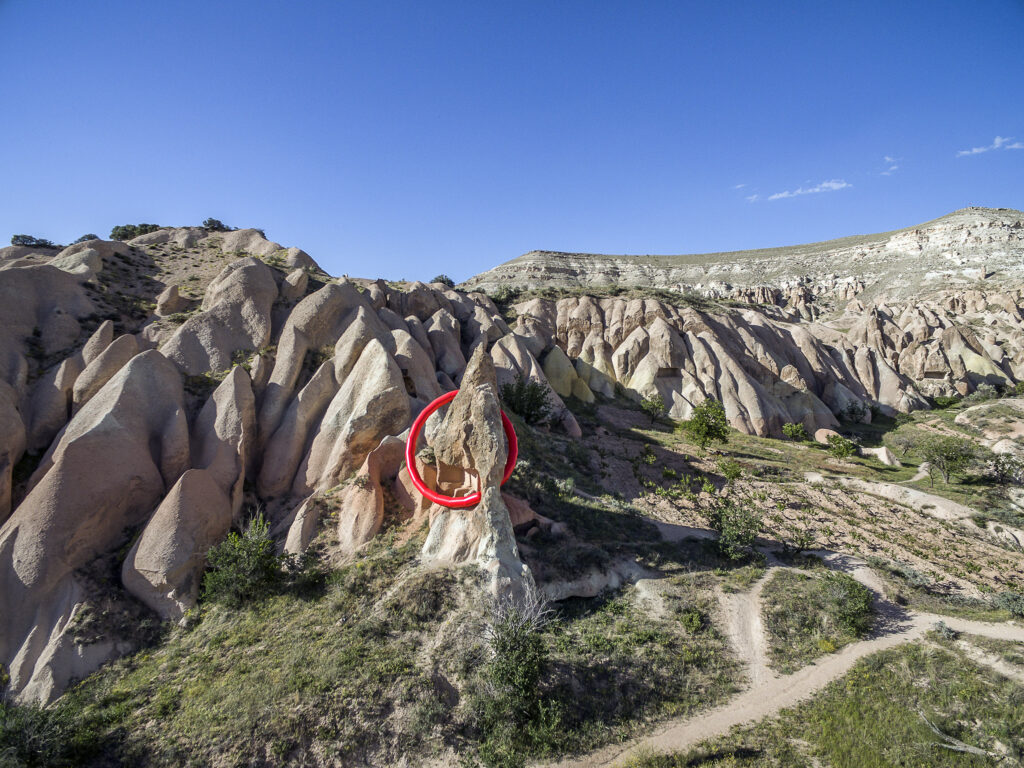
Let us Cultivate our Garden (Group) (curated by Fulya Erdemci and Kevser Güler). Cappadox Festival II, Cappadocia (Turkey), 19.05. – 12.06.2016. Exhibited work: Ödül / Prize, 2016. 142 Site-specific installation Photo Credit: Murat Germen
You are currently based between Istanbul where you were born and Berlin. How do these two cities inform your practice? Do you see any correlation between the two?
I have to quote musician/artist Ahnoni here who once said: “I want to go but I don’t want to leave” on a similar situation of living in multiple places. I feel exactly like that, always looking forward to the other place but sad to leave the place I am in. Istanbul being a difficult city as it is, makes me happy by just being there, the shout of its seagulls, the smell of the seawater, the honks of the boats, even the most serious conversations ending with chit-chats, its noble stray animals and endless variations of life style.
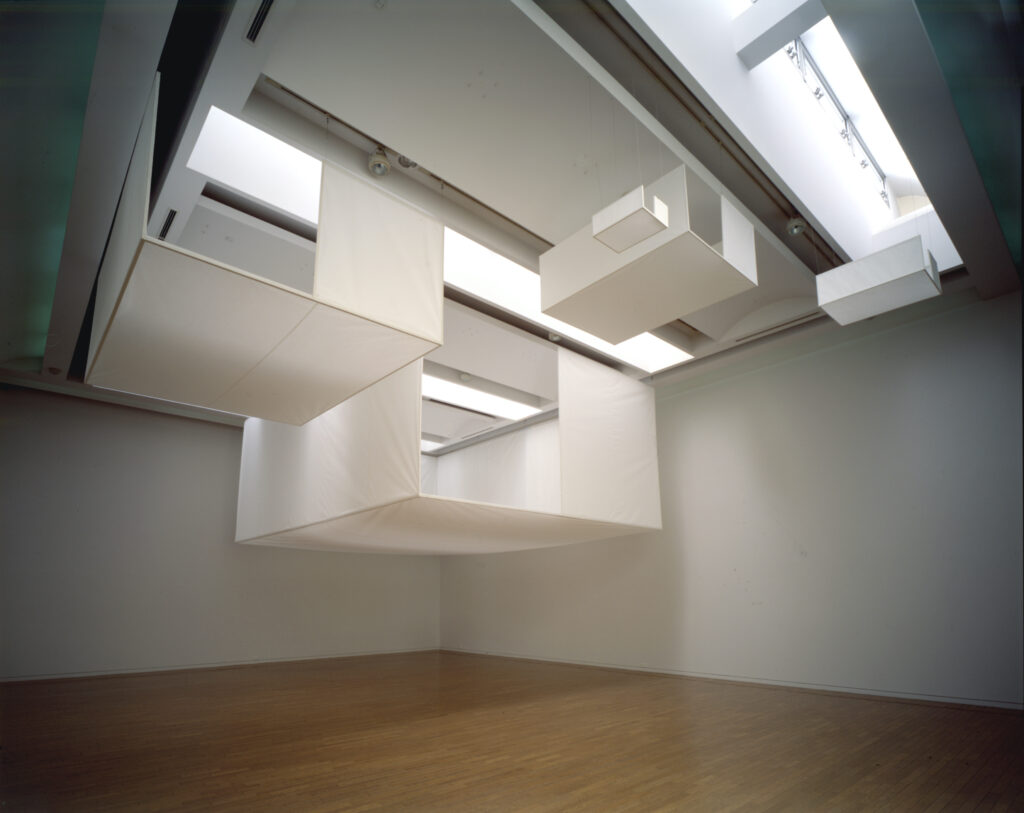
Ayşe Erkmen – Half of (Solo). Galerie Deux, Tokyo (Japan), 14.09. – 22.12.1999. Exhibited work: Half of, 1999; Photo Credit: Artist archive
Berlin a contrast but a good companion to this city; being so peaceful, easy and quiet if it were not for the official gray recycled envelopes of bureaucracy which one receives frequently. There, the small talks do not continue long and conversations turn into culture and art which is wonderful. Berlin is a city with so many venues of art, music, theatre, etc that knowing that they are always there one neglects them and gives too much a rain check. Berlin is a city that supplies too and pampers its citizens whereas Istanbul does this only by being there in that location that every time it angers or disappoints the blue sky and the seagulls appear out of nowhere.
Water appears as a recurring element in your work. Why this leitmotiv and what is your relationship to it?
“Water is something I can’t escape as an art location whether it is given to me or chosen by me, be it a river, the sea, a canal or a small pond. I always have the strong feeling that I should not lose this chance of being on water or using water as material whenever I can catch the opportunity.”
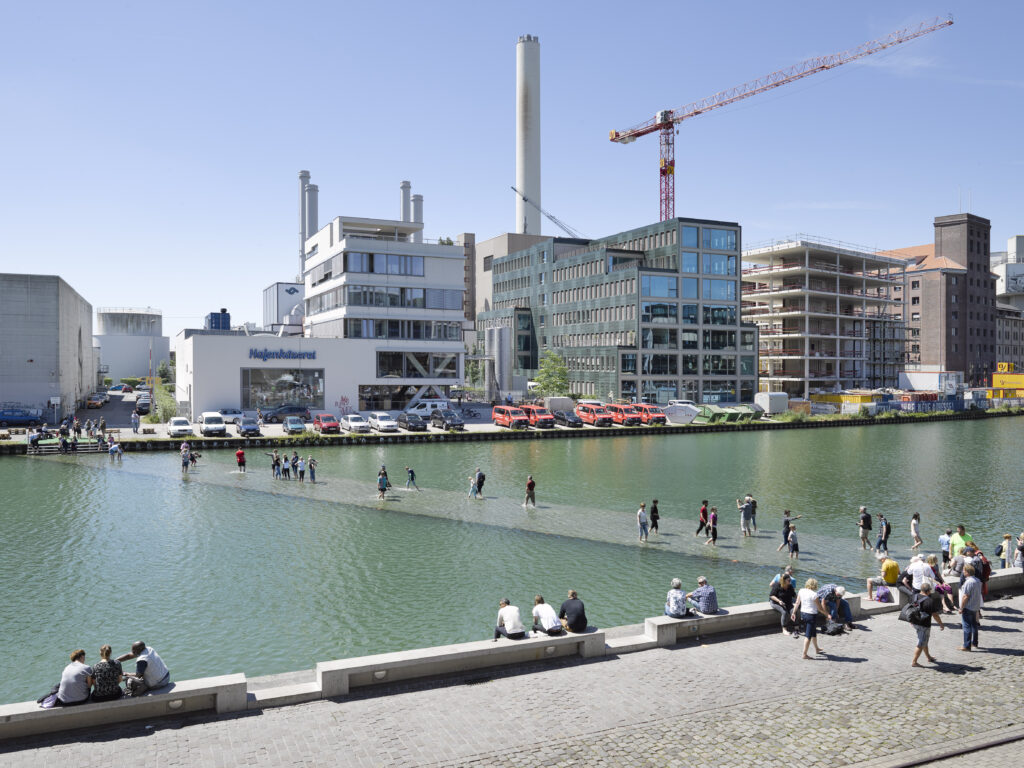
Skulpture Projekte Münster,2017 (Group) (Catalogue) (curated by Kasper König, Britta Peters, Marianne Wagner). Stadthafen 1, North side: Hafenweg 24, South side: Am Mittelhafen 20, Münster (Germany), 10.06. – 01.10.2017 Exhibited work: On Water, 2017 Site specific installation: ocean cargo containers, steel beams, steel grates, 6400 x 640 cm walkway Photo Credit: Roman Mensing
These fortunate offers make the recurrence in my work, unlike other repeating elements like animals, like stones and rocks, archival images, etc that are much more of a choice of mine. Water is not stabile, it moves and makes things move, It has power to create unexpected occasions and coincidences. I am looking for these instances that surprise me as moments that I do not have much control over. In some works I made buoys in water move balls on land which directly relates to the unpredictable movements of water’s effect on land. This makes continuously changing sculptural moments. In my work this is in general what I am looking for. Things that happen without the artist’s intention, water is chance.
“Besides there is the beauty of water that one cannot ignore although I would not want to be in a position of getting advantage from such a glorious appearance. I try to be as neutral as possible mixing it with contrasting technical vehicles that are invisible, unwatched companions of water.”
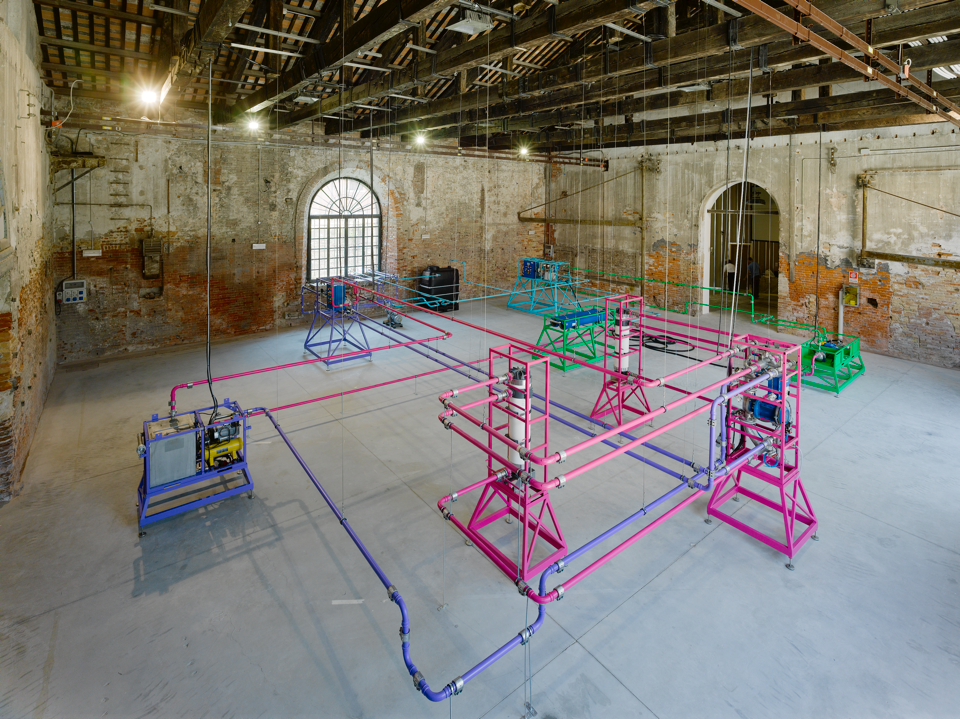
Could you delve into the concept for Plan B, the installation at the 2011 Venice Biennale, that transformed the Arsenale exhibition venue into a room for purification?
Plan B was prepared in a very short time, I still cannot imagine how we could achieve that project in four months only. Fulya Erdemci; the curator was selected in December before. She had to think which artist to choose for about two months. After being appointed by her I had to think what to do for a while but it did not take long as at our first location trip I saw that the place given to us as pavillon location at that time had the only window that opened to the sea/canal unlike the other rooms in Arsenale. This window to water told me that I had to find a way to bring it into this room one way or other. The canals of Venice that surrounds the whole city gave me the form and informed me that the room should be like the city itself surrounded by water. On the other hand the water needed to have an aim to come into this space. The most common thought about water is to drink it. There came the final idea.
Plan B (Solo) (Catalogue) (curated by Fulya Erdemci). 54th Venice Biennale, The Pavilion of Turkey, Artigliere, Arsenale, Venice (Italy), 04.06. – 27.11.2011 Exhibited work: Plan B, 2011 Installation: water purification system, pipes, pumps, cleansing machines painted in specific colors according to their function Photo Credit: Roman Mensing
Then we found a very sophisticated water distilling company in the middle of Germany. Fulya travelled from Amsterdam, me from Berlin, we visited the company and started working to make the plan B exhibition. In four months time realised the work, we made an extensive catalogue edited by Danae Mossman from New Zealand together with Fulya Erdemci and we also made a wonderful tote bag designed by Konstantin Grcic. Our idea was that if people would not want to make the effort to come to our space almost at the end of the Arsenale, would definitely come to get their beautiful Grcic bags! And it happened! We met in London at Danae Mossman’s flat to make the interview for the book. Danae was living in London at the time, Konstantin from Frankfurt, me and Fulya from Istanbul but were in Berlin and Amsterdam at that moment. We met many times, travelled to Venice and to other cities, had lots of fun, all of us from different parts of the world.
Plan B was created from one unit of a mobile water purifying machine rented for the duration of the biennial. This device was dismantled, its pipes between units prolonged according to the proportions of the given space, heightened to various levels depending on the advice of technicians and at the end of the installation, we even added minerals for the sea water to became tasty mineral water. The pipes came into the room from the canal and went back to the canal. My first idea to make the visitors drink the water was given up and the title therefore became Plan B. Fulya Erdemci and I had a last minute thought that making people drink water out of this work would be a too easy gesture and make the work too popular and take it out of its real content.
Your work as a sculptor and artist transcends the worlds of architecture and spatial design. Have you ever wanted to also become an architect?
I never thought of becoming an architect. Architecture and design always has purpose and function. I was and am still interested in purposelessness. I am always trying to achieve the most unhooked sense that aims to make the work be far from serving a reason or expectation.
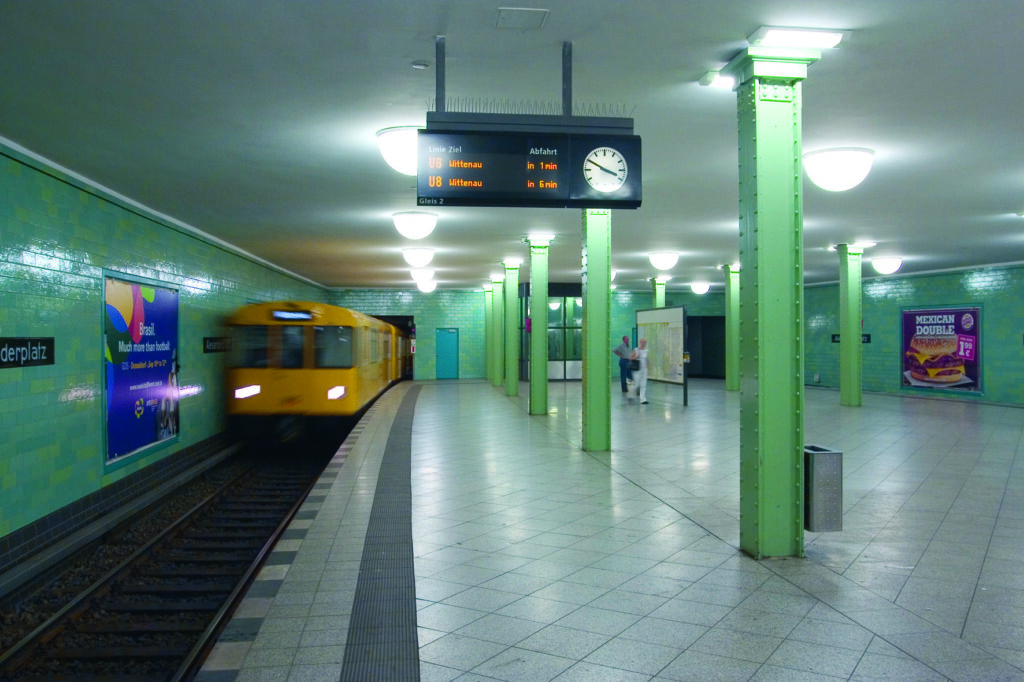
U2 Alexanderplatz (Group) (Catalogue) (curated by “Arbeitsgruppe U2 Alexanderplatz”, Neue Gesellschaft für Bildende Kunst e.V. [NGBK]: Christoph Bannat, Uwe Jonas, Annette Maechtel, Tine Neumann, Barbara Rüth and Birgit
Anna Schumacher). Alexanderplatz, Berlin (Germany), 27.09. – 29.10.2006. Exhibited work: U8, 2006. Intervention: existing speaker, computer, sensor, two CDs (As each train pulled into the platform of line U8, dramatic-sounding music was played for the time it took the train to come to a stop. Two pieces were played, both in the fashion of trailer melodies used for television series.) Photo Credit: Artist archive
Each of your work engages with specific sites, histories, cultures and societies. How does your work respond to the situations you face? A very good question and a very commonly asked one. Everyone asks me how my work responds to the site, its history, etc..The situations I face in a place is a very important part of this procedure. For example one of my most site specific work “Half of” for a gallery space of one room only (Galerie deux/Tokyo) was inspired simply by just the plan that was sent to me to introduce the gallery. Plan included the walls as well that when you folded the plan it became the maquette of the space. This was my simple inspiration for the work I made there which was consisting of five maquettes hanging from the ceiling, one by one becoming smaller, each one being half of the previous one . All was made effortlessly out of rice paper and wooden sticks by competent Japanese hand-workers.
Every work that engages with specific sites needs its own agenda which can be totally different each time and not necessarily with the expected inspiration. Sometimes it is history but a historical place can also get an artwork that has nothing to do with that because I also can have my kind of plans at the time which I want to realise urgently. Of course I feel the most successful when the work looks as if it had always been there or when I spend very little or no effort to make a work sparkle in the space or the best for me would be if I bring nothing to the space and only use the given elements of a space like my works with elevators for instance.
Pond to Pool to Pond, 2016, Japan and your most recent exhibition in Istanbul, I Insist, 2022 are other examples of your site-specific installations. How do you channel the premises of the spaces you use into your installation to reveal the space’s previously concealed features?
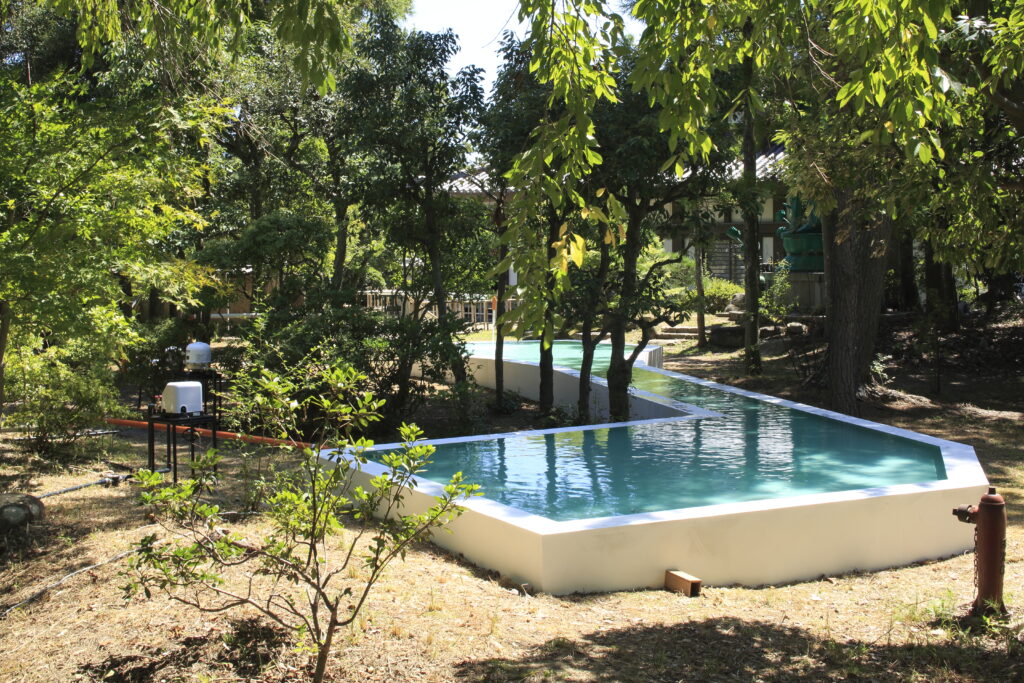
Pond to pool to pond in Nara, Japan is another version of a water cleansing work. In this exhibition each artist had been given a Temple in Nara to work with. My Saidai-ji Temple had a small pond which was dirty, almost like a swamp with lots of mosquitos. My aim was to clean this pond and to be able to do that, I installed a pool next to it. The shape of the pool was very much following the borders of nature placed in between trees and holy rocks. Between the pond and the pool, I installed the water cleaning and pumping system, much simpler than the Venice one because this time it just had to clean the pond. The pipes were installed to go inside the pool and the pond, the cleaning pumps were working continuously and carrying the dirty water back and front. In about a few hours both the pond and the pool were crystal clean and frogs started coming to the pond. The much needed balance of nature came back here and a bright blue colour of water with an unusual shape.
Art Projects at 8 Shrines and Temples – Travelling over 1300 Years of Time and Space (Group Exhibition) (Catalogue) (curated by Toshio Kondo, Art Front Gallery Tokyo). Culture City of East Asia 2016, Nara, Saidaiji Temple, Nara (Japan), 03.09. – 23.10.2016 Exhibited work: pond to pool to pond, 2016 Site-specific installation: already existing pond in site, connected to pool constructed out of wood, concrete, mortar, water and connecting pipes, cleansing and pumping machines Photo Credit: Keizo Kioku
“I Insist” is an exhibition that follows another exhibition titled “Ripples” in the same gallery and uses the leftover material of the previous show. The previous show Ripples was about the unfair gentrification of an area in Istanbul and also about making a first show in a gallery that is part of this gentrification. I cut out rectangles off the new plaster walls of the clean, white cube like gallery space and hanged these wall pieces from the ceiling. The left over wooden panels on the walls at the back of these cut out plasters had white small circular traces created by chance. Aside from this I made a sound piece out of the reading of the names of all the shops and studios on the street leading to the gallery giving reference to the fact that these places will soon be the victims of this gentrification and will be gone in a short time. This was the sound of their archive, music of memories.
In the five years later exhibition “I insist”, I painted these leftover panels that had been hanging before; each one a different wall colour, each one a different size, handled with their cracks and breaks together and hanged them side by side on the walls of the gallery as if this is how they should behave, as paintings like what a gallery is for.
As can be seen in these three examples I have used the nature of one location/Saidai-ji Temple /Nara whereas I have used the politics of an area/ Dolapdere/Istanbul and in the third exhibition I have used politics of art /Gallery Space.
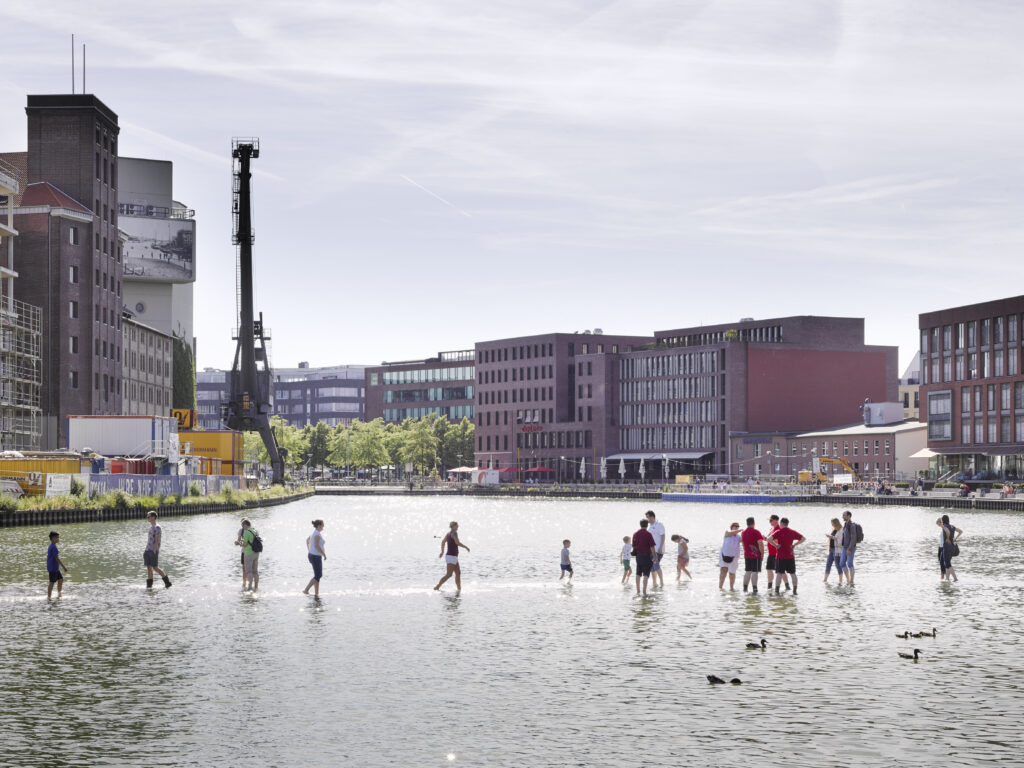
On Water, 2017, a beautiful installation that debuted at the international open-air exhibition, Sculpture Projects, in Münster, Germany took two years to be realised. People use it daily and the vision of passersby crossing the river whilst seemingly walking on water provides a beautifully striking scene. The public becomes an actor in this surreal scene. Could you talk more about the installation and its concept revolving around urban transportation and displacement?
The idea of the “on Water” installation came from the idea to be on Water. This was my second time of being invited to Sculpture Project Münster. My first contribution was moving sculptures on air by helicopter. The title of that work was “on Air” also giving reference to broadcasting. From being on air the first time around, I thought to be on the ground the second time would be too normal a gesture. In between the two exhibitions (1997 and 2017) I had taught at Kunstakademie Münster, therefore knew the city pretty well including this dead end/one way channel where a lively atmosphere was always existent; on one side art studios, galleries, restaurants, bars etc.. on the other part more industry and offices.
Skulpture Projekte Münster,2017 (Group) (Catalogue) (curated by Kasper König, Britta Peters, Marianne Wagner). Stadthafen 1, North side: Hafenweg 24, South side: Am Mittelhafen 20, Münster (Germany), 10.06. – 01.10.2017 Exhibited work: On Water, 2017 Site specific installation: ocean cargo containers, steel beams, steel grates, 6400 x 640 cm walkway Photo Credit: Roman Mensing
As it is clear from the images I made a plan to make a bridge that goes under the water and connects these two shores that people experience the magic of walking on water and to have the miraculous and mystic image of people effortlessly standing on water.
Not only people of course, dogs, bicycles, ducks were also there. Some moms and dads were teaching swimming to their kids. People had the chance to chat on water. It became too popular always full of visitors. The walk on water was slow and thoughtful which made kind of ceremonial and somber at times.
Do you like for the public/audience to interact with your artworks? It feels in some instances such as in that the audience completes the artworks. Yes, sometimes. In the case of “on Water” without the audience the work would have been invisible. The same goes for the work Shipped Ships where once people of Frankfurt were passengers in boats coming from Turkey,Italy and Japan. These two works and some more carried the risk of being unseen if not for the visitors.
“For some works lack of participants is not a problem. Mostly I like the audience to interact with works hoping they fulfil and feel my purposelessness.”
How influential is the audience’s perception of the themes you explore, to your work?
“I must say it is not very influential. I actually believe that the perception of the audience of the themes I explore should not be strong. I would rather give the audience something that they have not experienced before therefore their judgment as well as mine should not be accurate.”
You have explored the use of acrylic in your very first works (Yellow Plexiglas Sculpture, 1969, Istanbul). Why did you choose this material in particular? Which other techniques and media have you set in place to use? In 1969, I was a student of sculpture in the Academy of Art in Istanbul and I found these two pieces of plexiglass on the street. Plexiglass was for me a very advanced material at the time. I was fascinated. Without knowing much what I would do with them,I bent them and rolled them in a huge pot with hot water and placed one inside the other and participated in the school exhibition “New Tendencies” with this work. I placed it on the grass outside the exhibition room, maybe my first art in public space and to my surprise got the award of the exhibition with some money involved. This prize was not as important for me as these shiny plexiglass pieces. After the exhibition I recycled them to make other sculptures with the same hot water technique until the two plexi pieces broke down and disappeared.
I have great interest in material and have learned a lot from professionals who are experts on these materials. I like to work with professional people and I am mostly ready to change my forms according to their suggestions. Therefore I feel free to work in any media or technique as I wish or as my idea suggests.
What is your approach to form?
The same applies to form. I don’t have a strict or steady style. I have given myself the freedom to work in any material, style, or medium although I believe that I have a good feeling for form as I have had a very classical sculpture education for more than five years.
“I have learned a lot from one of my teachers Şadi Çalık who always said: ‘Forms should be outward rather than inward, as if they are hiding something inside, as if the inside is pushing from within’”
He always thought that although we dont see the inside, the inside of a sculpture is as important as outside which meant one should give the same importance to parts that are invisible as the parts visible. This stayed with me and applies to everything in life, in my opinion.
Your body of work shows a dedication to long-term researched based projects. What is source material for new ideas? What books do you like?
I like fiction books. I also like lifestyle magazines to be informed of what is happening. I don’t watch tv these days. I watch a lot of films almost one every night some days. I love to go to cinema salons, even queuing for the ticket or popcorn is exciting for me but I am not doing it so much anymore because of the lazy comfort we have inside our homes now. I also sit on my own outside in a cafe and have coffee and watching the daily life. When I am involved in a project like on Water for example, I make lots of unnecessary research. I am not a research artist in the sense to display the outcome of research or knowledge as an art piece.
This issue’s theme is IN OUR WORLD. In your eyes, what does our world need less and more of?
I will have to give a very classical answer, maybe too much like a slogan but as it has high priority and urgency in these times when we cannot say “Our World” anymore like in earlier years :
“More peace, equality and justice, less discrimination, racism, less starvation.”
What are you working on at the moment? I am very happy to be working on two permanent projects one for Japan/ Shikoku Island at the tip of a jetty and one for Istanbul right on the sea close to a shipyard from 15th century. The work in Shikoku island is almost ready, for the Istanbul one we will start working in August and will be ready for the 17th Istanbul biennial in September. I am excited for both as they will again happen on water.
NR 16 In Our World · Autumn Winter 2022 · Published · Print Page 004
Feature · Rebecca Ackroyd Words · Ellie Brown
From fragmented memories to ordinary encounters: Locating the subconscious in the work of Rebecca Ackroyd
Rebecca Ackroyd, 27, 2017
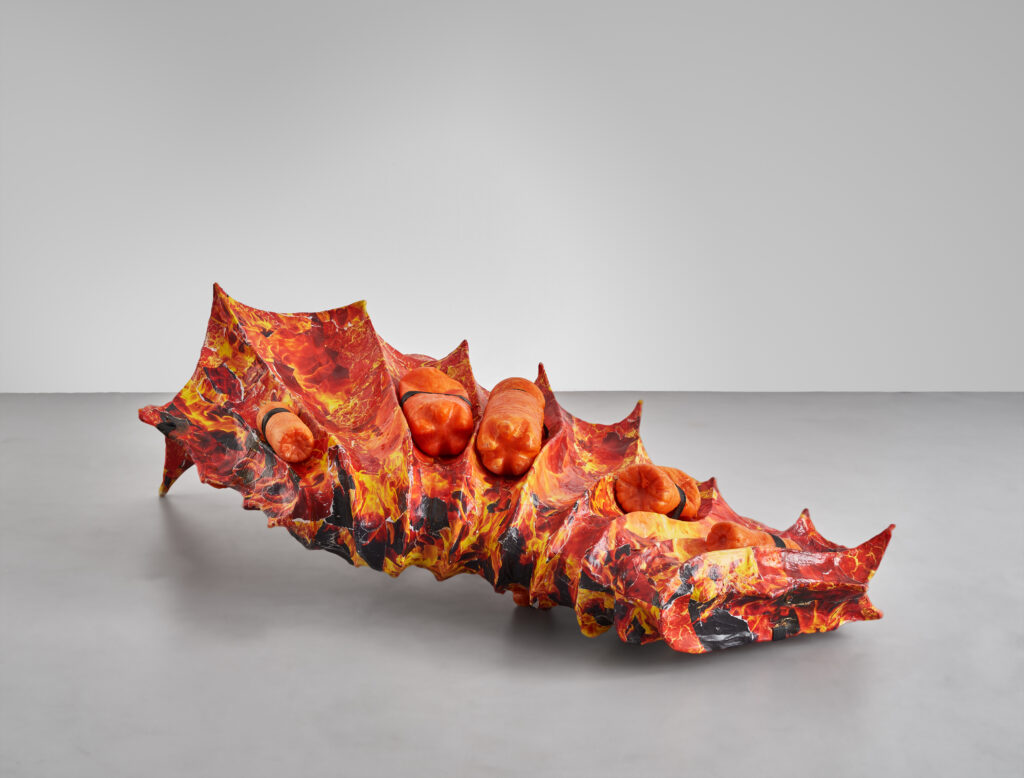
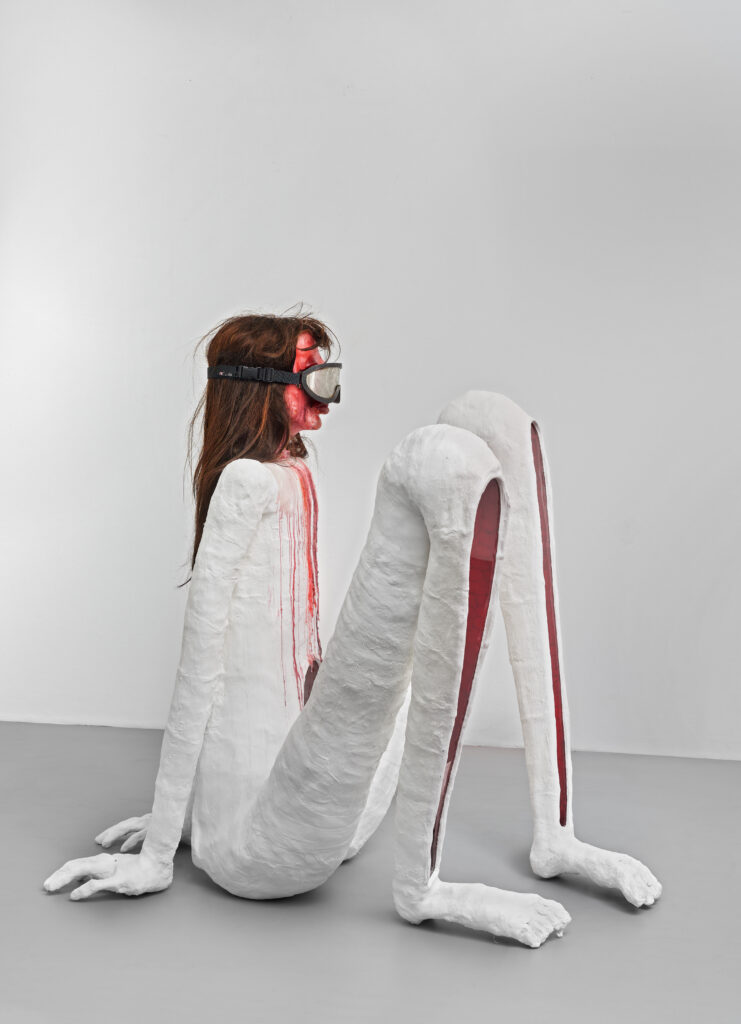
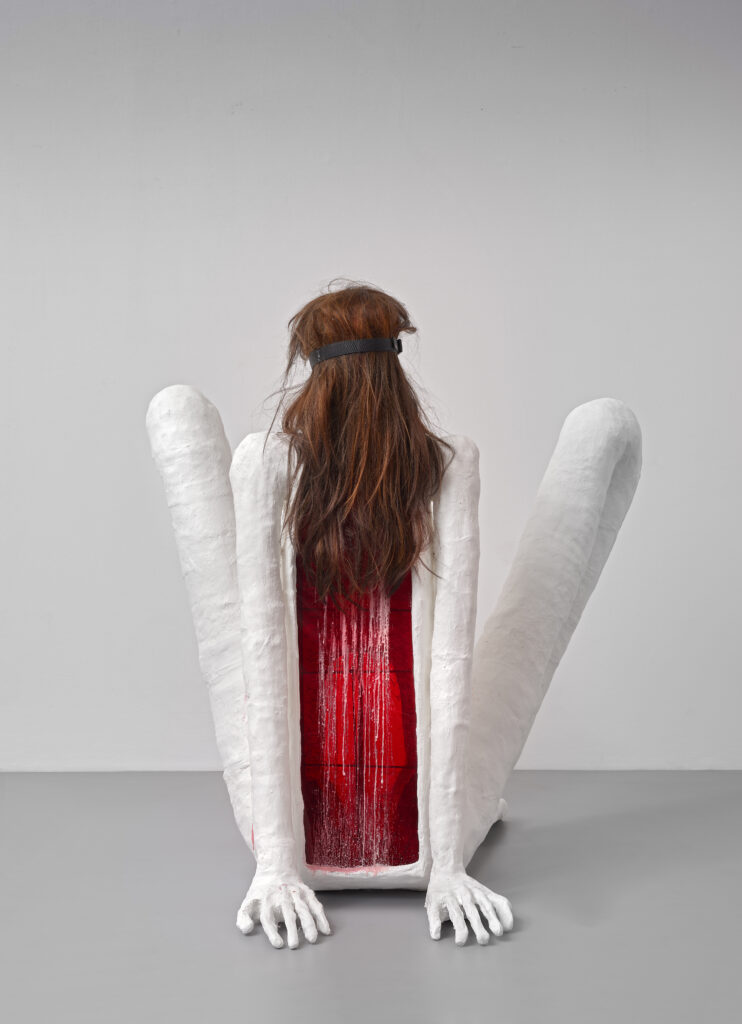
I speak to Rebecca Ackroyd via Zoom from her studio in Berlin in late August, not long before her solo exhibition, Fertile Ground, opens at Peres Projects in Seoul (until 13th October). She will also be exhibiting at this year’s Frieze London and in December at Art Basel Miami Beach. Fertile Ground, like much of Ackroyd’s practice, delves into the surreal whilst being grounded in the monotony of the everyday. In playing alone, for example, a cast of the artist’s hands in a sink is at once familiar and strange; the hands are disconnected from the body, whilst a blade – bloodied? – lies conspicuously in the basin. Those familiar with Ackroyd will know that epoxy resin casts of the body, often in lurid, sometimes grotesque colours, are a central part of her work. And oftentimes, fragments of these casts reappear in different bodies of work. In the Seoul exhibition’s title piece, fertile ground, the artist casts her arms, upper torso and legs wearing a pair of boots that belonged to her mother in the 1960s. The physical fragmentation of the artist’s body in this piece unpick the complexities of time and memory in relation to family history and connection. This can be evidenced by the fact that, as she tells me during our conversation, she has previously cast her mum’s ageing hands as well as her own, ‘and then in 30 years’ time, [mine] will be old and possibly look like my mum’s.’ This, she says, stems from an interest in preservation. But fertile ground also recalls, or reimagines even, an earlier sculpture, Tonguing the fence from her 2021 show,100mph which also features those 1960s boots. The 100pmh exhibition, which as the artist explains below came out of a dream journal she made during the first lockdown in 2020, had a crimson-tinged sleaziness to it. And if Fertile Ground grapples with the subconscious in order to examine how our sense of self is produced and reproduced through the memories we think we recall and stories we tell ourselves, 100mph delved into a very different part of the psyche. There, the works – and in particular Ackroyd’s gouache and pastel pieces – seemed to unlock a Pandora’s Box of what the artist terms ‘bad thoughts’. In pieces like 1,000,000 Eggs, green flesh gleams through fishnet tights, the strangeness of the tinted skin offset by a blood-red hand rested slightly coquettishly on a hip.
In unison with other pastel works on show at the exhibition,100mph recalls the garishness of Otto Dix’s triptych of Berlin nightlife from the early 1920s; in Metropolis (1925), like Ackroyd’s pastel works, there’s an uneasiness that oozes out – as a collective uncertainty seems to seep through the polished cracks (or, in Ackroyd’s case, grazed knees). Even the most exciting of circumstances – for Dix, a bustling club playing jazz music, or for Ackroyd, the experience of catching a flight to go on holiday as her work Singed Lids from the 2019 Lyon Biennale depicts – can be boring experiences. Resin casts of airplane seats are positioned in the artist’s character disjointed fashion, with the remnant of a leg or a suitcase making the odd appearance. In that work, Ackroyd again recalls a collective encounter, pieced together through the fragmented lens of a distant memory. Of course, the comparisons with Dix are limited – he was attempting to capture a broken society in the aftermath of war and hyperinflation, and the sexual politics are a far cry from Ackroyd’s own handling of sexuality and femininity. But nonetheless, both seem to touch on how we, guided by that inner voice in our head, collectively go about trying to make sense of the world around us. And below, as the artist discusses the importance of ordinariness in her work, it seems that sometimes the most ordinary of circumstances feature in the strangest of dreams.
Rebecca Ackroyd, Flower form, 2022
Rebecca Ackroyd, Flower form 2, 2022
Something that strikes me about your work, and seeing how it’s installed in exhibition spaces, is the idea of the encounter – and encountering the work in a space. For example, you’ve previously spoken about the use of a pub carpet as a recurring motif since you first used it in previous exhibitions in 2017, which is both part of the exhibition install and the work in a way. How do you think about the work within the space, and how do you visualize the experience and the encounter that the audience will have with your work in situ?
It really depends on the show and the mood at the time that I’m making the show. The last show I did at Peres Projects Gallery in Berlin, 100mph (2021), took place during lockdown and the basis for the work started from a dream journal I was making in the first lockdown. The works didn’t directly correlate to the journal though I ended up showing drawings from the dream journal in the show on a separate table. [But] it was mainly drawing because I didn’t have any assistance to make sculpture, and I was just working on my own with my boyfriend (he was my assistant!)
The work was really informed by the idea of dreams, psychological space and something that’s more of a subconscious thought that is buried or hidden.
Rebecca Ackroyd, RAY!, 2018
“There was very much this relationship between a sort of deep internal space and bringing that out. I was really interested in how that could kind of be expressed through sexual desire or ‘bad thoughts’; a sort of internal mechanism of thinking that we don’t express.”
That was the driving force behind a lot of the drawings.
The way install or approach altering the space really depends on the show, the content and the way I want it to feel. But I am definitely interested in there being familiar elements, like a carpet – the pub carpet, that I’ve used repeatedly, and I used again in 100mph – as a way of signifying a time, or a place, or a culture, and then contrasting that with these out-there drawings or psychological abstract works. I’m really interested in bouncing between places, and I think that’s definitely reflected in how I assemble a show.
Rebecca Ackroyd, Hear Her, man hole, 2018
For your most recent show, Fertile Ground (2022), reference is made to an encounter you had with a building site in London. But to what extent do you look for an influence or an inspiration when it comes to making a body of work, or does a body of work come out of something more instinctive?
I think it really depends, like with Fertile Ground, you mention the building site – I wouldn’t say that that memory necessarily meant, or influenced, the actual works themselves. I think I’d started making the work already, and it’s almost like I look for anchors that root the work in different ideas.
Rebecca Ackroyd, 1990’s REST, 2018
And that particular memory felt like it grounded the show somehow. In fact, I wanted the building site to be the show image, but then I found the photo of it, and it was such a boring photo. I thought the idea was more interesting than the reality. In my head, I’d built it up as this really overwhelming visual encounter – which I think it was, but it just didn’t translate into an image at all. It just looked like a building site.

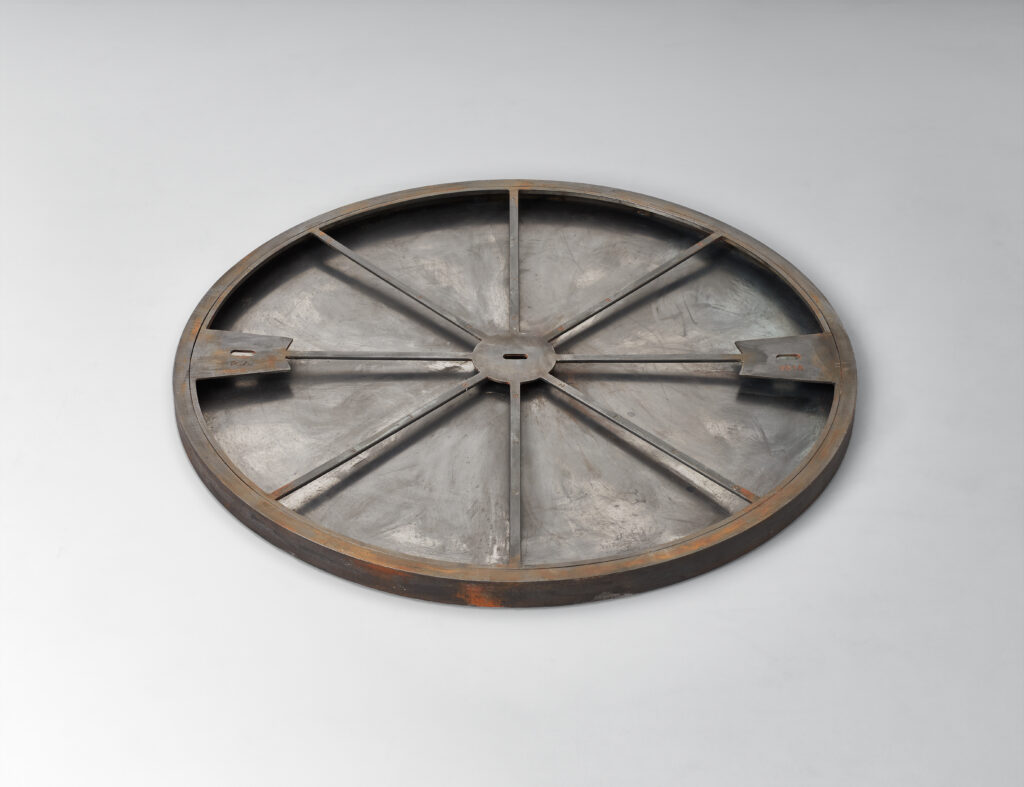
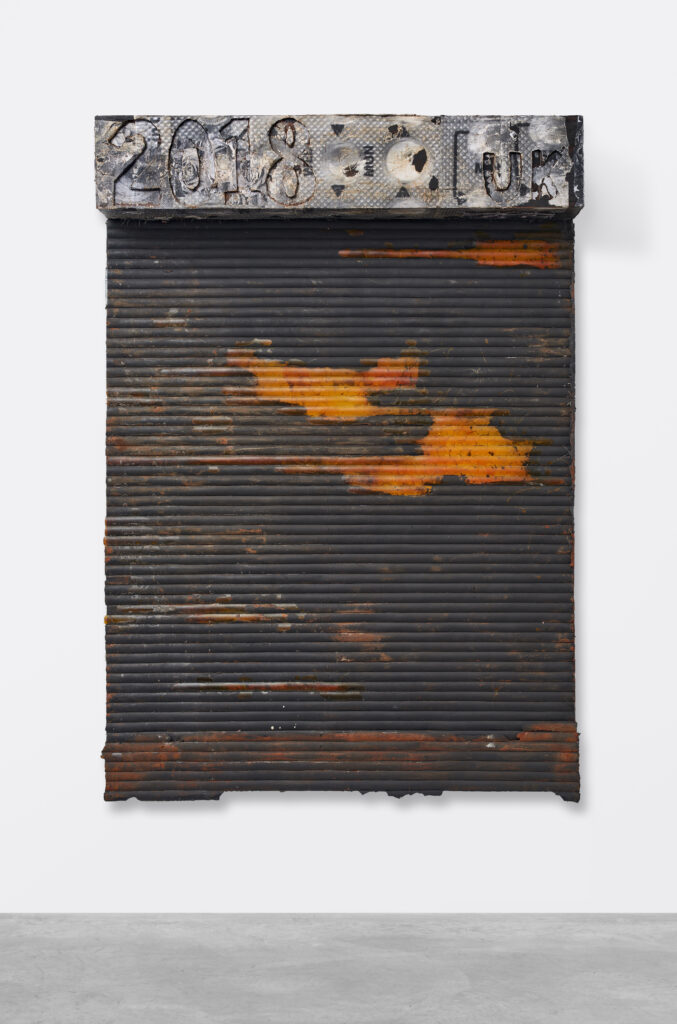
“It’s more interesting when the work is layered and bounces between different ideas of abstraction, figuration, personal history, and then more shared ideas of existence or life – or something more ubiquitous, like a shop shutter, or a tool.”
I’m interested in how work can be layered in that way basically; layering content and layering ideas.
Rebecca Ackroyd, Tide Turn 2018 UK, 2018
In Fertile Ground, you’ve got the cast of yourself and you’re wearing your mum’s boots from the ‘60s, which is a very personal connection to your own experience. But, from what you just said, I get the impression that your work is less autobiographical, and the use of personal history is more a vehicle for exploring certain themes at a particular point in time?
Yeah, definitely.I mean it’s difficult, isn’t it? I think the term ‘autobiography’ sounds very literal, and so Idon’t necessarily see it as autobiographical. I see it more as ‘biographical’, in the way that I’m really interested in stories and memory, and how that becomes so fragmented. That informs so much of who we are. With the memory of the building site, I had this vision of something, and then when I actually looked at it, it was really underwhelming! And so, sometimes the thought of something is much more exciting, or inspiring than the reality of it.
Rebecca Ackroyd, RA MULCH, 2018
That also correlates with the creative process for me. I was talking about this to a friend recently, another artist (Sam Windett)– we were saying how when you’re making a show, you’ve got the idea of the show in your head and you’re really driven towards it. And then, you have the reality of being confronted with what you’ve actually done in the space.You’re suddenly in reality and you have to just deal with the fact that you’ve made these works. And that’s what it is – I feel like there’s always a tussle between the idea of the thing, and then the thing itself.
That’s really interesting because the underwhelming reality of the building site memory also ties into the idea of the mundane that features in your work. In memories and dreams, we pick up on small things and remember them, but the reality is definitely not going to be what you thought it was. In works like Singed Lids (2019), for example, there are these bits of everyday detritus – the suitcase by the side of the seat. Is that mundane, or a way to be able to visualise through small fragments the things we can’t fully recall?
I think it’s both. In Fertile Ground, there’s a cast of a sink with my hands. I’m really interested in ordinariness, especially with the sculptures. I like the idea of just capturing something that is quite unspectacular, you know – like doing the dishes. I’m more interested in that than I am a performative gesture or something. It took me quite a long time to realise that there’s something really special about living with ordinariness; appreciating normal, day-to-day experiences.
Rebecca Ackroyd, Carpet burn, 2022
And then the fragmentation within the casting is very much about referencing something incomplete, which again links back to the idea of a memory, or, with the Singed Lids piece, a remnant of something. Casting is a very direct way of being able to do that, and I see it as being related to photography in terms of capturing a particular moment.
Rebecca Ackroyd, 100mph, 2020
Rebecca Ackroyd, 100mph, 2020
I think that’s really interesting because it’s almost like a reliable, true record of something. Whereas, with other mediums such as drawing, that’s always going to be more of an interpretation. And so, I wanted to ask you about the process of making work, and the contrast between having these sculptural works using materials like resin and wire, versus pastels, for example. How do you balance using these different approaches of making, and how do they then work together to create a wider body of work?
I came from making only sculpture to making these small drawings between bodies of work. And then, gradually, the drawings became the pastels, and now they’re as important. I don’t really see a distinction between the processes now.
Rebecca Ackroyd, Hunter/Gatherer viii, 2018
But with sculpture, the thing I struggle with is how full on it is physically. It’s something I have to plan a lot more and think about more in terms of practicality and how things are going to work.But quite often, when I make a cast, we make them in pieces in the studio, and then they’ll just kind of sit around the studio for months. Then eventually, they get incorporated into a work.
“So, in a weird way, my studio is a bit like a sort of graveyard! And then, they get brought to life.”
Rebecca Ackroyd, World view, 2020
I use the drawing and the sculpture in different ways. With the casting, it’s about bringing an element of reality into the work – using myself or a friend or family member, and then grounding that in a particular moment.
With the drawing, there’s definitely a greater freedom in terms of making, which is why I started them. I pretty much make every single one in a small version before I make them big, so I can work on a lot at the same time. I often have numerous ideas that I want to get out, then I can look at them and it gets translated onto a bigger scale. Or they just stay small, or I never show them.
“Making work is about finding ways in which I can have as much freedom as possible.”
It’s really important not to be precious, because once the drawings are on a bigger scale, there’s more pressure there to make it work. I think it’s really important to have the freedom to fail all the time. And I feel like with sculpture, it is this battle to not fail because it’s much harder to articulate. It’s a very different approach, but I feel like in a lot of ways, they inform each other.
Rebecca Ackroyd, Half moon or empty, 2020
You mentioned that you might cast something and then use it at a later date in a body of work. Do you see different bodies of work as a progression, or as a response to a previous body of work?
I think it really depends. With the sink piece in Fertile Ground, I never thought I would show it because it was just on the floor of my studio for years and then it just seemed to make sense suddenly. So then it gets used in a completely different context.I think it’s probably a bit of both because, when I’m conceiving a show, and especially when it’s in a particular space that I’ve been to, I will be mulling it over and figuring out what I want it to be. I’ll imagine how I will enter that space and then that will inform certain elements – like what I might do to that space. But in terms of the individual works, I think quite often I just have an idea for work, and then I’ll make that piece. But sometimes, it’s less formed than that; it’ll just be a fragment of something, and maybe I’ll make a metal stand for it.
Rebecca Ackroyd, Tonguing the fence, 2020
It really snowballs when I’m making work for a show. I’m not a very good planner; I think that’s just the way I work, though. I have to be able to change and shift things.But then it’s funny, because earlier today, I was thinking of a show that I don’t even have planned, it’s just an idea for a show of work.
“I like to have that openness, and I also like to not necessarily know exactly what a show might be because it’s much more interesting and exciting, and it means that the work can turn into something unexpected.”
With Singed Lids, I don’t think any of the curators even knew what I was doing because it was just like, “here’s a cast of an airplane seat”, or “here’s this cast of a leg”. You couldn’t see the whole thing. I didn’t even see the whole thing until I was in the space; I had no idea if it was going to work or be any good. It’s quite terrifying to do that to yourself, but I do think that that can be one of the best ways to work, it allows the work to unfold.
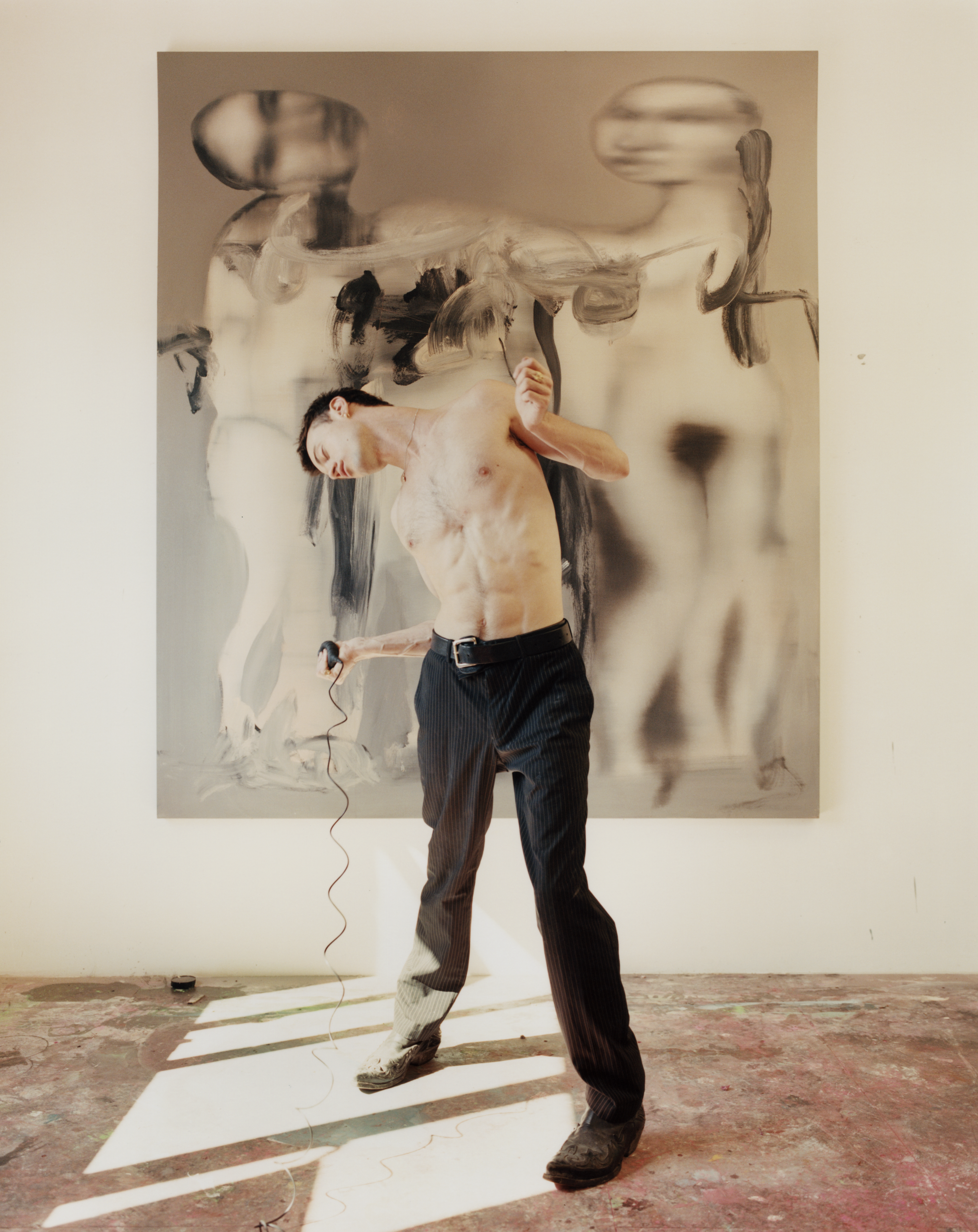
NR 16 In Our World · Autumn Winter 2022 Published · Print Page 308
Cover Feature · George Rouy Words · Matthew Burgos
Abstraction and distortion in art come out intuitively to George Rouy along with human emotions and relationships
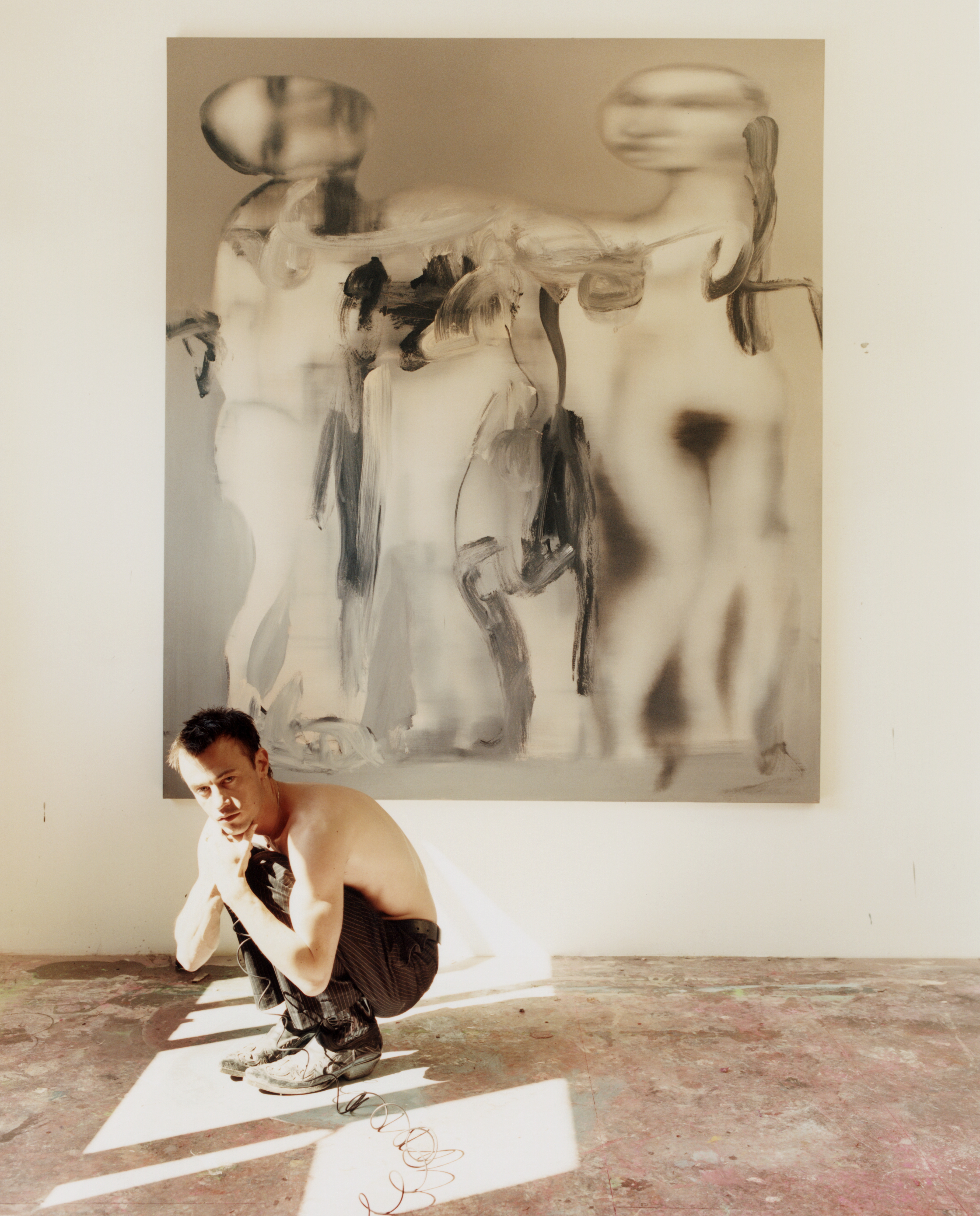
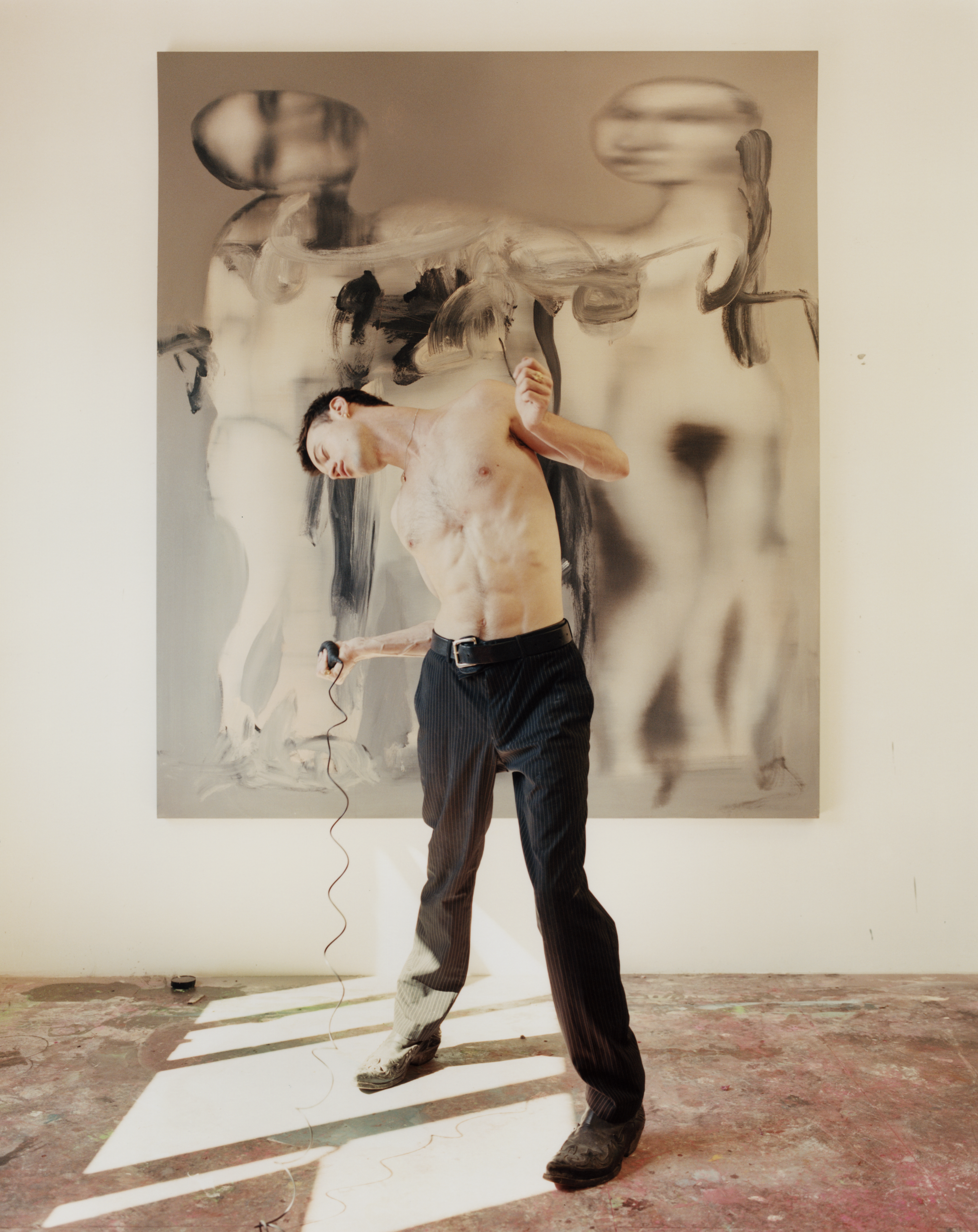
In his earlier artworks, George Rouy would paint elongated facial features for the wide bodies of his subjects. He would stretch the figures on the canvas through his strokes, and at times, have them sit or stand side-by-side as if conversing.
Then, around 2021, a shift took place.
Gone are the visible features of the face, replaced by intentional marks and lines guided by the haze of the moment, his creative spirit being summoned to life. Smudges of paint brush against a mosaic of splatters. Flecks of color shower dedicated spaces on the canvas. The figures still appear visible, yet invisible at the same time. They might be tall or short. Their genders, androgynous. They are colliding, manipulating the viewers first, then they sync, re-arranging themselves like puzzle pieces and letting their viewers know everything falls into place in the end. Rouy, an aficionado of abstraction, has transitioned, and he is introducing an evolution of his artistic practice.
The bodies in Rouy’s artworks evoke an innate sense of connectivity and transcendence. They trespass the realms of the physical and the beyond, almost anchoring an indescribable reason they visually came into sight in the first place. They might be five different characters Rouy brewed in his mind, but they could also be an individual with five versions of themselves. Deciphering the intention of Rouy’s paintings depends on the viewers, but the artist creates a two-way channel in his works. For every painting the viewers see, Rouy seems to ask them to trust him with their deep-seated thoughts, emotions, and fears and let him paint them through his style. For every painting he creates, Rouy stirs human sensations until he delivers.
NR wants to learn more about the psychedelic nature of Rouy’s works and mind, the desire that powers the artist to pick up his brush and lose himself in the moment of painting. When we caught up with the artist, he was in the middle of finishing some artworks for his next show. He would be flying out of the UK in the next couple of days, leaving the 12 paintings he was working on simultaneously for a while inside his studio in Kent, London. At one point, Rouy tells us he paints intuitively. He scraps off planning and gears toward illustrating what feeds his mind, whether based on his experiences or observations. Somehow, themes of interactive relationships, self-growth, therapy, and psychology bubble up and simmer in his paintings. These nuances might be implied, but one can see how they linger in Rouy’s works, drawing in whoever lays their eyes upon his paintings and locking them in there.
At first, NR wanted to ask Rouy whether he had always wanted to be an artist, then move along wherever the conversation would take us. But even before we asked him the question, Rouy had already let us in on what he would be doing in the next few days. A lot of it involved traveling, ruminating, finding breathing space, and looking at his artworks as he sits or stands before them, idling. The moment he spilled all these thoughts, we shifted our questions, inverted-pyramid style. From the role of energy in his artworks to the culmination of his present style, Rouy talked us through his artistry, influences, and life as an artist, revealing parts of himself that might be under wraps from the public’s eye.
We started with his travels.
Does consistent traveling affect your creative process?
I think yes. What I have found over the years of doing this is that I have times of concentration or intense work then a break. I have found that my creative process works a lot better now where I relentlessly paint all the way through before I try to find breathing space. For instance, I have solidly worked for a month now, and I will be taking a few weeks off just to ruminate and process. Then, I will come back and look at my works with fresh eyes. I see what I have done objectively and more since I have taken off some emotions and am now able to see what needs to change or shift. In that respect, traveling works well.
I also often find myself preparing for a show, so it is good to have the works just sitting in the studio for quite a while, just to live with them. They can breathe and have their own life without me working relentlessly on them all the time.
What is your breathing space? Do you intentionally create your own breathing space, or do you just do random activities?
Walking, for instance, on a day-to-day basis is breathing space. Strolling in the countryside is a great way for me to process parts of the day, especially in the summertime. I find it harder to find my breathing space in winter because of the lack of light – it is always dark when I leave the studio – but I love to think of other ways to take some time off. Currently, I am between here (Kent) and Paris.
In Paris, I work more on the computer, study my art, and think about where the series is at. I was there a month ago looking at the paintings I already had in the studio, took photographs of them, then looked at them through Photoshop, just to process everything in a different way. Then, I am just actively looking at my works, and I think it is important. The act of looking also takes up time since my paintings become jigsaw puzzles, and I try to work out the next parts. Sometimes, it just does not quite click at the moment, so I let it simmer for a while before looking at it again.
I have come to a point where I need to take some time off and come back to the studio once I feel rested because I get so caught up in the energy.
“I think painting is about having and regaining this energy and preserving the excitement, impulse, movement, vibrance, and emotions, especially because the works become a lot more abstract in areas.”
These works also need a sense of clarity, so I am trying to find and maintain that as much as I can. When I have a few to 12 paintings at the same time in my studio, I often jump from one artwork to another, so the energy gets transferred quite easily. I am conscious that when I quickly shift, things stagnate, or when I work on one painting for too long, something sucks the magic out of the artwork. It loses the spell it once had.
Since you put it in this way, does painting ever get overwhelming for you?
There is this idea that you have higher expectations of yourself at times, and you are constantly searching for more discoveries, so you never get quite content with the discoveries that you have already found. I think the overwhelming part is to maintain these high standards of and by self. When you reflect or get to a point when you look at some of the works you did that you felt successful, you look back to how you did in the past.
It is not that you are trying to top or match them, but I think this is where it gets overwhelming, when these successes are not happening now. When this happens, you push through it – you work through it until things reveal themselves. It is like when we plant a seed, it takes time before the plant fully grows.
I notice that some of the facial features of your subjects are blurred. Is that intentional?
The faces anchor the work and the composition. They can also be a distraction that ultimately defines the work – it is about having the right amount of purpose to them. I am into abstraction, and the blurred faces break emotions and sensations by delivering physical marks in the painting. When I start to apply them, I begin to see that everything becomes emphasized while they also contradict each other. The face is about having blurred moments of life, and having these pushed out in distorted ways allow the works to have the same breadth.
Sometimes, it is hard to explain. They just have an energy about them and a certain feel that is not of this earth – it is not from here. It is not even photographic. There is a clear distinction between these faces when they appear right, but when they do not, there is this balance between the ugly and the beautiful – transcendence and out of this world. These days, I am more into computer-generated faces or AI and the historical representation of a figure within a sculpture. Here, I can distort the face, making them heightened versions of humans. I also think about the idea of distortion or blurring as something that is not quick, but a time-based movement that links with the rest of the marks in the painting. They turn out to have the same amount of flow and energy.
Would you say then that your paintings are energy-based?
Not entirely energy-based, but they have an awareness of the physical in terms of their anatomy, time, and movement. So, the act of distortion can be hidden – you cannot quite tell how long strokes took or where the moment began. Other things can be visible such as the dancing figures in some paintings.
I notice that you often use lush or dark colors for your paintings. Do you resonate well with the dark palette or do you have any intentions in the near future to shift to bright tones?
Some of them have become brighter, but gray still is important in my work in terms of it sitting between the realms of dark and light and how it can emphasize contrast and complement well with the shades I use. I also like how gray can have different hues like pink gray or greenish gray.
I also notice that you have a lot of bodies on your canvas. How did you arrive at this point that you wanted to turn bodies into the subjects of your art?
It is an uplifting movement for me to have these bodies in my work a sense of connectivity and purpose – of flow, movement, and rhythm. I would say I am someone who has been into exploring figurative painting and how to achieve a painting that has multiple figures in it without giving a headache. I think about the figures as organisms who could be versions of themselves. There could be two people but split up into five figures. It is less about a collective, but a depiction of those you know in a space or non-space.
On the other hand, their meaning depends on how the viewers perceive them. Sometimes, the viewers place themselves in the realm that I created. Other times, they deem my paintings as romantic and soft. There is always an underlying intention to these figures and how they interact. Then, there is also this feeling of morphing, a shaping of an internal representation, of one’s psyche or being, and I think these are massively involved in my works. We are living in this life full of intricacies as an individual and as a collective, and I am thinking about these internal pressures, whether that is beauty, ego, or something else. Similar to how we show other people love or compassion, we have these intricacies that form part of who we are.
I did a painting last year called Shit Mirror (2021), and it was on how you can perceive yourself one day and have a good feeling about yourself then the next day, you have a completely different representation or idea of yourself. It is erratic when it comes to the human mind, and I try to represent it with marks, movement, and contradictions because ultimately, nothing is static. I think we live in a world where maybe we have the ideas of what and who we are, those that we think are set in stone or in one journey, then we realize they are endlessly moving.
In this matter, do you think psychology and the study of self are two of the many factors that have helped you develop or pursue your style today?
I have gone through a large amount of therapy and have to dig deep into parts of my own self-growth that there have been a lot of things I have had to tap into with myself that naturally comes out in the work I do today. I have always had this keen interest in these features of my experiences, and being able to express some of them, even hint at or allow them to just be present there, feels resonating.
I think you sometimes get forced into doing a lot of self-growth. In my case, there has been a lot of digging into internal beliefs, both rational and irrational, and they appear over time or I generate them. Then, they distort the sense of self and what is my reality in relation to other things. I have dug deep into layers of my deep-seated fears too, and I think when we start to embrace and understand these, we allow ourselves to push deeper into those areas of our mind and sensation.
Do you have any other sources of influences?
My work is so intuitive. I can go away and experience experiences, but the ideas that I have just sit in the periphery and do not fully sit in. It is not like I am going to do a painting about this or that, no. It all just comes out in an intuitive way. Also, being around other people and having interactive relationships are important too. I often spend time on my own, painting figures. From there, I have these two extremes where I spend so much time on my own – I also live on my own – and doing these paintings about figures of human interactions and about human sensations. All of them are intense experiences to live through which then can be parts of my influences.
Have you always wanted to be an artist, then?
Absolutely. Being an artist and painting have always been my natural ways to communicate. They have never felt like a struggle. School was hard for me since it was difficult express myself through drawing and art even though they felt natural to me.
“I have always wanted to be an artist, but it was challenging to tell that to my teachers because one needs to understand how to be and what it is to be an artist to fully understand the life of it.”
It has been a huge process, overall, and I am very lucky to be doing this.
Do you have any artistic rituals before you paint?
Yes, I have got rituals. I do some exercise in the morning and in the evening. Then, I go for a walk after painting in the studio (if there is light outside). I make sure I do not work overtime. Then, I have a bath every night because I am normally covered in paint, so having a bath every night is a moment – my moment. So, not many rituals, I think.
How do your immediate surroundings influence your artistic practice today?
Living on my own, going at my own pace with everything, and not being in London were massive shifts in how I operate. There is a lot more consideration and pace that is not rushed anymore unlike in London where I had always felt urgency. Now, it is more just about looking, taking everything in from my surroundings. The thing is that in London, I would commute to the studio, step inside, and tell myself “I have to paint now.” It was a lot frantic. Whereas here in Kent, I could just come here, do a little bit of painting, and sit and look at them. Sometimes, maybe even not paint and just look at them. This is where the surrounding influences come in.
Team
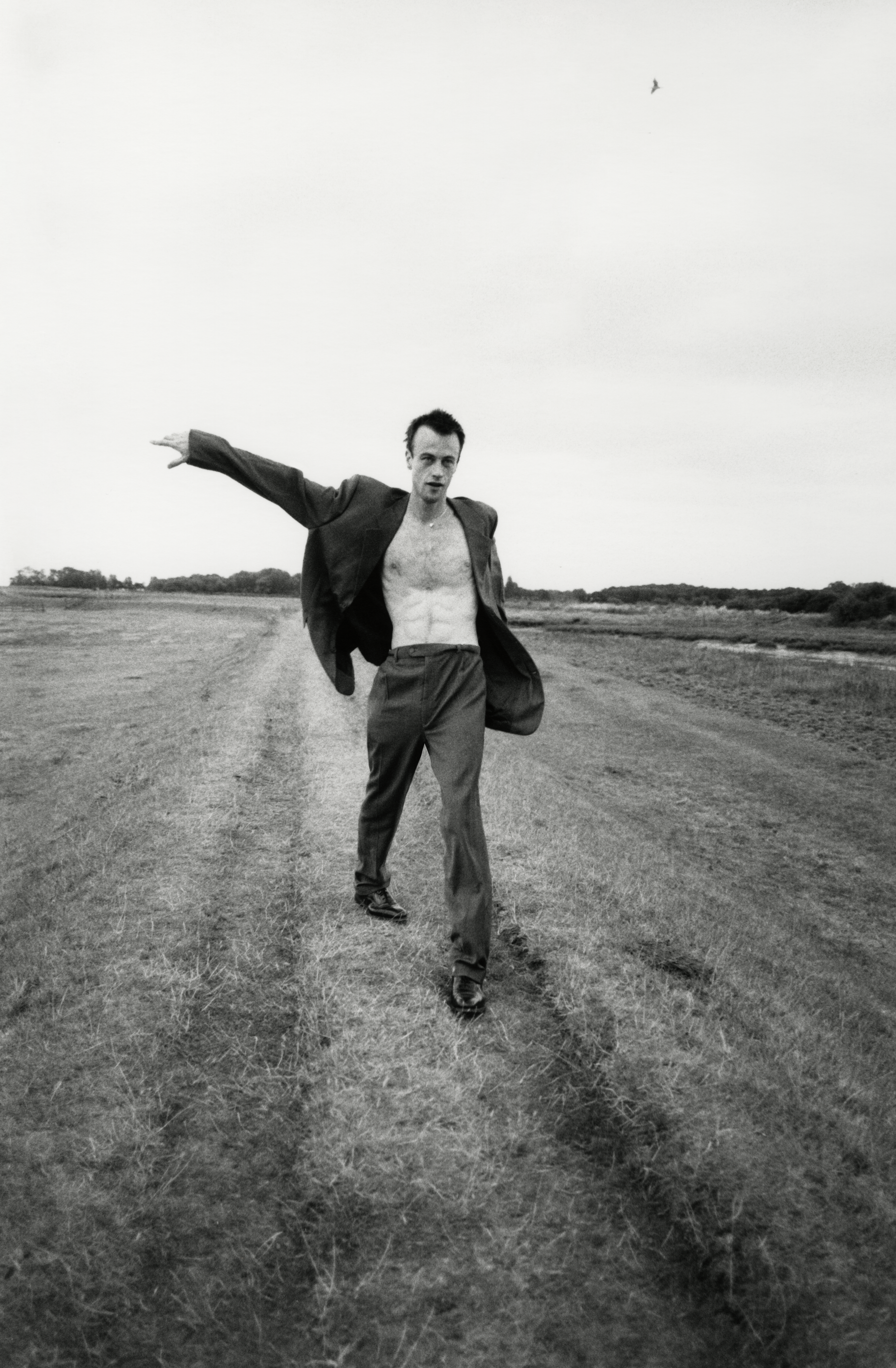
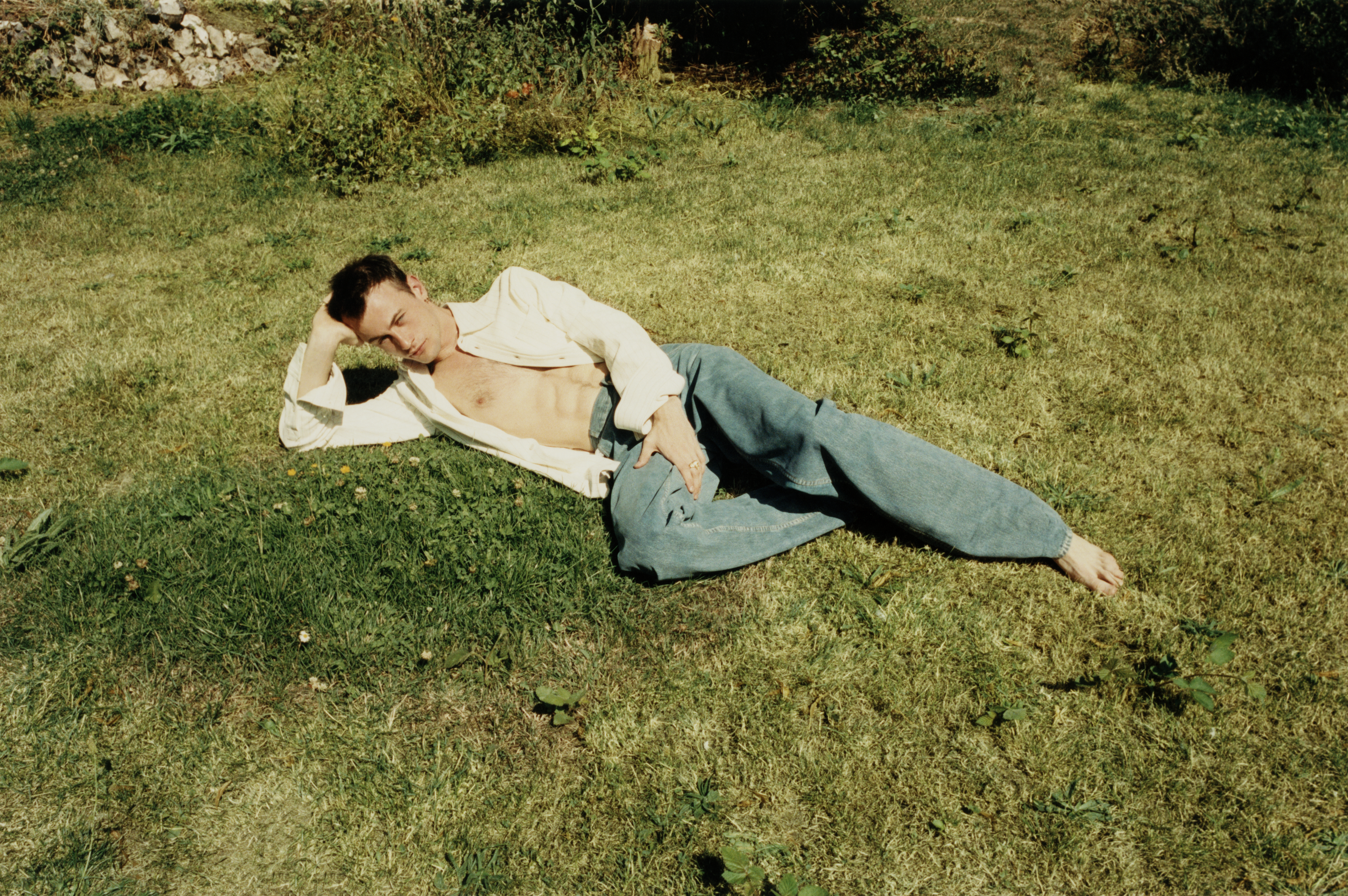
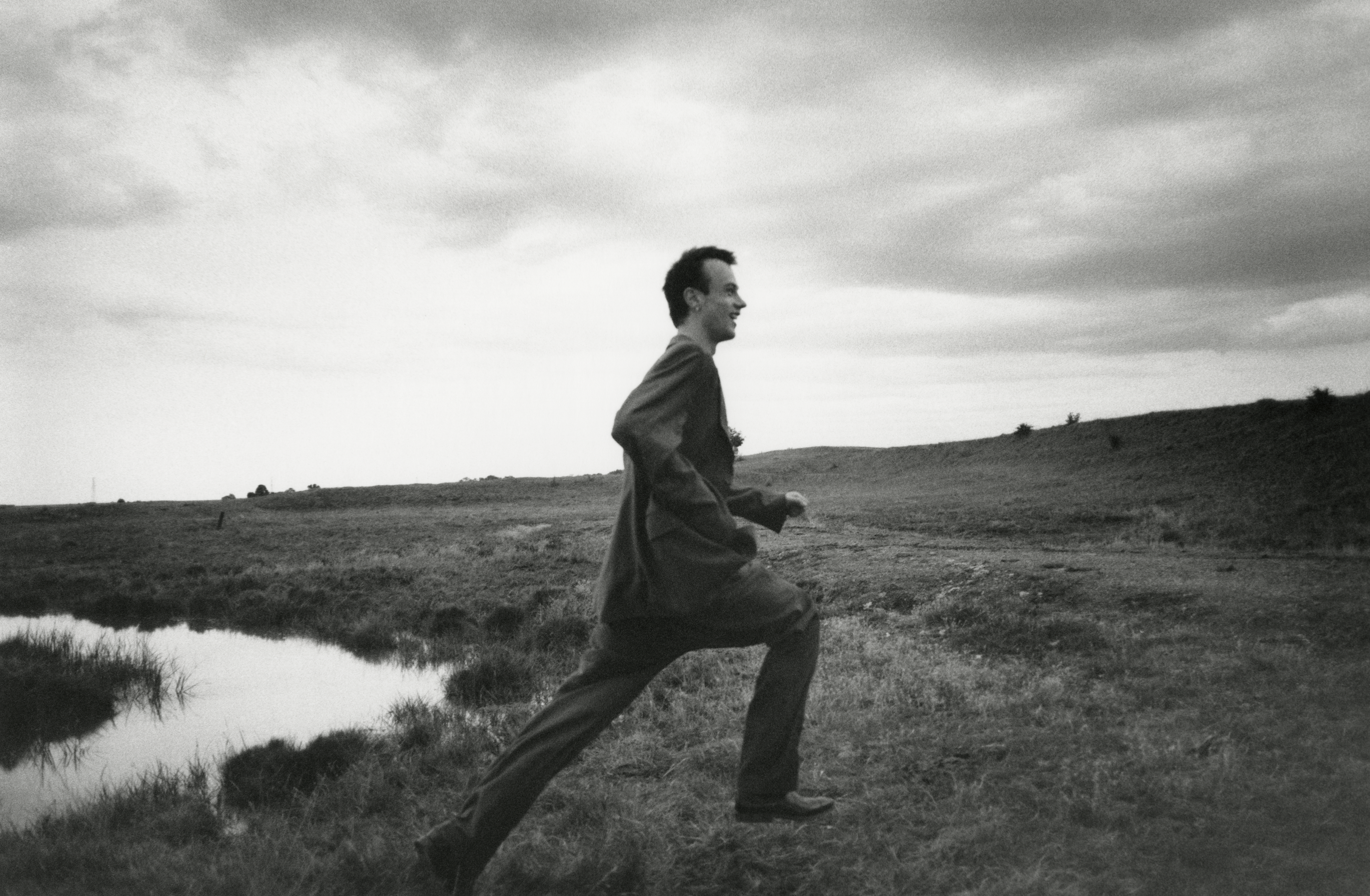
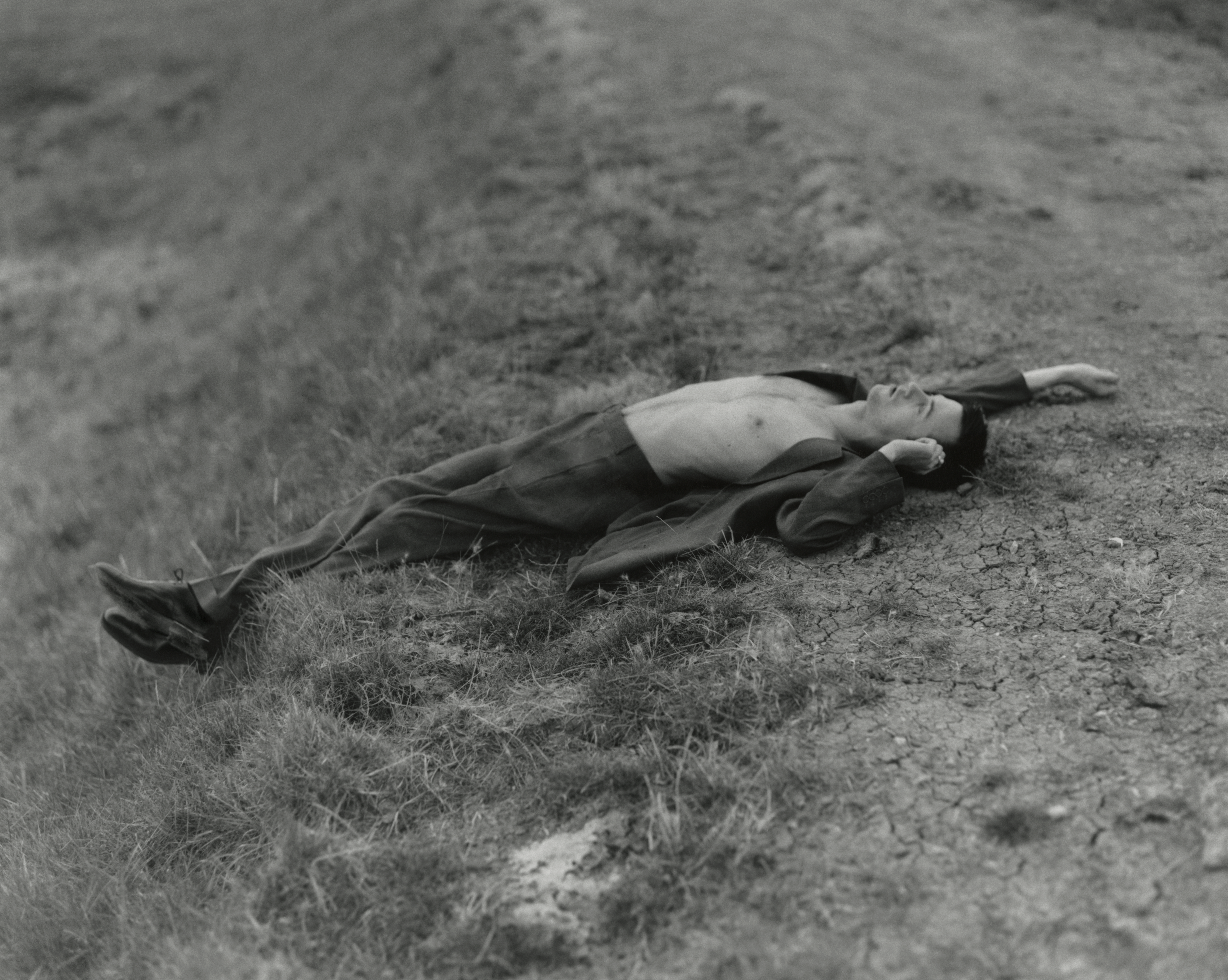
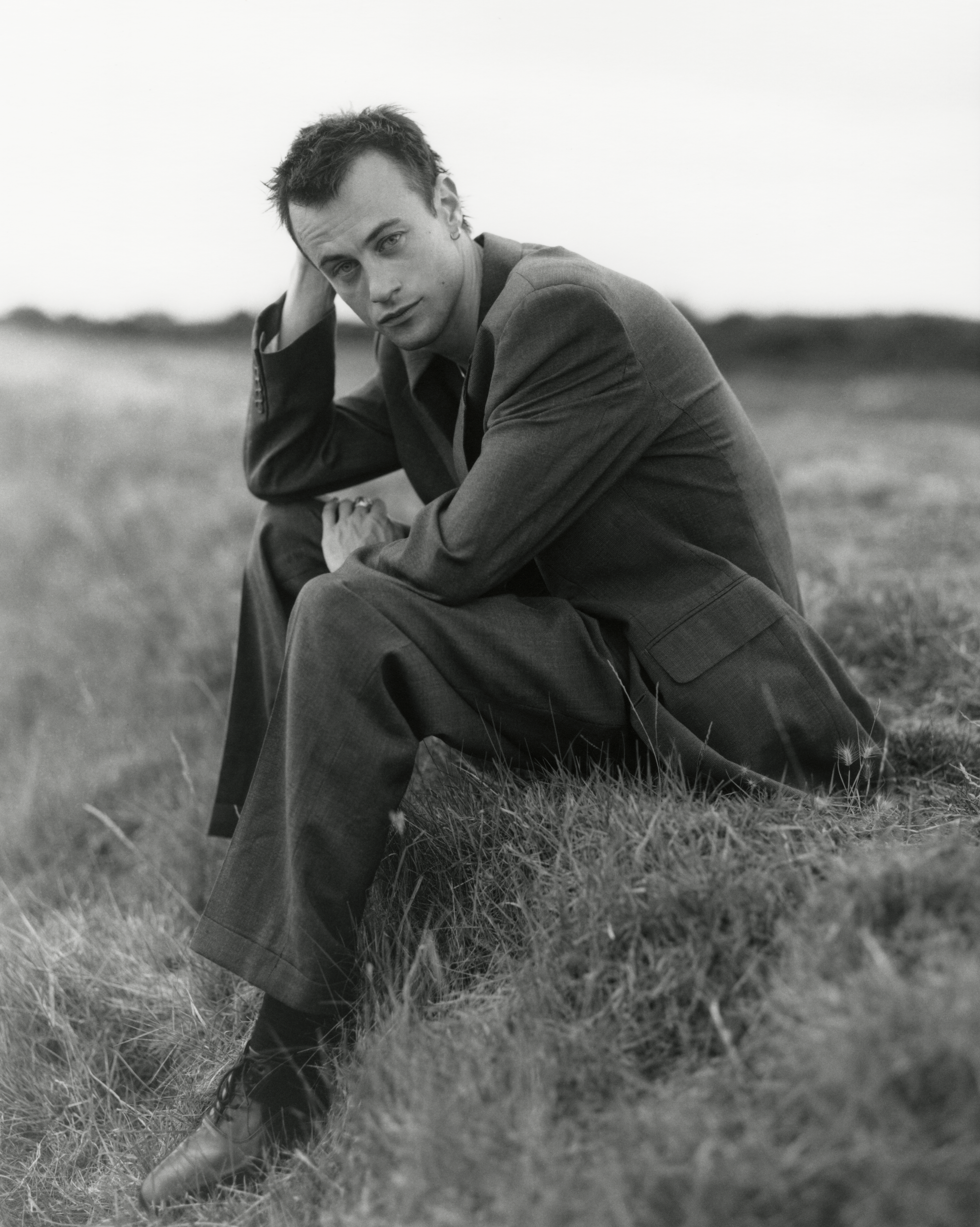
Talent · George Rouy Photography · Markn and Brigita Žižytė Fashion · Emma Simmonds Creative Direction · Jade Removille Special thanks to Rosie Fitter and Thibault Geffrin at Almine Rech
Designers
T shirt Vintage LAURA ASHLEY at LONDON.VINTAGE, paint splattered jeans and shoes George’s own, boxer shorts SUNSPEL and all jewellery George’s own
Vintage YVES SAINT LAURENT wool suit at GASOLINE RAINBOWS, shoes CHURCH’S and jewellery George’s own
Dress, archive GHARANI STROK at THE ARC
Jewellery George’s own
Vintage YVES SAINT LAURENT wool suit trousers at GASOLINE RAINBOWS and belt, shoes and jewellery George’s own
T-shirt in red ribbed jersey, archive HELMUT LANG AW1997 at ENDYMA and classic tailored trousers in polished calfskin, archive HELMUT LANG AW2000 at ENDYMA, crystal drop earrings Stylist’s own, shoes CHURCH’S and all jewellery George’s own
Vintage YVES SAINT LAURENT wool suit trousers at GASOLINE RAINBOWS and belt, shoes and jewellery George’s own
Leather shirt and trousers BOTTEGA VENETA and all jewellery George’s own
T-shirt in red ribbed jersey, archive HELMUT LANG AW1997 at ENDYMA and crystal drop earrings Stylist’s own
Archive HELMUT LANG SS 2004 cut out Nipple tank at ENDYMA, Archive HELMUT LANG 1998 Painter Jeans at NDWC0 Archive, Paint splattered shoes and jewellery George’s own
Black wool suit BOTTEGA VENETA
Archive JUNYA WATANABE, SS 2002, Poem shirt at NDWC0 Archive. Black jersey strappy top, archive ALEXANDER MCQUEEN SS2002 ‘Dance of the Twisted Bull’ at THE ARC, classic tailored trousers in polished calfskin, archive HELMUT LANG AW2000 at ENDYMA, shoes CHURCH’S and all jewellery George’s own.
Vintage YVES SAINT LAURENT wool suit trousers at GASOLINE RAINBOWS and belt, shoes and jewellery George’s own