NR 16 In Our World · Autumn Winter 2022 Published · Print Page 326
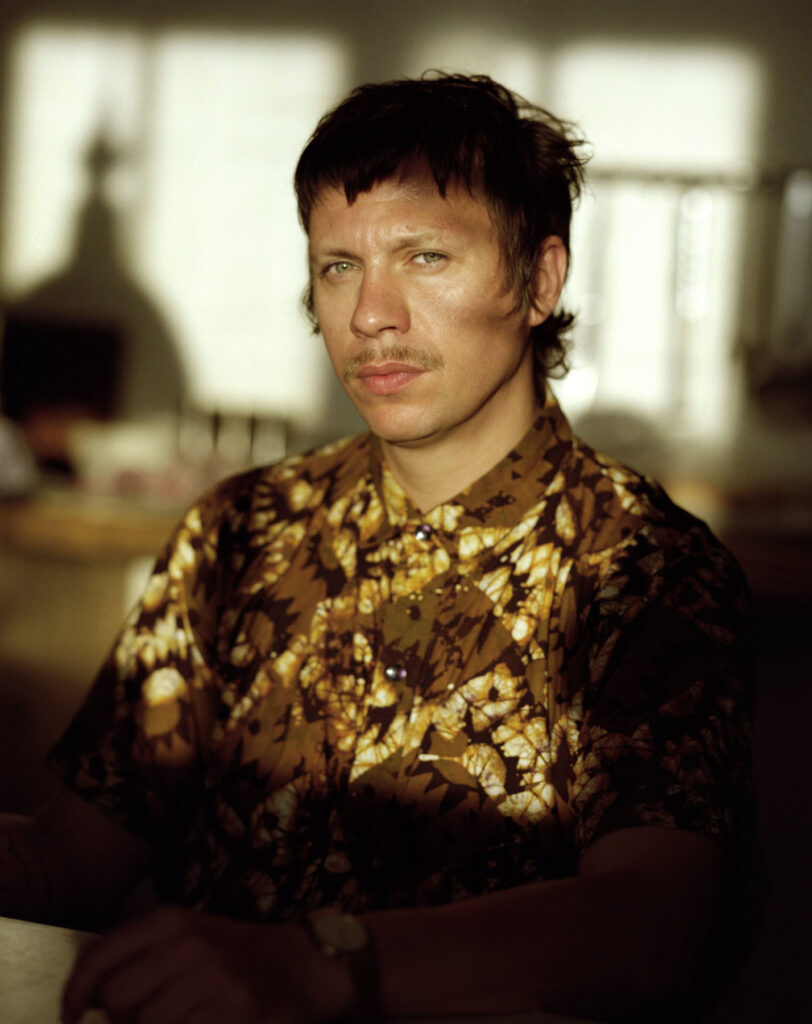
Cover Feature · Filippo Scotti Words · Matthew Burgos
Relieving trauma has Filippo Scotti revisit parts and memories of himself
Filippo Scotti wears a worried look as he fires off apologies for being five minutes late into the call. He was helping his friend with a project and lost track of time. He asked him to pedal fast when the two breezed through the street on his friend’s bike, hoping to catch the interview on time. After a bout of reassurance that he has nothing to worry about, he drinks from his 1.5 liters of water bottle to fight off the 38 degrees celsius heat crashing over Rome. Drinking tons of water forms part of his daily routine along with hours of physical training for his next project. NR tries to break through the secret project, but Filippo’s lips remain sealed. The only piece of information he gives is that “imagine wearing a t-shirt when it is 10 degrees out there. I have to prepare my body for that.” He assures us that he will not be doing jump stunts like Tom Cruise. Even if that were the project, Scotti would buckle down in a heartbeat to physically prepare for it.
On starting out
Scotti started out as a theater actor in Naples at the age of 16, and even before that, his mother had encouraged him to try his hand out at acting when he was 11. While on tour with his theater group for shows, an agency signed him, the gradual shift of the young actor from theater to cinema. His new lineup brimmed with auditions where he would prepare each day to spew out his memorized lines with depth to match his character’s emotions, almost melding with his own. Those moments culminated in Scotti earning the role of Fabietto Schisa in Paolo Sorrentino’s The Hand of God (2021). Now that he is thinking about it with NR, he admits he got lucky.
Working for the movie nudged Scotti to look at the cinema industry as a spider web where he always has to move, audition, secure roles, act, and go on press tours. The cycle repeats, and he admits it took him a while to get a hang of the rhythm. But his strike of luck keeps him in the spotlight, project after project. “I am also lucky that people whom I worked and work with trust and have taught me how to be and stay in character, to always be ready for what is coming. I am always learning and never stopping, and that is a double-edged sword for me. It scares me, but at the same time, it excites me. The whole experience is just wonderful,” he says.
On preparing for the shoot
From luck, the conversation flows to how mathematical he sees the process of being on set is. Everything seems to be planned – a miscalculation in schedule, equipment, script, and post-production means shooting delays. The viewers see the finished product flashed on the cinema screens, but it only scratches the surface of what happens behind the scenes (not the bloopers that seem to detract the attention from the hard work invested in producing and making a movie).
Scotti tells NR that often he wakes up early only to start shooting late in the afternoon or at night. The physical and mental preparation he undergoes also comes in handy when his first hours are spent idly waiting for his turn. Then, when he acts in a scene and the first take is not good enough, it might take two, three, four, five, or more takes before he can settle down. “During the shoot, I block out any thoughts so I can stay focused on my character. When I do more than five takes – even four because I always target a maximum of three takes – I start to hit this wall and fall into this repetition. It affects the way I act, so I strive to get it all done before the third take,” he says.
On relieving trauma
For The Hand of God, some takes took more than three times, and as the shooting went on, Scotti found himself in the shoes of Fabietto’s character, beyond the biopic he was portraying. He would think of ways to tap into Fabietto’s pain and tragic experiences, but would end up feeling obligated to play the role. Sorrentino noticed, sat with him, and told him that he should give his truth to the lines of his character. “If I am to say my lines, I should think of my truth – the painful events that happened in my life,” he says. Scotti followed the director’s advice and soon, he relieved his truth, even if it meant digging up the past he had already buried. “While I did not live the tragedy Fabietto lived, I felt the pain he felt as I remembered my past,” Scotti tells NR.
When asked about the experiences he went through, Scotti pauses. Seconds of silence have passed before he speaks. “I am only going to share one event that was strange for me,” he begins. When he was in high school, Scotti enjoyed the company of his friends, the topics his teachers delved into, and the theater classes he had in between. Yet the young actor felt as if he was in limbo, the weight of an unknown sensation seemed to be putting him in stagnation. He felt stuck and he could not pinpoint why. “Until now, I find it hard to describe the feeling,” he says. “I wanted to study, but I did not want to study. There was this push-and-pull feeling that tired me out.” Suddenly, Scotti was playing a role of a character who was stuck and wanted to find a way out, a real-life portrayal of a role he saw in movies. Like a coming-of-age movie, he figured out that he felt free after he pursued acting full-time. He still studies for pleasure from time to time, but he no longer has time to beat. His pace, his time.
Relieving his past traumas for his role in The Hand of God made Scotti realize how, at times, he has to take off his mask and acknowledge and understand his vulnerability. “To accept it is difficult sometimes,” he says. “But I feel lighter afterward, knowing that I have understood what it meant.”
On fame and recognition
Scotti has experienced being recognized on the street for his role as Fabietto. When asked if the gradual build-up of fame surrounding his career affects him, he says that he is more focused on the emotions and depth he dedicates to his roles rather than the recognition he receives from the public. It pleases him to know that he can influence viewers with his acting – he even receives direct messages on his social media, which he reads, double taps, and treasures – and Scotti reminds us that the Scotti who portrayed a role in his previous project differs from the Scotti today. “Am I the same person? Would I be able to do better in the next project? Responsibilities come and go. I love being the message people can relate to, and I hope to continue that.”
On moving beyond acting
During his press tours for The Hand of God, Scotti was asked at times if he wanted to be a director one day. He could not remember when he had said that, or if he had even said it at all, but somehow, it piqued the press’ curiosity over his next venture. For NR, he says he loves writing and the idea of crafting characters over directing a movie, but that above all, he would love to produce movies. “If I were to have the opportunity in the future, I would love to open my own production company,” he says. “It would be difficult but worth it at the same time. The idea is exciting, to be honest.”
Scotti already has a name for his production company, but he says he will keep it to himself for now. As for the movies he will produce, he wants some gut-wrenching scripts based on reality. They do not have to be drama or tragedy. He envisions his movies as means to address topics that the general public might not be open or ready yet to talk about or reflect on. While he is unsure of specific themes, his statement circles back to how he dealt with his trauma, a potential overview of the visual narratives he wants the public to see.
On reflecting on his own
As a fan of words, Scotti used to bring a notepad in his pocket to jot down his thoughts. They were gone the moment they crossed his mind, and he wanted to keep track of these phrases, hoping they would make sense when he revisits them in the future. Touring and traveling means he stays far from home and finds himself on his own. In the times he is in his own space, Scotti ponders on life, love, movies, his career, his next path, his decisions, his regrets, and what he might have forgotten to say or do. “For example, I am living in Rome and my family is living in Naples. It feels far and close at the same time. I check in with myself on what I feel when I experience this. Then, I write down my thoughts,” he says. He has replaced his notepad with a ‘notes’ app on his phone. He reminds us that his thoughts are not poetry, but just jumbled words that made sense to him at the moment of writing, a set of word vomit he feels acquainted with.
Filippo Scotti appears hesitant to share one of his personal thoughts. He fumbles on his phone and stammers as he finds an excuse to refuse. We assure him it is fine if he does not want to share anything. He calls his typed-down thoughts shitty and bad. We disagree. He turns his phone to the camera and shows a long list of saved thoughts on his app. He clicks on one and purses his lips. “Last night, I dreamed of your pain. Up close, I can see the waves of the sea,” he reads. Earlier, he said he wants to base his acting on emotions for people to relate with, a mission he eyes to fulfill by playing a character. His delivery for NR can attest that while he still has mountains to climb, he is already on his way to reaching their peaks.
Team
Talent · Filippo Scotti Photography · Bobby Buddy at Kaptive Fashion · Victoire Seveno at Kaptive Hair and Grooming · Miwa Moroki Set Design · Clara de Gobert and Nico Plinio Lanteri Agents · Carole Congos and Amal Jefjef Fashion Assistant · Flore de Sermet Special thanks to Gianni Galli
Designers
Full look PRADA
Full look PRADA
Full look PRADA
Full look PRADA
T-shirt RON DORFF, jacket, trouser and shoes BOTTEGA VENETA
NR 16 In Our World · Autumn Winter 2022 Published · Print Page 338
Feature · Andres Serrano Words · Jade Removille
The transgressive art of Andres Serrano, an introspective window into the past that continues to feed our present
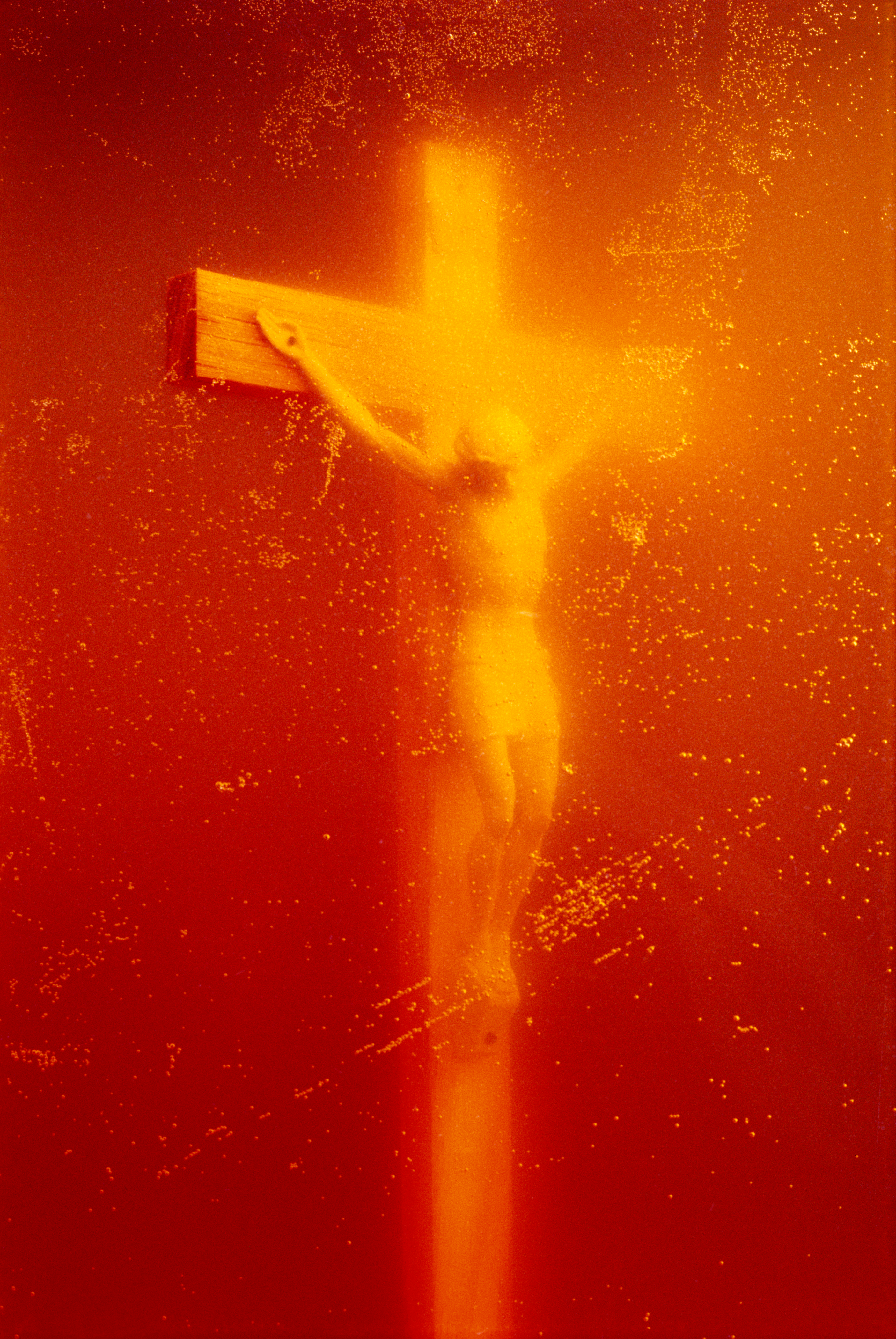
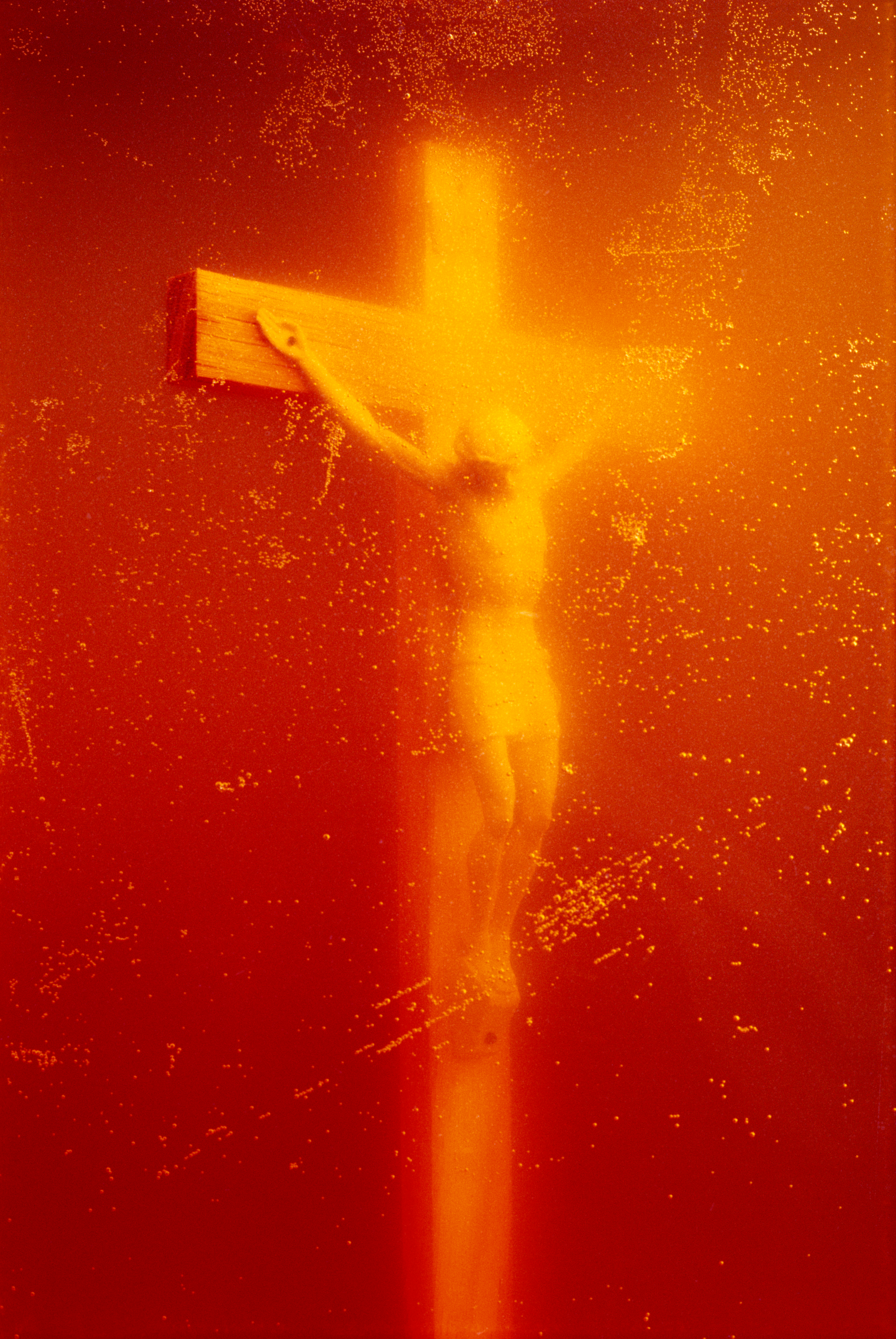
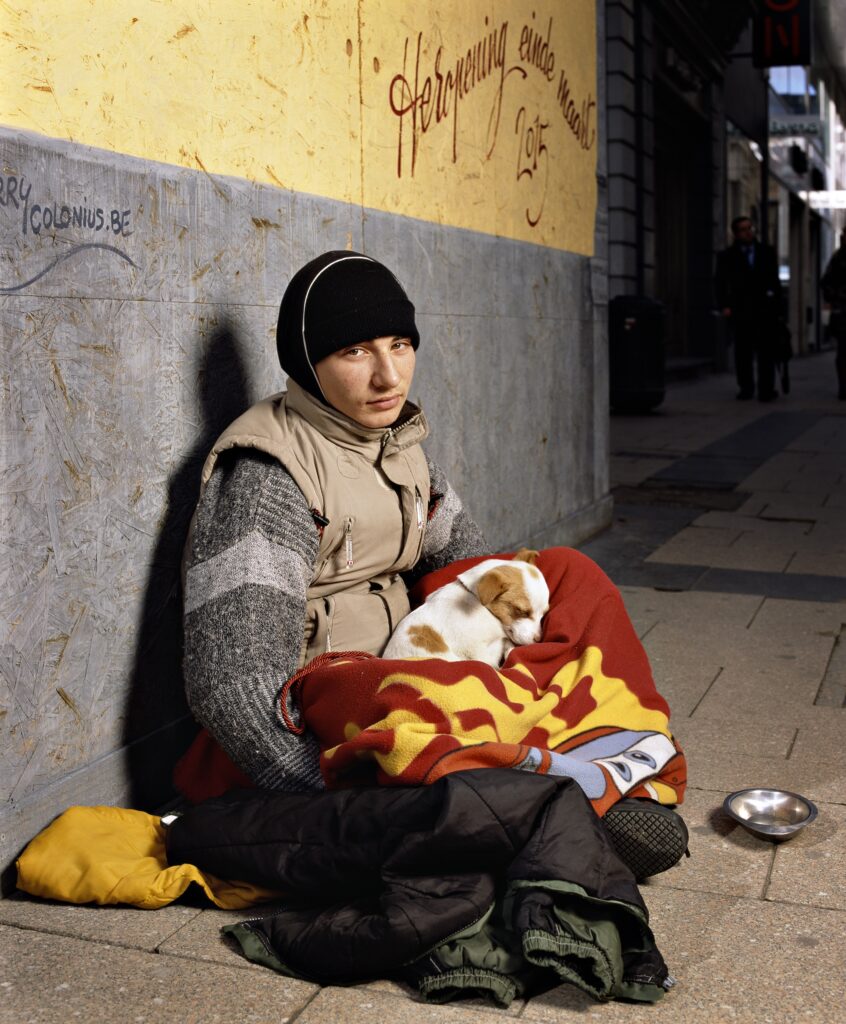
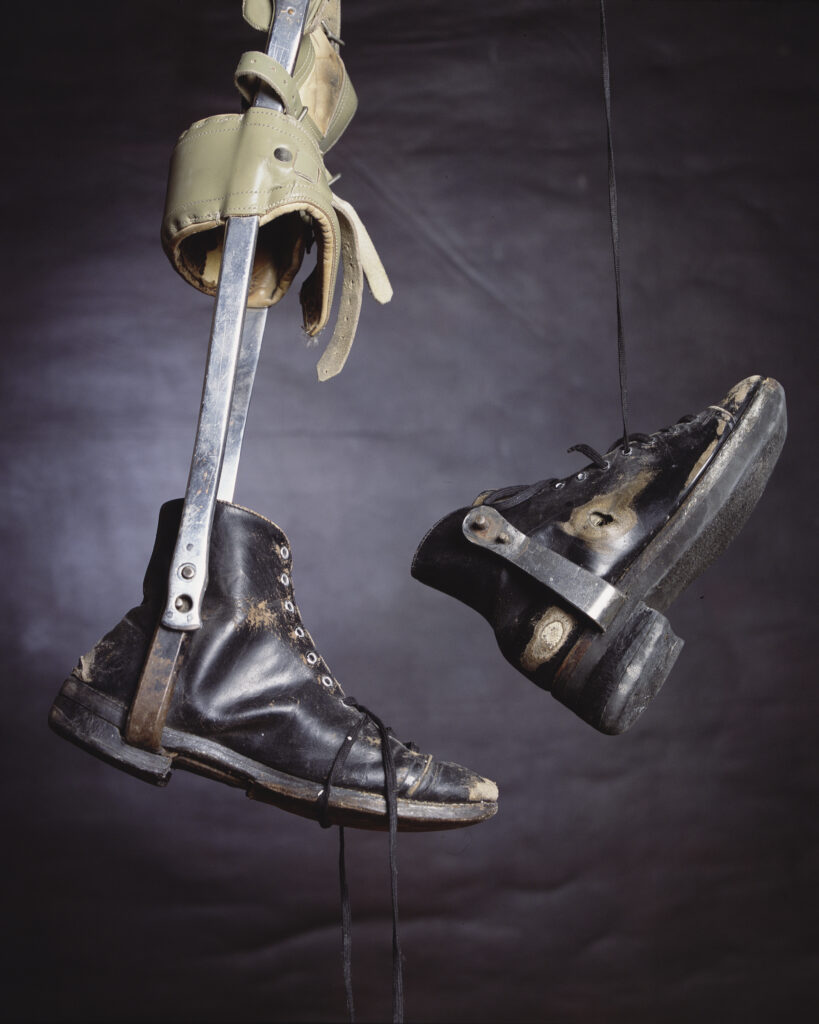
Andres Serrano (born 1950 in New York, United States) has been recognised for his thought-provoking photographs and installations. Although the public might mostly recognise his famed Piss Christ, 1987 installation, featuring a small figurine of crucified Christ immersed in the artist’s own urine, the photographer has created an archive of series reflecting on societal themes ranging from death, religion to torture, racism and more. The scenes and subjects of Serrano’s painting-like photographs provoke the mind exactly like one would hope art does. Trained in sculpture and painting at the Brooklyn Museum Art school and inspired by Baroque and Italian Renaissance art, rituals and religious iconography infused by his Roman catholic upbringing, Serrano’s transgressive art is timeless. Representing the destitute and the marginalised (Residents of New York, 2014), sharing an authentic and personal take on Cuba (Cuba, 2012), portraying one of the most infamous leader of our generation (The Game: All Things Trump, 2018-2019) are only a few of the many themes and subjects Serrano explore. No matter the matter, Serrano manages to bring its beauty and inherent peace to the surface as the subject takes precedence in his work. There is a confrontational aspect to Serrano’s body of work and that is the success of his challenging work. Serving as a tool for introspection and engaging the viewer to see what it is not easy to view, Serrano’s art is an invite to reflect and not perpetuate the horrors of the past that continue to feed our present.
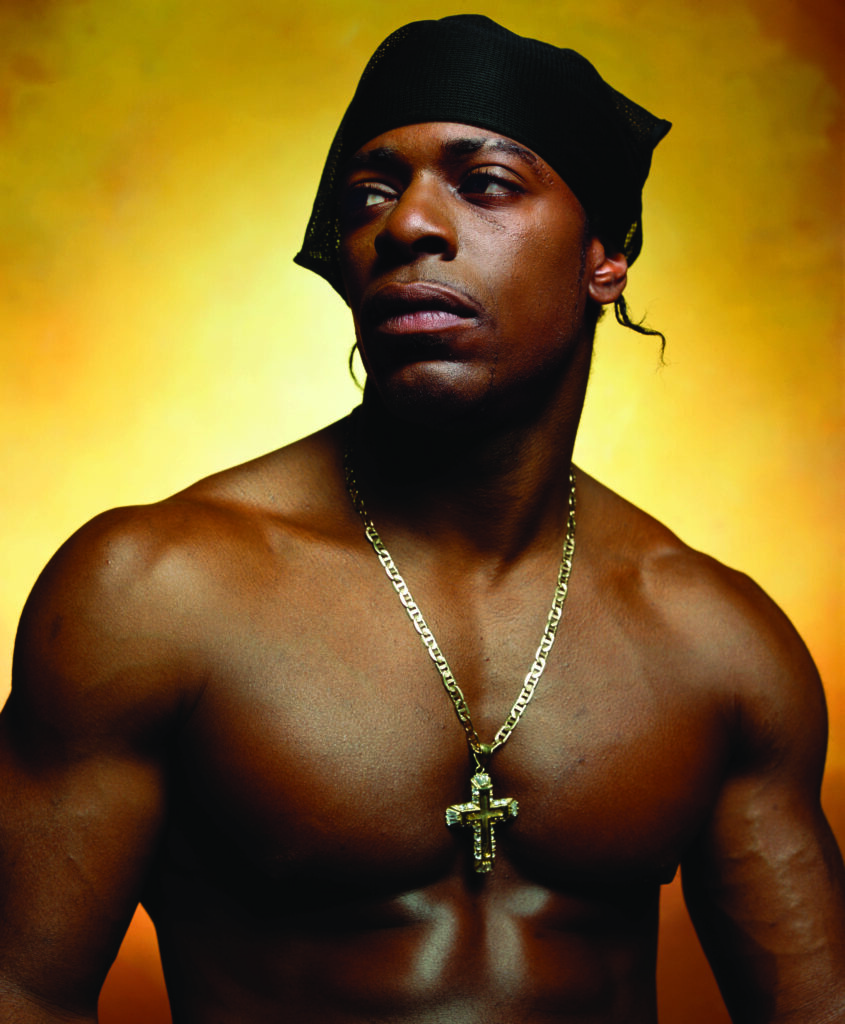
Andres Serrano, Lawrence Artis (America 2001-2004)
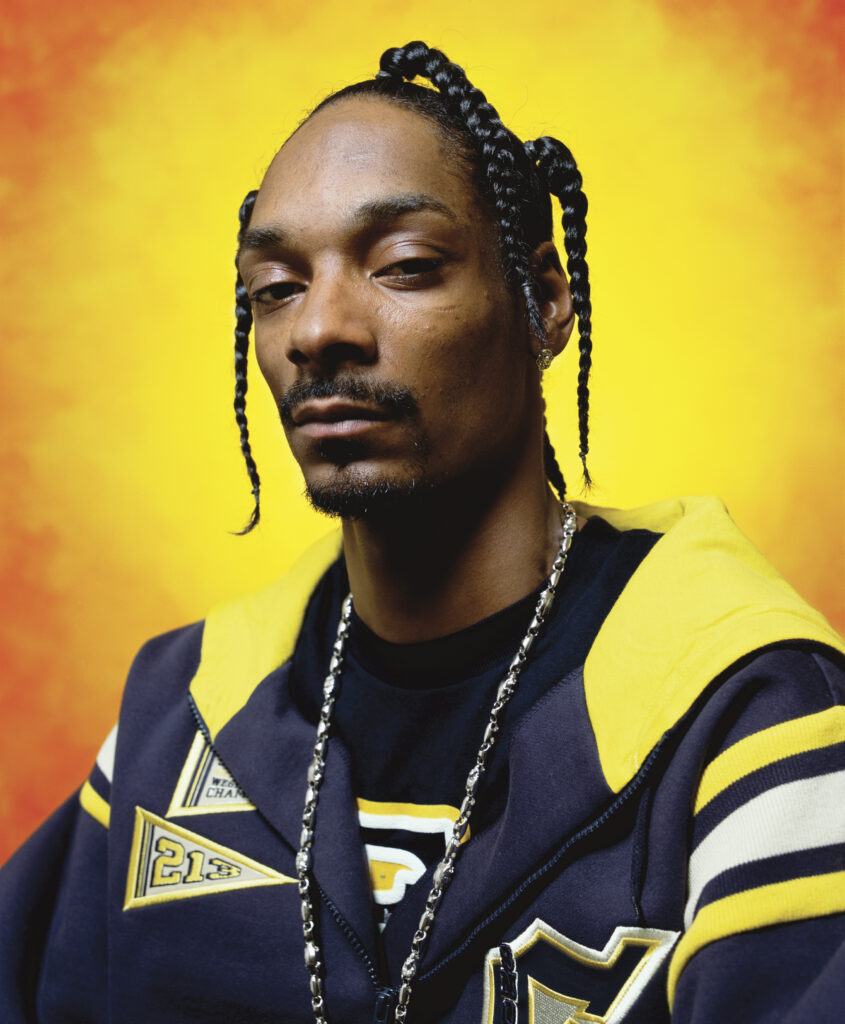
Andres Serrano, Snoop Dogg (America 2001-2004)
Andres, it is an honour to interview you. I have discovered your work a few years ago and have been fascinated ever since. Thank you very much for taking the time to participate, I am delighted to have you as part of this issue. I would like to start from the beginning. I was watching an interview with photographer Joel Meyerowitz (How I Make Photographs: Joel Meyerowitz in conversation with Amanda Hajjar) and he was reflecting on a life changing moment that made him see a realm of possibilities in front of his eyes: being on set with the great Robert Frank, in New York. Have you had an event like this, that changed the course of your life or initiated the beginning of your career?
I’ve had a few life changing moments, some good, some not. The problem with those moments is that you don’t always realize how profoundly they can affect you when they’re occurring. I used to see my life as a fast train not making any stops.
“The journey was more important than the destination. When you look back, you can’t say, “I should have done things different.” If you could, you would have, but you didn’t. I’ve fucked up more than once but I’m still here.”
There was one pivotal moment: when the Beatles came to America. I was 13. They were followed by the Rolling Stones and everyone else. Soon after that I discovered Bob Dylan and I was set for life.
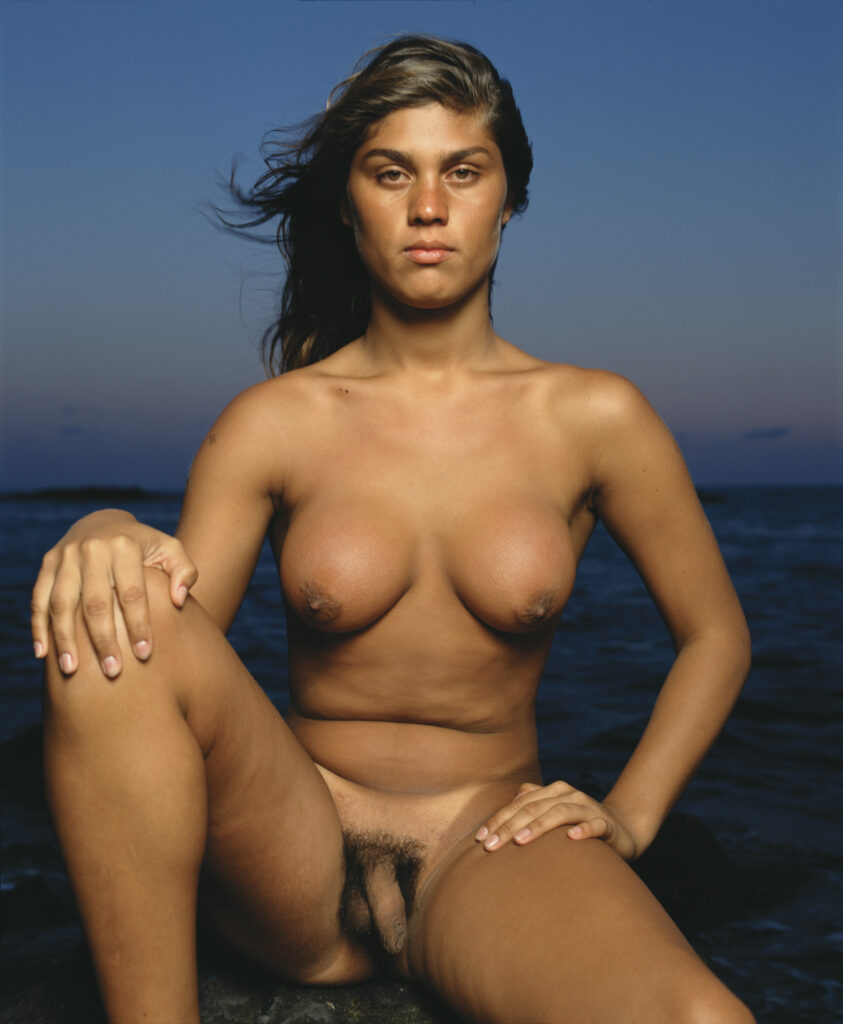
Andres Serrano, Alessandra (A History of Sex 1995-1996)
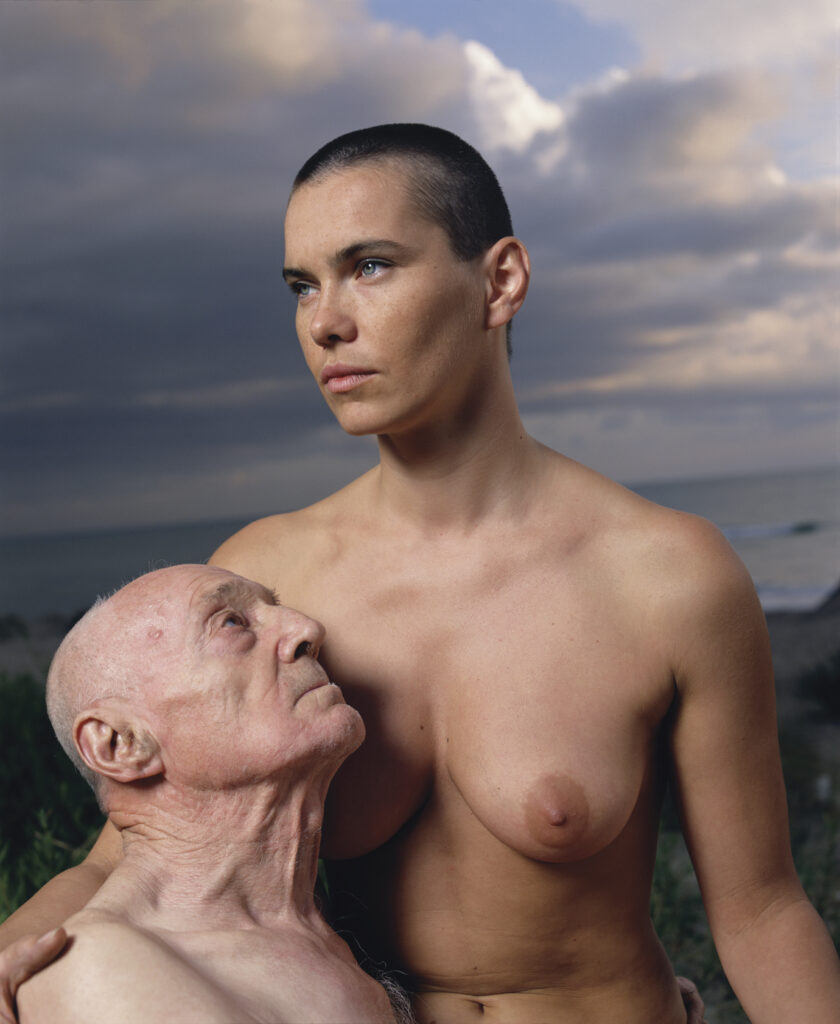
Andres Serrano, Antonio and Ulrike (A History of Sex 1995-1996)
You were born in New York, grew up as an only child raised by your mother. Your mother was born in Key West, Florida, was raised in Cuba and thus only spoke Spanish that you then had to learn at a young age. How did these different cultural identities impact you?
The good thing is that I had to learn Spanish at an early age. The bad thing was that I didn’t like my mother. We fought all the time. But that was also a good thing because she was tough so I had to be tougher. The only cultural identity problem I had was when Castro came into power and a kid in the fifth grade discovered my mother had been raised in Cuba. After that, the little prick would tease me by calling me “Castro” or “Cuban.” It would piss me off and also embarrass me. The Cuban Missile Crisis in 1962 was a big deal and no one wanted to be called “Castro” or “Cuban.”
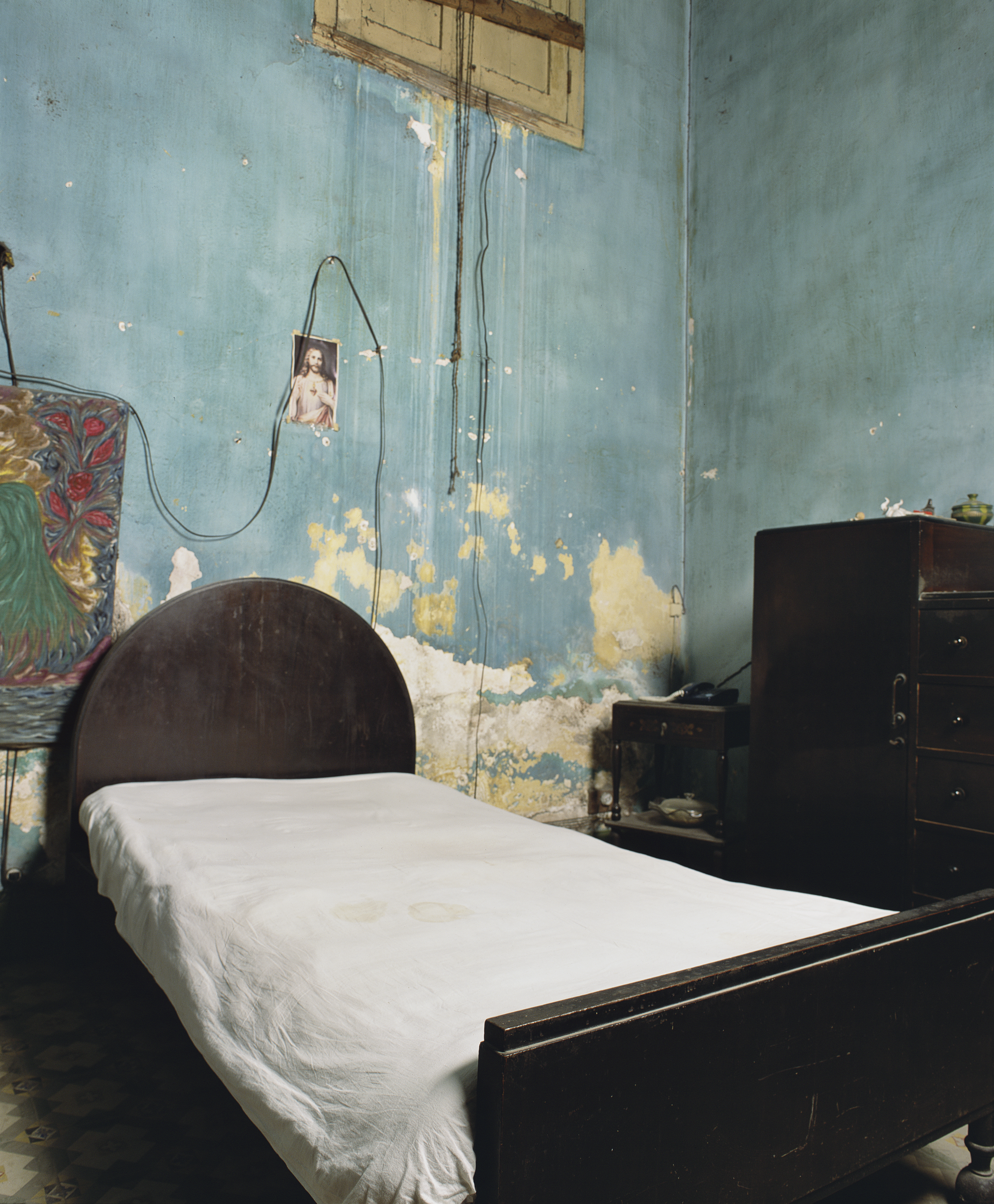
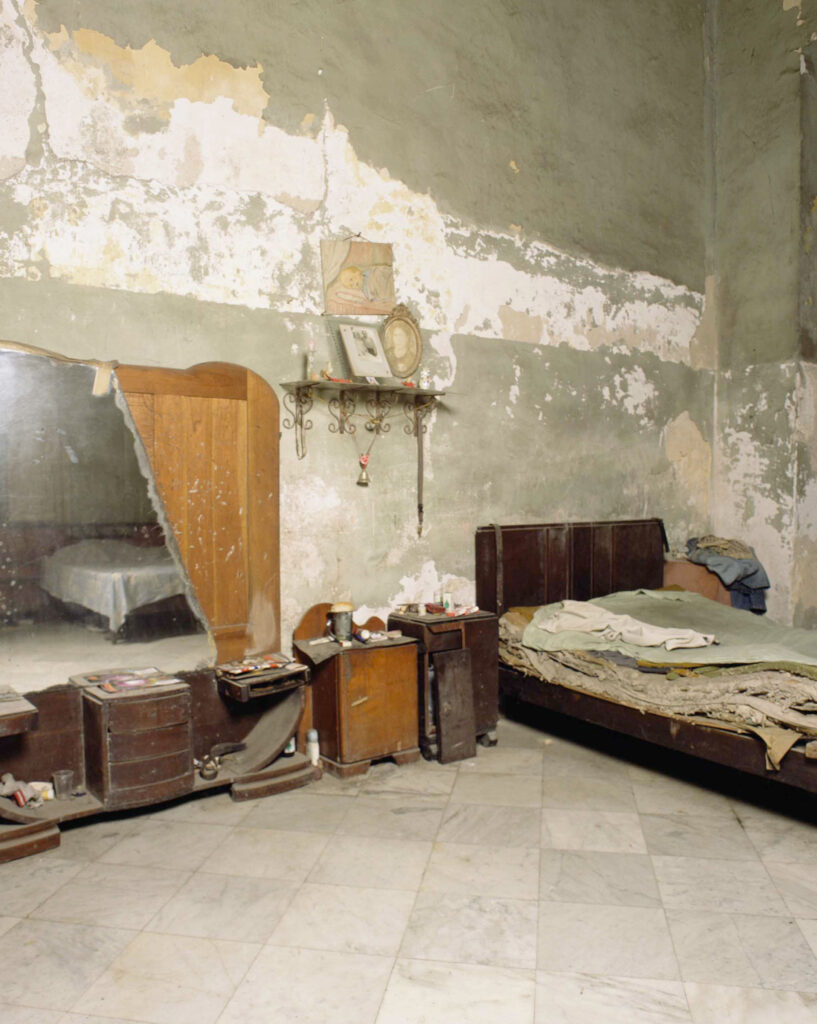
Andres Serrano, Bedroom with Jesus (Cuba 2012)
60 years later you would think that kind of stigma wouldn’t matter but apparently it does. America still acts like Castro and Cuba are its biggest enemies. It’s easier to pick on someone you don’t need or fear than to stand up to the real strongmen.
When President Biden went to Saudi Arabia he went for oil, not to confront the Crown Prince about the murder of Jamal Khashoggi. And when he tried to bring it up the Crown Prince responded by telling him America wasn’t so clean either. What’s Biden going to say to that? “You’re wrong, we don’t kill innocent people or put children in cages.”
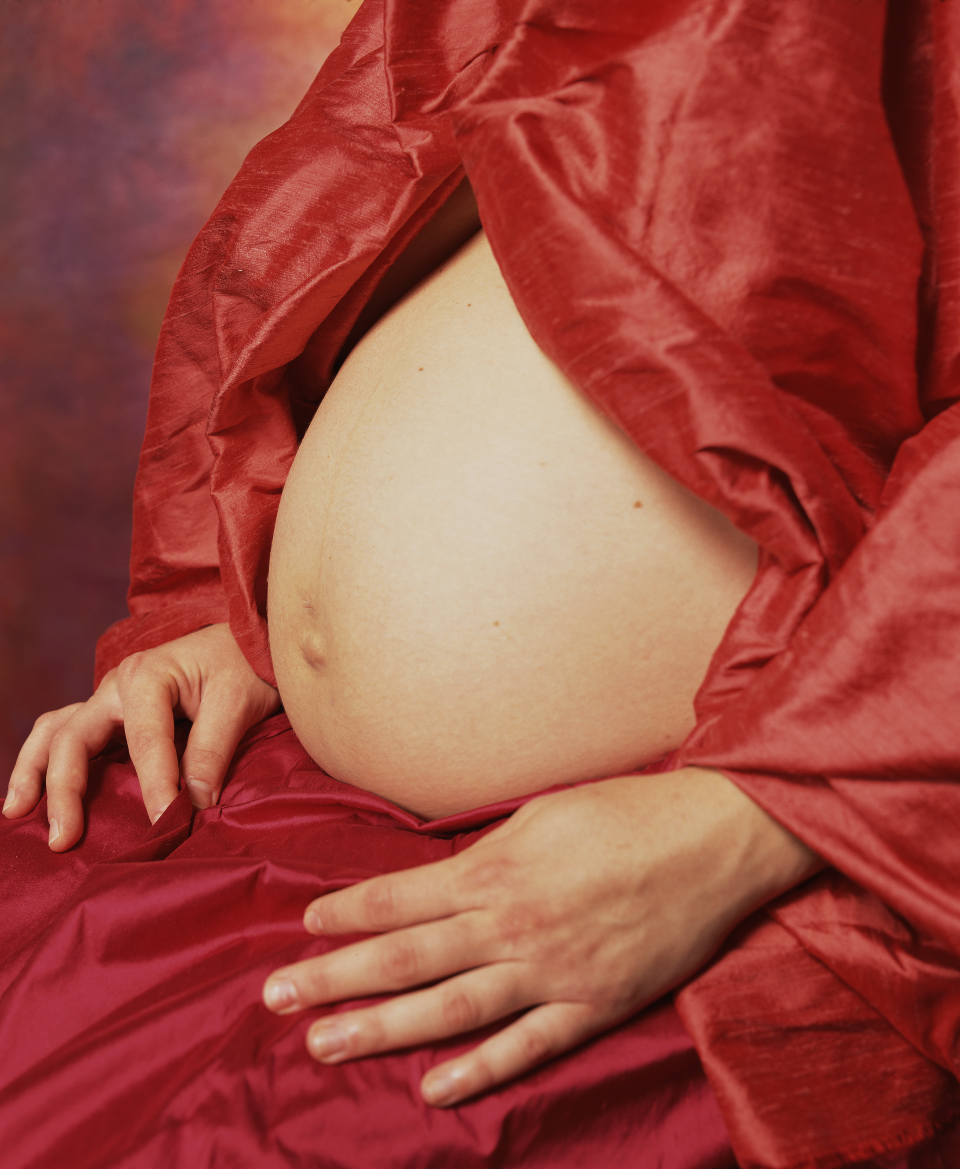
Andres Serrano, Magdalena, 2011 Courtesy of the artist and Galerie Nathalie Obadia, Paris/Brussels
I tell you what impacted me more than anything else. As a child growing up, my mother had several schizophrenic episodes. She would be fine for two or three years then she would have a nervous breakdown that would last a couple of weeks before she returned to normal. I was always trying to figure out what was going on in her head during those periods. It taught me to read people, to get a sense of what they were thinking and feeling.
Some people are obvious. They are what they appear to be. I would always shake my head when the political pundits on television would spend so much time trying to figure out what Donald Trump meant by the things he said. Trump is transparent. He means exactly what he says.
What was it like to travel there and discover it, later on, as an artist for Cuba, 2012 (exhibited in Brussels, 2014)?
I loved your documentation of the interiors of the houses and the portraits specially of the women. Did you feel attached to Cuba?
I loved Cuba when I finally went. I waited my whole life to go. I don’t like to travel except for work. I needed a reason to go to Cuba and the reason came when Jorge Fernandez invited me to the Havana Biennial. Actually, I think I asked him to ask me. I participated and at the same time I went to do some work. I felt very much at home there. I feel at home whenever I go somewhere to work.
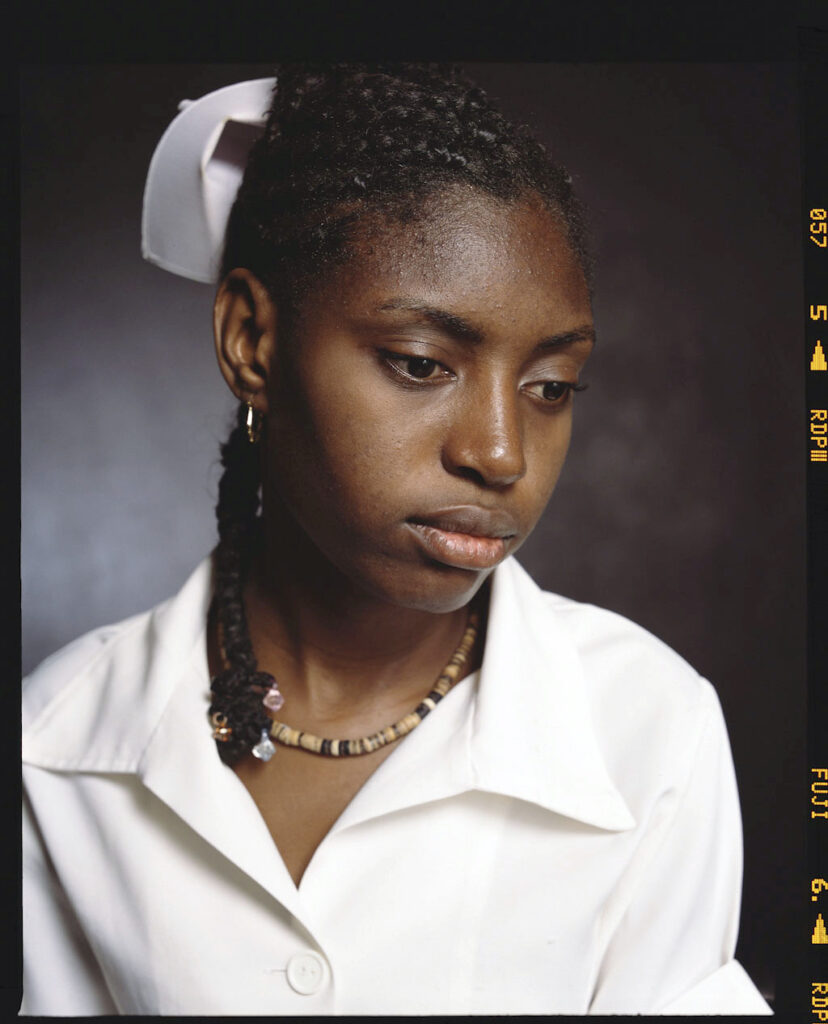
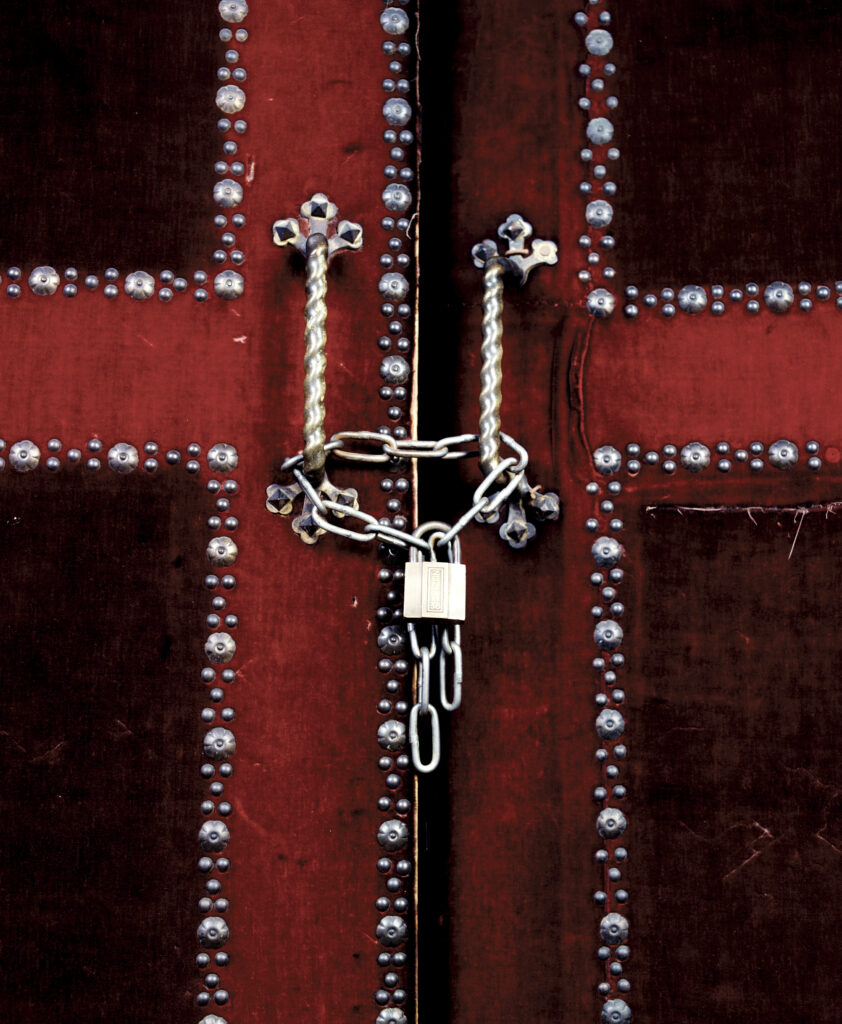
Andres Serrano, Cuba, 2012
The Cubans were very welcoming and I had a blast working day and night. Work, especially when it’s your work, gives you tremendous energy. I had my wife, Irina, my assistant from New York, some friends and comrades and a driver that drove us in a large SUV from one end of Cuba to the other. Talk about a great road trip! What I like best is driving in the middle of the night not knowing what you’re going to find. I don’t drive but I like being on the road, especially at night.
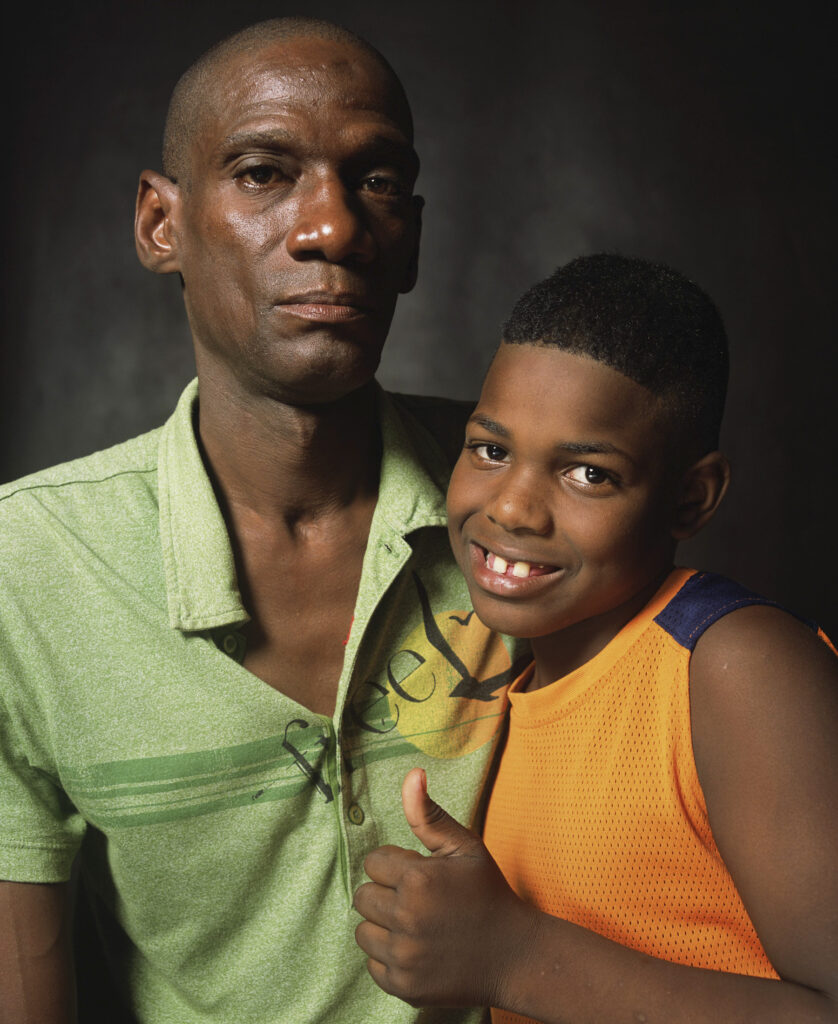
Andres Serrano, Cuba, 2012
The people are amazing! Cubans speak Spanish in a very precise way. They enunciate their words clearly. Once, in Havana, I saw a large stack of bread in a bakery that I wanted to photograph. I use lights and need time to set up for a shoot so I decided to go back the next day to photograph the bread. But the next day the bread was gone. They explained that the bread arrives early and would start selling immediately. So I bought all the bread in advance that was coming the following day. The next day, after I got to the bakery and took my picture, I told them, “Ok, now you can sell the bread again.”
I never talk much about myself in terms of ethnicity because it’s not important. All you need to know is that I was born and raised in New York City. But there are always people who like to get into your background, like it’s meaningful or the most important thing they can say about you. If you’re Black or White in America they don’t question you, but if you’re in a category that’s not easy for them to define, they try to define you anyway. My mother was born in America. I was born in America but they still want to place you somewhere else. I remember when we got back from Cuba I was telling someone about the trip. A couple of minutes into the conversation they say to me, “So what was it like going back to Cuba?” and I’m thinking, “Motherfucker, didn’t I just tell you I had never been to Cuba!”
“I don’t like to be called a photographer, but I have been called worst things.” At 17 years old, you studied painting and sculpture at the Brooklyn Museum art school. That background in painting can really be seen through your photography with the descriptiveness of the titles, the colours and the texture of the photographs. Why did you engage with photography as your preferred medium?
After two years at the Brooklyn Museum my scholarship ended and I didn’t have a studio to paint or sculpt. But I lived with a girl named Millie and she had a camera so I started taking pictures with Millie’s camera. I always knew I wasn’t a photographer but an artist who chose to take pictures as his art practice. I never went into a darkroom or printed my photographs (I still use film.) Photography has been a means to an end and that end has been to create art. I’ve always said I learned everything I know about art from Marcel Duchamp who taught me that anything, including a photograph, could be a work of art.
When I was in my twenties during the Seventies I wound up in the East Village taking and selling drugs. It was a period when I stopped taking pictures because I was not an artist at that point but a drug addict.
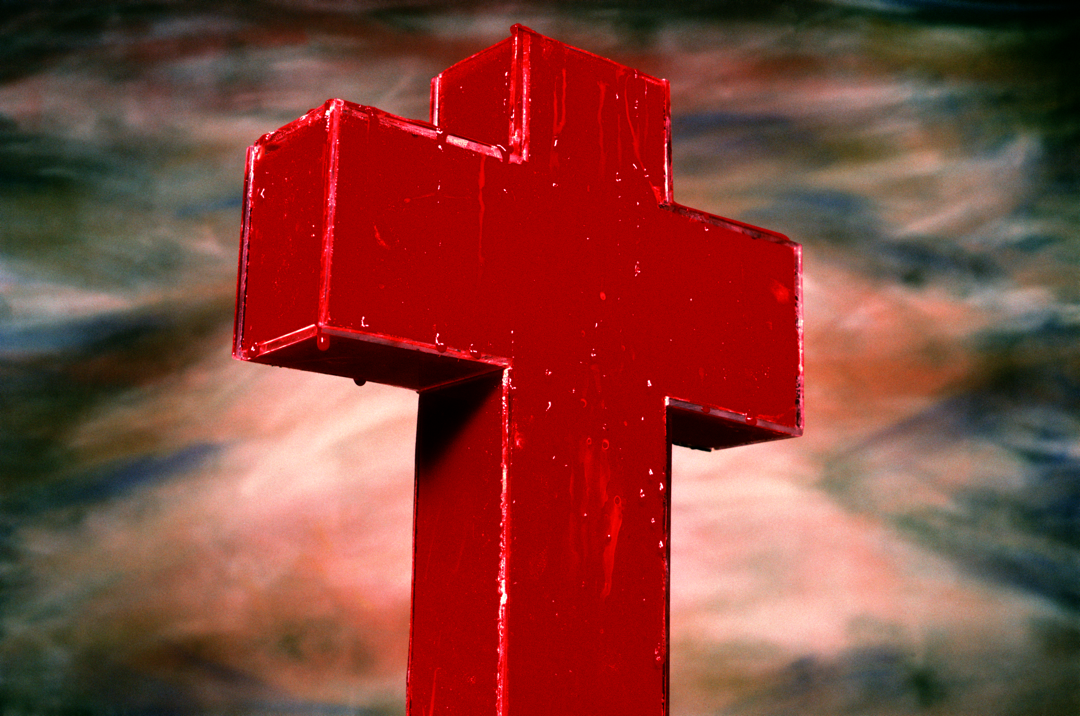
Andres Serrano, Blood Cross, 1985 Courtesy of the artist and Galerie Nathalie Obadia, Paris/Brussels.
I can’t say it was a bad time because I was having a good time. But it stopped being a good time when the people around me started dying and I knew it was time for me to leave. If I had gone from the Brooklyn Museum Art School to being an artist I probably would have been a different artist although I can’t imagine how. Everything is going to have an impact on you one way or another but you might stay the same.
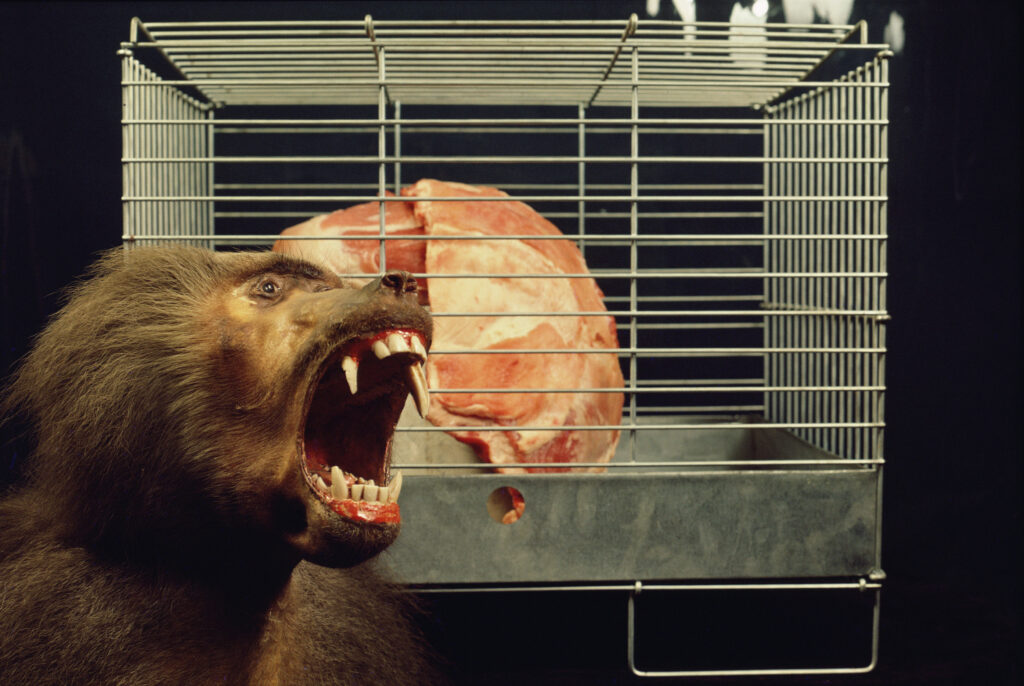
Andres Serrano, Caged Meat, 1987 Courtesy of the artist and Galerie Nathalie Obadia, Paris/Brussels.
The 1980s in New York, what did this mean as an artist in terms of starting out, getting recognised by galleries, having shows etc? How is it now?
The 1980s in New York was an exciting time for me. I met and married my first wife, Julie Ault, in 1980 and got back into art shortly after that. Julie had just formed an artist collective called Group Material along with Tim Rollins, her friend from Maine. Group Material was a group of several artists who mounted group exhibitions of other artists’ work that addressed social and cultural issues such as AIDS, consumerism and democracy. I was never a member of Group Member. Julie was doing her thing and I was doing mine, but it was through Julie that I became aware of what some artists were doing. I met some great artists like Leon Golub and Nancy Spero who were always super nice. They were very encouraging to other artists.
It was Julie, who, upon meeting Felix Gonzales-Torres invited Felix to join the group. Felix didn’t need Group Material to make it but Julie recognized his talent early. Back then I wasn’t thinking about the art world, I was just doing my work. Julie and I lived on East 10 St. and when the art scene moved to the East Village several galleries, including Jay Gorney Gallery and P.P.O.W., came to our block. Interestingly, art, punk, graffiti, new wave music and street culture all came together in the East Village. Even the Post-Modernists were there. The first time I saw Jeff Koons work was at International With Monument on East 7 St. where Jeff showed his basketballs in water.
Andres Serrano, St. Clotilde II, Paris 1991 Courtesy of the artist and Galerie Nathalie Obadia, Paris/Brussels
The Eighties were also important for me for another reason. It was when rap and hip-hop appeared. The first time I heard Rapper’s Delight I knew it was something. I spent the whole decade listening to and collecting rap records. Music has always moved me more than art. Art does not touch me in the same way music does and rap was riveting.
Julie and I separated after ten years. I spent the Nineties going to clubs and listening to dance and house music at night and creating pieces during the day.
Things are different now. People come out of art school knowing what galleries they want to get into. There’s Instagram and social media. I’m not on social media. I still use a flip phone. If it wasn’t for Irina,
I wouldn’t have any idea of what’s happening in the art world. I still don’t. I think art and culture is now defined by algorithms.
Controversy and provocation play a huge part in your work. Was that something intentional?
With Piss Christ,1987 for instance although some viewers may see it as a blasphemy, it is important to note the attention brought to the act of crucifixion and thus dying. As Sister Wendy says in an interview :’An abuse shouldn’t take away its use’ (‘Sister Wendy in Conversation With Bill Moyers’ 1997). As a religious person, how does your faith interact with your art?
I’ve always thought that being an artist was the least controversial thing I’ve done. My life has been much more intense than my work. I remember when I first heard Dylan sing “And if my thought-dreams could be seen, they’d probably put my head in a guillotine, but it’s alright, Ma, it’s life, and life only,” and I thought, “That’s ridiculous. How could anyone get mad at you over what you’re thinking?”
Andres Serrano, Piss Christ, 1987 Courtesy of the artist and Galerie Nathalie Obadia, Paris
I was born and raised a Catholic and have been a Christian all my life but who cares? Certainly not the people who label you “anti- Christian and blasphemous.” There are people who think only they know what it means to be a Christian. You can’t talk to these people because they’re convinced that only they know the answer. It must feel good to tell other people how to live their lives. Personally, I don’t have that luxury or want the responsibility.
I like what Sister Wendy once said about me in an interview. “Serrano is not a terribly gifted young man but he tries.” I was in my late forties at the time so I was flattered that Sister Wendy called me a “young man.” I also liked when Senator Jesse Helms got up on the Senate floor and said, “Andres Serrano is not an artist. He’s a jerk who’s taunting the American people.”
Piss Christ made me think about the installation of Italian artist Maurizio Catalan, The three hanging kids (Untitled, 2004) that had been taken down almost immediately by the Italian authorities. When asked about the work, Catalan wondered if the real tensions and horrors of contemporary life should not shock us more. The Klan, 1990, Torture, 2015 and Infamous, 2019 are very confronting for instance, to the tainted history of the world. In your eyes which role art should play in society?
Art should play the role it wants to. It’s not for me to tell the art world what to do or not do. They wouldn’t listen to me anyway. I’ve never been a political or activist artist although there could be some element of that in my work.
“I’d rather let the work speak for itself. My work is a mirror that’s open to interpretation. People see what they want to see.”
Half the people voted for Biden and almost half the people voted for Trump. It’s up to you to decide which side is more fucked up. I never voted in my life until I voted for Obama. Twice. In the last election I didn’t vote for Biden. I voted against Trump. If a tomato had been running for president I would have voted for that tomato.
Theoretically, Democrats talk a good game but often can’t deliver. On a practical level, the Republicans won’t raise your taxes. People try to shame you into voting. As an American you have the right to vote and you have the right not to vote. Even the Supreme Court sometimes says, “Let’s sit this one out.”
Since the theme of this issue is IN OUR WORLD, which themes would you wish to see more tackled in the art world?
The art world is not the real world so it’s hard for me to see how it could tackle anything other than itself. There’s a feeling of sameness in the air, same people, same faces, same chatter, same agenda. It pretends to care and promote inclusivity but that inclusivity only includes the people who fit the demographics they’re looking for. You can’t deviate from the status quo otherwise you’re left out in the cold.
I left Paula Cooper Gallery in New York in 2008 and since then I’ve been a stranger in my own country.
Andres Serrano, Denizens of Brussel. Cristo, 2015 Courtesy of the artist and Galerie Nathalie Obadia, Paris/Brussels
I’ve had a great many museum exhibitions in Europe and around the world thanks to Nathalie Obadia and Yvon Lambert. I was even appointed a Chevalier in The Order of Arts and Letters in 2017.
But I’ve only had one museum exhibition in America and that was in the 90’s. I recently saw Adam Weinberg, Director of The Whitney Museum of American Art, at the Whitney Biennial and told him, “You know I’m an American artist and I’ve never been in the Whitney Biennial. I guess you’re waiting for me to die before you show me.” Adam laughed and said, “We’ll do something long before that.”
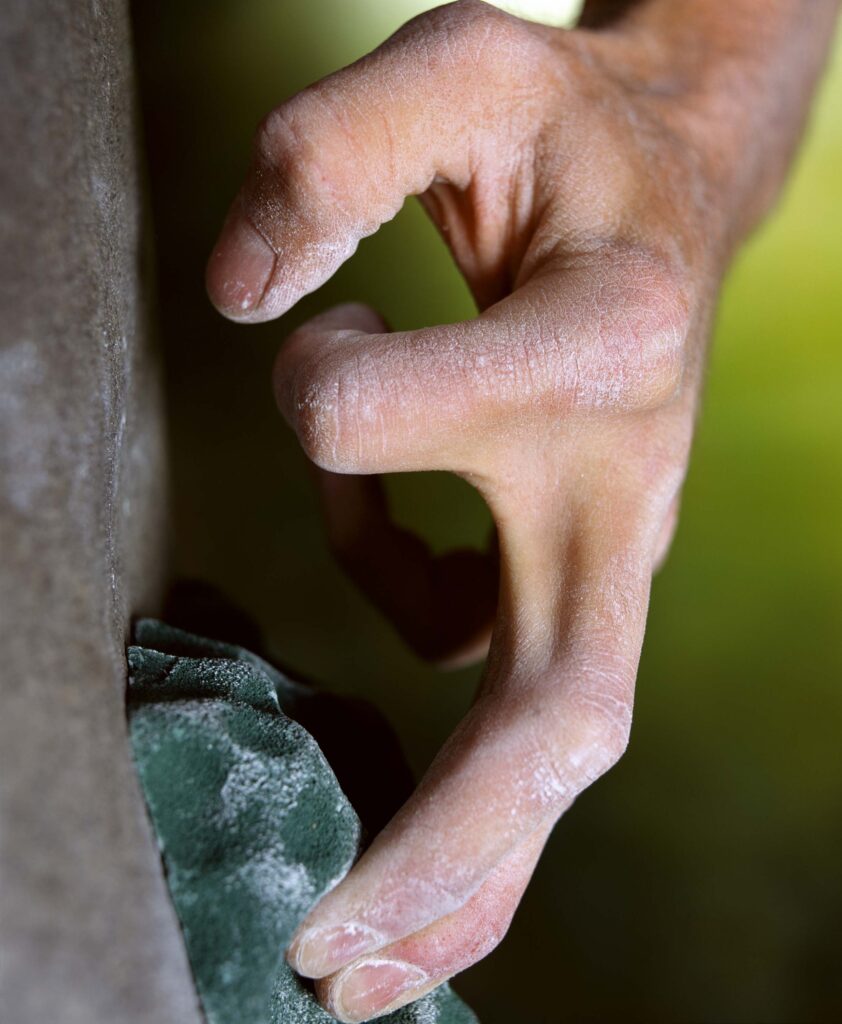
Andres Serrano, Chris Sharma, Rock Climber, 2006 Courtesy of the artist and Galerie Nathalie Obadia, Paris/Brussels
When I was a junkie in the East Village I felt somewhat distant from the people around me. “I am with you but I am not like you.” I still have that feeling.
Could you talk about your breathtaking series The Morgue, 1992 and those portraits. What was the reason behind the series and how was that experience considering that you were photographing people who had passed away. How was the interaction between them, yourself and the camera?
The inspiration behind The Morgue series was simple. I wanted to look at death. My interaction or involvement with the dead was as an artist who wants to find that inner peace that comes from an art that gives you spiritual and aesthetic comfort; the thing that brings stillness and tranquility. You could hear a pin drop in my work. It’s a moment frozen in time. When a song is right, when a picture pleases, it makes you feel like everything is right with the world. There’s beauty and grace everywhere, even in death.
With The Morgue, 1992, I think the titles indicating the causes of death in a way engage the viewer to wonder about the personal lives of these people. By this interrogation, it adds texture and life again to the stillness of death. That’s why I dont feel a sense of voyeurism but dignity and beauty. You have mentioned before that you are passing through. Could you delve into that?
The truth is we’re all passing through going from one thing to another, one place to another. I always title my work in such a way as to describe what you’re looking at. In the case of The Morgue, the cause of death tells you what brought these people to this place and everything I know about them.
“People change and in death they change even more. But the sense of humanity lingers on even after one’s demise.”
It was this essence that I wanted to capture. The soul and spirit of a person cannot be seen but it can be felt.
Andres Serrano, Body Parts, 2012
Andres Serrano, Body Parts, 2012
Could you talk about your collaboration with Supreme and how did that unfold? Which other brands would you be interested in collaborating with?
Supreme came to me and said they wanted to do something with my work. They had ideas and designs for sneakers, sweatpants, sweatshirts, hoodies and a skateboard with my work. It was an easy collaboration. All I had to do was say yes. In 1996, Kirk Hammett and Lars Ulrich from Metallica came to me and asked to use one of my images for a new album they were coming out with called, Load.
They following year they came out with Reload, the follow up to Load and again asked for one of my images. They also made t-shirts and other merchandise with my work. I’m always flattered and open to collaborations of my work with good artists and brands. I’m very proud of Load and Reload and the Supreme collection.
I’d like to collaborate with Gucci, Dior or Balenciaga. Sometimes the design houses are more cutting edge than the galleries. They know it pays to think outside the box. When people like you, they like what you do and these brands are well liked by their clients. The reason they’re liked is because their goods are well made and of good design. People always look forward to the new collections.
Do you have a favorite piece/body of work that you’ve realised?
I always have my favorites. I used to call them, “masterpieces,” the images from a particular series that stood out for me. There are many such images from The Morgue, The Klan, Immersions…etc.
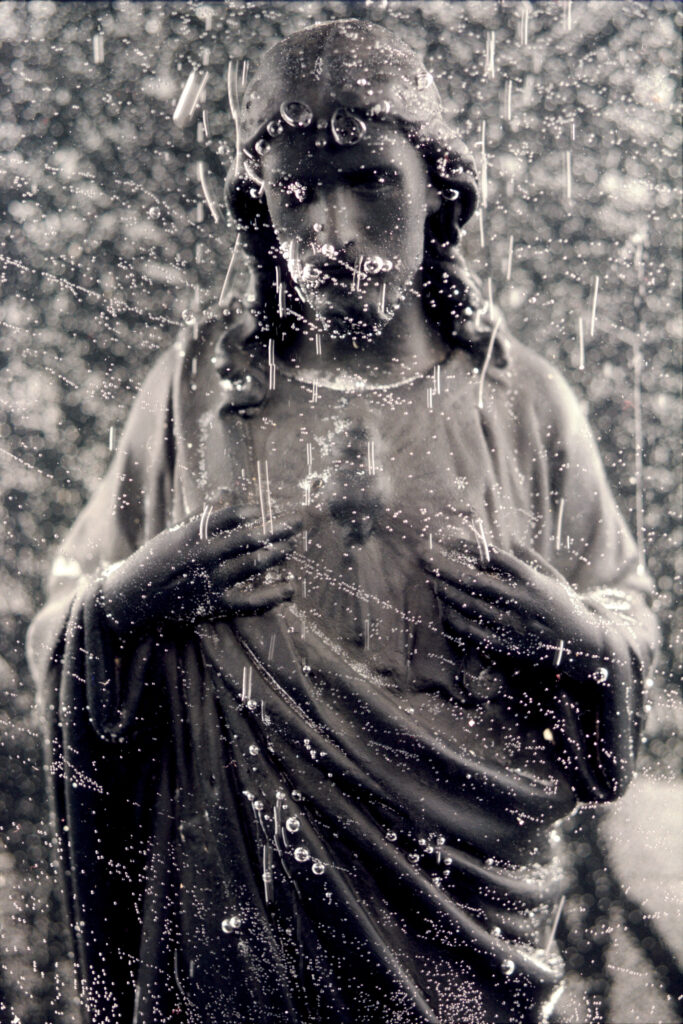
Andres Serrano, Black Jesus (Immersions 1987-1990)
Piss Christ did not stand out for me until it was controversial and then it became one of my favorites! The favorites usually get a lot of attention.
Your new series, The Robots, 2022 will be shown this November in Paris at Nathalie Obadia gallery. Could you talk about the series?
The Robots was inspired by NFTs and the Metaverse because before the Metaverse, there were robots. I like working with real things, not reproductions. And when I decided to create portraits of robots I went looking for vintage robots. I bought them on Ebay and other auctions. They’re mostly from the 60’s, and 70’s with a few from the 80’s. Some of them are rare and desirable.
The Robots is about race, childhood, science, science fiction and human nature. The word robot was coined by Karel Capek, and appears in his 1920 play, RUR or Rossum’s Universal Robots. It derives from the Old Church Slavonic word, “rabota,” which means “servitude or forced labor.” There are references to the work of Jean-Michel Basquiat, Jeff Koons, Kaws and Andy Warhol in The Robots, intentionally and unintentionally.
I did enough work for several exhibitions because as I started making them I realized they could be a book of robots. There are all kinds of robots: Japanese robots, European robots, black robots, white robots, …. Some of my favorite pictures are those of the very simple children’s robots. I love Mickey The Robot, Mr. Rembrandt Robot and Chuckling Charlie The Laughing Robot. All of these will be included in the exhibition at Nathalie Obadia Gallery.
Andres Serrano, KO Yoshiya High-Wheel Robot (The Robots, 2022)
Andres Serrano, Mickey the Robot(The Robots, 2022)
I once told Leon Golub about a bad review I got in The New York Times. I said to Leon I didn’t want to take it personally but it hurt my feelings. He said to me, “You should take it personal because when they criticize your work, they criticize you.” Leon was right. I am The Robots!
NR Vol. 15 Celebration · Spring Summer 2022 Published · Print Page 472
Feature · Superflux Words · Matthew Burgos
Speculating about reality while adding a dose of folklore and mythology
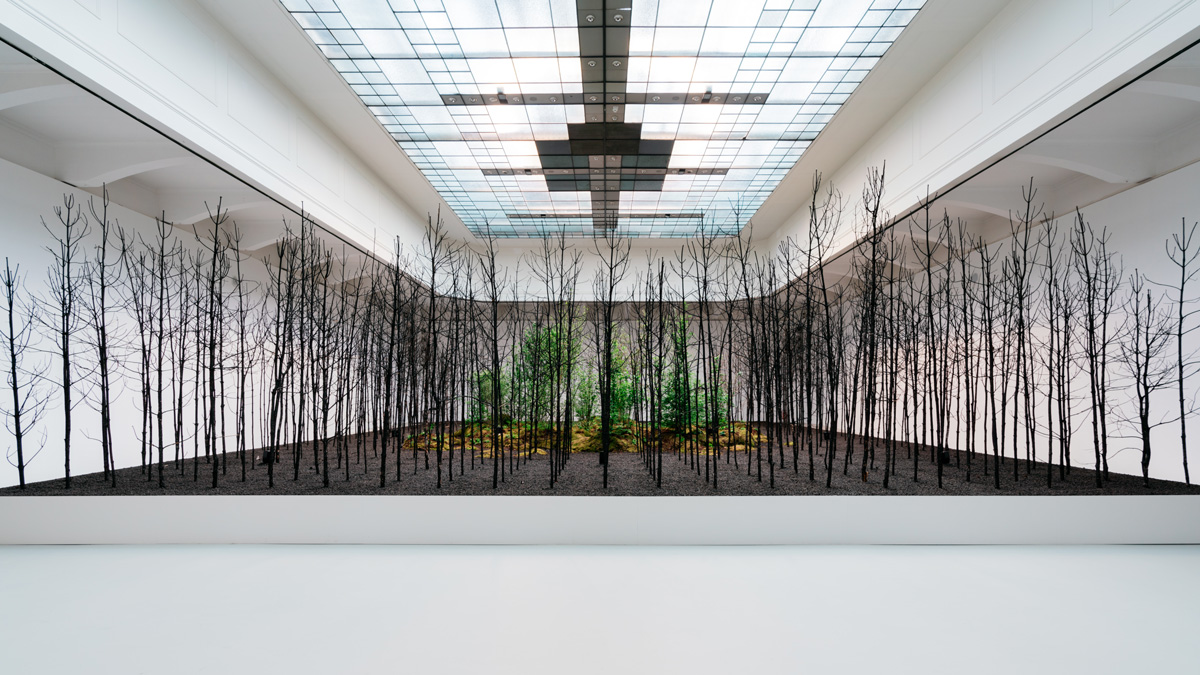
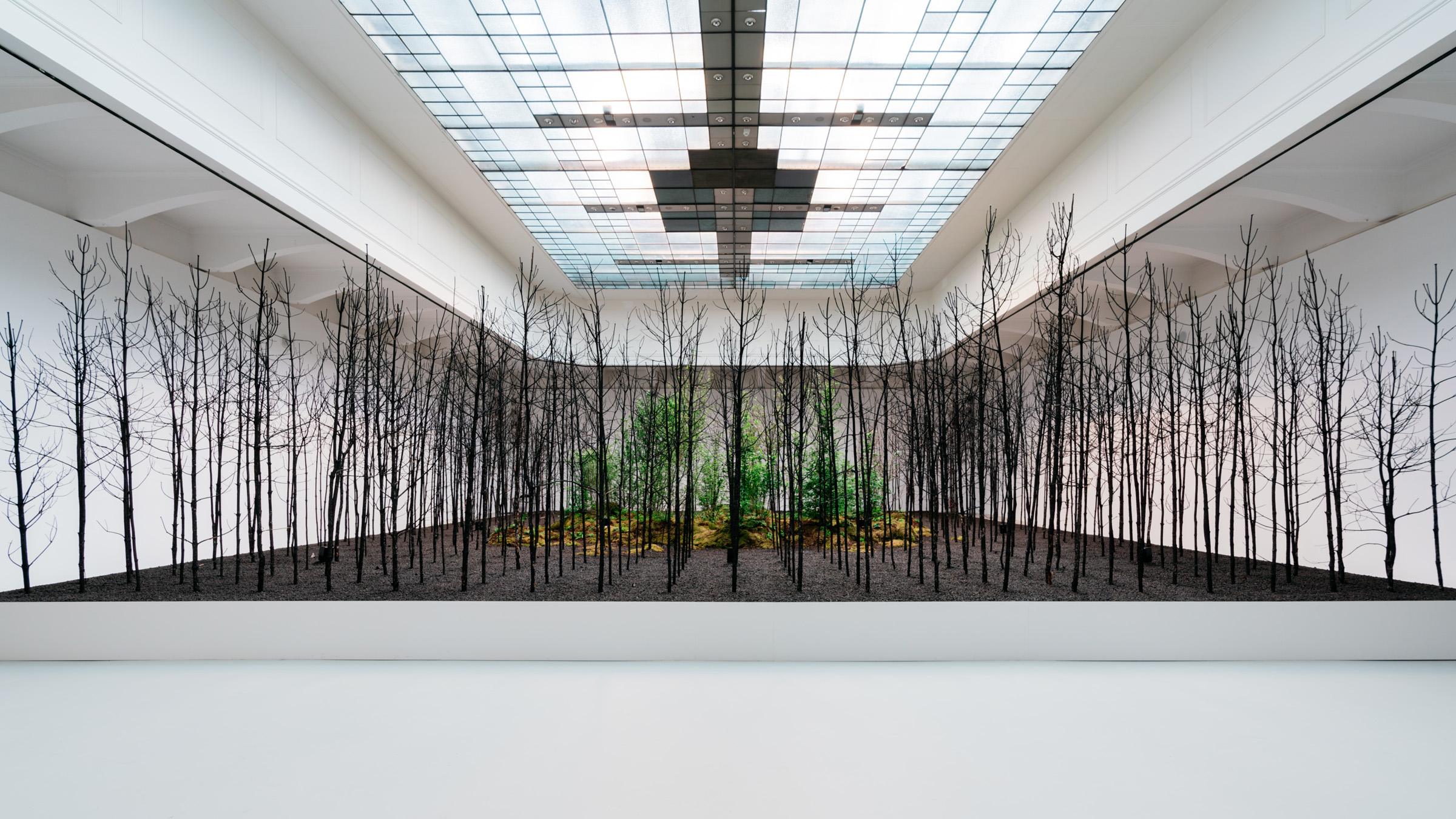
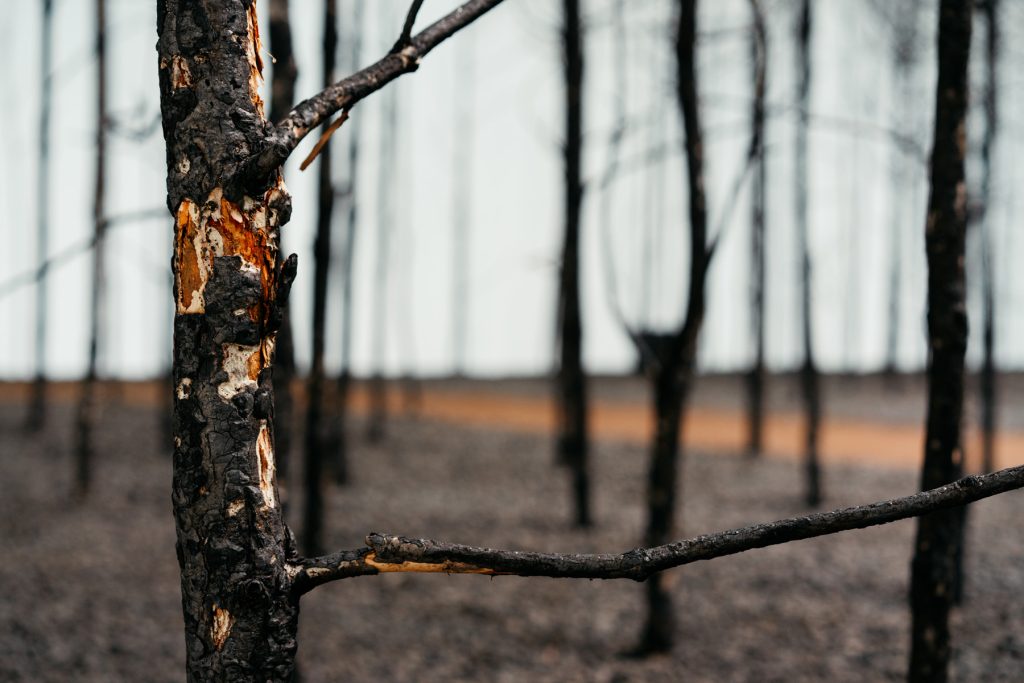
The skeletal remains of black pine trees stand like soldiers in command. Their charcoaled bodies remain rigid, stuck into the damaged soil, decomposing but not entirely disappearing. The installation looks as if a wildfire gorged its craftsmanship before the viewing, but every bit of it speaks intentionality. Every part of it defines the ethos of Superflux.
Founded by Anab Jain and Jon Ardern in 2009, Superflux calls itself a boundary-defying design and experiential futures company whose research and art practice range from climate change to algorithmic autonomy, from future of work to more-than-human politics. The installation above testifies to this statement. Its title, Invocation for Hope, overviews a slice of the bigger picture the practice paints. “How do we move forward in this shattered landscape?” they ask. Rather than just posing questions, they turn to art and philosophy to fuel the minds of their viewers, pulling them into their works to start acting.
Speculative realism has catered to the well of influences the practice draws from, but lately, they have been tapping into the mysticism of fantasy and folklore, the parallel universes that deflect the reflection of the present world. From here, the practice toys with less grounded ideas, but always instilling the plurality of futures – in the plural form to signal the abundance of what the future may be – and presenting the depth of the symbiosis of the beings, both living and non-living.
Invocation for Hope only identifies one of the myriads of thought-provoking works sculpted by Superflux. With NR, the practice opens up that while this piece may be an introduction to how they work, it only scratches the surface of what runs in the creative minds behind the project and the urgent calls towards the public to do something – more than nothing – to the present climate crisis.
NR: Part of your ethos lies in translating future uncertainty into present-day choices. Is it intentional to choose ‘choices’ over solid responses, answers, and actions towards the global questions and demands?
S: Yes, absolutely. The future is plural – there are many possible futures, and they are all unfolding right now, as we respond to your question. Each and every decision we make today affects our futures, and therefore we see them as choices we have today. For instance, politicians and big businesses can choose to stop coal mines but by choosing not to, they are directly affecting our collective futures and those of all of our future generations.
In our work, we scan large trends as well as weak signals to present the sheer breadth of the complex, interconnected uncertainties that lie ahead of us. By taking time to consider these complex uncertainties and how they might be, we invite decision-makers to consider the choices they have today.
I would love to learn more about your first-ever solo exhibition, Subject to Change. The show “invites viewers to remain open to multiple possibilities and navigate the uncertainty caused by imminent climate catastrophe with active hope.” What multiple possibilities concerning the climate catastrophe are there for the viewers to pick up and use to take action?
Subject To Changeis a collection of Superflux’s four recent works – addressing a range of present-day challenges – from climate crisis to ambient technologies, political unrest, and culture wars.
In Trigger Warning we attempt to surface the widespread civic unrest caused by algorithmically mediated networks, clashing culture wars, and warring ideologies. The fast-paced journey through a city of memes is a critical commentary on where our networked culture has brought us to.
Building on this, our more recent film The Intersection and its accompanying artifacts take us to the end where the seductive power of the metaverse, algorithmic journalism and greed lead to destruction. This time, we wanted to give a glimpse of the way forward, a future where we craft new, hopeful, and enduring relationships with our planet, with technology, with our land, and with one another.
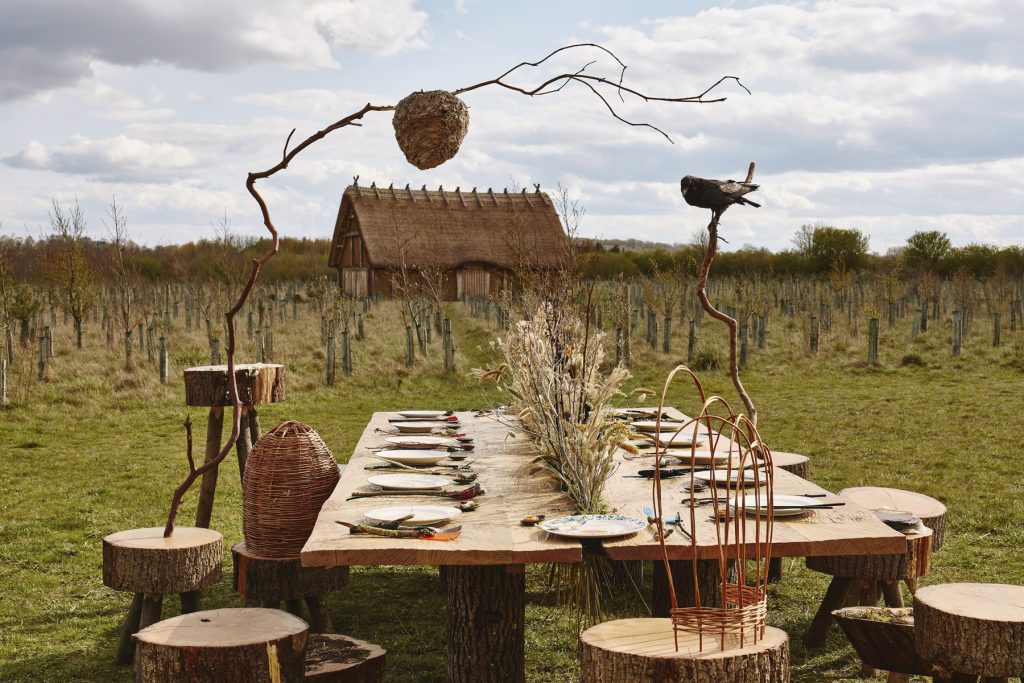
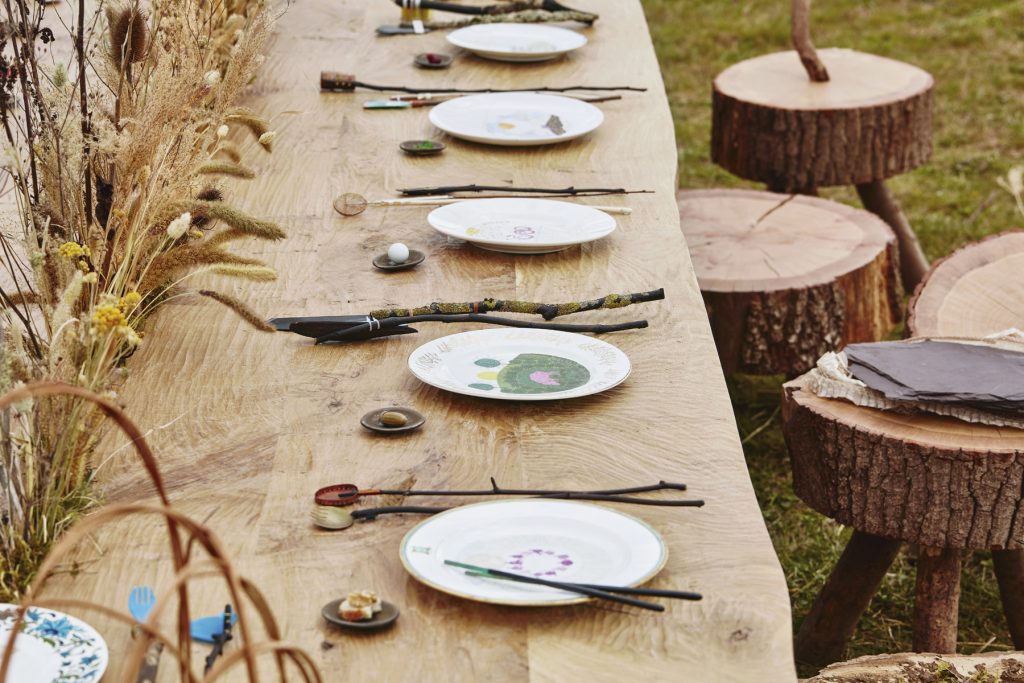
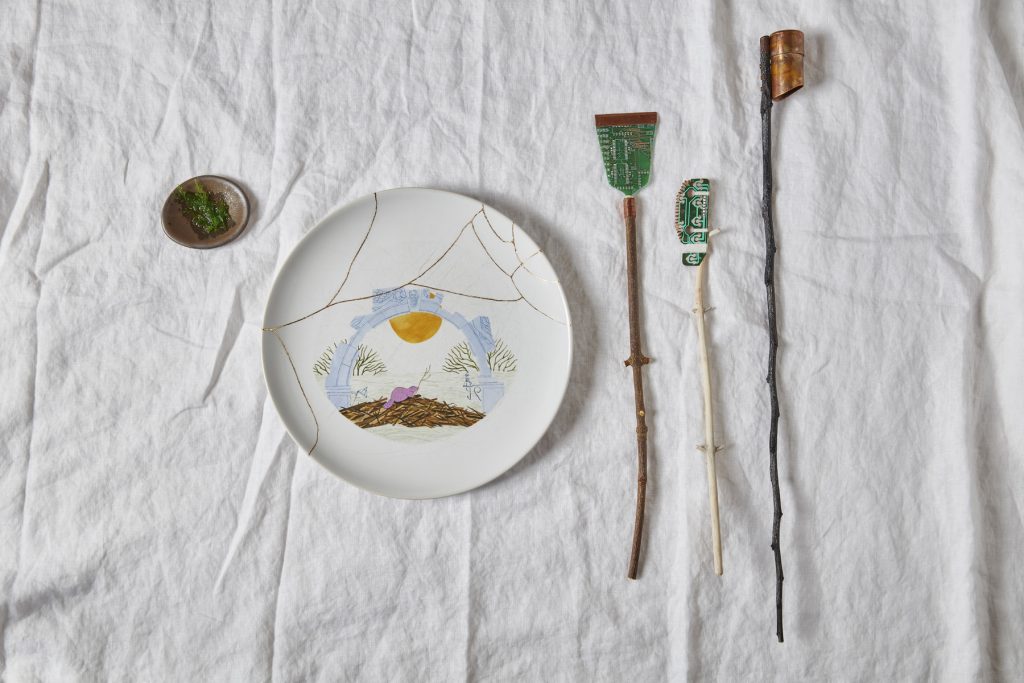
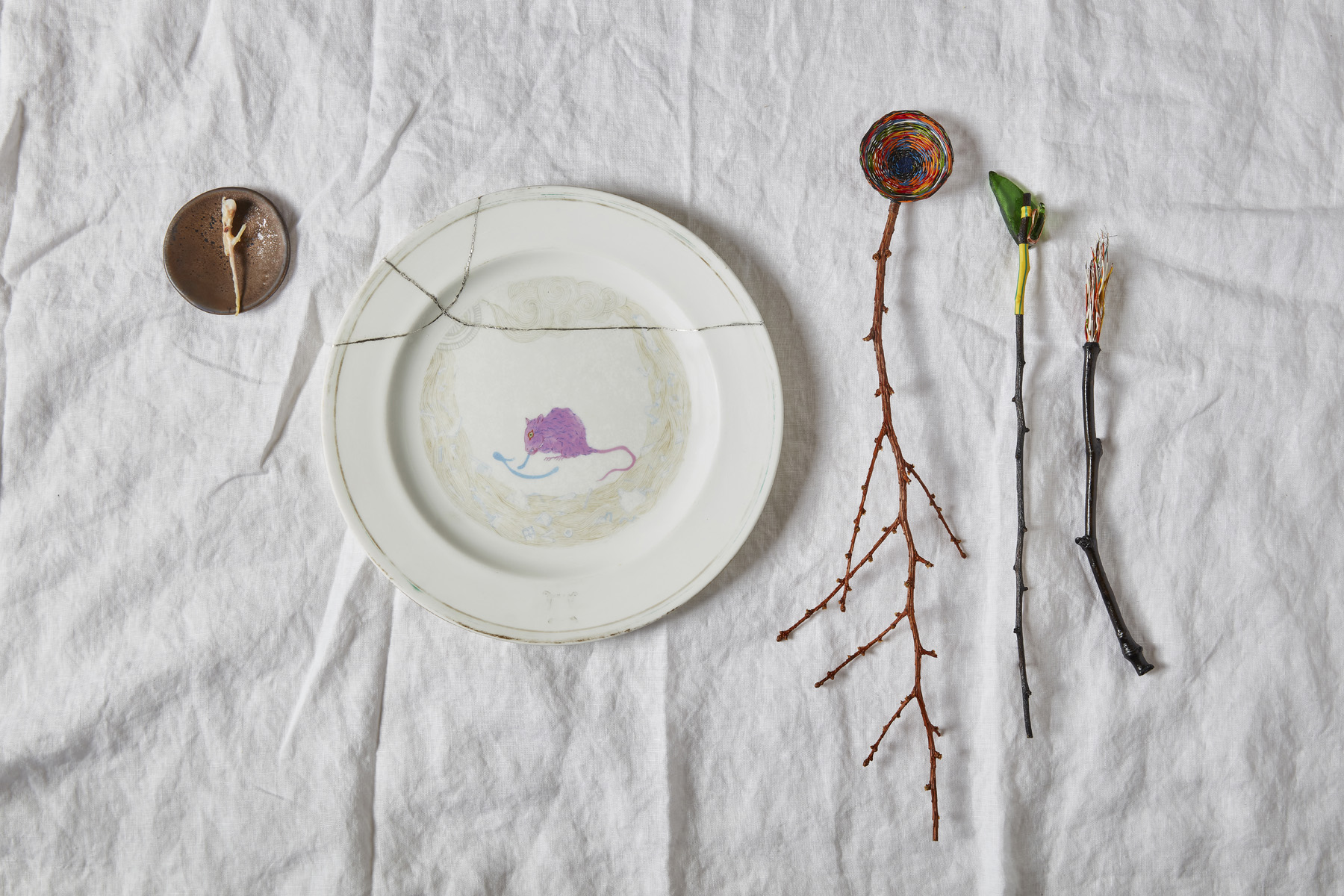
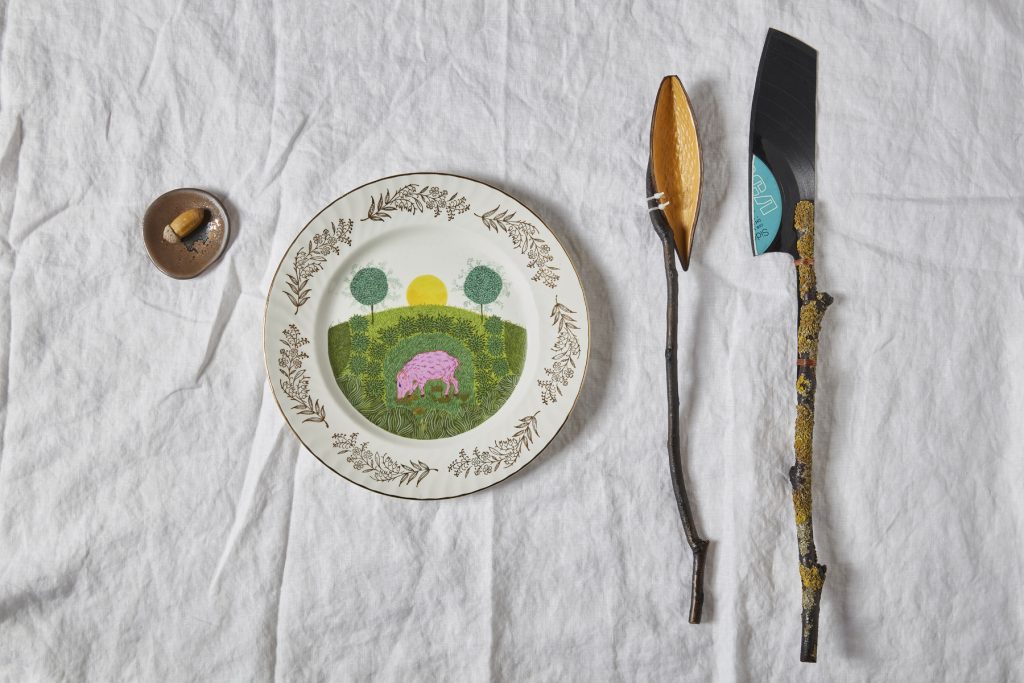
With our more immersive installation works Refuge for Resurgence and Invocation for Hope, we challenge long-standing histories of human exploitation and greed by reframing the human in direct interdependence with other species. In one room, visitors will encounter a majestic oak table inviting different species to dine together, thus acknowledging our shared purpose, our shared fates, a mythopoetic of our unison.
In the film of our installation Invocation For Hope, visitors will journey across wildfire-destroyed monoculture forests to a space of multispecies hope, a chance to reflect on our ecological, economic, and emotional entanglement with all species on the planet. When we love our earth, rivers, rocks, mountains, birds, animals, plants, and fungi, we care for them. And what we care for, we protect. We believe this is a simple but powerful message for action, framed through a poignant, mythical story, folklore, and sensory immersion.
We hope Subject to Change is timely and prescient.
“Our works are not solutions to our crisis, but perhaps more importantly, are beacons of hope, of reimagination, renewal, and precarious flourishing.”
How does poetic and immersive storytelling help you underline the urgent concerns to shift the way we live in the present for the future?
As we mentioned earlier in our earlier works, we have adopted this approach of speculative realism. Recently, though, we have been inspired by other genres like mythology and fantasy to explore possible worlds that are not direct representations of our current world. We want to open up poetic aspects of other worlds that might feel enigmatic, exciting, or magical. We are reaching into a more archetypal space where there are less grounded ideas about the ways we might transform ourselves. We are tapping into deep history and a more primal space in our exploration of the ways we relate to what we perceive as ‘nature’.
Our two recent works have very different manifestations of such poetic and immersive mechanisms to explore more-than-human futures, ecological interdependence, and multispecies cohabitation. Both installations are exploring mythopoetic expressions that celebrate our reciprocal relationship with other species and entities living on the planet, as opposed to a hierarchical or extractive relationship.
With our Venice project Refuge for Resurgence, multiple species enjoy a banquet around a large oak table alongside humans. With Invocation for Hope in Vienna, we are looking at a resurgent forest to show that a truly biodiverse ecosystem will be one that celebrates ecological reciprocity. Two similar themes are explored in very different spatial and aesthetic forms, at very different scales.
Referring to your centerpiece for the show, Refuge for Resurgence, it shows the stories of 14 species who represent life on an ecologically just planet. Do you think human exploitation and extraction are wired psychologically? With that in mind, how can we rework our lifestyles?
Who we are, how we act, what we gather around, our collective agency, our hopeful futures are all deeply entangled with messy histories of mindless extraction, oppressive colonialism, social injustices, and climate apathy. The roots of today’s surveillance technologies, algorithmic culture wars, fractured post-truth narratives, climate crisis, and the pandemic are part of this continuous narrative.
If we want to find hope amidst crisis, we must force a reckoning with such interconnected complexities, and imagine alternatives beyond our present limitations of reality. This is at the heart of our practice – whether it is an immersive installation, a speculation object, or a film,
“we are interested in confronting some of the most complex challenges of our times, and exploring different worlds of possibility, care, and hope.”
Let us move on to Invocation for Hope. How did the research come about? What was the premise before materializing the installation?
We have done a lot of work in the last few years around the ecological and social aspects of climate change. Our project Mitigation of Shock has had different iterations in London, Singapore, and Germany.
For the project, we invited audiences into an apartment where we are living in a climate of the future. Inside, it becomes easy for people to suspend their disbelief because they see familiar settings and familiar objects, but the longer they spend here they begin to realize that they are actually in quite a different world, with unfamiliar and strange elements such as a radio playing a show called ‘Pets as Protein’, a newspaper that has been opened on a disturbing article, or a recipe book next to some foraging notes.
There are many stories about climate change and our responses in the public domain. There is this ‘dig for victory’ narrative which argues that we can just grow food in new ways or create new technologies. In Mitigation of Shock we said: “Okay, what would that future actually look like?”
We invited people to explore that world. With Invocation for Hope, we are reaching into a more archetypal space where there are less grounded ideas about the ways we might transform ourselves, a tap into deep history and a more primal space in our exploration of the ways we connect to what we have grown to learn and recognize as ‘nature’.
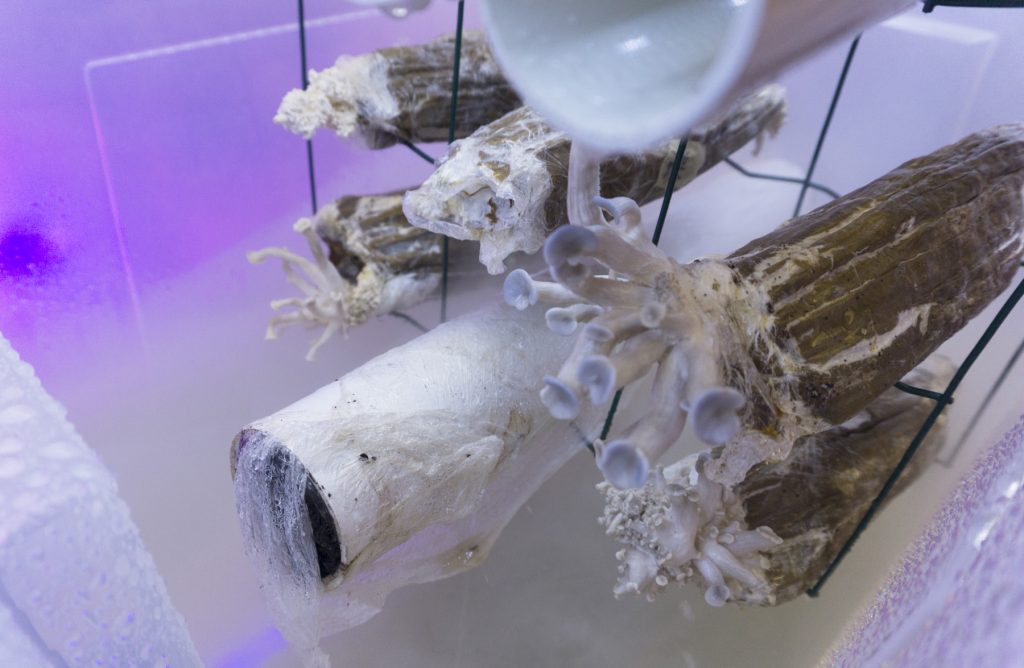
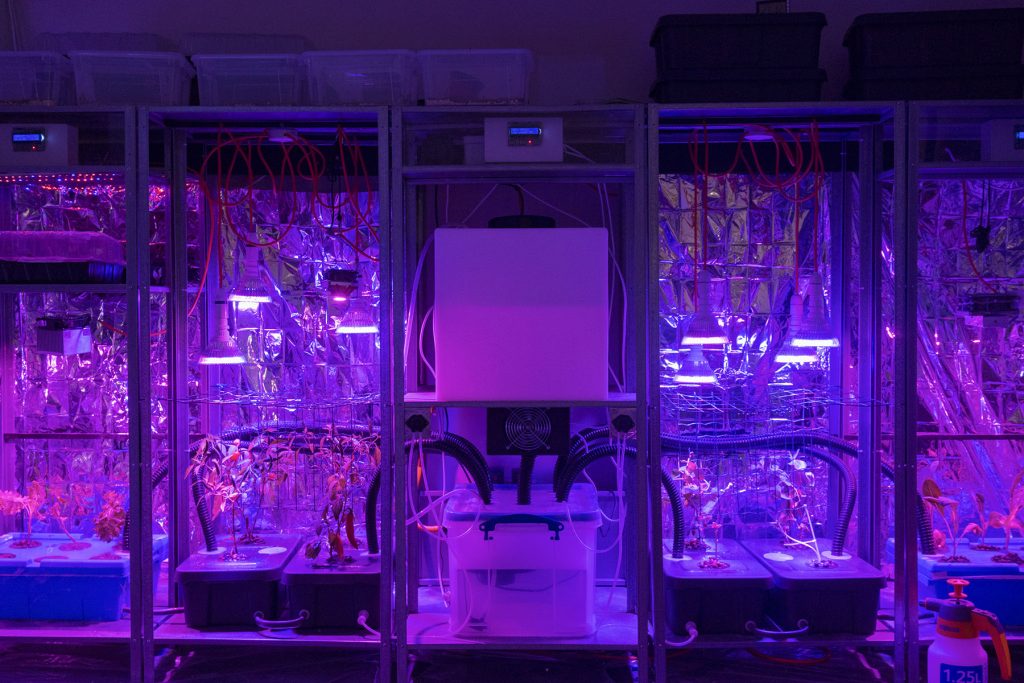
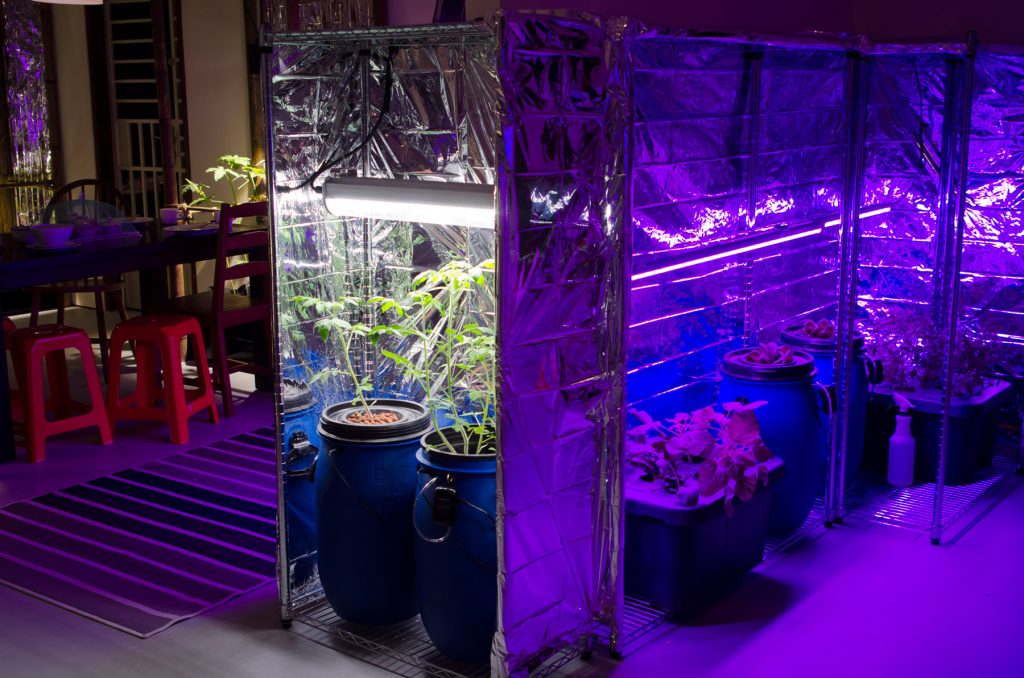
Through our projects around the climate crisis, we have become increasingly drawn to a more-than-human approach. Whilst working on Mitigation of Shock, we had the chance to closely observe and learn about our capricious food and agricultural systems. Through hands-on experiments in growing different prototypes of food computers, we became increasingly drawn to the importance of multispecies cohabitation.
Our work has begun to focus more on these conditions that we are generating in collaboration with other species. A more-than-human perspective allows us to see how we are ecologically, economically, and emotionally entangled with all species on the planet.
That gives us a certain kind of humility, to be able to see our role not as individuals who harvest nature for what we call ‘natural resources’, but to take care of those who take care of us.
That is at the heart of a lot of our recent work.
“We want to foreground how we are a part of a larger ecology rather than the masters of nature. Within this complex ecosystem, we all play a part in mutual survival and evolution. Without it, we cease to exist.”
For this issue, we’re focusing on Celebration. How would you like to celebrate your boundary-defying studio and the themes and philosophies the team believes in?
There is no more discussion around the fact that we are causing a climate crisis. We are. Human beings are responsible for what is likely the Sixth Extinction. There is so much work around the climate crisis, real action-oriented work, but we feel that alongside that, we also need to nurture the public imagination with alternative narratives.
It is only when people, from within themselves, start to feel a sense of love and connection with the species around them, a love for the planet, that this action-oriented work will take off because everyone will truly feel the same sense of urgency.
If we believe other worlds are possible, we will want to do something about it. That is what we want to celebrate: the power of our collective imagination in making other worlds possible.
“I rebought forty of my favourite destroyed singles and had them played simultaneously on forty record players.”
It’s difficult to summarise the art of Georgina Starr. Since the early 1990s, the artist has made use of the array of tools (video, sound, written word and live performance) at her disposal to create a rich and varied body of work. In early works, Starr engaged a cast of miniature paper figures as stand-ins for real life conversations the artist would covertly record in public spaces. Later, Starr appears in her work – though the extent to which she was performing as herself is itself part of her practice. In The Party (1995), a 25-minute video installation, Starr takes on the role of Liz (a character whose advances are rejected by another character in a previous film). As Starr tells NR below, though the role was fictional, the process of making the film instils it with autobiographic elements. Characters, motifs and themes recur throughout Starr’s work, which enable the artist to rework and reimagine earlier ideas. But it isn’t just Starr’s own oeuvre that she recreates, with much of her work taking inspiration from existing film and literature. The breadth of reference points throughout Starr’s work are demonstrative of the extent to which the artist employs a process of meticulous researching to inform her practice.
Aspects of Starr’s work recall a childhood spent watching tv; the object in the corner of the living room which, she explains in TheVoices of Quarantaine (2021), became her “gateway to another world”. Indeed, the blurring of reality and imagination, autobiography and fiction are common features of her work. Starr’s film, Quarantaine (2020), is not, as you might think, a response to the pandemic. Rather, the artist began working on Quarantaine before COVID; the film’s title referring to the French word for forty, historically also the term for a period of enforced isolation over forty days. The film tells the story of strangers who are transported to an alternative universe which the two women must navigate their way through. Across the breadth of Starr’s work, the body – the female body and feminine identity in particular – are (re)investigated. In her later works, including Quarantaine, Starr is no longer in front of the camera, with a cast of performers enabling the artist to realise her practice on a larger scale. Most recently, the artist orchestrated a live performance in collaboration with French fashion house, Hermès, which in true Starr style, is a dazzling display of colour – flawlessly synchronised and splendidly surreal.
NR: What have you been working on recently?
GS: I have been working on a new performance artwork in collaboration with Hermès to showcase their SS22 collection designed by the brilliant Nadège Vanhée-Cybulski. We performed it on 3rd February at a one-off special event titled ‘Gelato!’ at Old Sessions House in Clerkenwell. It incorporates a large set—a huge pastel coloured mountain sculpture, a new musical score for percussion which I developed together with composer, Thomas Haines, and is performed by four female percussionists, nine dancers and eight models all wearing Nadège’s designs. It was quite epic—a cross between a theatre play, a sculptural installation, opera, dance and fashion show. The collection is really joyful and screams summer, so I began by thinking about what ‘gelato’ would sound like. I imagined metallic sounds and warmer sounds of fabric on wood—glockenspiels, triangles, drums, wooden percussion, vibraphones, and I had a vision of a magic mountain which the performers, wearing these amazing clothes, would emerge from moving in synchronization with the sounds—this was my starting point.
NR: What does the process of rehearsing or being in workshops involve?
GS: With live performance works, the rehearsal period is more intense. I always script and storyboard, and it was the same for Gelato! There are spoken word poems in this piece as well as the music and choreography. By the time we went into workshopping in mid-December we were at a really good stage with the musical composition, and I had choreography ready to show to the dancers. We were working with four incredible percussionists who were able to immediately play the working score so that the dancers could start to interpret the live instrumentation and we could adjust the score as went, which was a brilliant way to work. The music starts out very minimally and gradually builds up as the percussive mallets are handed to the musicians. Some instructional elements were built into the score, so everyone’s movement was highly choreographed, and I had constructed my own mallets using coloured threads from the collection – so these were woven into the piece. The workshopping days were crucial to figure out if the movement and vocals I had imagined alone in my studio could even work on a grander scale! I had props too, as I wanted the performers to all begin from inside a ‘mountain’ and emerge with large circles like musical notes transforming the whole picture into a giant score. There were twenty performers to direct, so it was pretty intense. We went into full-on rehearsals for six days at the end of January and had the first dress rehearsals at the venue the day before the show. I loved this collaboration with Hermès, it was wild.
NR: How does working with performers compare to playing the role of other performers (alongside) yourself?
GS: The casting process is always really complex as I have a very clear idea of how I want the performers to look and what voices they bring. For both the Hermès piece and my last film Quarantaine (2020), it took a long time to find the right people, months of searching and meeting people. When I perform inside my work it’s a very insular and personal process, often just me and the camera. For my film THEDA (2007), I built all the sets in my studio and worked for a year filming myself in the various Theda Bara inspired roles, so became totally absorbed into the character. The way I work with a bigger cast definitely has some connection to this, I feel the need to demonstrate rather than just describe, it’s quite mediumistic, transferring my movement and voice into them. I like to work with a mix of professional and non-professional performers as the non-pros bring something magical and otherworldly. It often feels like the less experienced person is a stand-in for me in some way—I relate to them more strongly as they are working things out on their feet and negotiating this strange environment they find themselves in.
NR: There are characters, themes and motifs – the brain, the bubble – that reoccur in your work; did you always attend to develop your practice in this way? Or did it just occur over time?
GS: All the pieces I’ve made from the very beginning are completely interlinked. It happens naturally that one work leads to the next, so the themes and motifs overlap and merge. Sometimes an element in a work I made twenty-five years ago might suddenly appear in something new. A performance work I made at the Stedelijk Museum Amsterdam in 1995 called The Hungry Brain suddenly started to inform a work I was developing in 2013 which eventually became Before Le Cerveau Affamé a new performance and installation piece. In this work I created an illustrated set of predictive cards (Le Cerveau Affamé), the suits were the bubble, the hand, the brain and the cat. These cards found their way into my film Quarantaine. The cards appear in a critical scene in ‘The Grey Room’ where a group of waiting women are chosen for a card reading—the cards selected guide them to the next level of the journey in the film’s narrative. Sometimes it seems like one big Gesamtkunstwerk!
NR: As an extension of that, in TheVoices of Quarantaine you make reference to De Quincey’s The Palimpsest of the Human Brain which seemed to be an apt description of your work. Would you say that your work is palimpsestic?
GS: I think my last answer definitely describes a very palimpsestic way of working. I enjoyed making the performance lecture, The Voices of Quarantaine (2021), as I got to reveal some hidden details at the heart of my film Quarantaine. There are so many layers of meaning in my work it can baffle some people, so it’s useful to be able to unpeel these for the viewer. Although the lecture itself was something of a palimpsest too. While I was reading De Quincey, I realised that his essays had directly inspired Dario Argento’s 1977 masterwork Suspiria which in turn had inspired the forest wall-mural I had painted in a scene in Quarantaine. At the very beginning of Quarantaine we follow two women through an arboreal portal in a city park which leads them into a school of instruction—the first room they encounter has the eerie wall painting. The mural in Suspiria had always haunted me so it became an ominous character within my film—it holds another portal to take the initiates onto the next stage of the voyage.
NR: How much of your work is grounded in the idea of autobiography, and to what extent does the notion of autobiography become a way to introduce (fictional) narrative?
GS: There is quite an even mix of the fictional and factual, but it’s so integrated that I often lose track of which is which. I made fictional works in the past which I performed in and people presumed they were autobiographical. An early video The Party (1995), for example, was a piece about a lonely female character who throws the perfect party for one. It began as a fictional narrative, but I did spend two days alone having a party in my studio—constructing a bar, making food, dancing, drinking elaborate cocktails. When I look back at this work it’s part of my history and feels almost autobiographical, it’s a perfect merging of the two. There are personal stories within Quarantaine, which I discuss in the lecture, these stories begin from a ‘real’ place or at least a memory of something real and gradually become so entwinned within the world I’m creating that they drift away from reality and become something totally new.
NR: How do different mediums lend themselves to a particular work? What informs whether you use audio, film or a live performance?
GS: The idea usually informs what the piece will be.
“A memory I had about my parents burning all my records when I left home for example ended up transforming into a live sound performance piece called Top 40 on Fire (2010).”
I rebought forty of my favourite destroyed singles and had them played simultaneously on forty record players. It created a cacophonous sound at first that sounded like fire, but as each track petered out you started to hear the voices of the singers coming through and the final vocal lyric was quite profound. If I’m commissioned to make a work then it’s slightly different, although sound always plays a huge part of every work. Live works are the most difficult for me as it’s impossible to control exactly what will happen on the night. I’m pretty controlling about all the details so this can drive me insane; the uncertainty—at some point you have to let a performance live without you. When I made Androgynous Egg (2017), a live piece for Frieze a few years ago, it took me ages to let the performers just own the piece. It was performed four times a day for the whole of Frieze and it was only on day two when I realized that I didn’t need to sit in all the performances—they had it, it belonged to them now and I had to set it free, like releasing a child into the world. Quarantaine was really borne out of Androgynous Egg. I knew that I wasn’t finished with some of the subjects—the eggs, the Pink Ursula Material, the instructional poetry, even the choreography, and that I needed to make a film. Writing and making the film was my way of taking back the control I had relinquished with the performance. It meant I could close-in on the action and focus on the important details. Filmmaking is more my natural medium. I love editing with image and sound, it’s where the magic happens.
NR: In relationship to the magazine’s theme – celebration – how does your work celebrate, and explore, womanhood?
GS: I would say that it does this in every sense. I began in the early ‘90s by working with my own body and voice to create video and sound works. These works gave me an actual voice. I was suddenly able to articulate something within the work in a way that I felt I couldn’t in real life. It was a celebration of my inner world. Over the years I’ve gained the experience and confidence to transfer this and to share the ideas with performers, musicians, singers and composers so that the world becomes bigger, more complex and intense. THEDA was the last work I performed in front of the camera. It was a very physical work where I was on screen the whole time for forty minutes. Each time I screened the work at a cinema I invited different musicians to accompany it and perform a live soundtrack. I had done it a few times in London and New York when I realised that it was predominantly men that were playing the music; by some strange fluke it had worked out this way. I was invited to screen it in Berlin at an old silent movie theatre and decided that this time it should be a woman accompanying it. I tracked down this amazing soprano Sigune von Osten—diva der neuen musik, who had worked with John Cage and Luigi Nono, and she agreed to compose a new soundtrack and perform live to the film. There was something incredible about the combination of a woman (me) attempting to dissect and enact the lost films of another woman (silent movie star Theda Bara) while being interpreted and accompanied by the extraordinary vocals of a third woman (Sigune von Osten), it was a metaphysical experience—a total celebration and exploration of the female body and voice.
“I just so happened to want to capture the contrast of the beautiful sky against the ominous news.”
Sho Shibuya is a graphic designer who has lived in New York for the past ten years – the last five of those years spent painting every day. Originally from Tokyo, Shibuya’s move to the Big Apple gave rise to a fascination with the city and the elements of design that are distinctively “New York”. In fact, something the designer was quickly struck by was the number of plastic bags that littered the city’s streets – is there anything more “New York” iconic than the “Thank You” plastic bag? Shibuya began collecting abandoned bags which were the subject of a book from 2019, Plastic Paper. If the project was a celebration of the city’s rich visual identity, as captured in plastic bags, it was also designed as to provoke a necessary conversation about the environmental hazards caused by single-use plastic. The bags were banned state-wide on 1st March 2020, though a loophole meant that retailers serving food can still these bags. Nonetheless, Shibuya’s bag collection was featured in a New York Times article the day before the ban.
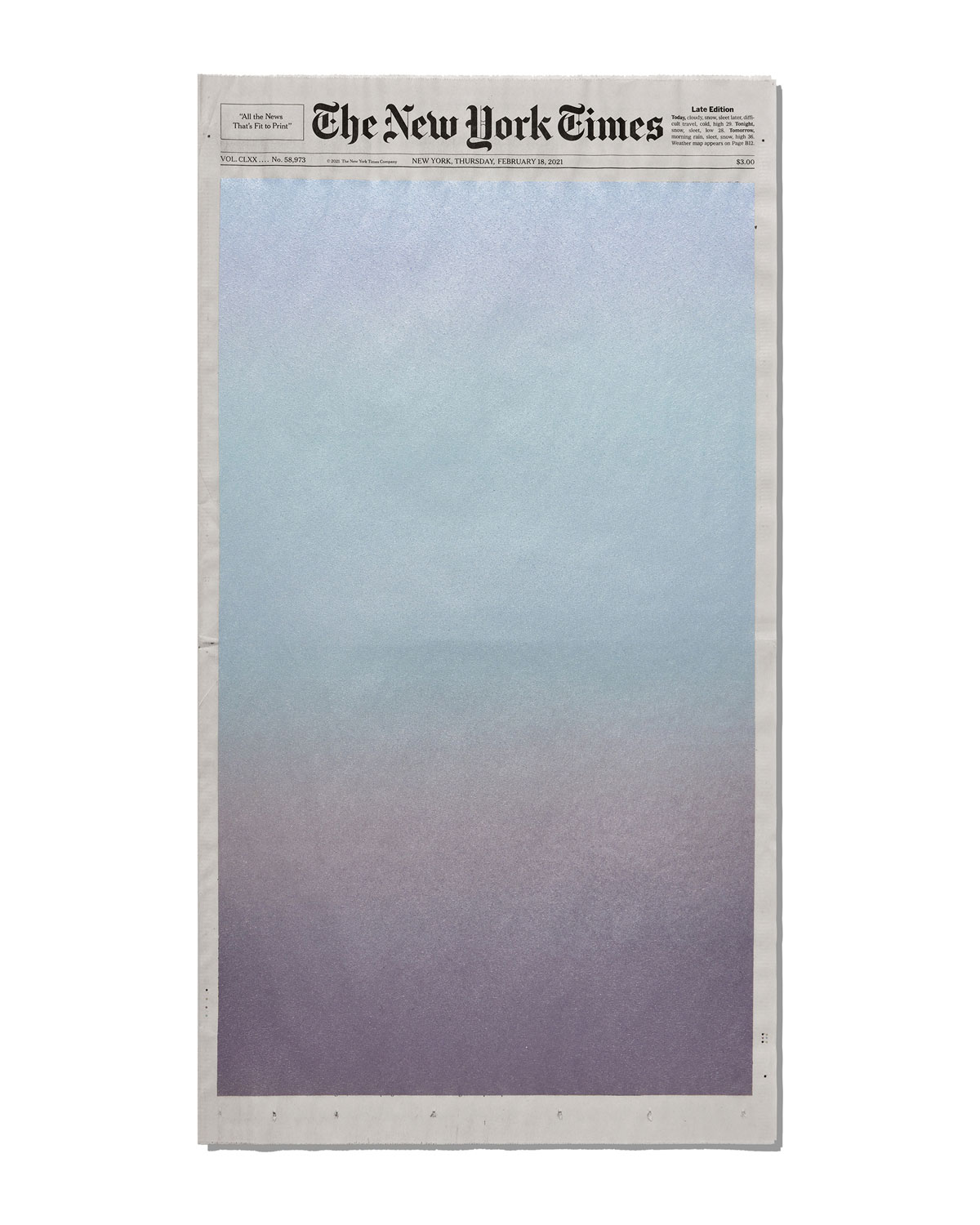
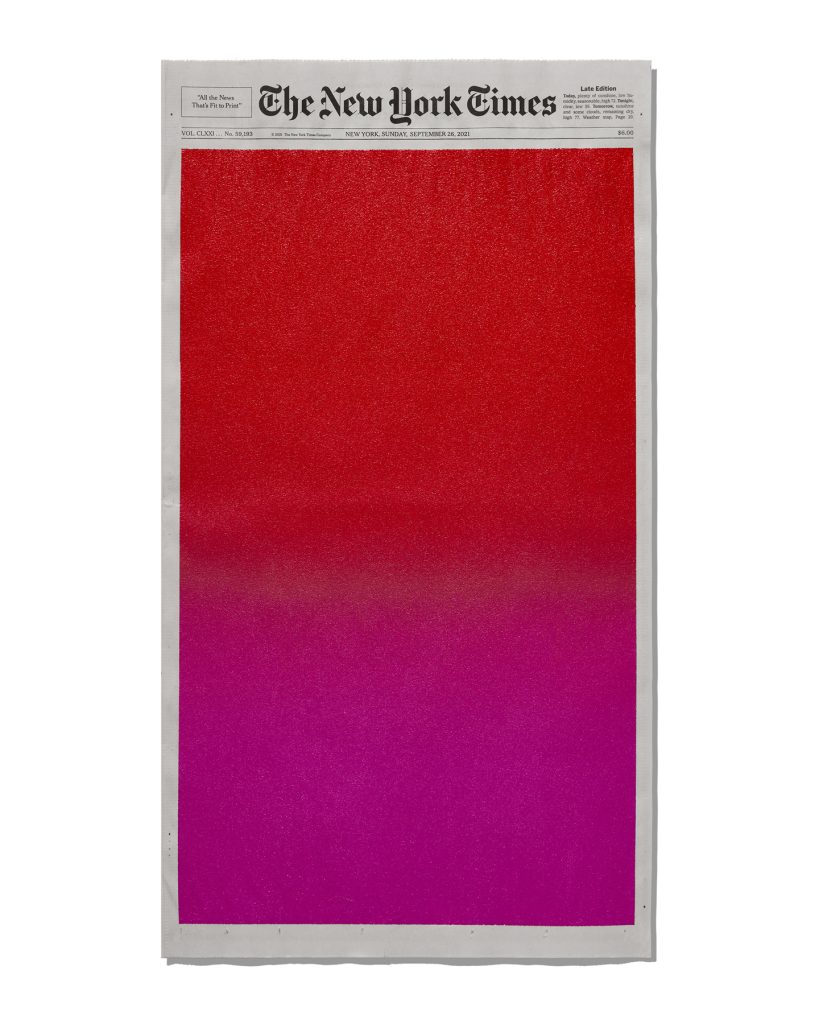
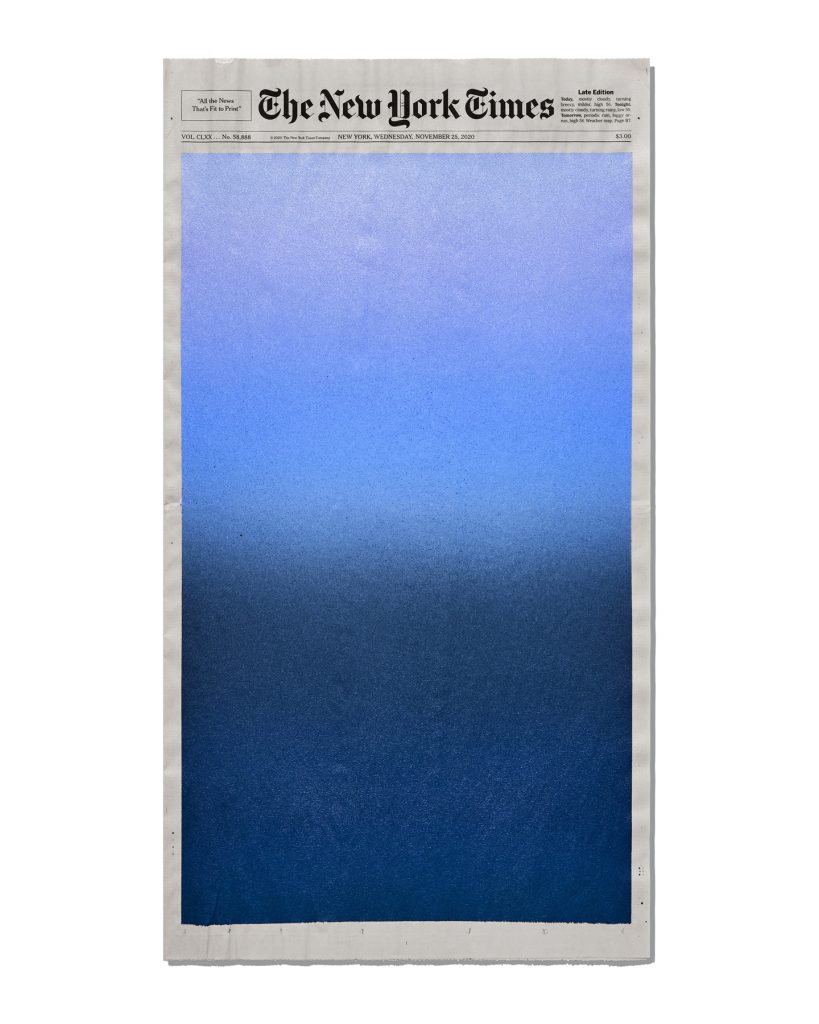
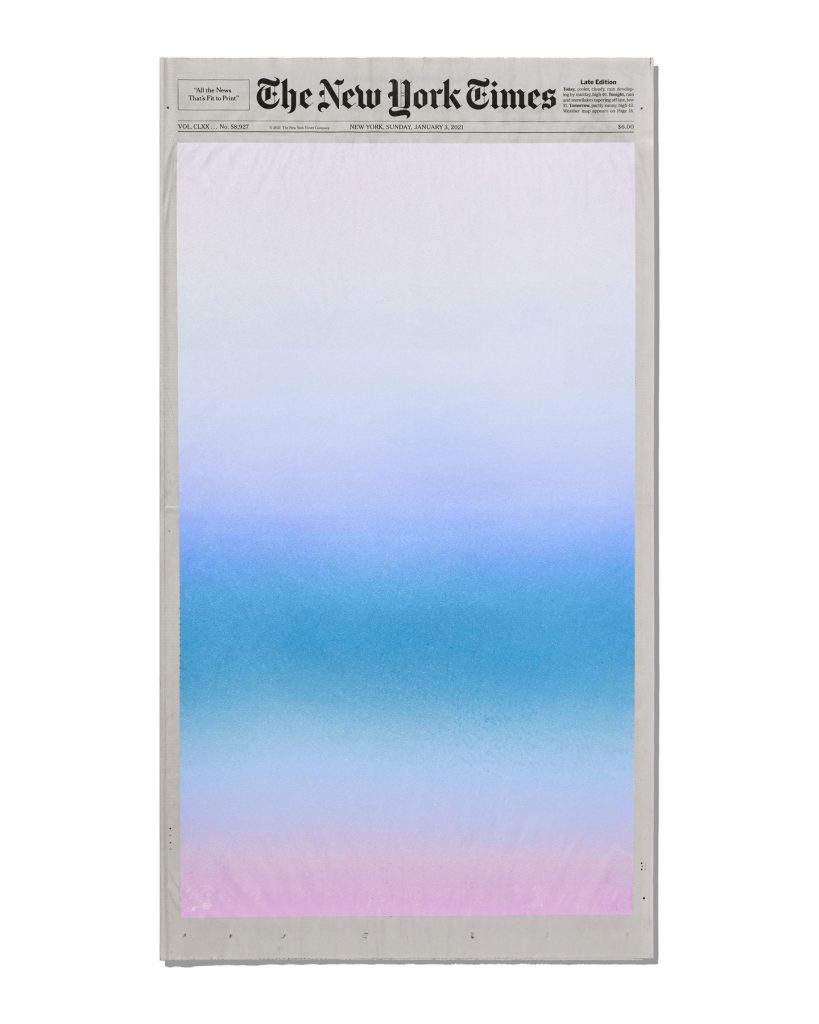
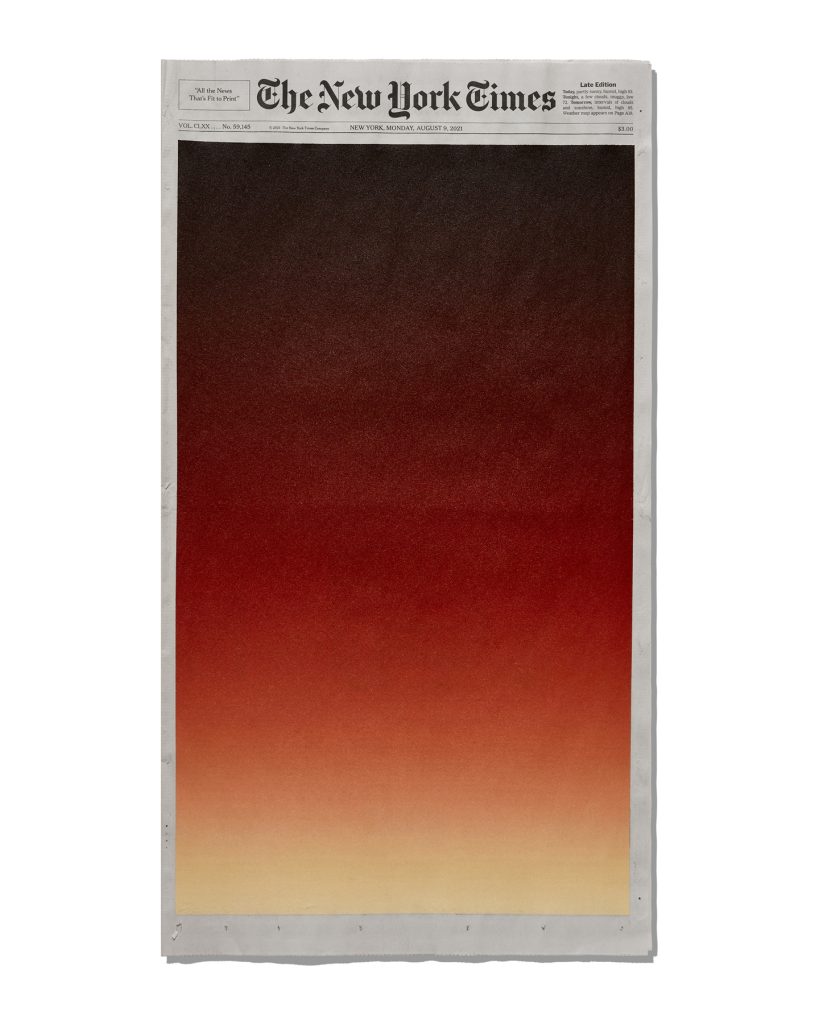
Fast forward to late May that year – with the city slowly emerging from lockdown following the first COVID wave – and Shibuya’s work appeared on the pages of the New York Times once more. This time, however, it was the designer sharing a photograph of a full-page painting over the newspaper’s cover on Instagram. Shibuya depicted a sunrise gradating from white to deep blue on the day that the Times paid tribute to the almost-100,000 deaths to COVID in the United States at that moment in time. This was Shibuya’s first full-page painting on (or over?) the cover of the New York Times, and it captures the way in which the designer (and painter) strives to “really understand [an] event and show respect to any cause.” There was some criticism to that initial post – that in painting over the names, it was glossing over the scale of pandemic’s impact – but as the subsequent paintings reveal, Shibuya’s creative interpretations of that day’s news, whether poignant or funny, emotional or thought-provoking, have come to attract an appreciative, warm response from a growing Instagram audience.
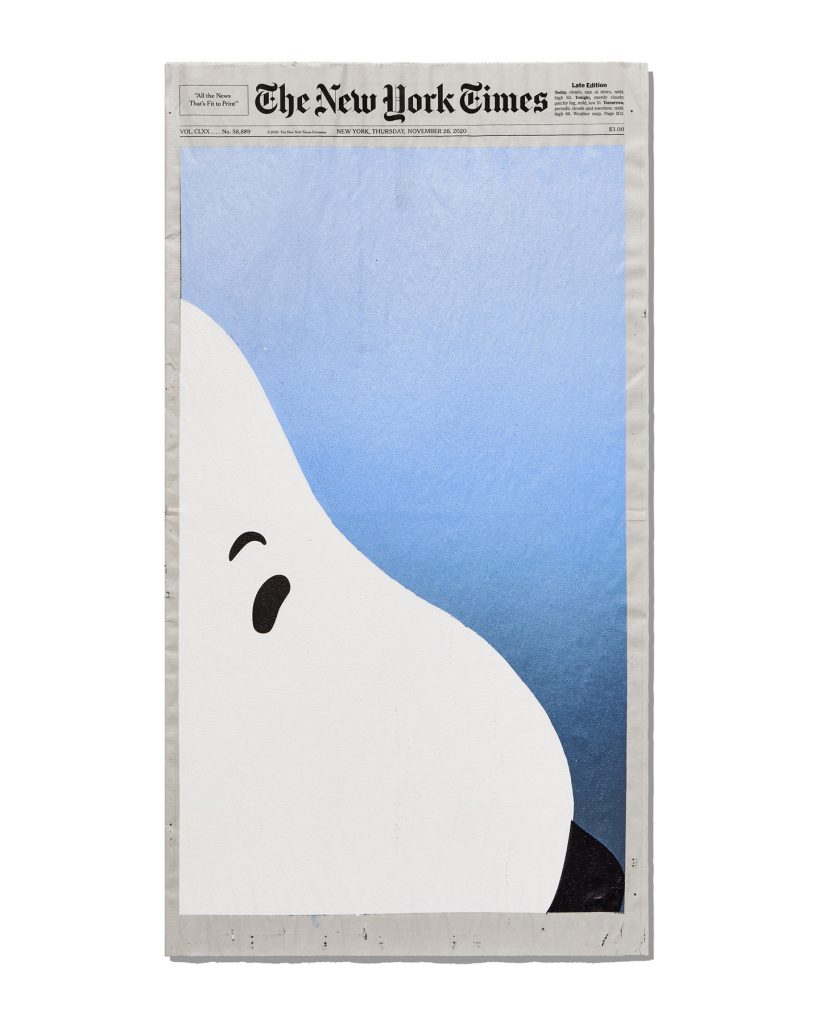
By using the daily New York Times as his canvas, Shibuya paintings move between reportage of local, American and international affairs – from painting the giant Snoopy inflatable from the 1988 Macy’s parade on Thanksgiving, the diagonal lines synonymous with OFF WHITE in honour of Virgil Abloh’s death, a collaboration with Patti Smith urging Americans to vote in the 2020 election, to painting scenes from the floods and forest fires that gripped the world last summer. If Shibuya began by painting the sunrise each day from his window during the lockdown, his paintings have become an entryway into a wider celebration of the little things we can be hopeful about. Each day, no matter what, the sun rises – and the news, no matter how difficult it may be, continues. And amongst that, Shibuya’s paintings give us a moment of pause and reflection.
NR: You started sharing Sunrise Through a Small Window on Instagram during the first American lockdown in 2020; were you expecting the kind of response you have had since then?
SS: Not at all. Painting has been part of my daily ritual for over five years. It just so happened that this series seemed to strike a chord in people. I appreciate the response; it makes me feel connected to the world through my work.
NR: What was it like being commissioned to paint two new sunrise scenes and exhibit a further 53 of your newspaper paintings in collaboration with Saint Laurent at last year’s Art Basel Miami for the 55 Sunrises show?
SS: I visited the Yves Saint Laurent Museum in Marrakesh, Morocco, back in 2018. I was fascinated by the whole experience there. Three years later, the collaboration started, and I am grateful for the opportunity. It was my first time in Miami. The idea for the location came from [Saint Laurent creative director] Anthony Vaccarello; I never expected the show to be held on the beach. I thought, it’s a wild idea that you will be able to look back and experience the sunrises and the turmoil of 2020 and 2021. Then, after you are finished looking at the painted sunrises, you can see the real sunrise on the ocean outside.
“It’s like a time capsule, or like a pathway from past to present, and perhaps a future, because I believe the sunrise carries with it some bit of hope or optimism for the future.”
NR: The New York Times paintings are quite different to your book Plastic Paper and the creative platform associated with it. How, in different ways, do both relate to the experience of living in New York?
SS: The objects at the centre of each work, the designs on the plastic bags and the New York Times newspaper, are both everyday objects in New York. From a foreigner’s view, I treat them differently. For instance, if someone took a trip to Japan, they would probably notice cultural significance in mundane objects, like Japanese typography on a sign or Pachinko store, etc. The everyday objects feel fresh to me. That emotion made me use it as a canvas.
NR: Do you have an idea of which painted New York Times covers, news or events might resonate with your audience?
SS: Each piece has different reactions. For instance, the inflation piece that visually explains “no more 99 cent pizza” might resonate with people in New York. In another article, I depicted the tragedy of the wildfires in Greece, and I received a lot of comments from Greece. If the events somehow relate to how people feel or what they’re thinking about, they respond. It’s a natural reaction.
NR: Some of your newspaper paintings (like Rudy Giuliani’s melting hair dye) are quite playful, whilst others are more poignant, how do you decide what kind of approach you’ll take with the paintings?
SS: I never plan what to paint. It is always spontaneous.
“I always start after reading an article, and if something lingers in my mind afterward, I paint that feeling or thought so I can speak up in a visual way.”
NR: What was it about the cover of the New York Times that lent itself to being the canvas for your sunrise paintings in the first place?
SS: I think it was a bit of chance. I always read the New York Times every morning, and when I made the very first painting, I just so happened to want to capture the contrast of the beautiful sky against the ominous news.
NR: Of all the New York Times paintings you’ve shared on Instagram, which one means the most to you? And which have people most engaged with?
SS: The first full-page painting: May 24, 2020. The New York Times cover paid homage to the 100,000 people who had died from COVID. I was really emotional painting that one and still remember every moment of when I was painting it. The most engaged one was when I painted the Palestinian flag on the cover. I agree when Haruki Murakami said, “between a high, solid wall and an egg that breaks it, I will always stand on the side of the egg.”
Feature · Stefanie Schneider Words · Matthew Burgos
On the West, Nostalgia and Instant Dreams
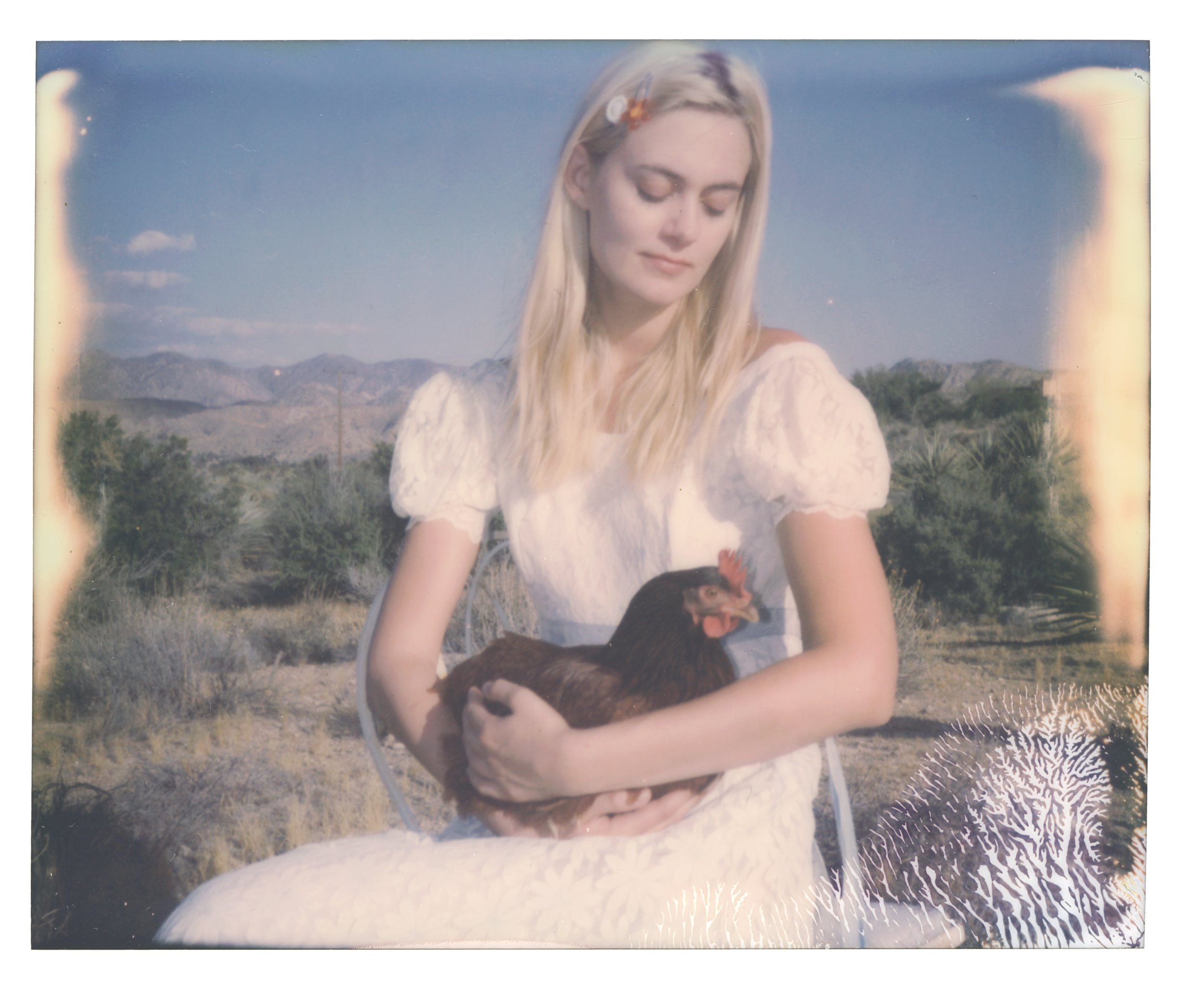
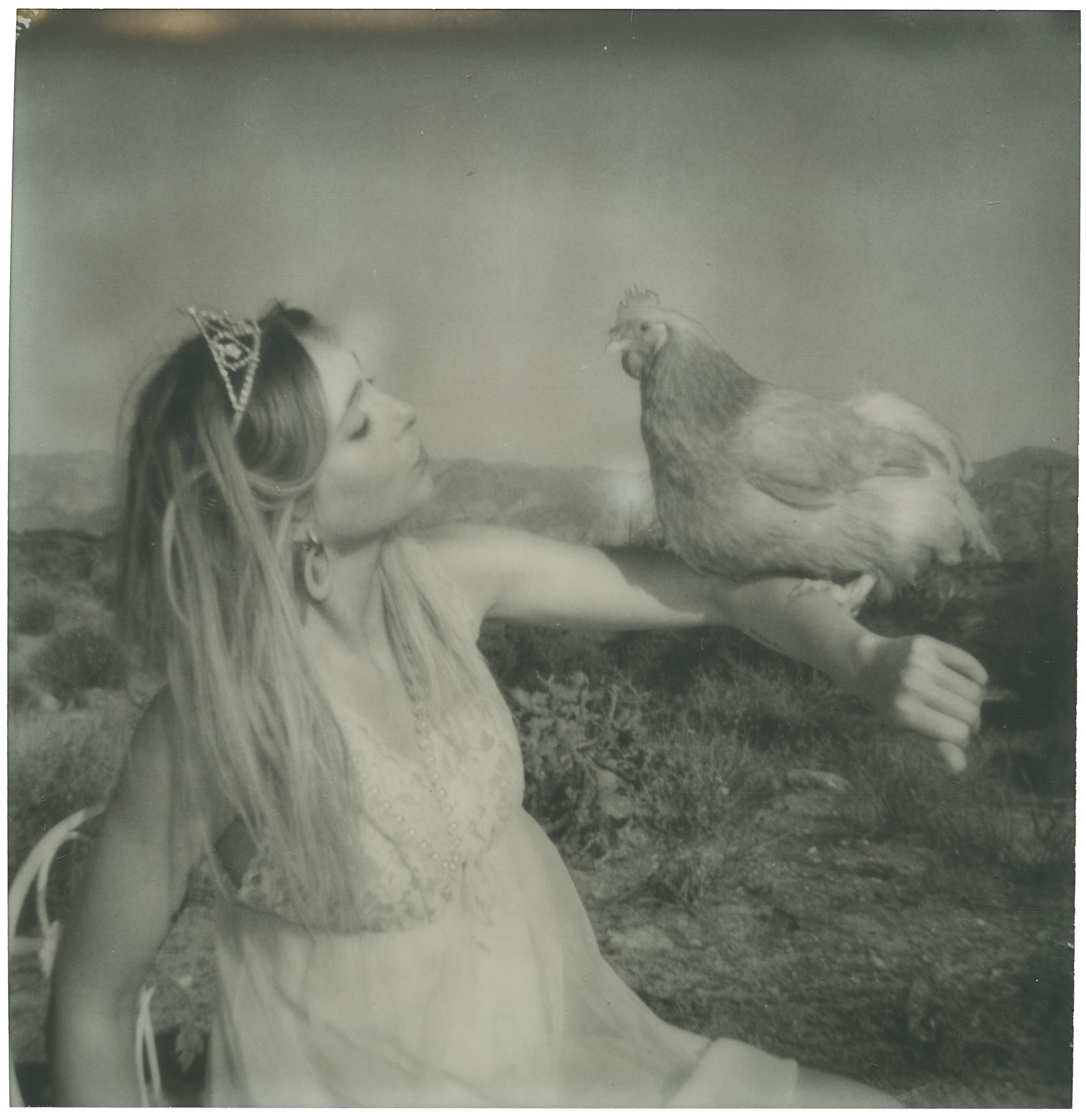
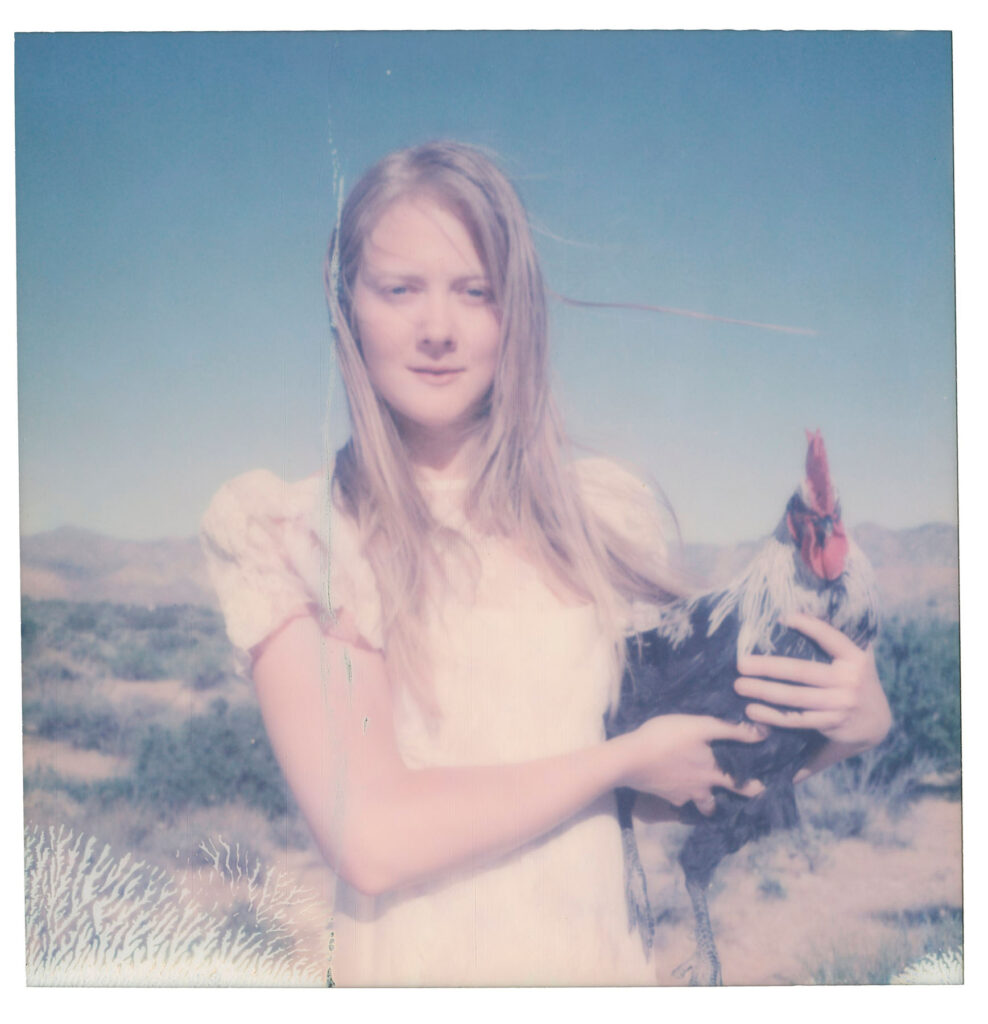
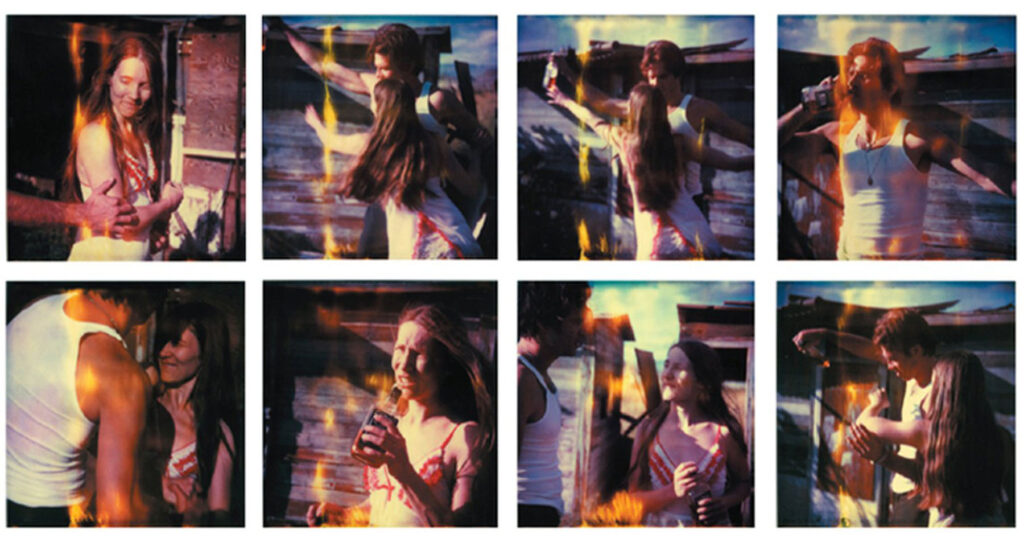
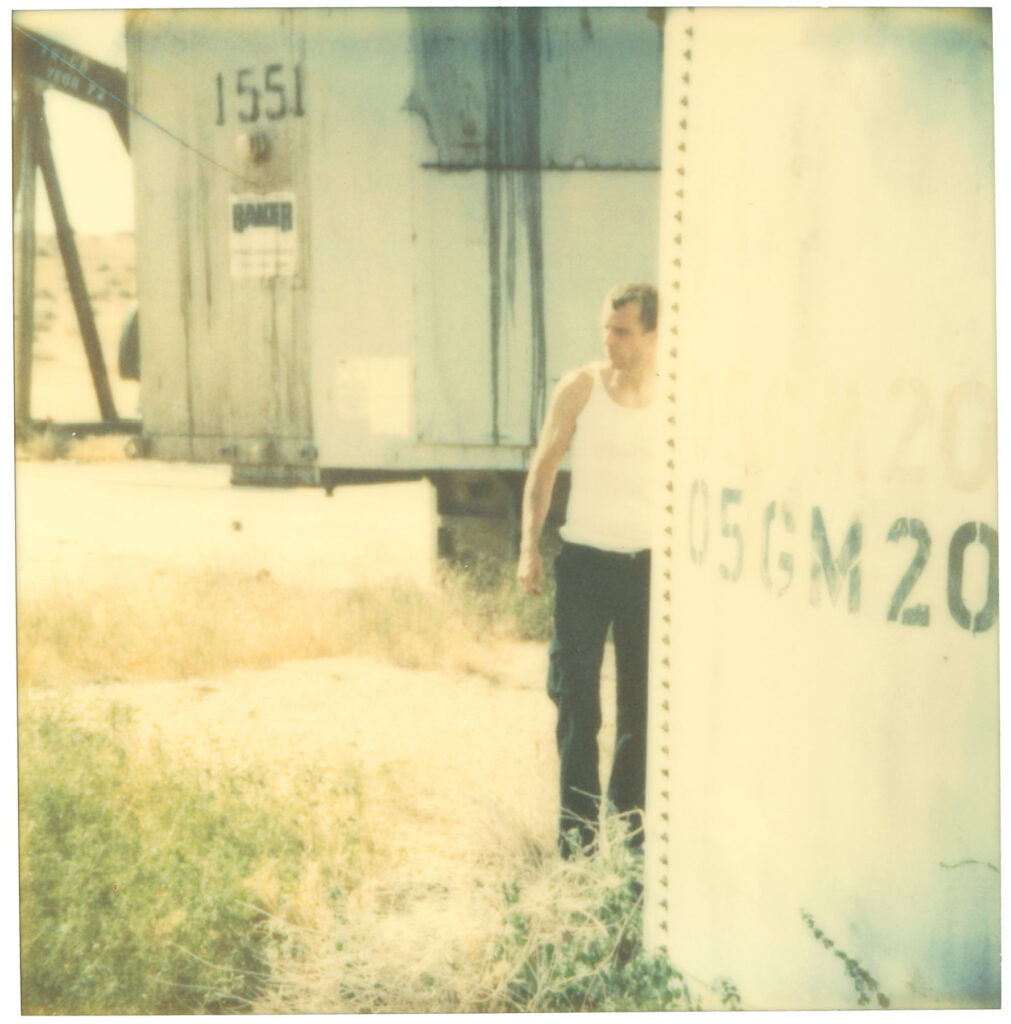
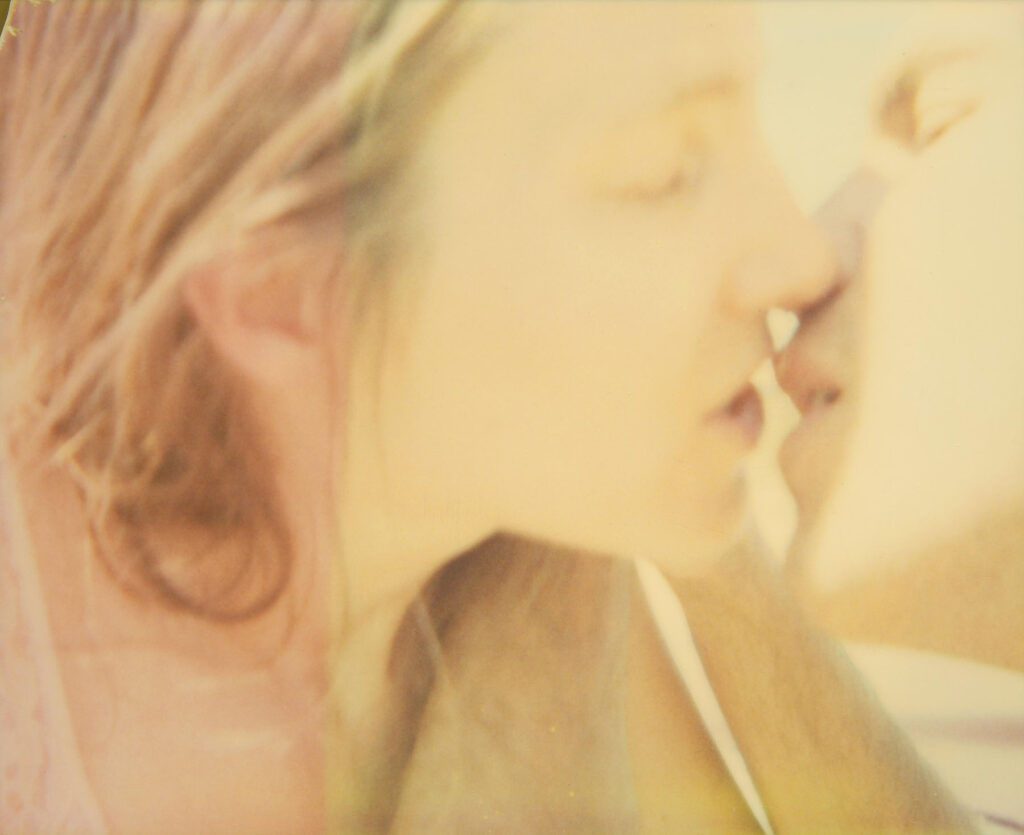
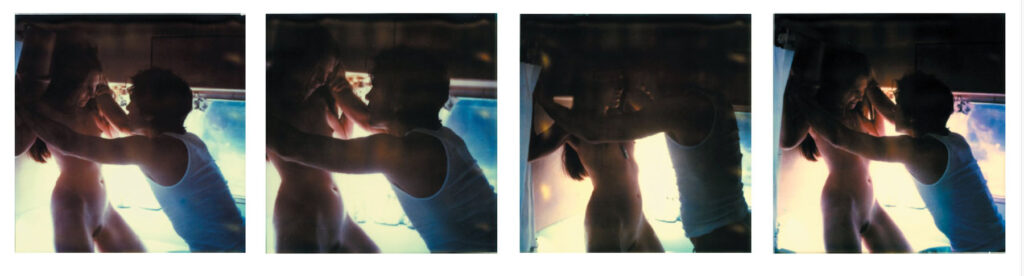
Stefanie Schneider captures the Western mentality and landscapes, archetypical histories of love, flawed beauty, and how women coddle chickens through her lens. She projects the life she yearns to live, the love she hopes to embody and receive, and the lust for both from within her onto her images. The results display burned spots in print or hazy and overlapping gradients of light, the signature she created for herself and her audience. These flaws, as she dubs them, manifest a mythlike dream Stefanie imagines for herself and those around her, ushering them into a discrepancy between light and darkness in photographic styles and the human psyche.
The German photographer works on self-portraiture as she poses for most of her projects, always infusing every shot with her views on life, love, and nostalgia. As she taps into her realm, Stefanie’s flair for memories and bygone eras – plus an old ranch and a farm of chickens – unravels into instinctive and distinctive photographs that ask viewers to journey through their definition of psychedelia and existence.
I wanted to ask how you got the moniker Instant Dreams then I came across your photo book of the same title. In this compendium, you take the American West as your inspiration to tell stories that evoke ideas of masquerade and play, and of love, pain, loneliness, alienation, rediscovery, and a social commentary on America. Why were you fascinated with these themes?
Instantdreams is simply a combination of my two primary interests: the American dream and instant film. It just came to me in 1998 when I was building my first website. The American West has wide, open spaces that give us perspective on the meaning of life. Its void is a reflection of your interpretation. Expired Polaroid film produces ‘imperfections’ that mirror the flaws of the American Dream. These imperfections also illustrate that the dream is a myth that misleads, offering unachievable goals; the dream turning into a nightmare. The disintegration of Western society. The last hurrah.
That is the canvas of my creations. In fact, it’s the rudder of my uncharted journey. The allure of America is my pursuit of self-identity through love and pain, alienation and loneliness.
In your first book, Stranger than Paradise, the description mentions: There is no script, and none is necessary – a primal tale with ordinary looking people with archetypical histories – they drink, make love in nameless hotels, stalk the desert under the blinding sun, dance and carouse, and endlessly move on. A sense of liberation surrounds these scenes. Have you lived through these situations? When do you feel the most liberated?
All of my projects originate from my personal story. I created a place for my imagination to flourish, so there are no limits to where I can go. This particular project you’re referring to is called ‘Sidewinder’ and is one of my most personal stories. It projects the intensity of love, the pain of losing love, futile attempts to hold on to it, and the destructive acts we engage in to avoid abandonment. For me,
“there is a catharsis in creation. Art liberated me. It allowed me to create a parallel universe.”
Going through your selected projects, three bodies of work caught my attention. I want to start with Oilfields (2004). It connotes both the notion of the frontier and the adventurous mentality of the West, and a kind of horizontal understanding of the landscape that is so quintessential about the West. Would you still describe the Western mentality as such today considering that you did this project in 2004? What changes have you noticed?
The project was published in 2004. The actual shoot took place in 1999. Considering that, basically everything has changed. There was still a kind of innocence present. The internet just started. Hardly anybody used cell phones. The information traveled slower. Actual letters were still sent and received. There was more time. Pre 9/11.
The landscapes were emptier and less populated. The feeling of being alone was much greater. Climate change wasn’t omnipresent. Back then the open landscapes felt like the last frontier. The last place to disappear into; to be swallowed into your own imagination. But it felt as if we were witnessing, with our own eyes, that times were changing, that everything would break apart.
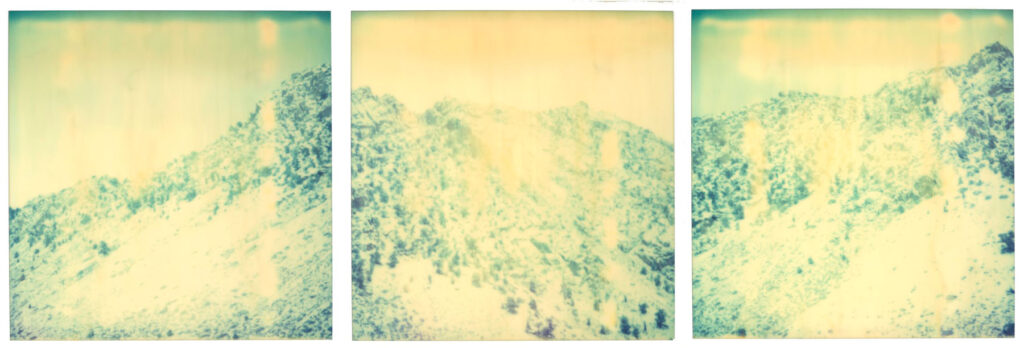
Fast forward to 2014, you introduce Wabi-Sabi (2014) as desolation and solitude are two adjectives that I would use to describe my Polaroid photographs, another two would be the Japanese term ‘Wabi-Sabi”. The simplicity of ‘flawed beauty’ comes from the expired film I use to create a reflection of love and loneliness. Why did you use desolation and solitude as descriptions? Was that how you felt? Then, why did you combine the feeling of love with loneliness?
Love, lost love, and unrequited love are the prominent themes in my 29 Palms, CA project. The consequences of emptiness, loneliness, and absence are related to existential themes, just like expired films. Constantly changing and crumbling, the film mirrors the changes of time, almost like a premonition. The summers seared through heat waves to the cracks of the Wabi-Sabi void.
Onto the third one: Chicks and Chicks and sometimes Cocks (2016 – present). One sees women dearly hold chickens in their arms. Can you share the concept and beginnings of this project? What do you aim to convey?
I rescued an old ranch in the High Desert just over ten years ago. Since then, I have been focusing on self-sustainability, growing organic food, and raising chickens, which has been so rewarding to me. I absolutely love chickens and wanted to share their beauty. I call it my Desert Living project. It is about reconnecting our human needs back to the sources of living, back to basics; my own personal reset.
You have used expired Polaroid films to capture and emphasize the sun-drenched, nostalgic, and photographic appeal of memories. Is there a forgotten memory that you want to relive? How do memories influence your creative artistry?
Memories are the essence of life itself. They are stories, they are history, they are our identity. The ones you keep and show define what transpires. The Polaroid itself is a tangible reminder of a moment we want to remember and hold onto.
“We only have what we remember or imagine.”
Thinking about your filmic and trance-like style, how would you direct your self-portrait and want the backdrop, the approach, and the essence to be?
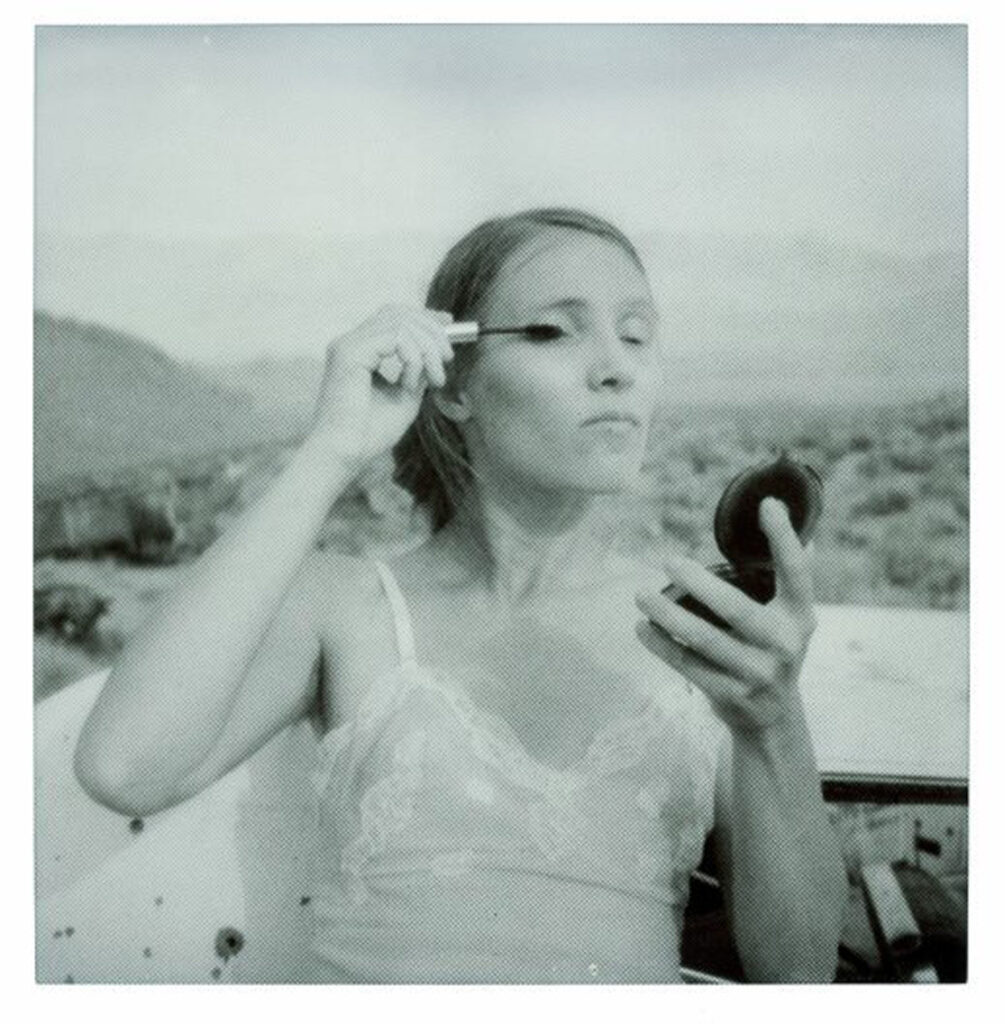
A picture of myself looking at myself in the mirror of some old car far out in the desert, alone and searching with desire for a love that I know exists.
My work is full of self-portraits. I am using myself as the subject a lot either because nobody else is around or because the project is so personal such as in the case of ‘Sidewinder’ or ‘Wastelands’. I can create my vision far easier and more precisely if I play the role myself. Nobody else could have felt what I felt at that moment, so I appear again and again and again.
NR Vol. 14 Identity · Autumn Winter 2021 Published · Print Page 324
Feature · Max Siedentopf Words · Nicola Barrett
“Turns out, there’s actually a lot you can do while taking your serious passport photo”
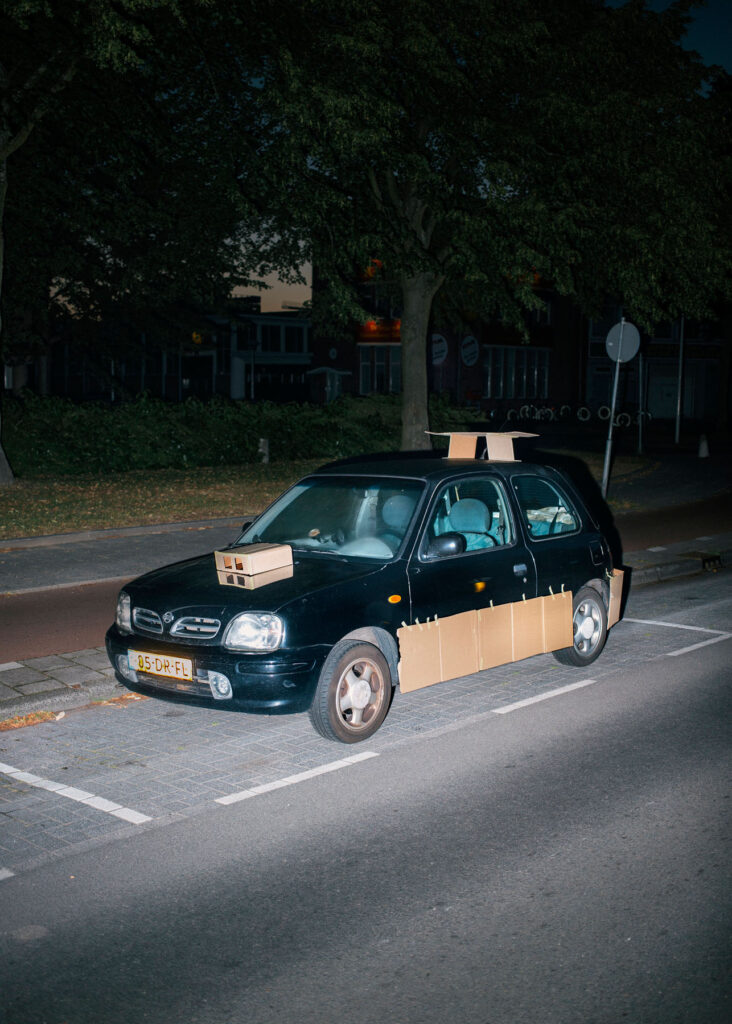
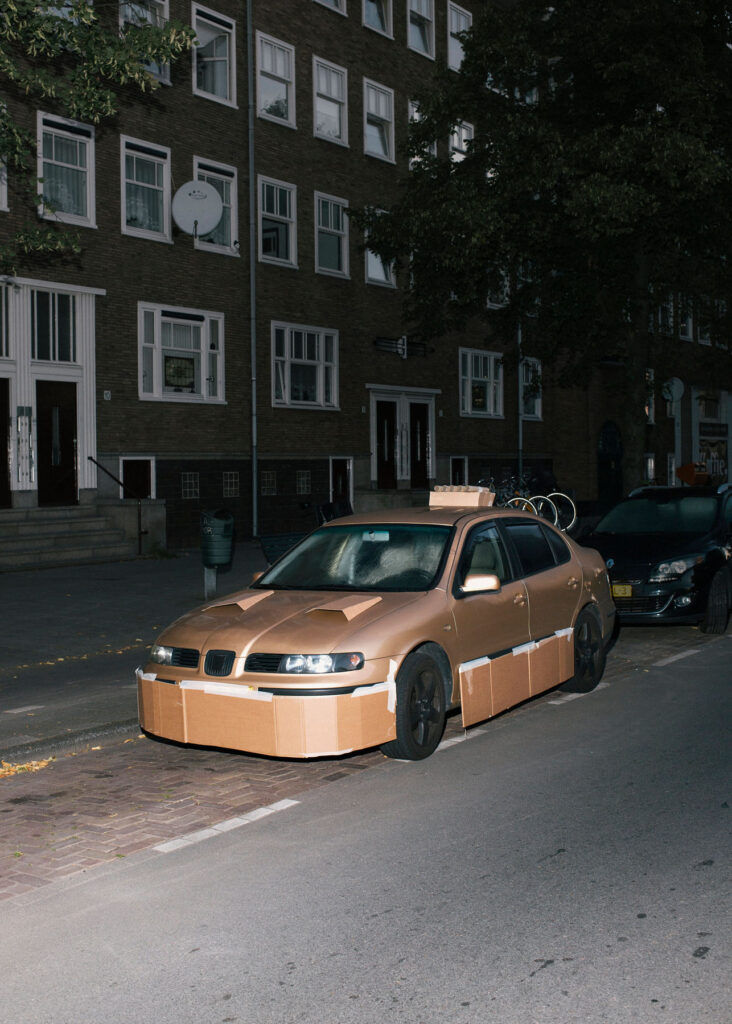
Somewhere in the golden sands of the oldest desert in the world, the Namib stands a circle of white plinths. On them sit speakers, playing Africa’s Toto for, well, eternity. Or at least that’s what Namibian-German artist Max Siedentopf tell us, the location of this artwork is undisclosed and, as no one has yet to find it, it’s rather hard to verify if it’s actually still blasting “We bless the rains down in Africa” into the wilderness.
This tongue in cheek in cheek approach is seen throughout much of Siedentopf’s work, his guerrilla art installation which involved binoculars tied to the railings of the viewing terrace at the Tate Modern allowed visitors to zoom into Roger Stirk Harbour + Partner’s Neo Bankside housing across from the gallery. It was a response to the residents of Neo Bankside taking the Tate to court as they claim the viewing gallery “unreasonably interferes with their use of their flats.” Siedentopf pointed out that the “Please respect our neighbour’s privacy” the Tate put up seems like a sign for an art exhibit and pointed out the irony of having huge windows that no one is ‘allowed’ to look into.
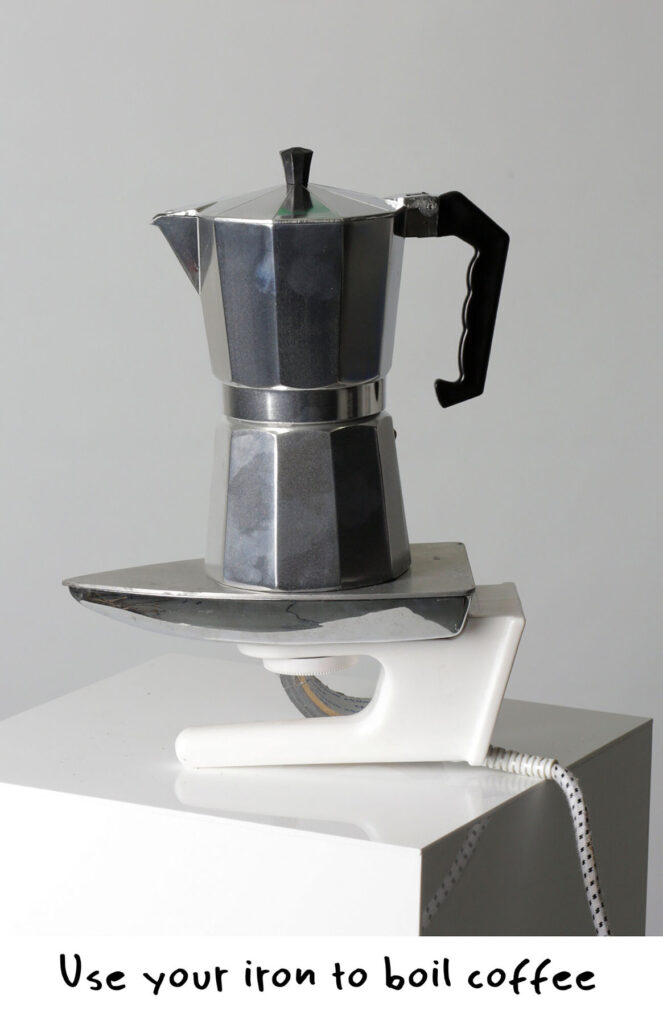
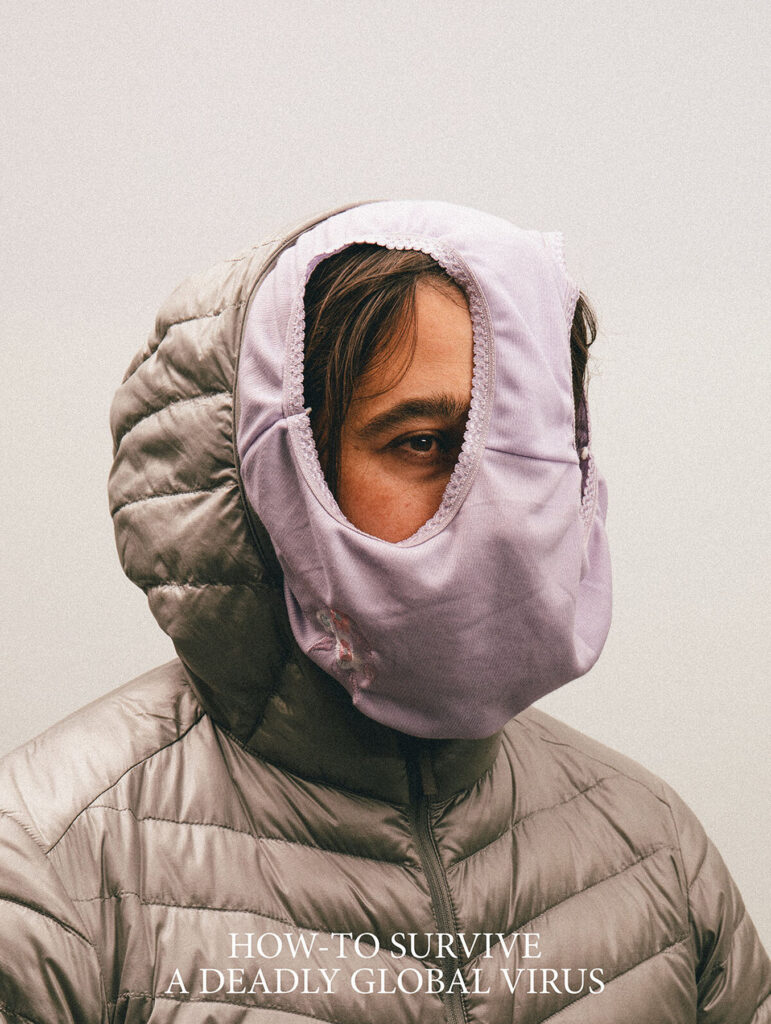
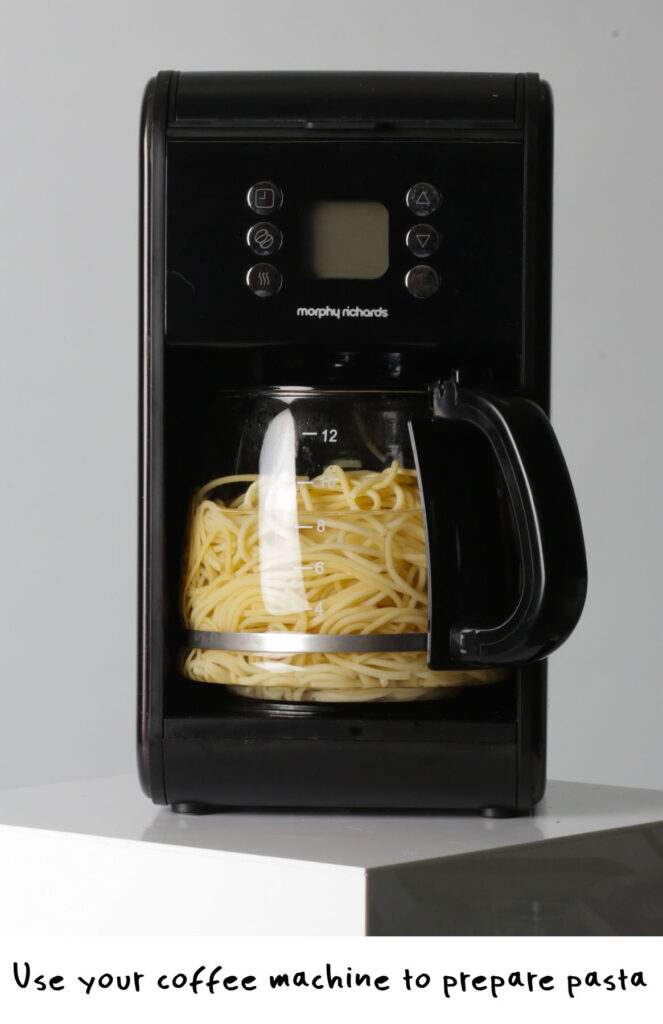
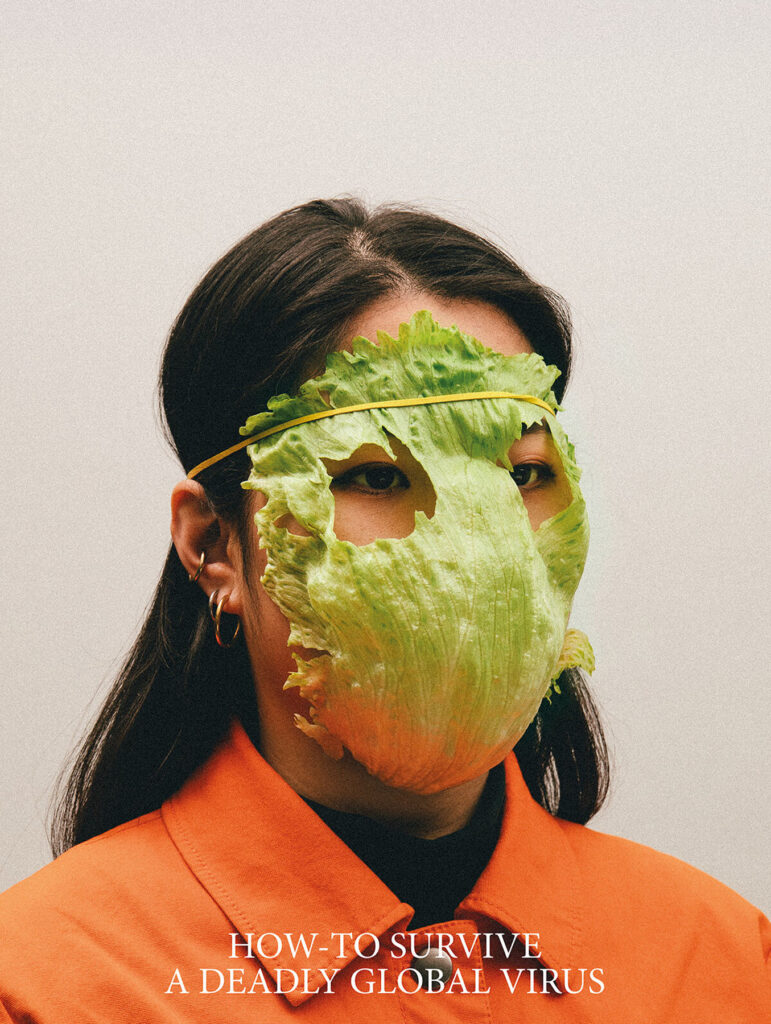
More recently he has created works about the pandemic, including a series of mask alternatives like bras, lettuce leaves and shoes, (which was met with some controversy as he created the series early in the pandemic), and an online series titled Home Alone – A Survival Guide which depicted a series of challenges for those bored at home during the lockdown. NR Magazine joins the artist in conversation.
What does Identity mean to you as an artist?
That changes every time I look in the mirror.
You are known for your guerrilla artworks, examples being Please Respect Our Neighbour’s Privacy at the Tate and Slapdash Supercars, and in addition to these, you also created artworks while stuck at home during lockdown. Do you think, as we become more digital, artists are moving away from the need for gallery backing or even gallery spaces to build their reputation?
Yes, of course, there are so many new and incredible ways today for artists to show and capitalise on their work that the gallery system isn’t the only way an artist needs to go today. With the click of a button, artists can show their work to a global audience and the success of your work is a lot more determined by the actual quality of the work and less by the gatekeepers of the gallery world.
You are known for using humour to explore serious topics in your art. Do you think that people these days, particularly the younger generation, see using humour as a coping mechanism as part of their collective identity? If so how do you think that affects how they approach the creative sphere?
I think humour often helps tackle serious subjects in a more digestible way for a wider public;
“I’m sure when the world will finally end the last artwork will be a funny meme about how the world is ending.”
However even there is a strong increase in art using humour as a coping mechanism, at the same time art has also become more serious than ever and there is much stronger pressure to make “politically correct art” which sucks out most of the fun – it’s like pleasing a big committee, in the end, no one hates it, but no one is super happy about it either.
Your work Toto Forever, in which Africa by Toto is played in the Namib Desert on a constant loop, gained quite a lot of attention, but you have never disclosed the exact location. Has anyone ever been able to find it and do you know if it’s still playing?
Good question, I guess you will need to find it, to find out.
I’m curious, has anyone ever questioned the validity of Toto Forever? It reminds me somewhat of the moon landing conspiracy theories, and as there is no exact location for people to visit I wonder if anyone has asked you if it’s fake?
Wait, the moon landing wasn’t real?
Passport photos play such a huge part in our ‘official’ government recognised identity, but in reality, they show very little of us. How did you come up with the idea for this project?
The series came about when I had to take a new passport photo. I thought to myself that being a passport photographer must be one of the most depressing things a photographer could do as there are so many rules. Your head needs to be straight, nothing may cover your face, you’re not allowed to smile and you need to have a plain white background. I wanted to challenge all these rules and find a way that you could still express yourself even under such heavy restrictions. Turns out, there’s actually a lot you can do while taking your serious passport photo.
Do you think in the future, technology will change how we are identified?
Of course – on the plus side I think it will make a lot of processes a whole lot easier, from how we travel, check-in or pay, however as with every technology that makes our lives easier we will need to give something in return, in this case, a piece of our anonymity and personal freedom.
Your project Home Alone – A Survival Guide was popular on social media and many people joined in the challenges you set. Now people are struggling with going back to normality as restrictions are being eased. Would you ever consider doing a second project, a survival guide for the outside as it were?
I didn’t think about it until this question but I could imagine it could be a good series – as life slowly goes back to “normality” I think there are a lot of factors that should be readjusted to a new way of living.
“I strongly believe we shouldn’t just chase the reality we had before the pandemic, which in many ways feels quite reckless (and got us into this mess in the first place) and instead focus on new, more responsible ways of living our day-to-day life.”
A step-by-step survival guide could be a good start.
Your project How To Survive A Deadly virus was met with some controversy, do you think if you had made it a year later people’s reactions would have been different?
Yes definitely and since the series came out I’ve seen hundreds of artist impressions similar to the series. However the series came out the beginning of February 2021, a time when most people in Europe were still very naive towards what was going on and didn’t anticipate it would ever affect their own lives – the series was a classic example of “too soon” and it was too early to talk about such a serious subject with humour. However, a few months later the series was received very differently when people started to accept the new reality and were able to joke about it.
What advice do you have for young creatives?
Eat your vegetables, exercise, spend quality time with your family, make work that brings you joy and most importantly don’t overthink too much, in the end, nothing really matters anyway.
Are you working on any projects at the moment and what plans do you have for the future?
Always – however the only certain plan for the future is to eventually end up in a coffin.
NR Vol. 14 Identity · Autumn Winter 2021 Published · Print Page 226
Feature · Mathias Schmitt Words · Izzy Bilkus
“A photograph says more about you than the objects you capture”
Taking us on a trip through the streets of Detroit, winding through the urban landscape in a Dodge Polara, passing old cafés and nightclubs – Mathias Schmitt tells a refreshing story of inner-city culture with his photography. Looking at his work as a whole, it presents itself as a cinematic mapping of an urban daydream. Capturing candid exchanges with locals and shedding light on the overlooked nooks and crannies of public spaces, Schmitt’s eye is unwavering, and never fails to channel the energy of the places he immerses himself in.
Inspired by the vibrancy and diversity of different subcultures, DIY aesthetics, music, fashion and photography icons such as Wolfgang Tillmans and Jürgen Teller, Schmitt’s work has a youthful spirit and reveals a strong love and appreciation for photography’s social potential and as a medium itself.
Finding inspiration and comfort in the everyday occurrences of city life and fuelled by a sense of inner freedom, Schmitt navigates urban photography with ease, constantly developing a sense of personal awareness.
NR Magazine speaks with the photographer to discuss how city life and the concept of identity has shaped his creative outlook.
You mentioned that Wolfgang Tillman’s book ‘Burg’ was a huge influence for you and your photography. Could you talk a bit more about that? What about this style of photography impacted you the most?
‘Burg’ hit me in 1998 when I was 20. Exploring different subcultures and aesthetics, this book presented me with a completely new world – it felt like a revelation. I didn’t know anything about cultural history, photo-technique or photography and its culture. While I was lightyears away from a full understanding, what affected me most was this certain kind of view, the glimpses, the candid faces, the natural collection of people, moments, and situations. I fell in love with this idea of being able to create images where I could share something with people who feel the same as I do, so I decided to become a photographer instead of continuing my plan of becoming a social worker.
Are there any other aspects of German culture that have influenced your work? And what was the photography scene like when you were growing up in Germany?
I don’t think German culture has specifically influenced me, but subcultures have always fascinated me. I liked the idea of being a part of something, of identifying with something separate from the mainstream. MTV was an issue back then, and magazines like Spex, Jetzt and Musikexpress drove me nuts with their photography. Kira Bunse, Sandra Stein, Wolfgang Tillmans and Jürgen Teller were people that I looked up to as well.
Some of your work shows an affinity for the city of Detroit. What other places do you draw inspiration from?
I can get inspiration from anywhere – a conversation, a person crossing the street, a train ride or just the desire to have a coffee at a specific place.
There’s so much joy in being able to travel to different places.
“An open and curious mind can bring you everything, even without asking for anything.”
Your work explores different aspects of urban life, capturing distinctive flashes of cities and their inhabitants. Are intimate moments or personal connections something you try to capture with your work?
Personal connections can be found in all sorts of things, like music, culture, fashion and food. I’m a huge fan of explorations – those distinctive flashes of cities and their inhabitants, of moments and their participants. Being in someone’s company with or without a camera can be a great gift. Sometimes you don’t know anything about the person in front of you, but it can also feel in some way very intimate when you’re both aware of that situation. I wouldn’t say that I aim to capture intimacy, but it is a very important aspect of taking a portrait.
You have a great interest in cars as well – where does this come from?
I like cars that have something to say. The presentation of a silhouette from a 1973 Dodge Polara or a 1969 Buick GS is fascinating to me. Imagining having a nice car trip for me, feels like a mental holiday.
How do you see yourself as the artist behind the lens? Do you try to influence your shots at all or is it more a case of it being a relaxed and natural process?
It is extremely important for me to be aware of when I can intervene and when I need to take a step back. Some pictures are accompanied by a certain casualness that is deliberate, rather than being something that happens by chance and from inexperience. Of course, I influence the frame, lighting, and shutter speed, but I’m a huge fan of sincerity. I’m not interested in phony smiles.
What aspects and aesthetics of city life stand out the most to you?
Being able to find everything you can imagine behind every corner, finding joy in privacy with strangers when you’re in public places, sitting alone in a café for 8 hours in a city you’ve never been to. Meeting people with different visions, different stories, finding places of joy – that’s exciting to me. I think these are the fascinating aspects of city life.
Has growing up in the countryside affected your attitude towards cities and more urbanised areas? Cities have a different kind of energy and vibrancy to them, but do you feel a particular connection with the rural landscape?
“Growing up in the countryside sharpened my senses for my surroundings.”
The isolation protected me from unwanted influences. Traveling from the countryside to bigger cities always brought about a sense of romance. I’ve always been thankful to come back to a calm place where I can separate my thoughts from what’s unwanted to what’s needed.
Do you find photography brings you a sense of identity and autonomy – particularly when visiting cities?
Identity is shaped by emotions, and photography gives me the opportunity to share these emotions. A photograph says more about you than the objects you capture. When I realised this, I fell in love with that approach, and I freed myself from all competition. I don’t expect everybody to understand or to engage with my work.
When I decided to become a photographer, I wasn’t aware of all the power it has as a medium, but I felt an immense freedom. The people I’ve met abroad and the situations I’ve been in with them has given me a sense of personal awareness.
Your series ‘Mittelkonsolen’ was inspired by the work of Hans Peter Feldmann and has references to the era of cassettes and CDs. You’ve also mentioned that reading music and skate magazines as a teenager had a big impact on you. Do you often try to channel a sense of nostalgia in your work? What is it that appeals to you about those times?
I think that using an analogue camera requires concentration, both for myself and for the participant. I’m a fan of the concept of nostalgia but I don’t particularly try to reference that in my work. We’re in a time of great technical development, but that’s not always enough. Everything must be faster, cheaper, easier – we want everything, and we want it now, no matter what.
‘Mittelkonsolen’ is an ode to a certain state of mind. The fact that you have to think about travelling and your choice of music, the atmosphere of your trip and its limitations – all that appears to me as something very logical and beautiful.
Have you discovered anything about yourself through your photography?
Separate from my images, I noticed a certain reservation in my work. I stopped caring about the specifics of how my work might be seen by others. Inner freedom is very important to me, and photography helps me channel that throughout my life.
Are there any aspects of your own life that you aim to interrogate through your photographs?
Besides photography, music plays a really important role in my life. Both mediums have almost no boundaries and provide me with a kind of shelter, allowing me to express and to address myself. Identity can be both fragile and strong, and I think the same applies to photography.
NR Vol. 14 Identity · Autumn Winter 2021 Published · Print Page 488
Feature · Hajime Sorayama Words · Nicola Barrett
“The reason why other works are regarded as vulgar is because they lack love and ability”
“Ugh, I’m sick of dating apps.” A friend slams their phone down in disgust. “It would be so much easier if we could just get a robot boyfriend.” “A sexy robot,” I reply, laughing, but privately thinking that it sounds much easier than navigating Hinge. For Hajime Sorayama the concept of the ‘sexy robot’ is not merely a passing joke between friends but his life’s work. Most well known for his hyperrealistic illustrations of eroticised feminine robots, Sorayama describes his highly detailed style as ‘superrealism’ stating that he “deals with the technical issue of how close one can get to one’s object.”
As a kid, Soryama states that he was always picking up scraps of metal from the lathe factory and had a love of shiny things. “They say only crows and humans are awed by shiny things. That’s why I like to create reflectivity and transparency in my artwork. It’s easy to produce those effects in a video, but not on a flat surface.” He is quite open about his metal fetish stating that “Even Nobel winners are often people who nobody quite ‘gets.’ You should be proud to be an outsider.”
Influenced by the American pin-up girl Sorayama’s work explore’s taboo, fetishism, bondage and genetic manipulation by presenting images of unattainable idealised women and he has risen from cult fame to internationally recognised artist as a pioneer of the sci-fi erotica genre. His work extends far beyond the Japanese art scene and his influence can be seen in media ranging from Hollywood films to advertising, robotic dogs or dinosaurs and beyond. NR Magazine joins the artist in conversation.
What does identity mean to you as an artist?
I’ve been working as an artist for about 30 years, and I’ve always done what I like. I think that the style that you are comfortable with is what leads to your individuality, wouldn’t you agree?
Do you think viewers connect with your work because there is a collective desire for escapism in this post-capitalist society and people find the alien and uncanny comfortingly different?
I communicate with fans through my various works. That’s why I don’t give them titles. If you share the same values as I do, you can understand what I am trying to say by looking at the work and feeling it.
If people who feel stuck in the same societal norms don’t try to escape, I don’t think anything will change, whether it is capitalism or post-capitalism. If you don’t take action yourself, changing your environment won’t change your life either. This kind of goes back to the answer I gave to question one…
You have stated that you are not interested in the future yet your work imagines a future where women are no longer under the patriarchy and are viewed as goddesses. Have you also considered a future where robot x human and AI virtual relationships are a possibility?
I don’t think the future will come when humans and robots or AI will be on equal footing. It is self-evident that humans have the upper hand. The disparity between men and women is a different story. I don’t think it makes sense to make minor discriminations among the same species. We are all primates.
“I think there can be romantic feelings between humans and robots or AI. We also have lust and attachment to inorganic objects.”
Are there any sci-fi films or books that you are particularly drawn to or enjoy?
You may or may not have heard of a book by Junichiro Tanizaki. He authored a book about how close one’s fetish is to insanity. I also like “Blade Runner”. It’s about the love between a human and a machine. Beyond this, I also like the story of Pugmalion in Greek mythology, who became so fetishistic that he even had a child with a stone statue he created.
Do you think aesthetic cybernetic body modifications will become common in the near future? If you were to design body modifications what would you create?
First of all,
“I don’t think becoming a cyborg will become a common practice. This is because there is no such thing as something that everyone finds equally beautiful.”
People instinctively want to be popular in a wide and shallow range, so beauty that is specialized in one direction will never become common. I think there are people who might become cyborgs purely as a personal hobby. It’s a person’s personality that dictates whether they like it or not.
If I were to design a body modification, I don’t know what the person likes or if they enjoy it, thus I think they should do what they want.
One issue with creating ‘realistic’ robots is the ‘uncanny valley’ phenomenon. Is this something you considered when creating your sexy robots? Do you think robot designs in the future will be similar to your robots because of this?
The “uncanny valley” phenomenon occurs because of the lack of love in the motif. I think this is a problem that can be easily overcome with love and ability. Dolls and robots are just like dead bodies. I’m trying to breathe life into them. I think the robot of the future will not look like my robot. Each of us has our own fetishes.
You worked with SONY on the concept design for their robotic pet AIBO. Do you see yourself working in other robot designs in the future as technology advances?
I would like to try it. But I think I will be turned down. Because what I want to complete is not profitable. For example, just by looking at the first motif prepared by a company, I know the result. It’s not good, and I don’t want to do it.
There is something of an inside joke in the art community, particularly amongst illustrators, that if you learn how to draw fetish art you’ll never have to worry about money. You yourself have stated that you have a metal fetish and that is seen in your work. Why do you think your work is considered fine art while other similar art is considered lowbrow?
The reason why other works are regarded as vulgar is because they lack love and ability.
What advice do you have for young creatives looking to explore technology and eroticism in their work?
Do you like women? If it’s something you like, you can do it even if you die! Can you keep doing it for 30 or 40 years? I think it’s good if you like it that much.
Are you working on any projects at the moment and what plans do you have for the future?
It’s a secret. I’m working on something that will surprise everyone. I just hope the world will be okay with it.
NR Vol. 14 Identity · Autumn Winter 2021 Published · Print Page 052
Feature · Andrzej Steinbach Words · Izzy Bilkus
“the creation of new perspectives can be found in the old, the ordinary and the familiar”
Born in Czarnków, Poland and currently residing in Berlin, photographer Andrzej Steinbach plays with concepts of androgyny and ambiguity in his work. Viewing his works serially, questions about the socio-political role of style, as well as the concepts of identity, personhood, and their representation through photography can be raised. Experimenting with the traditional methodology of portraiture, Steinbach examines how cultural habits and impressions are transposed and communicated through different postures, movements, and clothing.
Also intrigued by the political and revolutionary potential in commonplace objects, Steinbach observes that through appreciating the formal aspects of everyday items and images, artistic practice can be transformed and elevated.
Steinbach often creates a unique sense of disorientation with his figurative work, as his models resist strict interpretations and serve to remind us of the transience and inconsistent nature of relationships and the human condition. His work boldly asks us to confront our performative selves, and to consider how we connect to ourselves and those around us.
Operating within the realm of ambiguity and androgyny, Steinbach’s aesthetic codes are seemingly absent of empathy, and impose a distinctly cold aura onto his subjects. His vision is distanced yet personal, and his work often appears with multiple refusal to provide accompanying interpretations.
At a moment when pre-existing ideas about identity and representation are being redefined, Steinbach’s work continues the dialogue and is a notable reflection on our own ideas of selfhood and our participation in the communities and contexts of which we are a part.
NR Magazine speaks with the photographer to learn more about his own attitude towards his work and what it means to reimagine portraiture.
Born in Poland, you’re now living in Germany and have exhibited your work in cities across the globe. Do you feel a strong connection to any place in particular? Has your background influenced your work at all?
The short answer would be that the sum of places, people and experiences have influenced me – and that applies to all the people I’ve met. My time as a teenager in Chemnitz, East Germany was particularly influential to me, as it was when I first came into contact with sub- and DIY-culture. Coming from a working-class background, the punk and anti-fascist scene in Chemnitz gave me a chance to enjoy these subcultures together with others. At first, I was interested in music and political work, and later I had some small roles as an extra at the opera house in Chemnitz and then I began to work with photography and started documenting my surroundings and social events.
Your series ‘Figure I, Figure II’ explores how the appearance of androgyny has the potential to impact viewers in different ways, as the figures fluctuate between presenting as typically more masculine and feminine. Could you talk a bit more about the aim for this series? There seems to be a focus on exploring the residual identities of the subjects.
When I started working on ‘Figure I, Figure II’ in 2011, I wanted to develop a series that depicted a figure that played with pose, clothing, and habitus so as not to allow a definite image. It took me two years to find a suitable model and a method to create this. An important influence at that time was the book ‘Let’s Take Back Our Space: ‘Female’ and ‘Male’ Body Language as a Result of Patriarchal Structures’, from 1977 by Marianne Wex. I used her binary poses of ‘male’ and ‘female’ body language and turned them into new ‘prototypical’ figures. The prototypical should only have the function to break the idea of the binary and to encourage the viewer to look closer.
Androgyny is being brought to the forefront of a lot of art and fashion recently – we’re seeing more gender-neutral clothing lines and other representations. Has this focus on androgyny and ambiguity always been an interest of yours?
Androgyny can be a welcome tool for some moments to help attack the concept of ‘normal’, but I believe that this also has its limits. My dream is to live in a world where all forms exist without competition and can develop freely. With this, there is no need for an image alternative to the normative, and the idea of what is ‘normal’ itself must be attacked. Consequently, I understand ambiguity not as something confusing, but as a potential that brings us into a resonance with the unknown. In the interplay of the unknown and the familiar lie the productive practices of ‘togetherness’.
Your work also reflects on questions about alternative forms of style and cultural identity, particularly with the group of five images from ‘Figure I, Figure II’ that depict a Black woman fashioning a T-shirt, step-by-step, into a niqab. What was the inspiration behind this piece?
The work ‘Figure I, Figure II’ consists of two parts: the first consists of 120 images and depicts a person posing in front of the camera – each pose suggests a new role. The second part consists of 64 images and depicts a second person who gradually disguises herself in several sequences with different textiles. She uses ski masks, scarves and the clothes she wore before in the previous sequences to cover her face. As viewers, we see this action in a space closed off from the outside world. The office chair and blinds hint that the room is in some kind of institution or agency. I was interested in showing what it looks like when we gradually hide our face, without depicting the context of this action. In my photographs it’s hard to tell if the reason for covering the face is religious, political, or fashionable. For me, this is where the charm lies – in studying these images. Our own questions and associations with the images are channelled into the work.
These pictures, along with your other work like ‘Ordinary Stones’ and your still lifes seem to explore the political and revolutionary potential in everyday items. Has this always been something you’ve aimed to interrogate with your photography?
This is a wonderful question, as it points to what isn’t always seen in the works themselves. With ‘Ordinary Stones’ I present a series of stones lying on various glass plates and mirrors, and only by adding some recognisable political imagery, do the objects become projectiles. I like it when, in relation to images, we become aware that the context redefines our interpretation. If we think in a productive way, then the creation of new perspectives can be found in the old, the ordinary and the familiar. You could argue that my socio-political attitude isn’t revolutionary, but rather committed to the ideas of reform.
Your series ‘Gesellschaft beginnt mit drei (Society Begins with Three)’ was titled after an essay by the German sociologist Ulrich Bröckling – could you talk a bit more about this inspiration?
In his short essay, Bröckling beautifully describes the interplay and relationship between a triad of individuals or political groups. The triad functions as the starting point of a model of society in which clear power structures can be disrupted. Opposing relationships can be undermined by the third party and renegotiated again and again. When I was thinking about my next piece after ‘Figure I, Figure II’, it quickly became apparent that I wanted to make a series that depicted several people in relation to each other. In doing so, I focussed on the concept of the group and family pictures. Usually, the people who are posing stand to face the camera, and show not only themselves, but also their position in relation to the others in the picture. I wanted to create a group picture from three figures in which each person poses at least once in a separate position. I then included three different uniforms – construction worker clothes, a suit, and casual clothes. Each uniform was then worn by each person at least once.
This series subverts the traditional format of a group portrait by having the models cropped partially out of frame and having them switch clothing and positions. What attracted you to exploring these inconsistencies of relationships and resisting homogeneity?
I ended up developing a group portrait of 35 figures using only three people. I could have continued adding to this, but 35 seemed like a good number to me. Cropping the figures at the edge of the picture suggests that nobody is alone in the photograph – someone is always standing next to someone else. Society is the main subject of investigation here. The different roles being played, and the changing positions demonstrates for me, the principles of constant renegotiations of relationships with one another. The photographs serve to remind us that there is no concrete picture of society.
What do you want people to take away from your work?
Ideally, to understand the effect that works by other artists have on me. This can sometimes be sensual, other times rational and other times even educational. When I started getting into art and photography, I learned how to create images for the world. I discovered later that I find it more exciting to find worlds within pictures.
Do you confront aspects about your own self through your work?
Aspects of yourself always flow into your work – I think that’s true for almost all art. I make my art primarily for others and for the sake of art itself, but I can only be confronted by something if it comes from outside myself – something unfamiliar. That’s why I love to engage with the work of others. I get to know myself more through the work of others than through my own.
How do you feel identity and ambiguity interact in your work?
This is a very complicated but important question. I would say that aspects of identity are brought into my work by the viewers themselves, as they always differ according to who is looking at my work. Ambiguity comes from a disappointment perhaps, but it’s a crucial part of the concept of ‘togetherness’.
How would you define identity in the present day? What does it mean to you and your work?
Identity has become such a big word nowadays. I don’t feel quite confident enough to give my own definition. We live in a time where so much is in motion, and I’m curious about where this journey is taking us. I wouldn’t want to think too much about the term itself, but rather about the effects that the discussions around identity cause today. In terms of its significance to my work, I can’t tell at the moment. I have a sense of the scope of the term and how it will affect the way people read my work. When you look at my work, there is no specific points of clarity. Personally, I find the concept of resonance more interesting.
What do you enjoy most about working with portraiture – specifically with a black and white aesthetic?
What interests me most about portraiture is orchestrating the figures. I see my process as being similar to directing. There’s an interesting contradiction with my work and how I use my models. I want to depict figures that are absent and ambiguous, but at the same time are sites of great possibility. One person cannot stand for everything, so the selection and constant addition of new figures to expand this world I’m trying to create helps me deal with this problem. As long as I live and work, things will always change, new ideas will form, and old ones will be re-evaluated. This brings me back to my belief that cultural images and ideas are always evolving.
For my photographs, I work with both a black and white and a colourful aesthetic, depending on the topic of a piece. Colours draw the eye to specific things that grey tones can’t – I just see what fits best with each project.
With your piece ‘Untitled (Bat)’ you’ve mentioned that it points to an important aspect of artistic practice: the love for form, turned into a weapon. Could you talk a bit more about that?
Without form, there is only context and narrative. Form without context and narrative doesn’t exist, and if it does, then it just appears to us as decoration. In ‘Untitled (Bat)’ I present a metal rod that had been used as a weapon. I wasn’t interested in the weapon as such, but rather the form. It’s a metal rod from a shopping cart of the supermarket chain ‘hit’, and at its bottom end has been duct taped. It looks similar to a regular metal pipe, but I was fascinated by the relationship between form and function. I think this is an essential relationship when discussing art.
What is your approach to working with photography compared to other artistic mediums like video and installation?
My approach is always affected by the rules and limits of a medium itself. I believe that every piece of art must operate moving back and forth between the boundaries of a medium. Depending on the topic and project, a project can challenge and break these boundaries, as well as working well within them.
Are you working on any projects at the moment? Where do you see your practice heading?
I am currently working on several pieces at the moment. One project deals with food from industrial production, which I’m exploring as an expanded image of humanity. It has always been possible to understand and interpret social relations from food. I’ve also begun to explore the illusion of eroticism in analogy to macro-photography, but I don’t want to reveal too much. In short, I’m continuing my practice and delving into different ideas. I enjoy straying from the path and seeing where I end up.
Credits
Images · ANDRZEJ STEINBACH www.andrzejsteinbach.de