Ici ces drapeaux n’ont pas pu exister
Here, these flags could not have existed
Rome, 1666. The scaffolding is still up in front of St Peter’s, where the last columns of Bernini’s colonnade are being hauled into place, and the carts keep coming up from the travertine quarries at Tivoli. The city is in the middle of remaking itself: new fountains, new façades, new piazzas opening where there were lanes a decade ago. Beyond the basilica it runs downhill through gardens and ancient stone, and above it all stand the hills where the cardinals have built their villas to look out over one of the finest views in Europe.
A thousand kilometres north, in a room at the Louvre, Jean-Baptiste Colbert has been making an argument for years. He runs Louis XIV’s finances and most of his cultural ambitions besides, and he believes French artists deserve better than copies of copies. Charles Le Brun, the king’s first painter, agrees with him. Everything they want their students standing in front of is in Rome, and since none of it can come to Paris, Colbert sends the students to it. The Académie de France à Rome was founded.. Charles Errard, a painter who had already spent much of his life in the city, is sent back as its first director with a dozen young men in his charge, and they go south by road, the better part of two months of it.
Then the years start moving. The pensionnaires keep arriving, one cohort after another, and what they send home transforms the royal collections. David comes, then Ingres, then Berlioz and Debussy. Monarchies fall and the Académie outlasts them. The idea of forming an artist by giving him years abroad becomes a model other countries adopt outright.
Since 1803 the Académie has occupied Villa Medici on the Pincio, and time is at its most legible there, in the garden façade. Ferdinando de’ Medici had his Roman bas-reliefs set directly into the wall, so that the marble is fifteen hundred years older than the brick around it and the institution behind it is younger than both. Seven hectares of umbrella pine and clipped box run back into the hill. The city opens out below the terrace, more or less where those carts once came up from Tivoli. Entry was by the Prix de Rome until 1968. The Académie belongs to the French Ministry of Culture now and selects through an annual international competition.
What it offers is twelve months for creation, experimentation and research.
Curators, Roberto Pontecorvo and Imma Tralli met in Brussels, at BOZAR, and in 2021 they moved south to start the Marea Art Project, on the Amalfi coast. Tralli is an art historian from Matera, with cultural associations and museum years in Brussels and Madrid behind her. Pontecorvo grew up in Praiano and read international relations. Their gaze reveals a rigor that extends beyond the curatorial practice. These two seem to carry, almost in a single sentence, in the quiet force of their gaze, something of all the values we seek. Every idea they put into the world is worked through with extraordinary care, considered down to its finest grain, felt, questioned, and lived. Pontecorvo and Tralli found at the Villa an institution willing to keep the dialectic of the perspectives embodied by the fellows. “At a historical moment when a plurality of perspectives does not always manage to coexist”. At Villa Medici they meet. “This is profoundly rare. And perhaps, precisely for that reason, especially precious today.”
Sixteen fellows arrived in the autumn of 2025, from architecture, art history, art theory, literature, curating, musical composition, photography, cinema and the visual arts. Each applied alone. Each proposed something connected to Italy. Nothing has to be finished. The residency does not ask for production, and the exhibition that closes the year is not compulsory. For some it becomes a turning point. Some of the fellows spent the year working in mediums they had never used before. A maze can take shape in the mind— Around them the Villa runs: guests, screenings, book launches, workshops, short-term residents passing through.
The institution invited them into a group already assembled, which reverses the way they normally work: at Marea Art Project, their own residency in the Italian south, now in its fifth year, they choose the artists and build the process around that choice. Here the process was accompaniment. Sixteen practices, sixteen geographies, sixteen political positions, and a year of listening. Many of the fellows embody their research rather than conduct it. For the fellows, the curators state, certain practices and certain positions are not simply important. They are vital. “For some of them, a personal life becomes not just a personal life. It becomes political, and at the end it becomes collective.”
Late in their year with the fellows, after the studio visits had ended, the curators visited in Ramallah the Palestinian artist Vera Tamari. They had gone to meet her. As they leafed through a catalogue, Tamari showed them a work she had made in 1998: clay faces modelled on her ancestors, mounted on metal rods and planted along the shore at Jaffa, the city her family had been forced to leave in 1948. Left exposed to the wind, sand and sea, the faces would gradually wear away. She had called it Oracles from the Sea.
On the journey back, Pontecorvo and Tralli discovered that the work had stayed with both of them. Its title, they felt, could also name the closing exhibition. The exhibition’s title became both a tribute to Tamari and a return to November.
The idea of the oracle became a framework through which to offer audiences an entry point into the works, suggesting possible connections and resonances without imposing a single interpretation. It is an invitation to embrace visions, omens, and questions, and to cultivate the critical awareness needed to navigate the complexity of the present. Oracles Beyond the Sea therefore names not a subject shared by the sixteen fellows, but a condition of looking: a set of practices gathered without being reduced to a single meaning. The sea, too, had already begun to surface across their work, appearing independently in projects that had started without common ground. What emerged was not a theme imposed from above, but a resonance discovered along the way.
The night of 27 November 2025, two months into the residency: From six in the evening until midnight, the Villa opened its gardens, loggias, and studios to anyone who walked up the hill. That night, the front of the building went dark. Then the flags began to appear. Countries that had disappeared, been partitioned, or been denied recognition were projected one after another across four hundred years of brick and marble, each holding the façade for a moment before giving way to the next. Across the same wall ran a line of text: “Ici ces drapeaux n’ont pas pu exister.” Here, these flags could not have existed.
Inside the Neviera, voices were arranged like a chorus, entering over one another until the room could hold several at once. Poems by writers from Gaza played in the recorded voices of residents, among them Refaat Alareer’s If I Must Die. Marin Fouqué performed with the Roman boxer Adriano Tramontozzi and with Husam Maarouf, a poet in Gaza who joined from a distance. Elitza Gueorguieva read with the Palestinian writer Karim Kattan from texts including those of Heba Abu Nada, accompanied by music from Giulia Lorusso. The fellows issued a collective statement—“a white night can be spent celebrating, or trying to survive bombardment”—and transformed the Villa’s annual Notte Bianca into Nuit noire, working with Palestinian artists through Ma’an for Gaza.
It was the first thing the sixteen fellows did together. Months later, when the curators encountered Tamari’s Oracles Beyond the Sea, they recognized in its title something that had already begun that night: not a prescribed theme, but a way of gathering disparate voices without silencing their differences. The title of the final collective exhibition became, in that sense, both a tribute to Tamari and a return to November—a name for the questions the residency had opened, and for the meanings the sixteen practices would leave for others to interpret.
Pontecorvo and Tralli leave the portraits to us. What follows draws on NR’s conversations with Ben Russell, Paul Maheke and Elitza Gueorguieva— reflections on the year at Villa Medici.
Ben Russell is wary of the words people use for him. He came to the name of the artist late and reluctantly; filmmaker he rejects outright, because his films are largely non-narrative and not character-driven and the word tells an audience to expect something he is not going to give them. Five features, around forty short films. Programmes he made fifteen years ago come round regularly and he does not always recognise the self who made them. What he recognises is the boldness — the obligation, as he puts it, to be as radical as he can inside whatever framework he is working in.
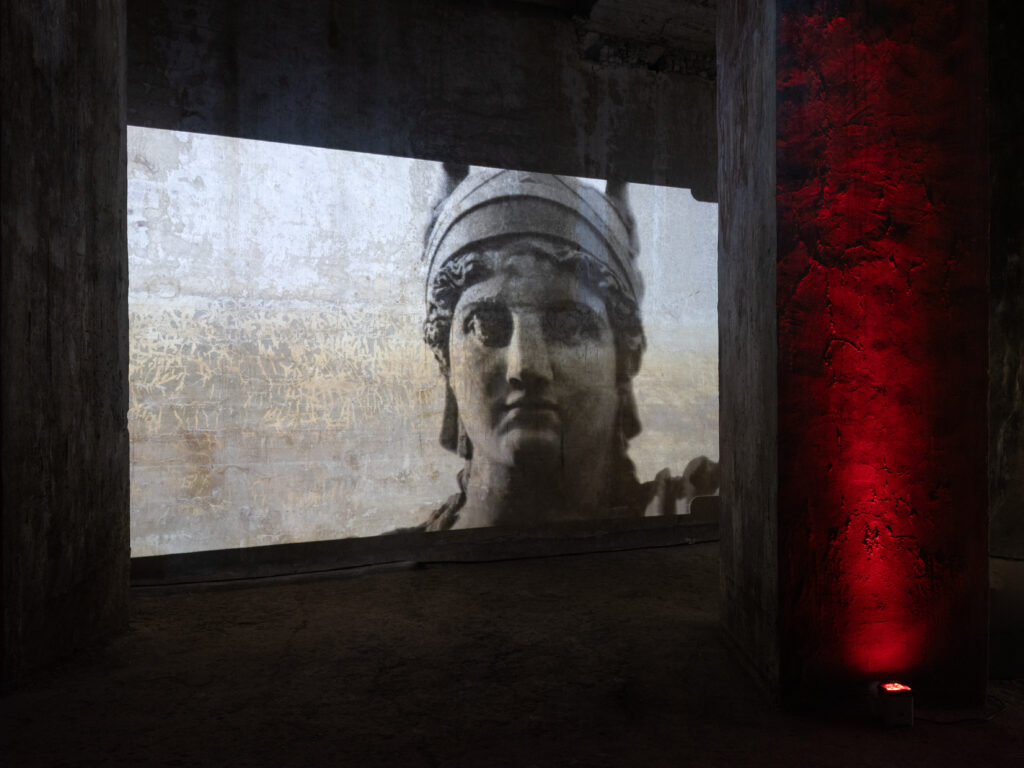
He came out of an American underground where everyone had a second job and the work was determined by what could be reached, and he has never pretended the practice floats free of its costs. He left teaching in 2011 and moved to France. He shoots 16mm; film costs forty euros a minute; a twenty-minute film means exposing between sixty and two hundred. It is not possible to make a feature a year — raising the money takes years, while shooting and editing do not — so everything in between is waiting, and the waiting has to be filled. The curatorial work came out of that, and the performances, and now the music. The Villa gave him somewhere to live and a space to film.
Russell’s interest in psychedelics and surrealism has always been an interest in perception itself; he remembers watching a bird while tripping and seeing three points of its flight at once. Perception is a language. Cinema offers another manipulation of time — the lens is a different kind of eye, and duration makes a spectator increasingly aware of the body doing the looking. Rome makes the same argument in fresco: trompe l’oeil, perspectival experiment, and in every church the impossibility of representing heaven. Cinema, he thinks, wants the same thing, to produce what cannot be experienced in the present world.
He walks through the decorative gardens each day to reach his house and watches the sun go down over a city that has existed in various states for a very long time. He calls the feeling awe, then corrects it into something more useful: recognising how relatively unimportant his presence in this moment is. The people on the street are descendants of people who have walked there for two thousand years, and he is another iteration of the visitors who have always come to look. “We don’t have ruins of ruins that have been shifted and changed.” Understanding that takes time, and the danger of working quickly is arriving at the wrong thing: react to your first impulses and you are only reacting to surfaces.
He had arrived with a proposal that connected a sacrificial myth from 362 BC to contemporary anti-fascist militants and occupied social centres; he went to Acrobax and to Angelo Mai. It did not survive contact with the city. He had expected Rome to be a place where the past lies in pieces and the present walks over it. Instead he found a city that assumes its material history, carries it structurally, keeps using it. Following it took the rest of the year. The proposal became a question about layers rather than about parallels, and the work reorganised itself accordingly: a two-channel installation, sound experiments, a short film, material for a feature, sixty minutes edited down. No single object arrives out of it, which he considers the point. The research residency meant learning to let himself write with the camera.
What accumulated is a practice of stratification. His installation at Villa Medici, Le fantôme souriant, places five moments spanning roughly two and a half thousand years beside one another, held together by a ghost, because a ghost is not subject to ordinary human time: a day is a decade, is a century. It is projected inside an ancient Roman cistern, onto walls carved two thousand years ago, so the room itself passes through the image.
The layers refuse to stay aligned. He recorded aqueducts and discovered that an aqueduct makes almost no sound; what the microphone picked up was trains, birds, cars, people. The image could remain in antiquity. The sound could not. Marble carried a chronology of its own — geology, quarrying, transportation, labour, empire, museum — and at the Capitoline he built competing sound waves around the statues so that what a visitor heard changed according to where the body stood. He recorded aqueducts, but an aqueduct makes almost no sound. The microphone picked up trains, birds, cars and people. The image could remain in antiquity. The sound could not.
If you begin at your loudest sound you cannot scale back, and whatever the audience sees first is what they will expect from that point on. So a film opens in a way that persuades people to be present. The installation loop swaps its screens at the end, left to right and right to left, so an hour is needed to see everything from one position. Nobody is obliged to stay. It is the cut between the parts that gives meaning to the whole. And once he has explained the work he relinquishes the explanation almost immediately — once it’s gone, it’s not his.
You see because you have eyes. The perception produces you in the act of it. There is the author, there is the subject on screen, and there is the viewer, who in a room where nothing much is changing is made into a subject as well. “People are afraid of losing themselves, but in fact what’s happening is that they’re becoming so wholly embodied that it’s terrifying.” The brain filters, because feeling everything is not useful. “When in fact, it would be beautiful to feel and see everything.”
Paul Maheke is a French-Congolese artist whose work moves between dance, sculpture, sound, and installation, often treating the body as something that can be sensed through weight, rhythm, and resonance rather than only through image. Trained as a dancer at the Paris Opéra Ballet School and with a background in philosophy and performance, he has developed a practice that asks how bodies—especially Black, queer, and diasporic bodies—leave traces in space and time.
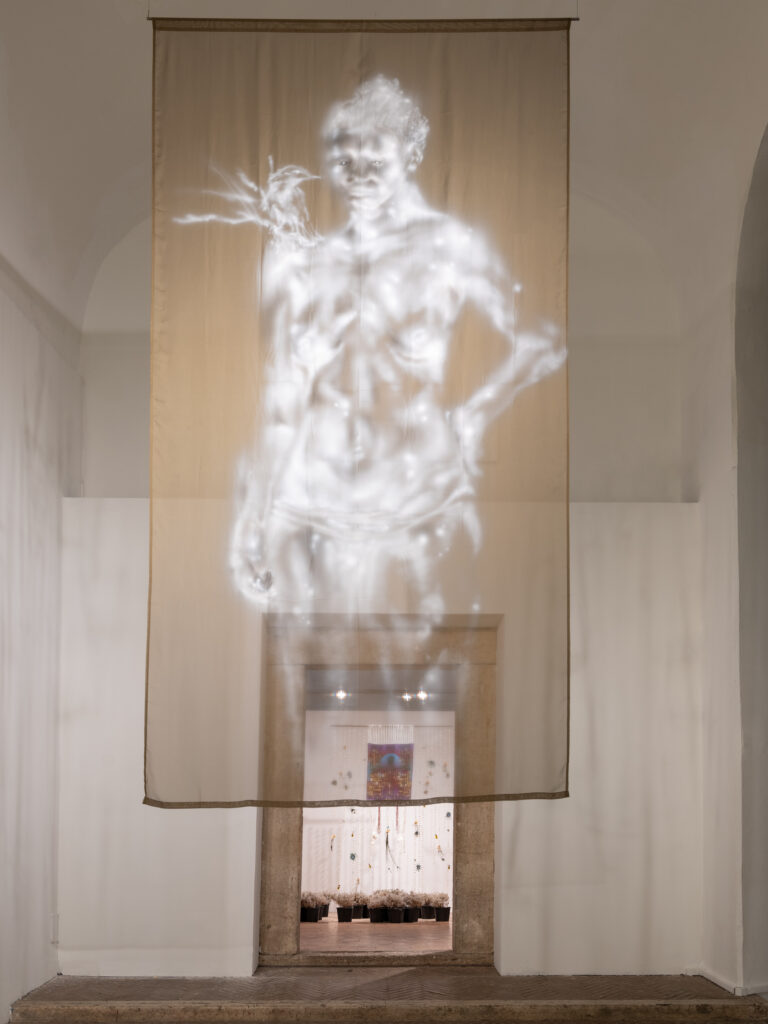
(figures noires), 2026. © Daniele Molajoli
Speaking of Villa Medici, “I see in this a way to maintain the dead in our existence as living bodies,” he says.
His own The Rise remakes the sarcophagus in smoked plexiglass, filled with water calibrated to the weight of an average human body. The body is present as weight without needing to appear as an image.
The year pushed Maheke unexpectedly toward painting, but his understanding of research resisted a distinction between investigation and making. “For me, research doesn’t end once the making begins.”
It also resisted another expectation surrounding contemporary art: that knowledge should become completely available to whoever encounters it.
“What is lost in the effort of translation? What is left incomplete does not mean it is powerless.”
Elitza Gueorguieva was a child in Bulgaria when the regime ended. What she remembers is the set being struck: precise objects leaving daily life, adults beginning to behave differently. “I didn’t understand everything, but I could see how the décor was changing.” The change reached children’s dreams before anyone explained it.
Black humour arrived with it. Countries that have not been lucky in their history laugh at themselves in order to get through the day. She quotes Beckett: nothing is funnier than unhappiness. Misfortune is good material for comedy, and comedy is a good way of speaking about misfortune. It is also how she argues. She contests by parodying rather than denouncing. Writing is what keeps the intimate from collapsing into a private joke. She spent part of her year confronting an absence.
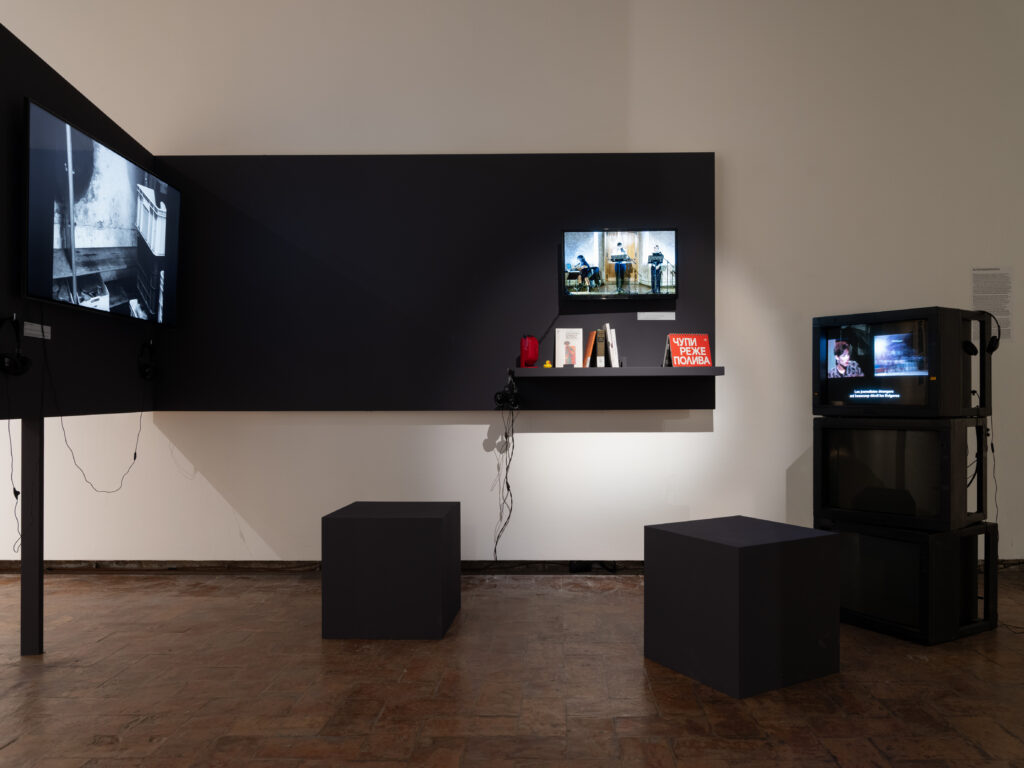
Nos langues maternelles chantées dans un
jardin, 2026, 7’
Her novel draws on archives, migration and naturalisation, but she is careful about what historical research promises. “I’m not a historian, and I’m always afraid of being submerged by too much information.” She describes her method through tâtonnement: feeling her way through material without allowing information to close every uncertainty. What she is after is not documentary accuracy but a certain truth about the condition of the people she is writing, arrived through a gaze that stays novelistic and sometimes exaggerates.
She travelled to an Italian village looking for the trace of a woman at the centre of her research. She did not find her. What emerged instead were the conditions around the disappearance: migration histories, local memory, a very large family, people who had known its members, the circumstances surrounding departure.
The conditions of the residency were material before they were intellectual. The grant meant she did not have to work beside the book. Being abroad, without full command of the language, closed her in, which suits writers. She arrived with the beginning of the novel and is finishing it as the year ends.
The research changed again when Gueorguieva performed part of the novel at Villa Medici, in a register closer to political cabaret, with two artists she knows. People in the audience had experienced administrative procedures similar to those she was writing about. They challenged parts of the work and supplied experiences outside her own. She had wanted out of the profile of the foreign artist. The archive could no longer be the only thing answering back.
Hearing the text in other voices changed the writing. What survives aloud is not what survives on the page, and music delivers an emotion a sentence cannot. She calls it almost magic, and has been writing the ending with those voices in her head. The novel is built as a braid rather than a testimony. It is not exhaustive and it is deliberately not centred on her own experience.
One expression remained particularly charged: the “useful woman.” In the archival material, usefulness becomes entangled with nationality, merit and service to the state, and foreigners are pressed hardest to prove it. For women it attaches to reproduction, and to expectations placed on the body. Gueorguieva connects it to her own French naturalisation procedure, where an abstraction such as liberté, a word in the Republic’s motto, becomes an administrative question asked across a desk. Reading the documents was also a way of putting distance between herself and something that had happened to her. The novel takes the vocabulary of the prefecture and turns it toward the trajectories of women who moved in order to be freer.
She felt free. She sets that against the period: the rise of the far right, a sense of ending around art. She describes being protected by people who were benevolent, and a year that left her more solid when she arrived.
The three practices approach research from different directions: Russell makes material that may disappear; Gueorguieva searches and fails to find; Maheke refuses the assumption that incompleteness constitutes failure.
For Marin Fouqué, that meant deciding what literature could become in a room. A writer publishes and reads aloud; exhibiting is not part of the form. After spending time in Roman boxing gyms in the popular neighbourhoods, he recorded texts with the boxers he had met and placed the voices inside a punching bag. A visitor had to move towards it to hear them. The exhibition did not simply display the outcome of his research. The difficulty of exhibiting it generated another form.
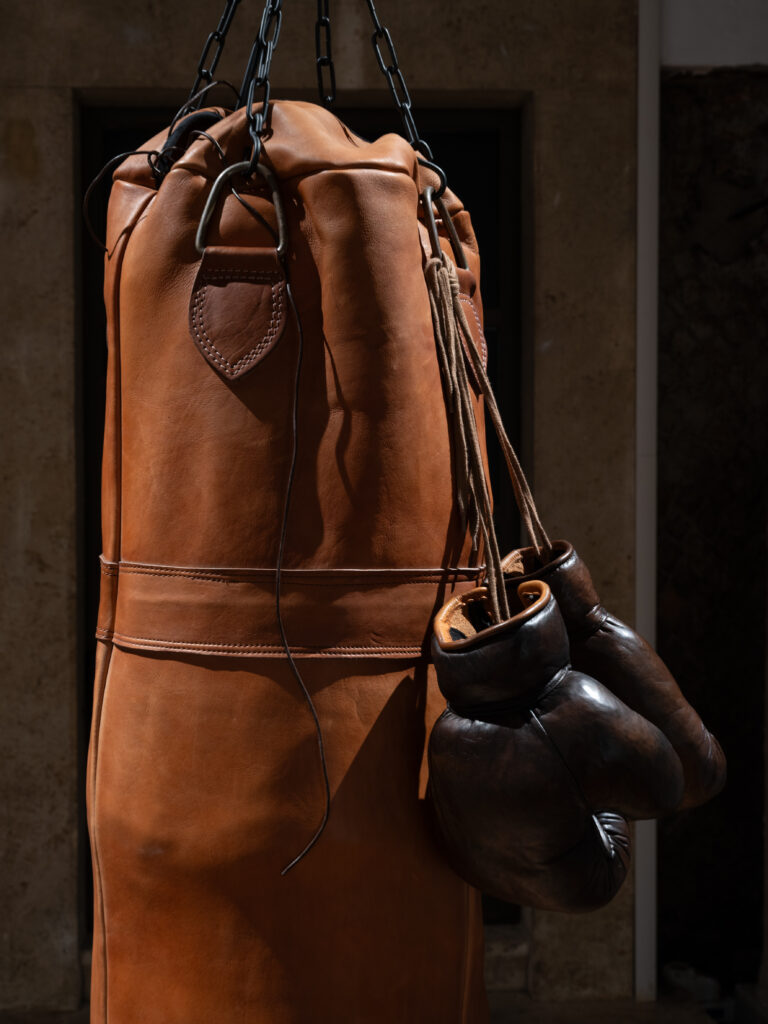
The show carried other traces of the year. Fellows recorded videos for one another and wrote texts for one another. Some brought in artists from outside the Villa to work inside their rooms. Pontecorvo and Tralli consider mediation part of curatorial responsibility, at Villa Medici and before it: how does somebody without the codes of contemporary art enter the work? At Marea the question is literal. The public there includes shepherds and fishermen. He and Tralli test decisions against one of them by name: if that person walked in, could he understand what was going on.
Visitors to Villa Medici arrive expecting an exhibition. Some of what they find is finished work. Much of it is a moment inside a process, or an experiment that has not been resolved. Saying so without saying everything is difficult. Maheke leaves a question beside that ambition: what disappears when something has to become legible?
Sixteen fellows arrived at Villa Medici with separate practices. They challenged boundaries and definitions together.
Perhaps this is exactly what the oracle stands for. Sometimes the future begins with making visible what the present insists cannot exist. Or refuses to leave undefined.
Ici ces drapeaux n’ont pas pu exister.