Beyond Real-Time Capture
Raised in Ghana by a family of careful hoarders, suits preserved, lace folded, church memories intact, Carlos Idun Tawiah grew up surrounded by objects that outlasted their moments. Photography wasn’t everywhere in his Ghanaian childhood. His practice turns that surplus into something else: staged portraits that reconstruct lost time, casting strangers as fathers, lovers, and priests to fill the silences his family album never caught. The fiction, he insists, only makes the truth more complete.
“A poet is allowed to speak about a subject in whichever poetic way they want,” Idun says. “But a photographer is often not allowed to have that poetic part of themselves.” He takes that permission anyway, pushing the medium beyond real-time capture to reclaim what time stole: memories with his father, harbor escapes, and his parents’ love story as it existed before he was old enough to witness it. Personal gaps, he’s discovered, have a way of echoing universally.
Idun unpacks this reconstructive drive revealing how personal gaps echo universally through faith, hope, and the quiet virtues that bind us and reminds us that the most ordinary moments are often the ones most worth preserving.
You’ve said your relationship to photography begins with absence, with family albums that failed to hold the quiet, unposed moments of your childhood. If that absence had a form, what was the image you never found? The one that compelled you to begin making photographs yourself. And before this became a practice, how did your interest first take shape?
Before this became a practice, my interest in photography started quite naturally. My dad often bought disposable cameras for the family because he loved to keep prints with him whenever he travelled. That was how I started experimenting with those cameras at family gatherings. We also had this family tradition of taking professional photographs at Church every Sunday. The photographers would come by the house on Wednesdays with the prints, and we would shuffle through them, select our best prints, and fix them in the family album. Looking back, I think that was the first time I observed photography and curation happening in real time, but in a very vernacular and intimate sense.
Later in uni, my dad bought me a DSLR camera which got me a lot more hands-on with image making. At the time, it did not feel like I was building a practice. I was just curious, trying things, taking portraits of the people around me. But those little moments slowly grew into everything it is now.
Returning to those gaps in the family archive, what exactly was missing? What was the image you were searching for inside those absences?
I think the image I was looking for was not one single photograph, but a kind of photograph: the quiet, unguarded moments where we were not posing or performing for the camera. As much as we photographed family gatherings, there was still a gap. I barely had any photographs with my dad, and very few photographs of all those mundane moments I shared with family and friends, which, to me, matter the most.
Something as ordinary as a father teaching his son how to polish a shoe, friends making paper planes, or couples cooking together is what I would have loved to see in a family album. Those simple moments say so much about love, care, and family.
When did you begin to trust fiction as a legitimate photographic language?
I think I began to trust fiction when I realised the work was not only reimagining my family’s history, but somehow allowing my audience to return to theirs as well. As personal as these photographs are, they’ve been able to resonate with people in ways I did not fully expect, and that made me think about the work differently.
There is this perception that staged photography is vain, but I think photography has boundless potential when we allow fiction to explore and amplify fact. If a photo story that begins from my own wishful thoughts and memory can become a marker for someone else to reminisce about theirs, then we may have to rethink the place of storytelling in photography. Fiction, for me, does not take away from the truth at. It only gives us another way to reach it.
The image operates on a child’s logic, where memory is not corrected but believed. How important is it for you to preserve that original way of seeing?
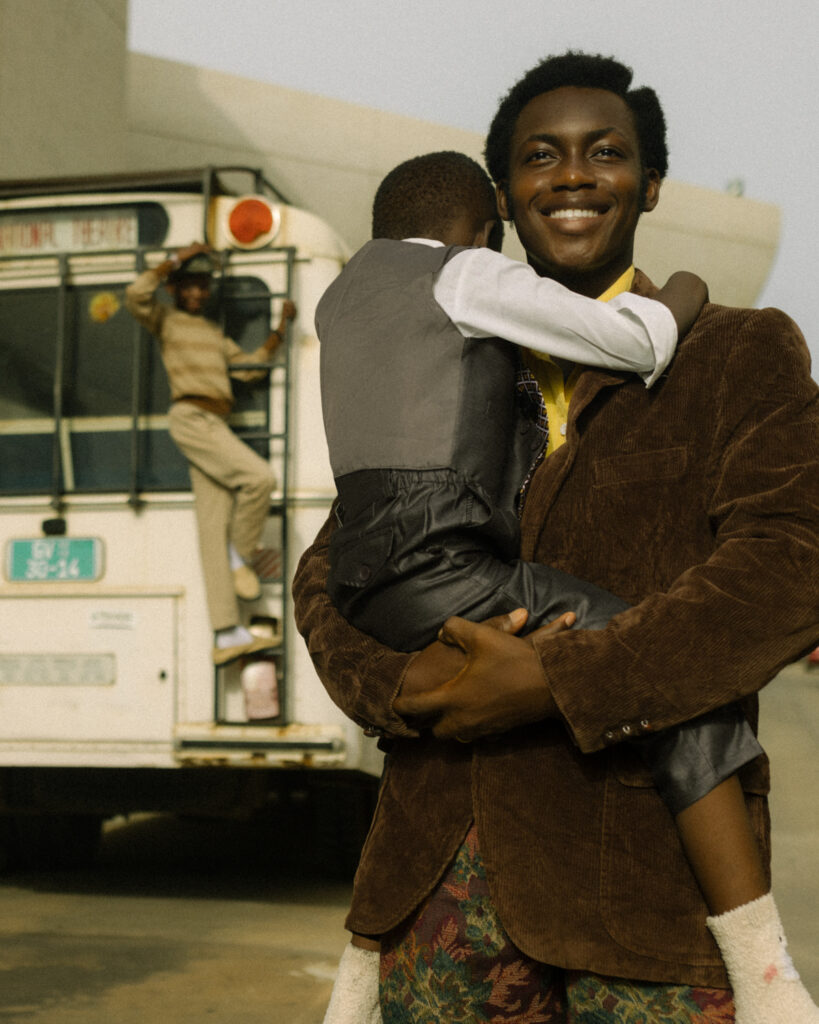
One of my core memories as a kid was seeing my dad with his brown suitcase at the airport. And for some reason, I was so convinced he was the one flying those planes. When I made the photograph My Only Ticket Home, that was really what I was thinking about. The novelty of a child’s logic, and how we process memory before the world comes in to correct it.
I think it was important for me to reimagine that childlike memory as honestly as possible, because those kinds of memories hold both factual and emotional truth. My dad was not a pilot, but in my mind, he was. And that version of the past also matters. The image also allowed me to think about imitation in fatherhood and sonship, the way a child watches a father and begins to imagine himself through him.
For me, we have a burden as imagemakers and artists to keep pushing the boundary of our mediums, and this is my way of doing that. We often say, “We need to photograph a moment before it is gone.” But I am also interested in the idea of photographing a moment that is already gone.
Your work often reconstructs highly specific memories, down to textures, gestures, clothing, and atmospheres that seem almost sensory. How do you translate something as intangible as memory into an image? What does your process of reconstruction look like?
It can be a lot of work piecing everything together, but strangely, that is also the fun side of it. I play a lot with fabrics, colours, and anything at all that takes me back to a memory or the feeling of it. Sometimes it is an old chair, a lace cloth, a dress, a wall colour, or just the general feeling of a room. The point for me ultimately is to chase a picture in my mind’s eye until it starts to feel right. Whether I am reinventing my grandmother’s kitchen table area or a memory of Sundays in Church.
Your images begin from a deeply personal position, yet they consistently extend outward, touching something collective. What kind of shared narrative do you feel emerges from your work?
As much as I’m grateful when the work resonates with people, I still feel it first has to be personal. That is the only way it can be honest. I try not to think too much about making work for an audience. At the beginning, at least, I have to make it for myself.
The shared narrative, for me, is in the things we all know and carry. Our friendships, faith, joys, and those little moments of care and belonging that keep us going. They may seem ordinary, but they are the ethos of our human experience. And maybe the museum walls deserve to see more of that as well.
Beyond your personal history, what references have shaped your return to memory as a photographic language?
Beyond personal history, I draw a lot of inspiration from African cinema. I love Ousmane Sembène, Djibril Diop Mambéty, Kwaw Ansah, and King Ampaw. These filmmakers shaped my perception of the image, especially my love for making work that feels nostalgic but still alive. People often say my photographs feel cinematic, almost like film stills, like the subjects could move but somehow they don’t. I guess a lot of that comes from the way cinema taught me to think about time and moments.
Over the years, I have also been heavily inspired by Black and African photographic archives. Growing up, I remember seeing a lot of James Barnor, Alex Webb, Roy DeCarava, and Gordon Parks, and those images have stayed with me. They allowed me to see photography as both personal and political. In hindsight, all these experiences have shaped how I approach memory as a photographic language.
It feels really full circle to now be in a group show with Paul Strand and James Barnor at Les Rencontres d’Arles, because these are the very legends whose photographs have shaped what I’m doing now.
Certain elements recur throughout your work: white lace, polished shoes, church benches. Do you see these motifs as a kind of coded uniform? Beyond their direct connection to memory, what are they holding, protecting, or preparing your subjects for?
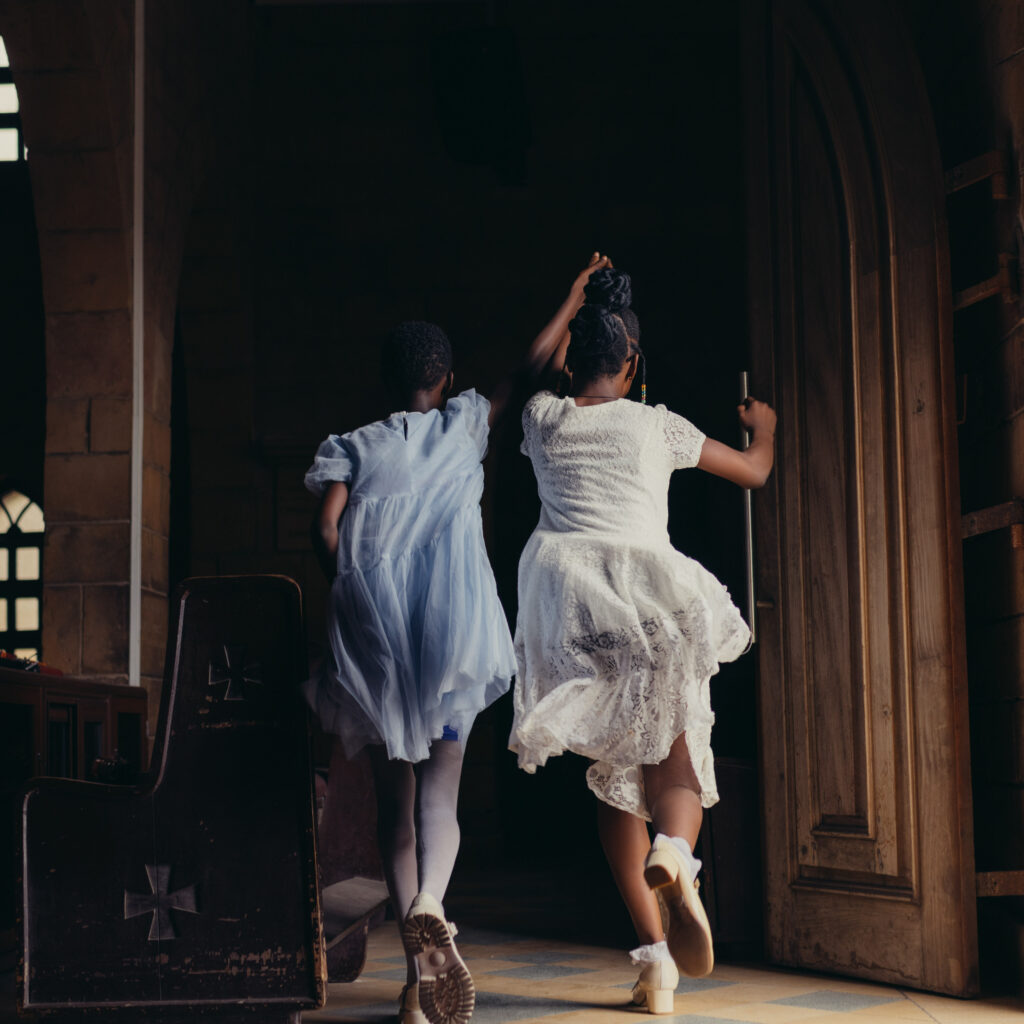
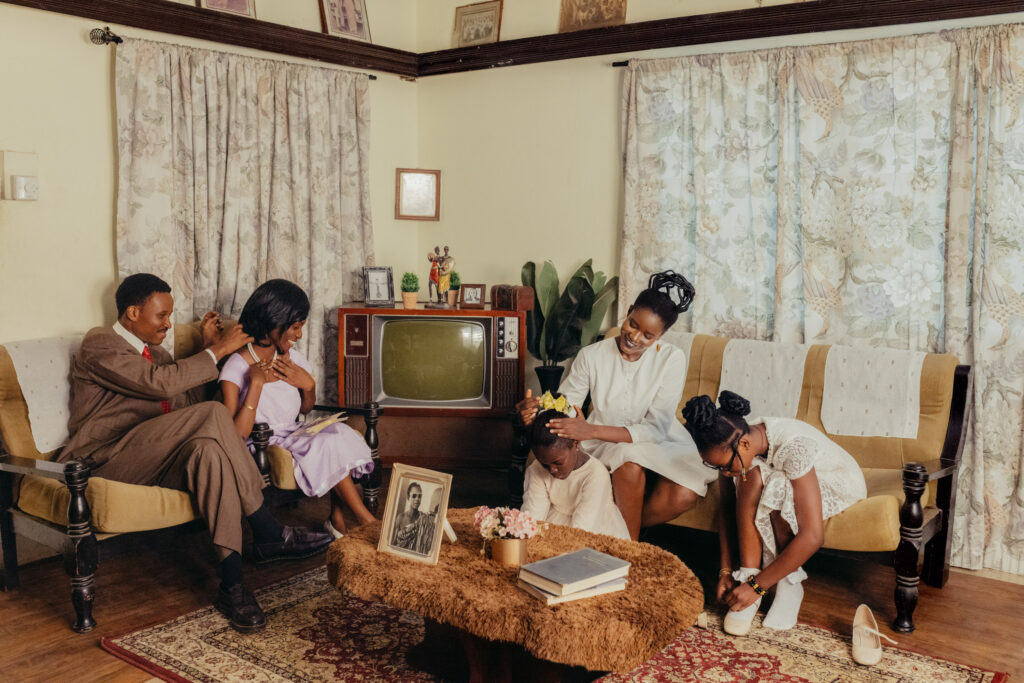
Now that I think about it, these elements that keep repeating in my work are the things that remind me the most of my childhood. I grew up in the church. I spent at least two days of every week there, so when I think of my childhood, one of the first things that comes to mind is the pews, the benches, the feeling of sitting in those spaces for hours. I also remember my grandmother restyling our furniture with white lace fabrics every other week. So when I think of home, I first think of wooden sofas with armrests and those lace cloths sitting on them. At the time, they were just part of the house. Just one of the many things we owned. But now they hold much more because there are so many memories attached to them. So yes, I guess we could call them coded uniforms.
In your images, masculinity is rendered with a rare tenderness: boys chasing kites, fathers and sons resting in each other’s arms. Even though this comes from a personal point of view, why do you think the lens has historically resisted this kind of vulnerability and intimacy? And what becomes possible when that resistance is undone?
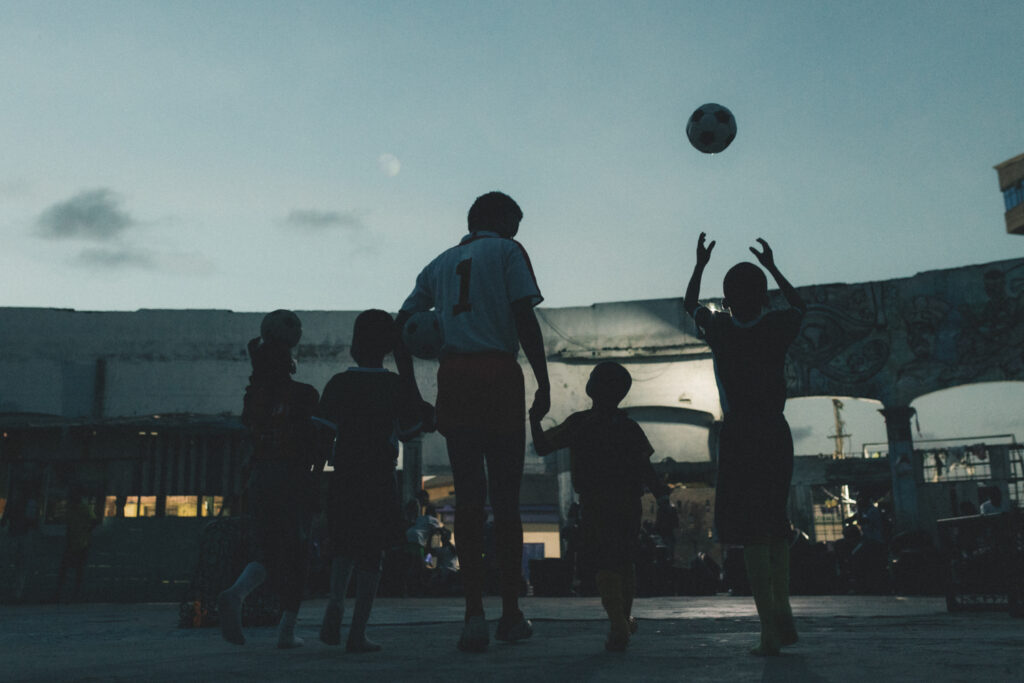
Having a father who taught me how to make a tie and how to cross the street, I think those moments deserve to be represented in the photographic canon as well. As small as they may seem, they say so much about care, intimacy, and what fatherhood really means beyond what we have been taught to see. For me, it is about using the medium to make the archive more complete. Our understanding of fatherhood becomes more sincere when we are able to see its many different sides.
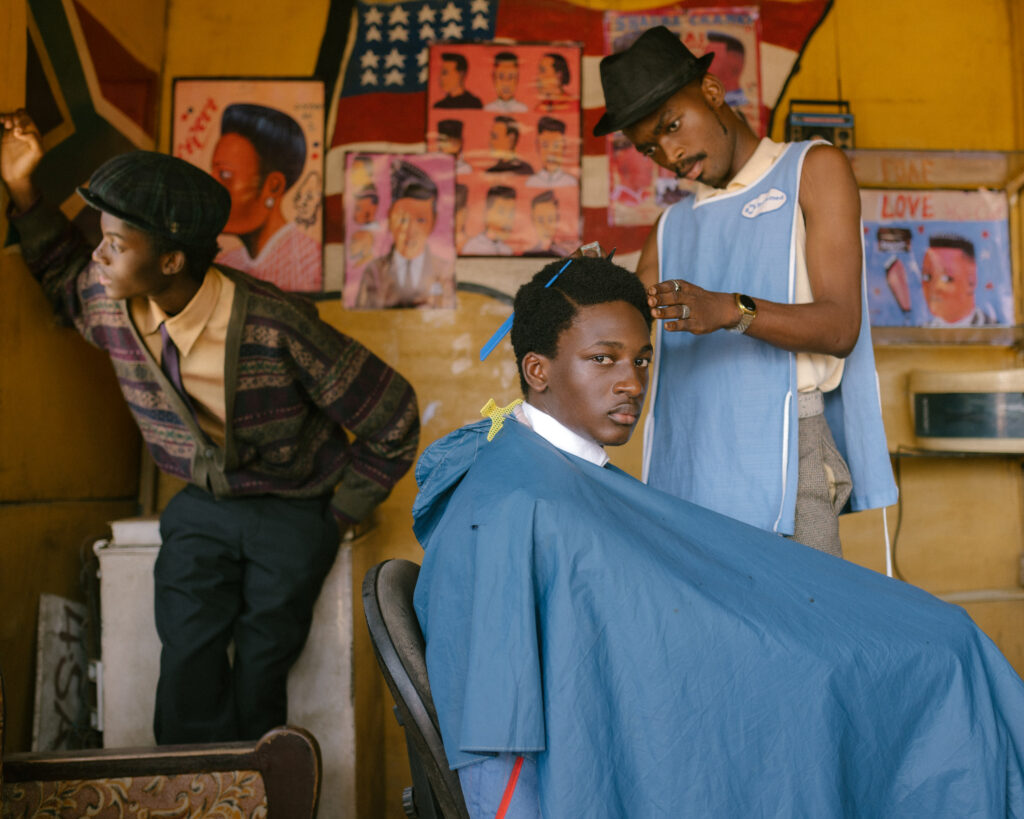
In many older African vernacular photographs, subjects appear composed, almost immovable. Your work carries some of that gravity forward, but with a more softened approach and contemporary sensibility. Are you extending that lineage, or gently shifting it? What does this balance allow you to express about identity today?
I think I am doing both. I am extending that lineage, but I am also gently shifting it. When I made the photograph Don’t Say Cheese, I was thinking about why I never really saw any broad smiles in group photographs from my family albums. Everyone always looked so prim in front of the camera, almost as if the photograph required a certain kind of seriousness. I understand that formality, and I respect it, but it also made me want to see my subjects more at ease.
For me, joy is very human, very necessary, and one of the qualities that keeps us going. So maybe part of my responsibility as an image maker is to allow the world to see more of that side of our human experience too. At the same time, I think portraiture will always have a tendency to be a little pretentious, simply because we naturally approach the camera with an ideal or composed version of who we are. I am interested in that tension. The composed self, the joyful self, the awkward self, the version of us that exists beyond how we want to be seen.
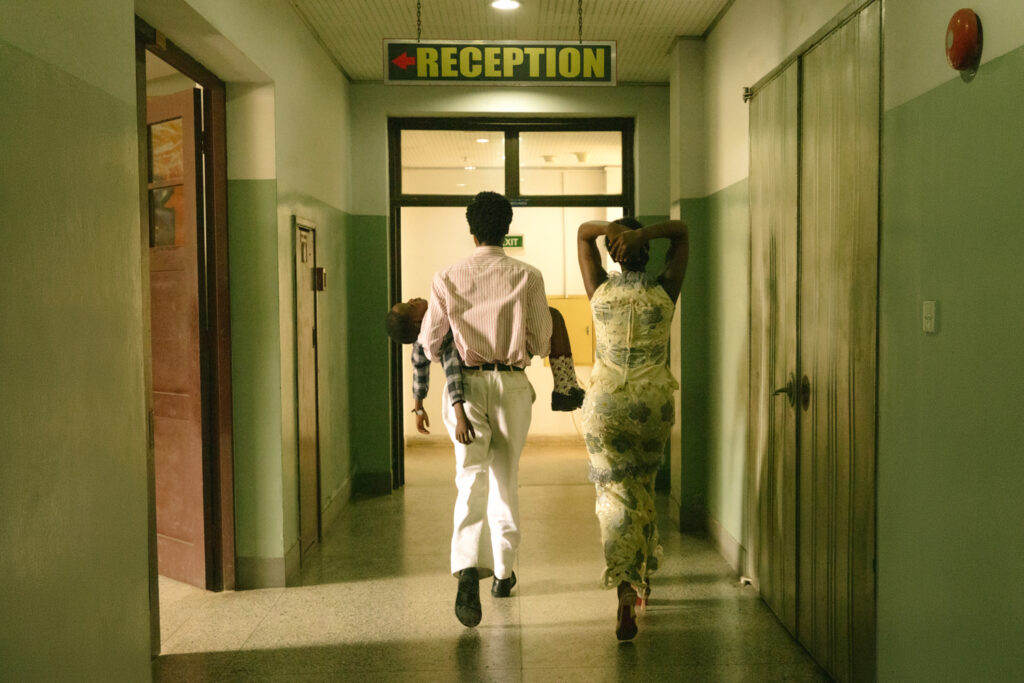
That is also why I am drawn to situations that may not seem elegant at first, but are still deeply true. For instance, I think the hospital is one of the most visited places in our lives. Almost everyone has been to a hospital, but it is one of the least photographed and least represented spaces in the archives because I assume it does not always feel beautiful or easy to look at. I turned my gaze there through my body of work Hero, Father, Friend, and it received mixed reactions. I loved that, because that was the point. Can I use my work to make people see things again? To look at moments we would not ordinarily photograph, and still find something sincere and beautiful in them?
Your grandmother also feels like a bridge between generations within your work. This is a more imaginative question, but if you could send one of your photographs back to her, which image would you choose, and what might it reveal to her about the world her descendants would come to inhabit?
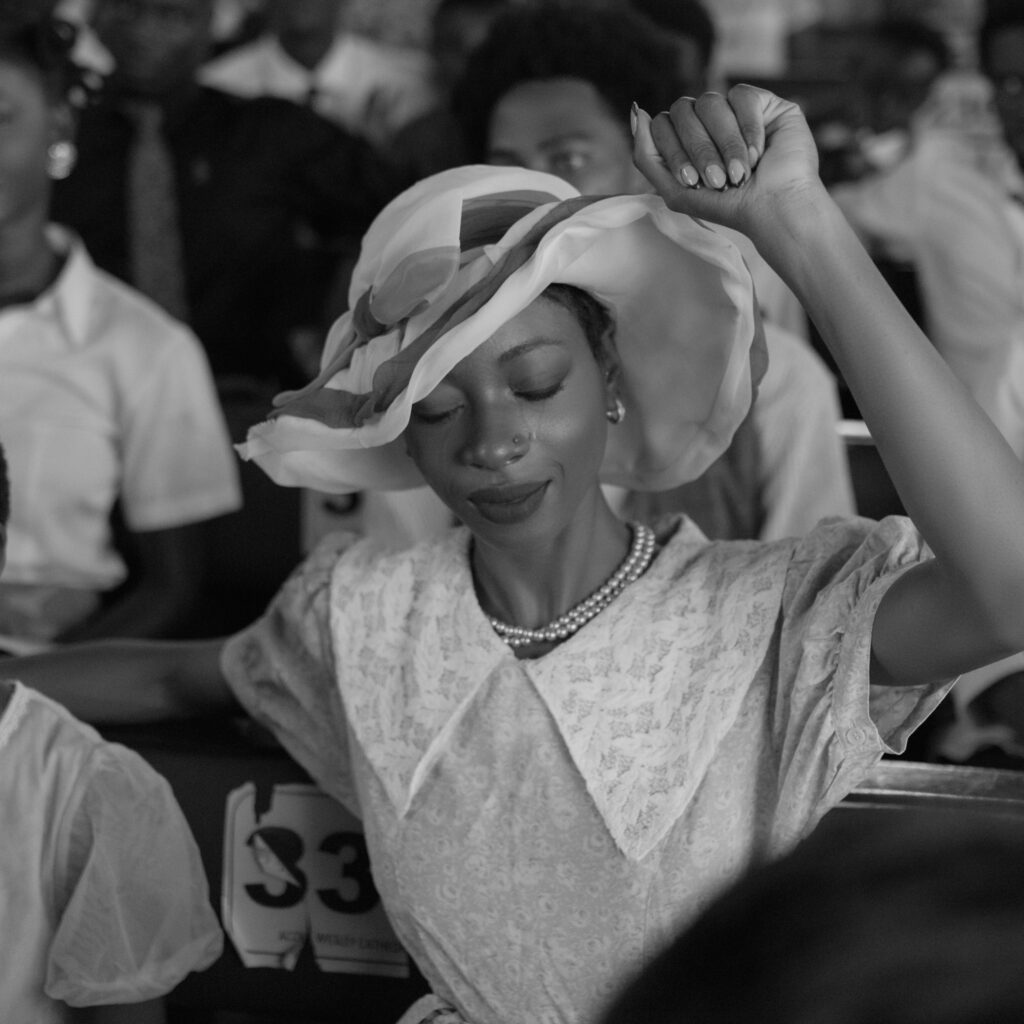
I would send her Grace Flows Like a River, 2022. It is a photograph of my subject seated in the pews of a Church with her hands raised, wearing a dress and hat that belonged to my grandmother from over 20 years ago. It only made sense to reinvent that core memory of her completely unapologetic about the way she expressed her faith.
You’ve also spoken about embracing chance within your process. How do you keep the work open enough to remain spontaneous while still framing your subjects through memory? Can you recall a moment where something unintended transformed the image entirely?
I love photographing strangers and people who may have never experienced the roles they are being asked to embody, because it brings something fresh and unpredictable to the work. I have learned to lose a bit of control over the story and not direct as much as I maybe should. As much as possible, I allow my subjects to respond to the scenarios in their own way. That, for me, is where serendipity and spontaneity come in. I may have the vision for the story, but the people in it always bring something I could never fully plan. A good example is the making of the photograph, Mommy, Smile, 2022. It was actually a test shot, and the photograph was originally much wider. But in the corner, I saw this young boy fidgeting with a camera from the prop box, and it took me directly back to that early curiosity and excitement I had when I was discovering photography myself.
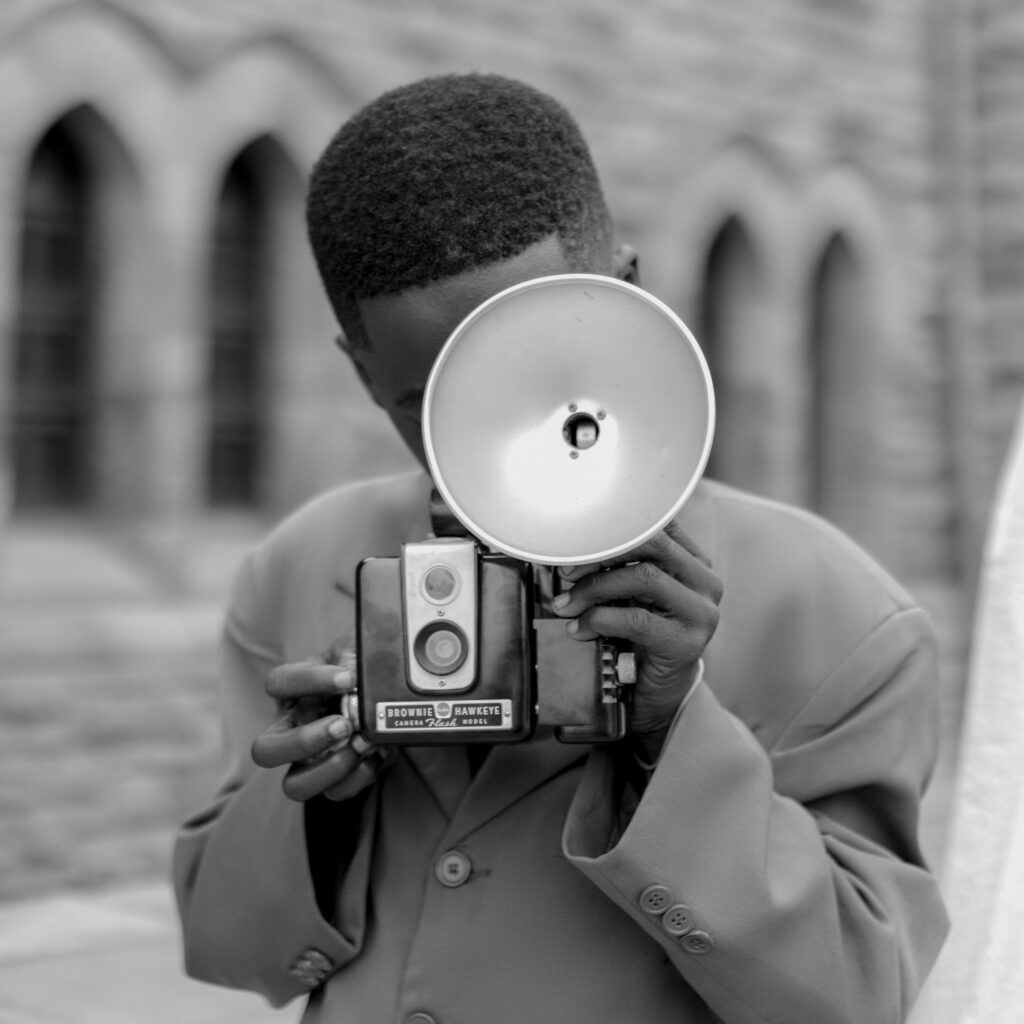
The moment felt just right and it was no longer just about the scene I had initially imagined. That’s what I love about allowing the work to stay open. Sometimes the image you are trying to make makes room for another image. It creates a new story within an old story, and that makes it all the more special.