Archive page:


Primavera Sound Festival Barcelona 2022

After a two-year hiatus, Primavera Sound returns to the Parc del Fòrum in Barcelona this weekend. That, in itself, is a reason to celebrate. For sure, the very idea of a live festival is music to the ears of many after the coronavirus pandemic saw the cancellation of summer events in two consecutive years. Last year would also have marked the twentieth anniversary since Primavera Sound launched back in 2001. In its first edition, the festival was a much smaller ordeal and took place at Barcelona’s Poble Espanyol. But the likes of Sonic Youth, The Kills and The White Stripes all performed there – setting the precedent for the festival’s line up each year, as music icons and legends from around the world return descend upon Primavera’s stages each summer. Of course, the festival has grown considerably in size, popularity and reputation since then, whilst managing to retain something of a “local” festival feeling. But perhaps there’s no greater testament to Primavera’s global influence within the music world than the fact this year’s iteration has been promoted to a two-weekend line up. Whilst Massive Attack, Tame Impala, The Strokes, Gorillaz and Tyler, The Creator (to name just a few) are set to headline this weekend’s events, the likes of Dua Lipa, Lorde and Megan Thee Stallion will also perform next weekend. 

The addition of this second line up to Primavera’s programming is part of the festival team’s response to the pandemic. As Marta Olivares, Primavera’s affable Head of Communications, tells NR over Zoom, COVID was a moment for pause and reflection – especially as, she says, it was a time when the “whole ecosystem proved to be so fragile.” For Primavera co-founder, Pablo Soler, this couldn’t have been more apparent; the pandemic didn’t just reaffirm the importance of live music, he says, “it has revealed it;”

“Without festivals, we realised that we were missing a part of our lives that was the collective experience.”

The communal aspect of a festival goes without saying – it’s about the excitement and the emotions that are experienced with other people that, Pablo says, is crucial for creating a state of happiness. The idea that the festival is nothing if not for the people is crystal clear, as Marta explains that having this year’s events spread out over the course of two weekends (with a week of indoor performances in Barcelona in between, no less) was made possible by the fact that last year’s ticketholders “overwhelmingly” decided to keep their tickets. As a result, Primavera 2022 is an amalgamation of three years’ worth of acts in some ways; Beck and Pavement, scheduled to headline in 2020 will, for example, make a much-awaited appearance in Barcelona this weekend. But over the course of the pandemic, Marta says, we’ve witnessed;

“so many artists creating amazing stuff, working so hard and releasing incredible records.”

In that sense then, Primavera 2022 is an ode to music in the lead up to, and over the course of, the pandemic – especially when popular acts from today might have flown under the radar back in 2020. 

Given that the festival will be a de-facto twentieth birthday celebration, this weekend’s events will be both a moment to look back on Primavera’s journey so far, whilst also looking towards the future. In fact, part of the festival’s events will take place at Poble Espanyol – something that Pablo thinks the team can be justifiably sentimental about. “Over the years, we have played concerts at this venue outside of the festival,” he notes, “but going back there with Primavera Sound is even more emotional.” It will be, Marta says, a kind of homage to that tiny festival that was first unveiled. But as much as Poble Espanyol is part of Primavera’s legacy, the festival team’s outlook is to keep moving forward. In fact, in the midst of the pandemic when the Primavera team were figuring out their bid for survival, the answer was, perhaps surprisingly, to grow bigger still – though “sustainably” as Marta puts it. “It felt weird to stay put,” she recalls adding that there was a need to pivot somehow. As in previous years, the festival will head to Porto for the weekend (which will occur at the same time as the Barcelona edition’s second weekend). But satellite festivals will also take place in Los Angeles, Santiago, Buenos Aires and São Paulo later on in the year. “It was [a case of] go home or go big,” Marta notes of the decision to grow the festival in this way. “Definitely we’re going big.” For Pablo, the new locations explain the festival’s future-facing outlook in themselves: “we are a festival that any country would want to have.” And with an insatiable international appetite for Primavera as it’s staged in Barcelona, it perhaps makes sense to take the music to the people. So how does the essence of Primavera translate to these new locations? Marta notes that the festival’s Barcelona location is part of its draw – close to the city, near the sea, and with a lot of cultural pull as well as music. “That’s something we want to be careful with,” she says of the other locations – noting, for example, Porto’s luscious green backdrop near the coast at the festival’s site in the Parque da Cidade. But as Primavera looks outwards and globally, it’s also turning back inwards, too. Earlier this year, Primavera Sound Madrid 2023 was announced – a way for the festival to continue its newly-established tradition of two back-to-back weekend events in Spain. There is, it seems, an exciting path ahead for Primavera over the coming years, but first: this weekend. 

“We are always the first festival of the season,” Marta explains, adding that this particular edition means that the weekend will be something of a test run for the string of European festivals that follow on.

“I want people to come to Barcelona and celebrate life, to express themselves and to feel safe and alive again”

Marta says. Pablo concurs; “seriously speaking, we have learned that we have to live in the moment – seize the day – because we are all more vulnerable than we thought. If we should take this twentieth anniversary party as the party of our lives, then so be it.” But what should Primavera punters expect when they’re there? For Marta, it’s the unexpected – recalling Arcade Fire’s impromptu performance on a boxing ring-esque stage at the 2017 festival. This is, of course, not an indication or confirmation that such an event might occur this year, but possibilities and chance encounters are certainly part of the Primavera fabric. To that end, Marta describes the ideal standard that the Primavera team strives for: “at the perfect Primavera;”

“you would be able to enjoy a show from your favourite band; you would go to something that challenges you; you would see someone you don’t yet know will be your next favourite act; and the fourth would be something you really had fun at.”

And with a line up as glittering as Primavera’s is this year, it’s almost guaranteed to be perfect.

Credits

More info · Primavera Sound Festival Barcelona
Special thanks to Chris Cuff and Henry Turner (Good Machine PR)

Larry Hallegua

In 2014 I moved to China to teach English in a primary school for one year. I was based in the west, in Chengdu, the capital of the Sichuan province.

During this time Chengdu had a growing population of over 14 million, and was one of China’s ‘pilot reform regions’. The city was experiencing rapid economic growth, resulting in heavy investment in infrastructure, such as a fast expanding metro and rail system, as well as the building of new schools to cater for the large migration of rural workers and increasing urbanisation.

I was amongst only a handful of foreigners living in Xipu on the outskirts of the city, and would receive daily stares from locals who rarely saw or mixed with foreigners. I used my camera to record, albeit in a whimsical manner, some of the behaviours of a city experiencing a growing sense of self confidence.

Justin French

“The beauty of creating imagery is that ideas do not have to be completely finished or expertly manufactured”

When did you start taking pictures?

I began taking images professionally around 2014. A friend recommended me to a brand that needed a photographer to get imagery during NYFW and for the next two seasons I covered most of the backstage activity. From there I just continued photographing friends. 

How do you find the balance between the vision you have and the mediums you are using?

I don’t really think so much about it, I usually just have the idea and find a way to achieve it. The beauty of creating imagery is that ideas do not have to be completely finished or expertly manufactured, they simply need to be developed enough such that the image can be executed, the rest is up to viewer imagination.

What inspired your style of work?

A combination of classic and modern photography, as well as fantasy and documentary photography. Most often I’m reading, listening to music or watching films and a particular aspect about something within that content will inspire me to create.

Where do you get inspiration from? 

I draw lots of inspiration from cultural imagery and films, also lots of inspiration for me comes from music and songwriters. Helps me to imagine and develop visuals.

What is the process behind a photography, if there is one?

There is a certain emotional intensity I strive to have present in my work. Much of that is achieved by trying to establish some level of comfort between myself and those I am working with.

Would you say that there is a main thread connecting all your photographs and if so, which is it?

I believe the tie that binds the imagery together would be this aspect of aspiration to the images. I feel as though however serious or playful in tone the images appear, there is a level of strength and honour present in each.

What kind of talks would you like to hear around your photographs? 

I am really excited when I hear diverging dialogues regarding my imagery, my intent is to create impactful imagery that can conjure reactions like nostalgia, comfort, amusement, familial, imagination, and also possibility.

Frederik Nystrup-Larsen

“Say no: say no the market, say no to people, not just following along”

Growing up in Copenhagen, Frederik Nystrup-Larsen was surrounded by the principles of design. ‘I thought I was going to be an architect because that was the most prestigious and important thing you could do’, he explains. But, when, as a young teenager, he realised that this would involve a lot of technical drawing and ‘sitting in an office’, his ambitions shifted towards becoming an artist. An awareness of the uses of space, and the ways in which users interact with their surroundings, nonetheless underpins Frederik’s work. The installation of much of his work, whether sculptural or more performance-led, is shaped by its siting and the ways in which people respond. Those factors are no more present than in last year’s Off Licence – Cash Only, a project with long-term collaborator, Oliver Sundqvist, in which sculptures of everyday objects were made out of found trash and papier-mâché, and sold at a pop-up shop, priced according to their retail value at that moment. If Off Licence – Cash Only was, as Frederik suggests, an ‘analysis of consumerism’, the importance of having a critical approach is key. And, on the day we speak, the innerworkings and underlying motives of the art world is something that has overshadowed the importance of integrity that appears to push Frederik forward. Last year’s installation, How to Build a Blanket Fort, designed in collaboration with Sundqvist for the Tuborg Lounge at Roskilde Festival, presented Frederik with an unfamiliar set of challenges  – mainly, designing a space from London, to be installed by a team in Copenhagen. ‘It becomes about communication; how good are you at saying what you want to have made and what is the result of that?’ But, it seems, the result was more than he bargained for,  where the reality of commercial involvement (and ensuing ulterior motives) have jaded his view of an otherwise well-received project. The tensions between art and critique are extended to the materials that Frederik uses; the Eros Torso vases, repurposed single-use plastic containers, have been latched upon by certain fashion brands keen to champion the importance of ‘sustainability’. Yet, as Frederik maintains in our conversation, neither he nor Sundqvist vocalise the fact that most of the materials they use are recycled; ‘it’s not a selling point’. Rather, he continues, ‘I think it’s irrelevant, I think it’s something that is necessary and everybody should just do it.’ Across the various mediums that Frederik’s work takes, there’s a  quiet emphasis on organic matter, which in turn, translates into a necessary critical engagement with the world around us. 

How do you anticipate the way people might interact with your work?

I think I’m quite open to it, for sure. I mean, a lot of the work is made for interaction; that’s an important part of it. But it’s also always quite interesting to observe how people act around things. When we did the Off License – Cash Only project, when people started coming in, there was a line for the opening of the store and, in the beginning, people would go up to the counter and say, ‘I want that piece’, and the store clerk would say, ‘Just take the piece and come pay for it’. Then, people in the shop realised that that was the whole point, so people just started to grab things, and they would just be holding like five, six pieces to reserve them so nobody else could take them. That whole thing was kind of funny, and interesting, and it obviously worked as a critique of consumerism. People bought the cheapest stuff first, and then it went from there. So it was this analysis of consumerism. 

I read that you were planning on doing Off License – Cash Only in other cities as well, is that still your plan?

Yeah, for sure. I mean, I don’t think it’s going to be in the near future – maybe next year. The work was extremely fun to make – I really enjoyed it – but it was also a case of, when you sell a piece of work for £1, you don’t earn any money. So, it’s more of a fun project, that you can’t do all the time, because you can’t really live…

I read too that you bought fake followers for the Off Licence Instagram account: How did having an Instagram account for something like that work? Did people realise what it really was, or?

No, I don’t think anyone really noticed it. I mean, I had a couple of people asking like, ‘How did you get so many followers?’ But what I saw was that, when the Instagram had so many followers, a lot more people started following it just because it had a lot of followers – which is obviously how things work, with algorithms and stuff like that. But I was like, really? That that amount of followers becomes this signifier of authenticity – like, ‘like, ‘Oh I need to follow this as well because there’s a lot of other people following it’, but’, but it would take you five seconds to realise that all the followers are fake. When you go through the process of buying followers, you also realise how many people buy them – and I started to realise how many people actually do this, and it’s incredible. I don’t remember the number, but it’s something like 60% of all influencers have bought followers, so it’s a big thing.

How did you get involved with the kind of materials that you use in your sculpture? 

To be honest, it probably begins with the fact that, if you want to make big things and don’t have any money, how can you actually do something for nothing? Especially with the Off Licence – Cash Only project, which is made from trash found around London – we weren’t going to spend any money on that because we were going to sell it for nothing. The Eros Torso vases was a similar situation, using found plastic barrels. I mean, I’m not saying I’m going to do this forever, but I like to think about where stuff comes from. It’s also about the concept of the work, and that the concept fits together perfectly with the materials. 

You’re in your final year at the Royal College of Art – has that experience impacted on the work you’re doing outside of the Masters? 

Yeah, quite a lot I think. To be honest, I haven’t been to school a lot because I’ve been busy, and I’ve been sad about that because the whole point of going was to have time to reflect and develop my practice. So for this past year, I’ve been spending a lot of time thinking and not necessarily producing, which is good because I came to the MA confused about what to call myself, in terms of the work and myself as a title. I think doing an MA in sculpture makes it easier because that’s sort of the label; sculptor. Also, London is extremely different to Copenhagen, and that’s been great. Coming from a place that has zero diversity, it’s amazing to be in London and seeing the way people work. In Copenhagen, it’s the easiest place to live – everyone’s has the same sort of ideas. So I think it’s extremely interesting to be involved in a community like RCA to see how other people are working.  

A lot of your work is in collaboration with Oliver Sundqvist, have you got anything that’s in the pipeline?

Not anything I can really say anything about. I mean, I had a long talk with the V1 Gallery that I work with a couple of weeks ago, and we agreed that I will focus this half year on my Masters. For the moment, I’m really into saying no, and I think that’s going to be playing a big part in things coming up. Say no: say no the market, say no to people, not just following along… 

As a young artist, being able to say no is quite a bold thing to do. 

Yeah, for sure. And I think everybody should do the same because I feel like commercial partners take advantage of young artists, using them as figures that they can put their commercial work up against. For the artist, it becomes sort of like peeing in your pants – it’s really nice when it happens, and warm, and then after, it’s a reality check: you showed yourself up and nobody else of value will probably want to work with you anymore. When I started out, I was having a hard time dealing with this. And, after a couple of bad situations, I’m not going to do that again. That’s not why I’m in this game, it’s not about that. 

Credits


www.frederiknystruplarsen.com
www.instagram.com/ok.international
www.instagram.com/offlicense_cashonly
Words · ELLIE BROWN

Designers

  1. Artemis Tears
  2. Floor Standing Pedestal Champagne Bucket Cooler
  3. Folding Electric Scooter
  4. Firechief Pressure Water Fire Extinguisher
  5. Gold Plated Family Portrait Frame
  6. Japanese Army Sword

Frederic Tougas

Snoh Aalegra

Snoh Aalegra on signing to Roc Nation, her music making process and ‘Ugh, those feels again’

There was a moment last summer when it felt as though one song in particular was seeping from every open window on a warm day; it seemed to be the backing music to Instagram story capturing a stream of sunlight falling upon the interior of an airy apartment. ‘I want you around’, Snoh Aalegra sings on the song of the same name – velvety lyrics dabbling in the simultaneous thrill and uncertainty of a new love, above a pared-back beat.

In fact, the entirety of her most recent album, Ugh, Those Feels Again, felt like the soundtrack to the summer. And for Snoh, her music provides the soundtrack to her life; each album or project is a ‘mini movie’ of encounters, experiences and feelings. That Snoh speaks about her music through references to movie soundtracks is testament to a childhood spent watching, and falling in love with, the film scores of Walt Disney movies. ‘The big strings, the orchestras and the choirs,’ she enthuses, ‘they feel so grand; all these instruments and sounds that I love.’ Similarly, the layers and theatrics in the oeuvre of Michael Jackson had a significant impact of Snoh’s taste. It’s clear from the influences she has cited – Lauryn Hill; Nina Simone; Whitney Houston; Stevie Wonder – that Snoh follows in a long tradition of R&B icons. Somewhat fittingly, the album cover for Ugh, Those Feels Again has a touch of Sade about it – something Snoh’s been hearing a lot of.

The artistic direction behind the covers of her releases prior to this album, 2017’s Feels and 2016’s mini album Don’t Explain, took a different direction, however. Both covers were designed by the artist Joe McDermott; the pop art illustrations making reference to the movies of old Hollywood. When I first heard Don’t Explain, the combination of McDermott’s album art with Snoh’s smoky vocals over grand orchestral compositions felt timeless. In many respects, it’s only upon hearing features from rappers Logic, Vic Mensa and Vince Staples on Feels that bring Snoh’s music into the present day. It’s fitting, then, that she walked for Thierry Mugler’s A/W 2020 show in Paris earlier this year. ‘It’s a class brand that I’ve always loved, you know; it’s timeless and contemporary at the same time,’ she explains: ‘that’s what I relate to a lot.’ It’s something that she tries to do with her music, but progression is important too. In fact, the day before I spoke to Snoh on the phone, it was announced that she’d signed onto Jay-Z’s Roc Nation – a huge step forward if ever there was one. 

NR: First of all, it’s just been announced that you’ve signed with Jay-Z’s Roc Nation; how does that feel, and what does this mean for your music? 

Snoh Aalegra: Yeah, I mean, I’m very happy about it all. Me and my team, we’ve been working our asses off, doing everything ourselves for so many years. And I have a really small team of like three people, and at some point, we were like, ‘Ok, it’s time to expand.’ I mean, we work around the clock and we needed to delegate some of this insane workload. Talking to labels was a natural next step in my journey, and our journey as a team. I think choosing Roc Nation was just the most organic way to go; there’s a pre-existing relationship and respect there already, you know. No I.D. [Snoh’s producer] is close with Jay-Z, TY TY, Jay Brown and everybody, and I feel like no matter how big their company gets, they still operate like one big family. And I think that’s something that’s very important to have for me, in contrast to other cutthroat, hype-driven labels. I look at Jay-Z, his close circle of people and see the insane careers they’ve built for themselves and the help they’ve given so many other artists. And as far as my creative process goes, that will stay the same. I mean, I always strive to evolve and learn, but I definitely have a particular way of how I like things to be done and that will probably never change. 

NR: Something that interests a lot of people is that Prince was your mentor when he was alive; what do you think he’d say knowing where you’ve got to today? 

SA: Yeah, it’s interesting cos he really told me to never sign with a major label, and when I met him, I was with a major label. He was like, ‘Get out of this deal!’ and I did; I went indie. But, funny enough,

“I know one person that he [Prince] really respected and trusted, even with his own catalogue, was Jay-Z. So, I feel like I’ve made the right decision and he probably would have supported this too.”

NR: How do you find the space to create new music, and is having a certain space to work in important to you? 

SA: I think it’s important to live and to have something to write about; to take your time and have space. Like, I thought I needed more time to start making music again after this album, but I’ve already started making music and I think that’s because I naturally have things to write about. If I don’t, I’m not gonna force it, you know? I’m very real with what I say,  and not say, before I get into the studio. I go in with that mindset like, ‘Ok I want to write about this.’

NR: When it comes to the composition, where do you begin? Do you start with the lyrics, an idea or a sound?

SA: It really begins with me, walking into the room, knowing the mood – there’s always a mood. Sometimes, it’s just only me and an engineer, and I’m there writing the whole thing myself, either to a beat, or I make up melodies and lyrics – and then I have somebody come play for me. Sometimes I like to bounce off ideas with a co-writer or with a producer and work that way. I’m all for either ways. It’s really about myself and my life, so it’s super important that it’s all authentic to me. And if I bounce off with somebody, they need to know that it’s really personal to me. And that’s why I don’t really write with a lot of people. So, sometimes, I already have a lyric idea; sometimes it’s like, I’m jamming to a beat. My favourite is probably jamming to live music where I’m just jamming with live musicians. That’s probably my favourite way to work.

NR: Ugh, Those Feels Again was a year or so in the making: How do you know when something’s complete and ready to go?

SA: I think it’s just a feeling you have. Like, I’m ready to put this out; I’m ready for people to hear this. And it’s not always that it’s perfect, or that you feel like, ‘Oh I have a hit, I have this, I have that’. I had no idea how people would react to the album. All I knew was how it made me feel and that it was, you know, a good feeling. For me, it’s about what I want to have said on a project, and if I expressed these emotions. My projects are like time capsules of my life. So, this album that’s out right now, was the sum up of what happened after a break up and what I was going through – reminiscing back on why we broke up, how we broke up. Songs like Charleville 9200, Pt. II, songs like Love Live That and You, reflect on the break up. And then, I was single for a whole year making the album, experiencing new love or situations, so songs like Situationship and I Want You Around describe that feeling when you just met somebody new, and you want them to be around them, but you don’t really know where it’s gonna go. So, that’s a mix of a whole year for me. 

NR: Once you’ve put an album out there, do you move on, or do you look back at that period and remember how you felt? 

SA: Well, in real life I move on. I’ve moved on from those relationships and stuff, but I can never escape it all the way because I have to perform! But sometimes, I’ll channel another feeling, or I’ll think about something else. Every time I’m performing certain songs, I’m not standing there thinking about my ex, do you know what I mean? But some songs, like Time, every time I’m thinking about my dad. So, it can be hard because I’m always thinking about something – cos I really get into the vibe when I’m performing. 

NR: Your lyrics are very personal to you, but I think people connect to them because you really capture emotion. How does it feel that people might listen to your songs and put their own experiences and feelings onto them?  

SA: And they do, and I notice that they do, which is really surreal. I grew up listening to music as a fan, and I know what music does to me so, to be able to do that for other people as an artist is kind of unreal. But, I think that was a part of why I wanted to become an artist, you know. I want to inspire; that’s why we do music I think. But it’s kind of crazy; there’s been people come up to me saying I’ve saved their life, and that listening to my album has stopped them from doing something. That’s feels crazy to me – that that’s helped even one person. It just shows how powerful music can be, and how it can connect people at the same time. 

NR: In a similar way, you’ve previously mentioned some of the musicians that inspired you growing up. But, for you now, how does it feel that your music could inspire a young generation?

SA: I mean, it’s surreal because I just know how I was feeling as a little kid listening to artists I looked up to. I was inspired by Whitney Houston; when I heard her voice, that’s when I knew that I wanted to be an artist. So, it’s crazy if somebody feels that way hearing me. At the same time, I would feel nervous for them because I know how tough this industry can be, and what a tough journey I’ve had to get this far. It’s all been worth it, but I don’t know how much I would advise somebody else to get into this industry! But, you know,

“if I can inspire somebody to do their own thing- no matter what it is – if they want to be an artist, a lawyer, or a nurse, whatever they want to be; if I can inspire that, that’s a beautiful thing.”

NR: Being able to look back on the journey you’ve taken, is there anything you would have done differently – or something that you’ve really learned from that’s shaped who you are today?

SA: I’ve learned to not be a people pleaser; I used to be a people pleaser because, you know, I was signed for the first time when I was thirteen. And, I had a lot of respect for authority, listening to people telling me what to do, and what not to do. I didn’t have my own voice. Things were really different when I was thirteen, or even when I was eighteen, to being a teenager now. We’re way more educated, smarter, we have more access to information, to make music and to have a reach. When I was a growing up, there was no SoundCloud or Instagram. So, for me, I had to go through labels –that was the only option. I put a lot of trust in other people around me and I didn’t know what I was doing; I was a kid. So, I think yeah:

“that’s something I’ve learned – stop being a people pleaser. Do your own thing. Life’s too short to do something you don’t want to do.”

And, I stand up for myself more than ever and I don’t take things personal. It’s a whole big game for everybody in the industry; it’s not just about the artists – there’s a whole political game. For artists, nothing is set for us, basically. It’s crazy how it’s a whole world of politics, and artists get really affected by this. And now I work with family so I know that they would never fuck me over. 

NR: Finally then, if you were to work on a film score of your own, what would be the ideal project for that?

SA: James Bond. 007. That’s always something that’s been on the bucket list; if that were ever to happen, that would be super crazy. It’s been a goal of mine cos I’m a big fan of the James Bond soundtracks. License to Kill – Gladys Knight, Golden Eye – Tina Turner, or like, Gold Finger – Shirley Bassey: they’re some of my favourite songs and compositions. So yeah, that would be a dream cos I would want to make a song like that. 

Team


Photography EMMAN MONTALVAN
Photo assistants ANGEL CASTRO and PATRICK MOLINA
Fashion SHAOJUN CHEN
Make-Up CHERISH BROOKE HILL
Hair SCOTT KING   
Words ELLIE BROWN
Creative Direction NIMA HABIBZADEH and JADE REMOVILLE
Special Thanks to GOOD MACHINE PR

Designers

  1. Body Suit RUI ZHOU Earrings MISBHV
  2. Swimsuit RUDI GERNREICH Jacket VERSACE Shorts R13Boots PYER MOSS
  3. Swimsuit RUDI GERNREICH Jacket VERSACE Shorts R13Boots PYER MOSS
  4. Swimsuit RUDI GERNREICH Jacket VERSACE Shorts R13Boots PYER MOSS
  5. Body Suit RUI ZHOU Earrings MISBHV
  6. Bra, Jacket and Pants I LOVE PRETTY Shoes ALEXANDER WANG
  7. Bra, Jacket and Pants I LOVE PRETTY Shoes ALEXANDER WANG
  8. Dress PYER MOSS Earrings MISBHV
  9. Full Look HELIOT EMIL Earrings MISBHV

Eric Gottesman

For Freedoms

By definition, a super PAC is a political action committee that is able to raise an unlimited amount of money to influence the outcome of political elections in the United States. Yet, For Freedoms, a super PAC registered back in January 2016, is somewhat unconventional in its intentions and approach. As the first artist-led super PAC, For Freedoms was created by Eric Gottesman and Hank Willis Thomas to encourage greater political engagement through art – and to engage people in complex conversations that have become simplified into binary concepts.

For Freedoms has made an impression on both the world of politics and art since it was registered. In 2016, the super PAC opened their ‘headquarters’ at the Jack Shainman Gallery for a takeover exhibition there – and have since been hosted by MoMA PS1 for an artist residency in 2017 to coincide with the first 100 days of the Trump administration. Their exhibition at the Jack Shainman Gallery provoked a national discussion about police brutality after Dread Scott hung a flag at the exhibition headquarters, whilst their ‘Make America Great Again’ billboard in Pearl, Mississippi caused controversy for its depiction of Trump’s election catchphrase imposed on an image from the Bloody Sunday march of 1965.

Through their use of advertising as a super PAC, their background as artists, and their commitment to creating change, this project by Gottesman and Willis Thomas hopes to open up necessary political and cultural conversations. Speaking over the phone, Eric Gottesman talks through the motives of For Freedoms, the role of advertising, art and propaganda, and why we should come together, regardless of political agenda. 

NR: Where did the idea of forming a super PAC originate?

Eric Gottesman: Over the course of several years, my friend Hank [Willis Thomas] and I, had these conversations about art and politics. Both of us are artists, we both address politics through our work in various ways – I should say, other people talk about the politics of our work. But both of us are interested in the overlap of art and society, and so over the course of those conversations, we often talked about doing something that directly engaged with systems of politics. We talked about maybe having an artist run for office, but eventually, decided to start the super PAC in the fall of 2015, after talking to a number of lawyers about how to do go about it – so we did really before the 2016 election started in earnest. 

NR: Something I was actually going to ask is whether the political climate in the run up to the election was a factor in forming the super PAC. 

EG: No, not really – it came before that. It was less about any specific candidate or campaign, than it was about the way political discourse happens in the United States.

“The oversimplification of complicated situations and political solutions often leads to the factionalization, and people retreat to notions of nationalism that are extremely simple but not necessarily the best.”

So we wanted to see if we could expand the political discourse to encourage or allow people to talk with more nuance about complex issues. 

NR: Do you think that the culture of politics today reflects advertising, because of this simplification?

EG: Very much so. This was something we were very interested in, as a super PAC is basically a political advertising agency. We decided to take on the most egregious part of the problem – which is that money filters through organisations and into our politics, in order to create extremely simplified forms of advertising that is supposed to shape how to think and how to vote. We wanted to shift that up and play with that idea. 

NR: By buying advertising space for billboards, newspaper, and online, can your political advertising be interpreted as a form of propaganda? 

EG: I think it can be, it usually is. Advertising has got much more complex and savvy – often times, you’re being advertised to without knowing it. It doesn’t just take the form of propaganda; it now also takes on the form of ‘culture’ in certain ways. But I also think there’s a pedagogical difference between propaganda and art.

“Propaganda works behind an argument, whilst art offers dialogue. Propaganda has a certain kind of insistence that advertising also has, as opposed to art’s openness.”

NR: How can For Freedoms stimulate critical engagement when political discourse is reduced to this culture of advertising?

EG: That’s exactly what we’re trying to figure out! So far, this has involved trying to merge artistic and political discourse, bringing political content and conversations into art spaces, using our access to these spaces as artists – and vice versa: we’re trying to find ways to bring content out into the public, that we produce as artists. So, we’re bringing politics into art and art into politics through various means. We are also holding a series of town hall meetings and conversations, often in conjunction with exhibitions that we curate. And then, for next year, we’ve got our 50 state initiative, where we’re going to have a presence in all 50 states in the lead up to the 2018 election. 

NR: The idea of town hall-style meetings, feels as if it is taking communication back to a pre-internet era, back to before everyone interacted online, to having that physical meeting with your community. In that sense, are you trying to bring people back together?

EG: That’s an interesting point, I hadn’t really thought about it like that. One of the things we thought a lot about was to try to ‘make dialogue great again’. I don’t think we’re doing it out of nostalgia, but we are trying to inject a form of humanism into the modes of dialogue that we use now. I think the way in which we communicate on social media is fantastic, as we are much more connected in a certain way – but the trade off is that it demands that we use short hand to encapsulate messages and conversations we want to have.  There’s nothing wrong with that form necessarily, but I do think that we need to be able to have deeper, broader conversations about things that go beyond 140 characters.

NR: And there is the danger of communicating with only those who share what you want to see.

EG: That too – and we see that a lot right now, which is one of the things we’re really trying to work on. The art world also has that echo chamber effect, so we’re trying to figure out how to access all parts of society. How do we reach a wide range of people that might be interested in helping us build a movement around building a better political conversation, even if we don’t share the same political agenda?

NR: What is the incentive for people to come together in public spaces despite opposing views, in the interest of shaping the future?

EG: We already do this: we’re consuming the same culture, and as a result of that culture, we form our (political) identities. I think there’s this notion that, only certain people will be interested in art, and only certain people will come to a museum and participate in something like what we’re doing. The assumption is that cultural production only lends itself to one set of opinions – that you agree/disagree, you’re a democrat/a republican, etc. A lot of these binary concepts are much more complicated, so when you ask why somebody with a different set of ideals would want to have that dialogue, I think it would be because we want to better understand, and hopefully to encourage an atmosphere that allows people to appreciate those different views.

NR: Whilst we’re consuming the same culture, places like art institutions can be off-putting to people who feel alienated from them. If there is a way to make these places appeal to a broader range of people, can that instigate better dialogue and a sense of community between different groups of people?

EG: Absolutely. I’m one of those people that feels very alienated by art, and I do think For Freedoms is as much a rebuke of the art culture and the art world, as it is to the world of politics. Art institutions are already political: they make decisions about who they include and exclude. In order to address that, we need to insert conversations about who’s included, and who’s excluded. These are essentially political questions that are at the centre of our political structure. If we insert these questions into the museum, hopefully we can shift what is defined as art, and what is not – and change who is defined as the art viewer. 

NR: Do you think the problems with the financing of super PACs in a political context, are issues that also need to be addressed within the art world?

EG: As an artist, I look at the art world as being this enormous archive of capital that determines what has social value in our culture and so, there are two ways to respond to that. The first, which is how I have responded for much of my career, is to think: “fuck that! I don’t care about that, and I don’t care about those rich people! I’m just gonna do my thing and work in my way, and hopefully at some point after I die somebody will recognise my brilliance and that will change the world.” That’s one way, and the other way would be what we’ve done with For Freedoms, which is pretty new to me to be honest. The way we have done it with our super PAC is to confront the art world, and to claim a space by participating in this world of extreme wealth that governs and shapes how art is valued. For me, the real issue is figuring out how to shift the system so that wealth doesn’t necessarily determine culture, and so that artists are recognised for their power, and are able to utilise the power they possess. Art is used in every society, whether it’s through propaganda or commercial wealth, and so what we’re trying to push for is for our society to value the role that artists play in shaping, not just culture, but how our society works. 

Photos

  1. Mass Actionwith Nari Ward – Lexington, Kentucky
  2. Not Voting Is Actually Voting with Eric Gottesman – Flint, Michigan
  3. A Man Was Lynched By Police Yesterday with Dread Scott
  4. With Democracy In The Balance There Is Only One Choice with Carrie Mae Weems – Cleveland, Ohio

David Vail

when I was a kid, I was being dragged around a garden-centre type 

shop by my mum, from what I can remember, I was doing her head

in something horrible, so to distract me she told me she was going 

to buy me some seeds to grow my own plant when we got home 

the patch I chose to plant was right beside the garage at the back

of the garden, perfectly viewable from the kitchen window

my well renouned patience did not set me up in good stead 

for the coming weeks 

slowly but surely the seeds gave life to a sunflower, luckily it was 

the start of summer so – even though Ireland isn’t synonymous 

with beaming sunlight, I figured it would have a chance in this patch

by midsummer my sunflower had become somewhat of an 

attraction to the neighbours in the street, as it now stood at least 6 feet 

high, boasted a thick, strong stalk supported by a piece of bamboo

the summer inevitably came to an end, and the plant withered

but the memory of this flower has lived so strongly in my subconscious, 

veritably popping into the forefront of my mind from time to time 

i often ponder why the image of the sunflower has left such a lasting memory 

why I have chosen to preserve this over others 

i have always found myself distracted by the passing world, which would 

get me in trouble in school for daydreaming – but I couldn’t help but wonder 

where my daydreams would take me, what else would I see that would have the 

lasting effect of the sunflower 

Credits

Photography and words DAVID VAIL
Inspiration and collaboration BENEDIKTE KLUVER
Models ABI FOX, TONG
www.davidvail.co.uk
www.benediktekluver.com

Darby Milbrath

“I see my art as a collaborative spiritual practise”

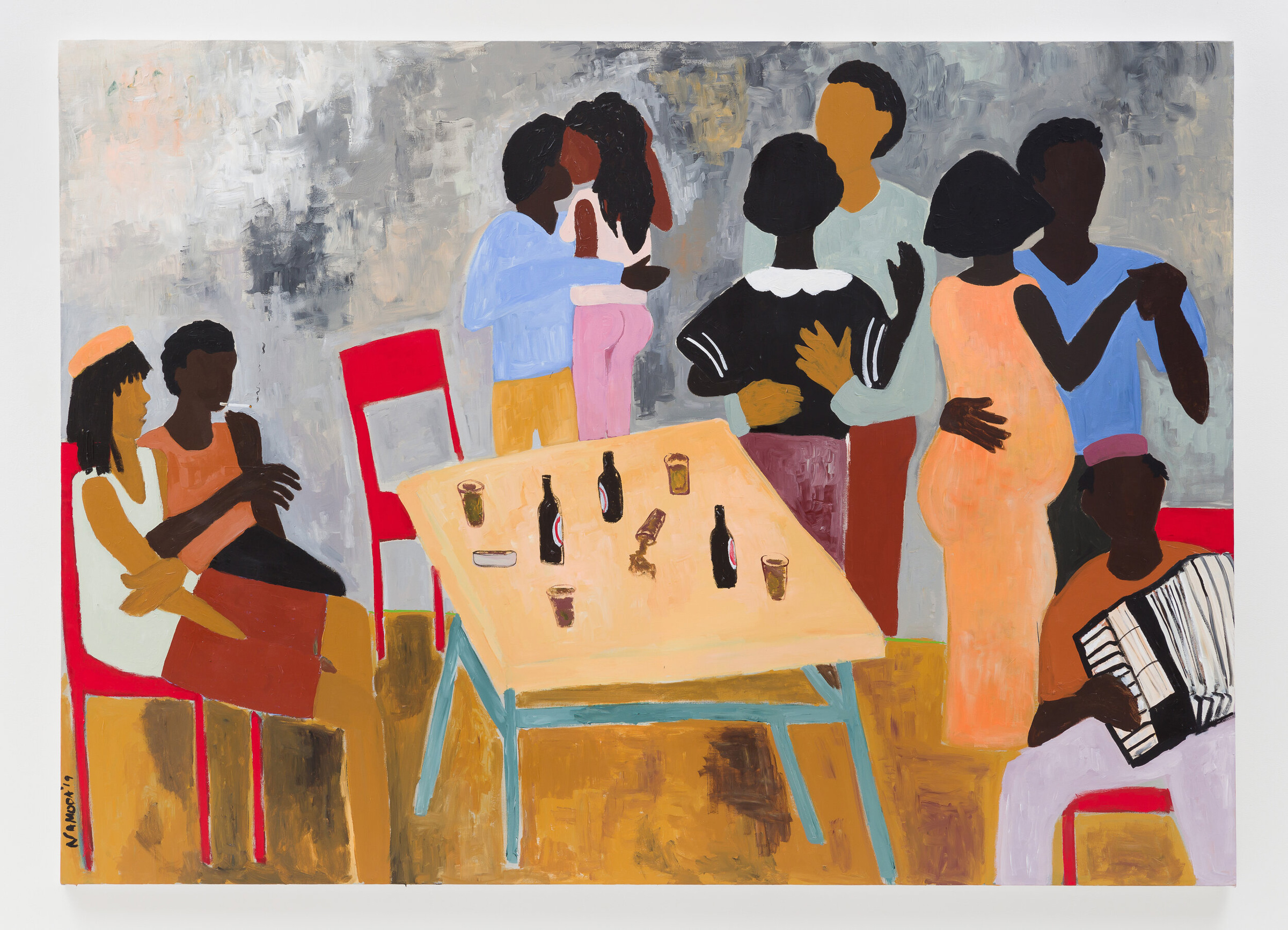
The significance of the theater in Darby’s art practice began in childhood and later into a profession as a contemporary dancer. Her commitment was primarily to the technique of the late pioneer, José Limón, which is based on the falling and recovering of a human body. It explores the adaptability of a body in space, indulging and resisting the polarities of high and low, swinging from one extreme to another like a pendulum. The tension and duality of these echoes in the complexities, miseries and beauties of human life as a trope of Melpomene and Thalia, the theatrical masks of tragedy and comedy. In this dance, bodies are instruments in an orchestra, working alone or in solidarity, suspending and releasing, giving and taking, descending and ascending. The cyclical nature of ebb and flow, death and rebirth are ongoing themes explored in Darby’s paintings which express empathy, sexuality, sorcery, womanhood and ceremony. Her paintings are intimate and confessional self-portraits of her life as a young woman. A mystic, Darby believes her work is a collaborative process with the spirits and a parting of the veils between the realms.

When did you start painting and creating?

In childhood I began as a dancer. After training at The Winnipeg School of Contemporary Dancers, I continued dance and choreography professionally. In the last three years drawing and painting have become my primary focus.

How do you find the balance between the vision you have and the mediums you are using?

My work is a practise of letting go of my own ideas and expectations so that I can listen to the guidance of the spirits and my intuition. I see my art as a collaborative spiritual practise. By painting and studying everyday I hope to better understand my mediums so that I can more skillfully and freely denote without doubt.

What inspired your style of work?

As a dancer I understand line, movement, expression of emotion, harmony and music, all which inspire my painting. I was immersed visually with female bodies in motion, on stage, backstage, in costume, in the nude and in a myriad of emotions for most years of my life. These images still permeate into all of my drawings and paintings. My flat backgrounds are inspired by theatre stage set designs. Theatrical elements such as the colours and textures of stage curtains and costumes, masks, props and lighting as well as the mystery, drama, superstition and magic of the theatre often come to play in my paintings.

Where do you get inspiration from? Are there any particular artists, photographers, painters or designers you look up to their works?

I’m currently looking at works by Odilon Redon, Marc Chagall, Edvard Munch,  Raoul Dufy, Emily Carr, Van Gogh and  Édouard Vuillard for inspiration.

How long does it take to create a piece? What is the process being it?

The time fluctuates depending on my emotional state and level of resistance. A painting can take as little as one hour and as long as half a year. I approach a canvas similarly to performance which is very ritualistically and superstitiously. The canvas which I stretch and prepare myself is done and ready on an easel. I will often burn herbs and rub oils onto the backs of the paintings and myself for luck. A candle is usually lit. Always I paint to music. Always I physically warm up my body so that I’m loose and present. I paint from memory and imagination, without a plan, reference or sketches, so I try to be as open and physical as possible to avoid fear or judgment to cloud my sense of intuition and play.

Would you say that there is a main thread connecting all your artworks and if so, which is it?

My work is diaristic. I am the thread connecting the artworks. Femininity, nature, mysticism, and dance are all very strong themes in my life and painting. I am deeply connected to my childhood which was spent on the West Coast gulf islands in Canada where the nature is overwhelmingly wild, fruitful and erotic. Since childhood I have had visions and hauntings of ghosts and spirits. Mysticism and magic are embedded into all my works. I am closely knit with my sisters who I paint metaphorically in nearly every painting. Sisterhood and expressing the lightness/darkness of being a woman is an ongoing theme in my work. All of these elements weave and dance together on the stage of my canvas.

 

What kind of talks would you like to hear around your artworks? 

I need to stay present in the process of creating rather than in the consequential conversations of the work that is finished. I need to just keep going on in the dark, forward.

Designers

  1. Mirror
  2. Women in the Field
  3. The Fortune Teller’s Tent
  4. The Flowering
  5. Fruits Of Paradise
  6. Red Moon In The Orchard
  7. Dancers in the wings

Clemente Vergara

Arcosanti

An aperture into architect Paolo Soleri’s City of Future, an urban laboratory

ARIZONA, UNITED STATES—I arrived to Arcosanti late on an afternoon, after driving many hours from Monument Valley through Sedona. I was really looking forward to visit Arcosanti, but having seen the wonders of those natural reserves, canyons and spectacular landscapes, I believed Arcosanti would not impress me… and I was wrong… I didn’t know much about Paolo Soleri’s project. I just knew it was an unfinished experimental city created during the 70s designed to be self-sufficient, and that we were going to sleep in The Sky Suite, the room with the best views you could rent in Arcosanti.

Once there, I was amazed by the project, the buildings, the people living, working and studying there. Also I got interested about the Architect (Paolo Soleri’s) work. I was lucky that in the room there was a huge book that gathered his drawings and ideas about futuristic cities. I also learned that the name of Arcosanti came from two italian words “Cosa” and “Anti”, that literally means, “before things”. I learnt also about the concept of Arcology, which comes from putting together Architecture and Ecology, and the importance of that concept in the current society of “take make dispose” that is ruining our planet. 

I will always remember the days I spent in such a special city, that keeps alive Paolo Soleri’s ideas.

Credits

Photography and words CLEMENTE VERGARA
www.clementevb.com
www.instagram.com/clementevb
www.arcosanti.org

Subscribe to our
Newsletter