Archive page:


Karimah Ashadu

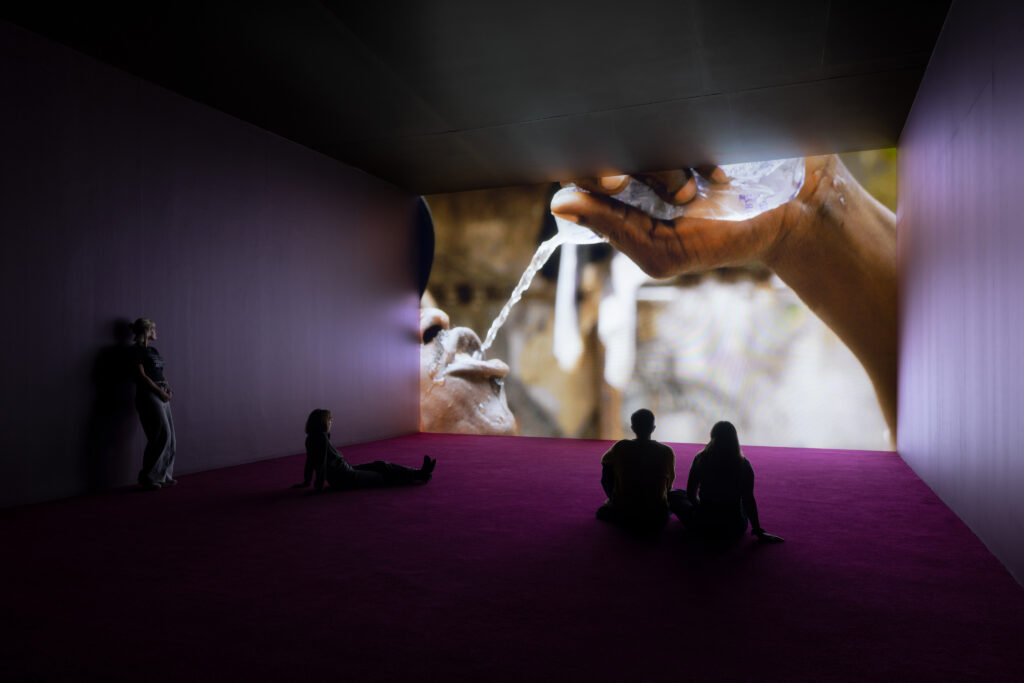
Installation view, Karimah Ashadu, Tendered, Camden Art Centre, 10 October 2025 – 22 March 2026
Credit: © Karimah Ashadu. Courtesy the Artist, Fondazione In Between Art Film,
Sadie Coles HQ, London and Camden Art Centre. Photo: Andrea Rossetti

From Within 

Karimah Ashadu’s work begins with the body. Before turning to film, she trained in painting and spatial design, developing a way of thinking grounded in surface, scale, and physical presence. That foundation continues to shape her moving images, where cameras are often attached to bodies or custom-built mechanisms, and motion becomes not a visual effect but a method of inquiry.

Living between Lagos, London, and Hamburg, Ashadu’s films move across geographies, economies, and identities. Her work engages labor, masculinity, migration, and autonomy, particularly within informal systems that exist beyond regulation yet sustain everyday life. Rather than offering explanation, her films construct encounters. They ask the viewer to feel position, proximity, and imbalance, and to recognize the conditions under which looking itself takes place.

Recipient of the Silver Lion for a Promising Young Participant at the Venice Biennale, Ashadu reflects on painting as a foundation for filmmaking, the role of physicality and installation, the politics of direct address, and why her films function less as statements than as self-portraits shaped by lived experience.

You began your practice in painting and spatial design before moving into photography and film. What did painting teach you about surface, scale, and attention that still shapes how you compose moving images?

What painting teaches you, fundamentally, is composition. How you want the work to feel, the kind of emotion you want it to engage in the viewer, and how you achieve that through shape, texture, and surface. Painting creates a visual language that stays with you. For me, it is completely fundamental to how I make film.

Your approach to film seems to emerge through the body, through position, balance, and movement. How did working physically influence the way you first understood motion on screen?

When I was painting, I was very interested in performance painters and artists who worked directly with their bodies. The body was always at the center for me, and that is what drove my entry into filmmaking.

I started by building mechanisms, structures where I would give control to the device itself. I placed my camera inside the mechanism, and over several years that process evolved. What I loved was not knowing exactly what I was going to see, and how movement could influence narrative. The physical relationship between the camera and the body, and how that is experienced, became central. The way the film moves physically contributes to the narrative.

You have lived between Lagos, London, and Hamburg. How does moving between these places shape your sense of framing, duration, or where the camera is allowed to be?

Moving between these places influences me on many levels. It makes me aware of myself, my body, and how  the world interacts with me as a Black woman, as an African, as a European woman.

It also makes me think about space, where I am allowed to be, and how I move through environments. One moment I might be filming in the slums of Lagos, and the next I am sharing that work in an art space across the world. That movement is key to what I do.

For me, moving between these places is essential to my practice.

Many of your films are encountered by audiences far removed from the conditions they depict. How do you think about the distance between lived experience and its reception through the image?

I am not naive. I know what I am doing. It depends on how open the audience is. If someone is guided only by what they have absorbed through the media, they will view the work through a specific lens. If the audience is open minded, has traveled, reads, and is culturally engaged, then there is space to see from a different perspective.

I am not trying to educate anyone. I am not trying to be an activist. I am simply showing the world as I experience it. I cannot control how the work is read. I can only present it honestly.

Speaking about Makoko Sawmill, you have said that your methods make closeness felt. What concrete choices create that closeness, and where do you intentionally hold back?

Making Makoko Sawmill happened during a period when I was figuring out my place in Nigeria. I grew up there, then left for the UK, and this was a time of return, of re-learning the culture and understanding where I fit in the landscape.
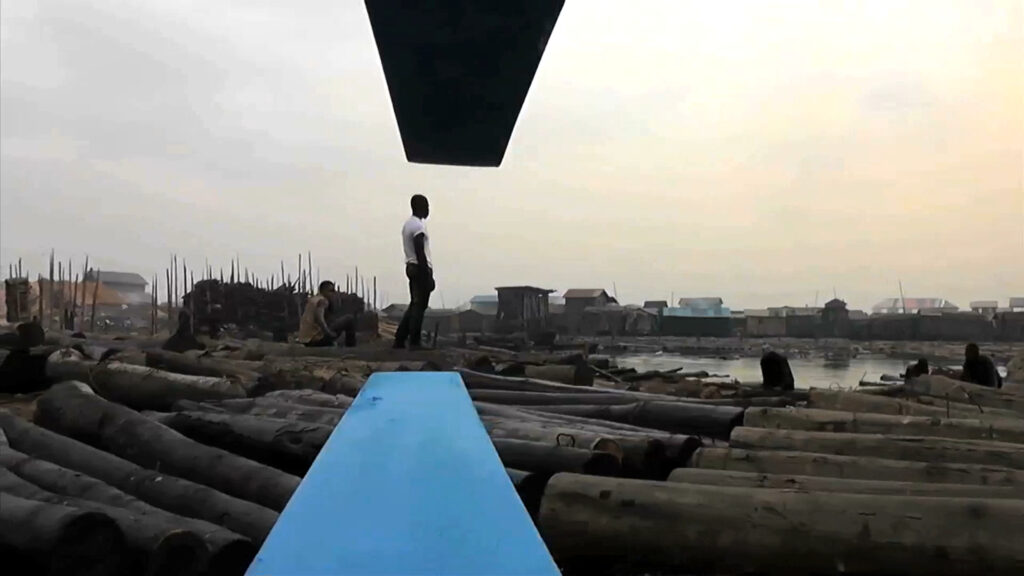
Karimah Ashadu
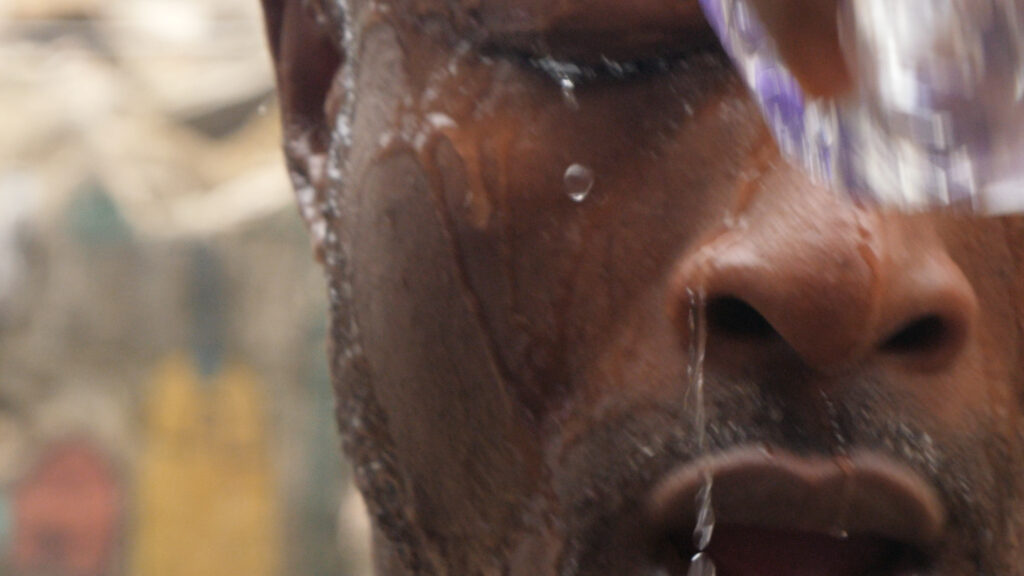
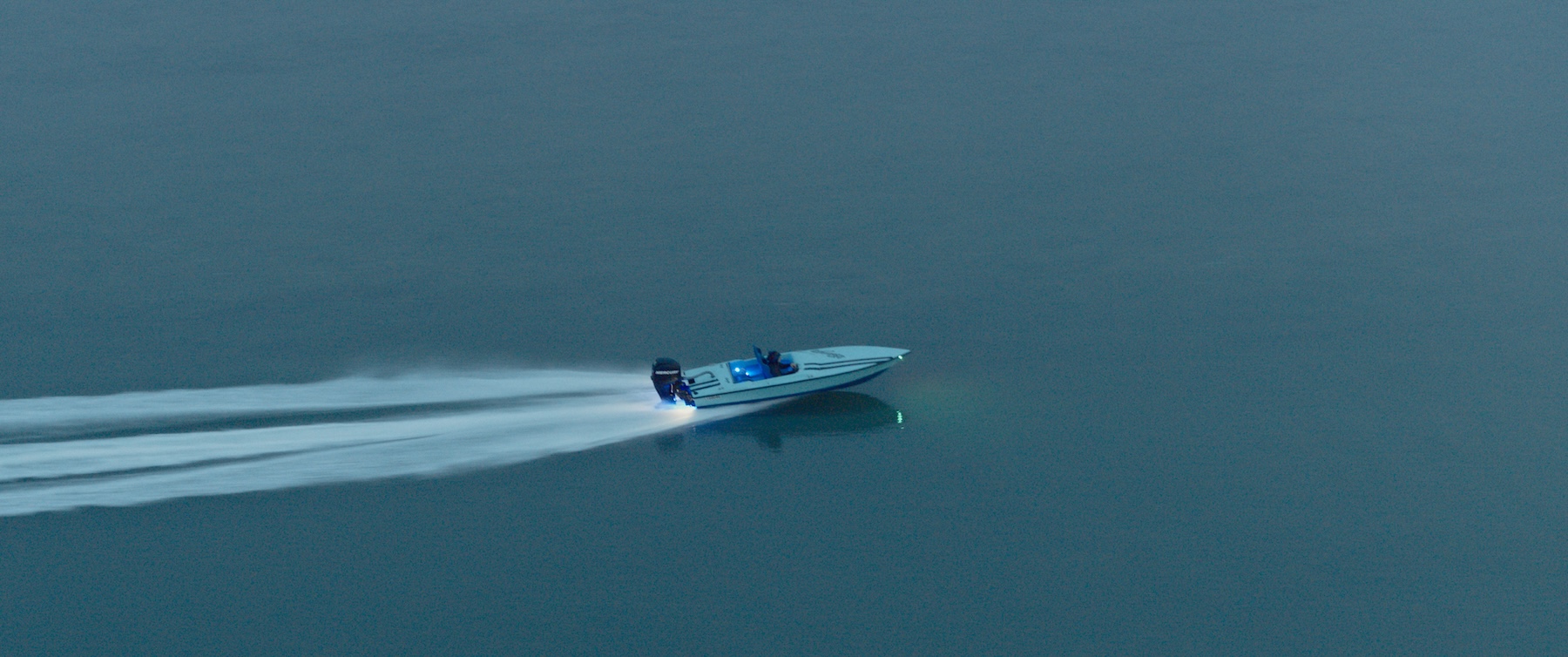
Makoko Sawmill, 2015 [Still]
HD digital film, colour with stereo sound
20:00 mins
Credit: © Karimah Ashadu. Courtesy the Artist and Sadie Coles HQ, London
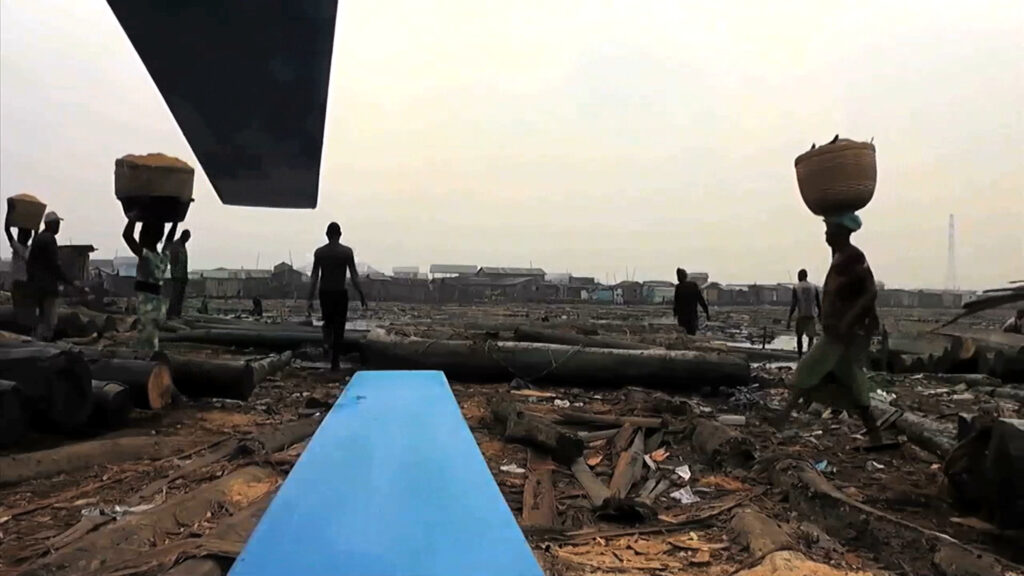
Karimah Ashadu
Makoko Sawmill, 2015 [Still]
HD digital film, colour with stereo sound
20:00 mins
Credit: © Karimah Ashadu. Courtesy the Artist and Sadie Coles HQ, London
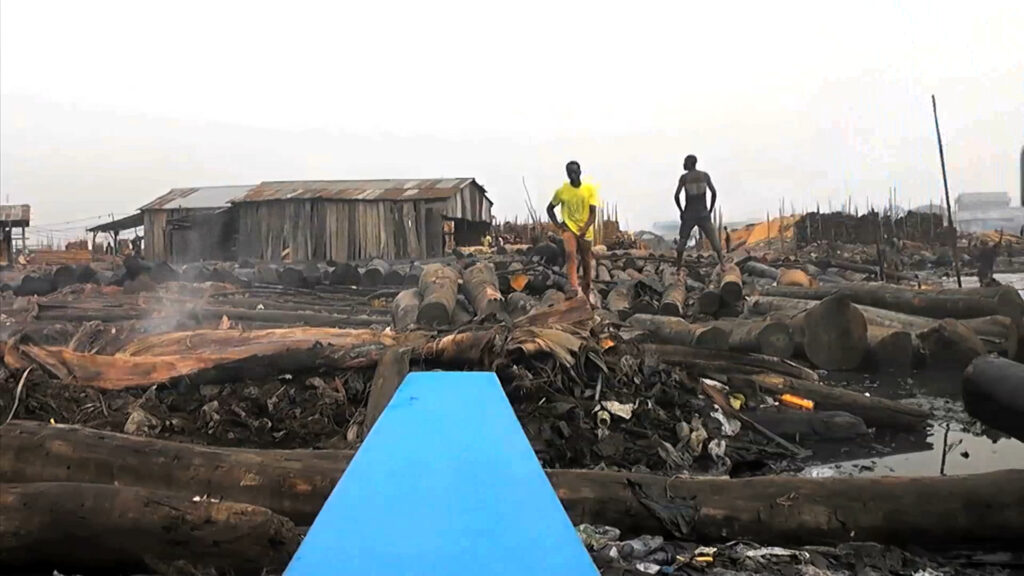
Karimah Ashadu
Makoko Sawmill, 2015 [Still]
HD digital film, colour with stereo sound
20:00 mins
Credit: © Karimah Ashadu. Courtesy the Artist and Sadie Coles HQ, London

The mechanisms I was using allowed me to work through that process. The audience accompanies me on a journey of reconciliation, and that is intimate in itself. Making art is intimate. You are sharing parts of your process and parts of your emotional world, parts of your “soul”, really. 

With my films, I am creating a world and inviting the viewer into it, framing that experience very specifically. It is about opening a dialogue. It is an invitation rather than a declaration.

In several works, your subjects look directly into the camera. What does this direct address ask of the viewer, and how does it shift the balance of looking and being looked at?

On one level, you are watching a film and become hypnotized. That direct look interrupts that state and makes you aware of yourself as the viewer.

It is about the subject meeting you directly. That moment becomes one of reclamation and empowerment. Often this is a Black body, frequently a Black male body, onto which so much history and projection is placed. 

You often attach the camera to your body or to custom-built devices, allowing movement to generate the image. What kinds of understanding emerge from this method?

It comes from having a physical approach to filmmaking. For me, anything is possible. I think about the image I want to achieve and then find a way to achieve it.

The movement of the camera works hand in hand with the subject. Over time, I have learned what works for me and what does not. It has been a process of discovery.

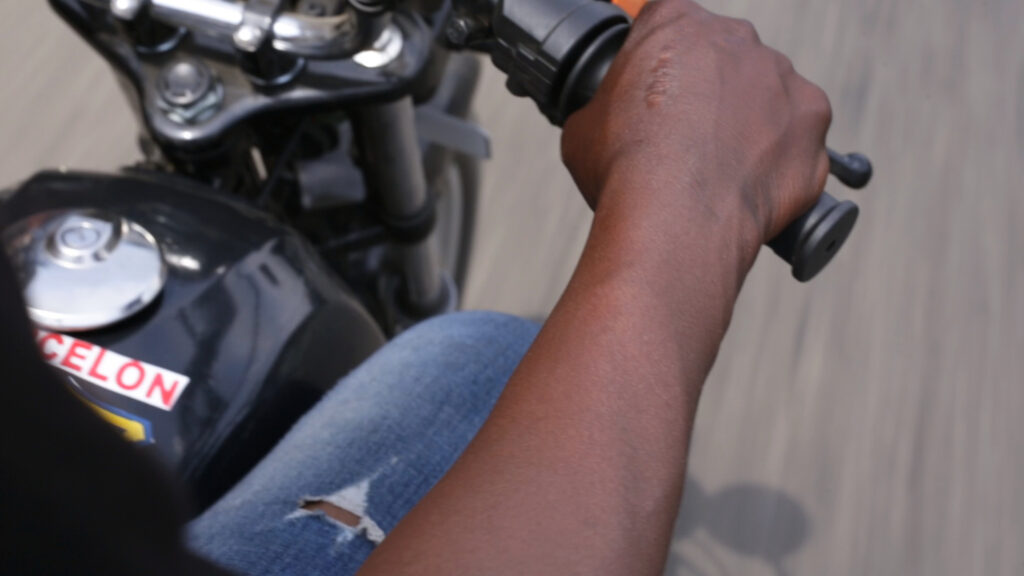
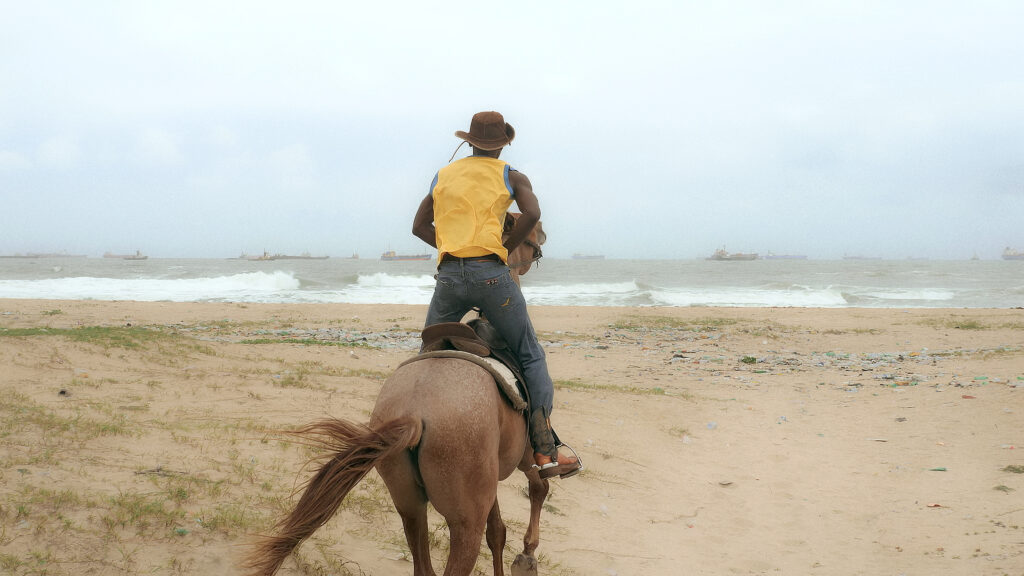
In Cowboy, the camera moves with the rider, sharing speed and rhythm. What changes when the image moves alongside its subject instead of observing from a distance?

You follow this African cowboy from behind, and he leads you through his environment. Historically, that act of following a Black person in this way, carries meaning.

He takes you to the shore, to the Atlantic, and charges toward it without entering. The ocean becomes a site of historical violence for Black people, through slavery and contemporary undocumented migration. It represents the unknown.
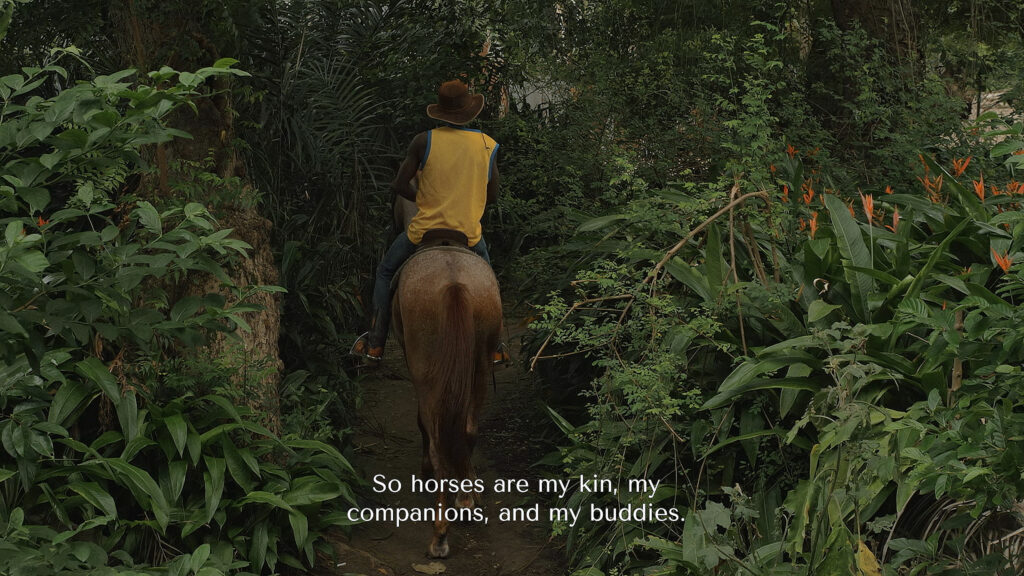
There is a lot of symbolism woven in. The palm tree, for example, is a symbol of peace in West African history and was used as camouflage during times of war. On a surface level, these details might be missed, but they are deeply woven in with meaning.

From sawmills and tin mines to motorcycle taxis and makeshift gyms, your work repeatedly engages with labor carried out in informal or unregulated conditions. What draws you to these spaces of work?

When I think about Nigeria and independence, I think about how independence was taken from us. We were always independent. Labor becomes central when thinking about rebuilding autonomy.

Labor in Nigeria is extremely physical and often harsh, very raw. But for me, it is also a pathway to autonomy, not only individually but collectively. It connects to history, social structures, and the body itself. The way the body moves through labor has always fascinated me.

In MUSCLE and Machine Boys, strength is constantly displayed, yet it never appears stable. What interested you in filming masculinity at the moment where effort becomes visible?

I was thinking about representations of masculinity, what it means to be a man and how manhood is performed. Amateur bodybuilding became a space to explore that.

By getting very close, you see how vulnerable the pursuit is. Muscle is temporary. It requires discipline and constant effort to maintain. In the Nigerian context, masculinity carries heavy stereotypes, particularly around the Black male body. I wanted to fragment that image.

The film has no clear beginning or end. It inserts you into a moment. Sound, repetition, and strain build discomfort. The sounds themselves are abstract. You feel unsettled, but you cannot look away.

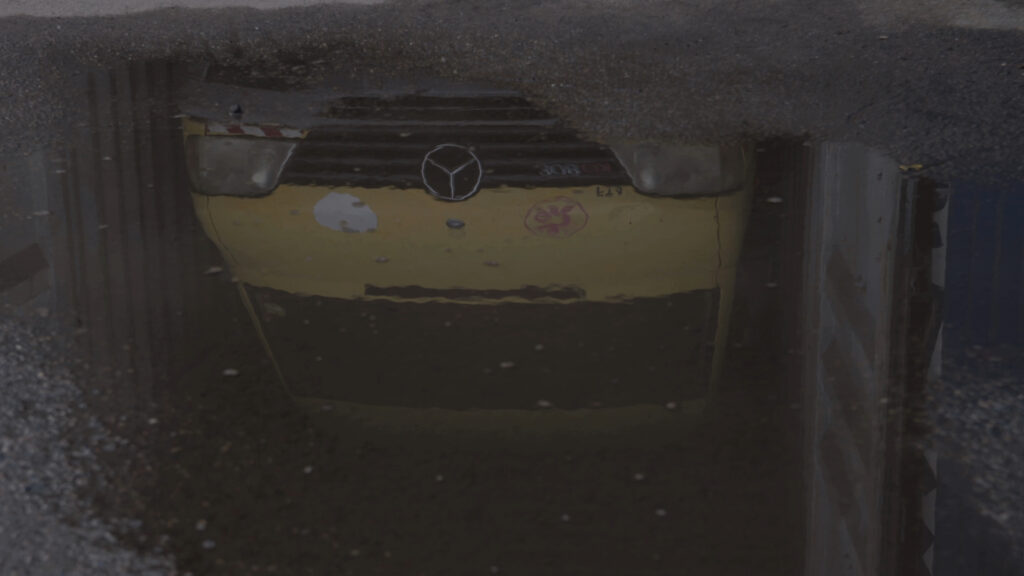
Brown Goods approaches migration through circulation, trade, and value. What led you to focus on movement and exchange?

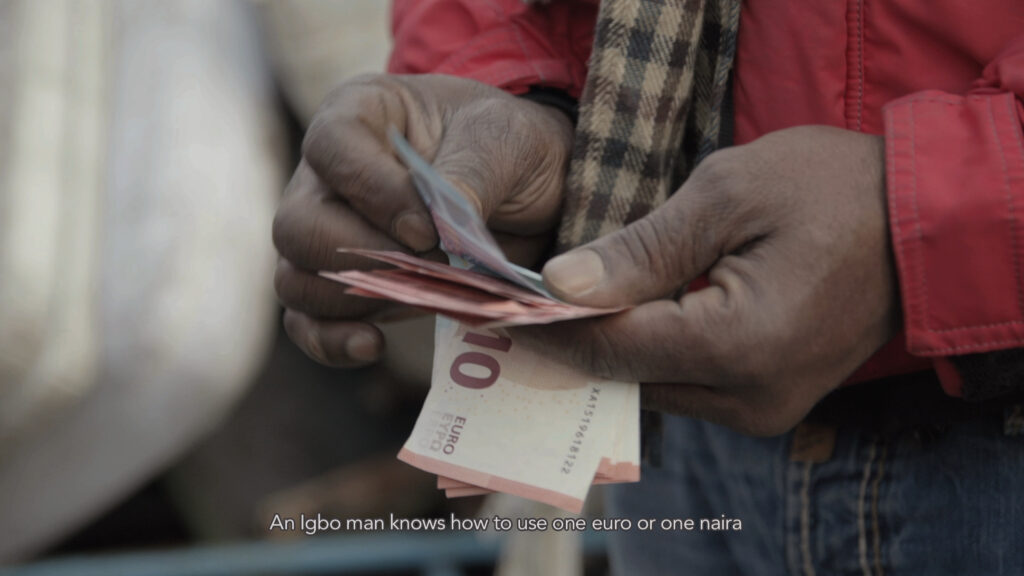
I was living in Hamburg and did not speak the language. I was trying to understand the city and its layers. I discovered an informal trade network run largely by West African migrants, importing and exporting second-hand goods.

Karimah Ashadu, Brown Goods, 2020 [Still]
HD Digital film, colour with mono sound
12:00 mins
Credit: © Karimah Ashadu. Courtesy the Artist and Sadie Coles HQ, London
Karimah Ashadu, Brown Goods, 2020 [Still]
HD Digital film, colour with mono sound
12:00 mins
Credit: © Karimah Ashadu. Courtesy the Artist and Sadie Coles HQ, London
Karimah Ashadu, Brown Goods, 2020 [Still]
HD Digital film, colour with mono sound
12:00 mins
Credit: © Karimah Ashadu. Courtesy the Artist and Sadie Coles HQ, London
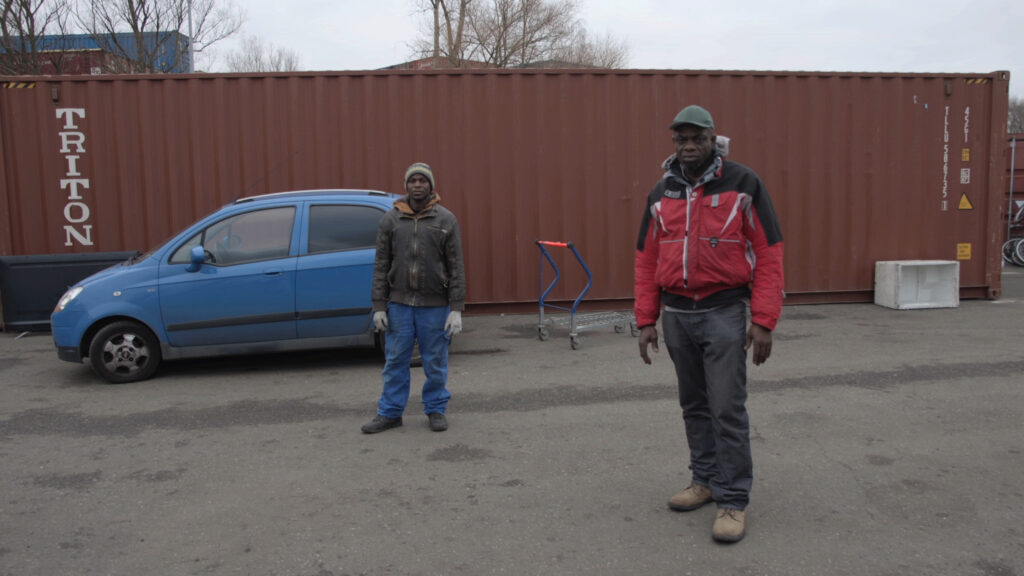
The protagonist, Emeka, left Nigeria through Lampedusa. As an asylum seeker, he was not allowed to work officially, so he found a niche to earn money by trading second hand goods to Africa, effectively earning African money in Europe. That cycle fascinated me. The film follows his labor and his thoughts on autonomy and identity, being African and European at once. My films are self-portraits. I find situations that reflect my own questions and experiences.

You have spoken openly about the fact that once a film is completed, you leave, and the relationship often ends. How does that awareness shape the way you film intimacy?

Life happens in moments. You do not enter a relationship thinking about its end. You enter it openly. That is how I approach filmmaking.

I am clear about my intentions, and the people I film know why I am there. There is an exchange, including a monetary one. These are moments of connection. You do not know how long they will last. You just know that you want to connect.
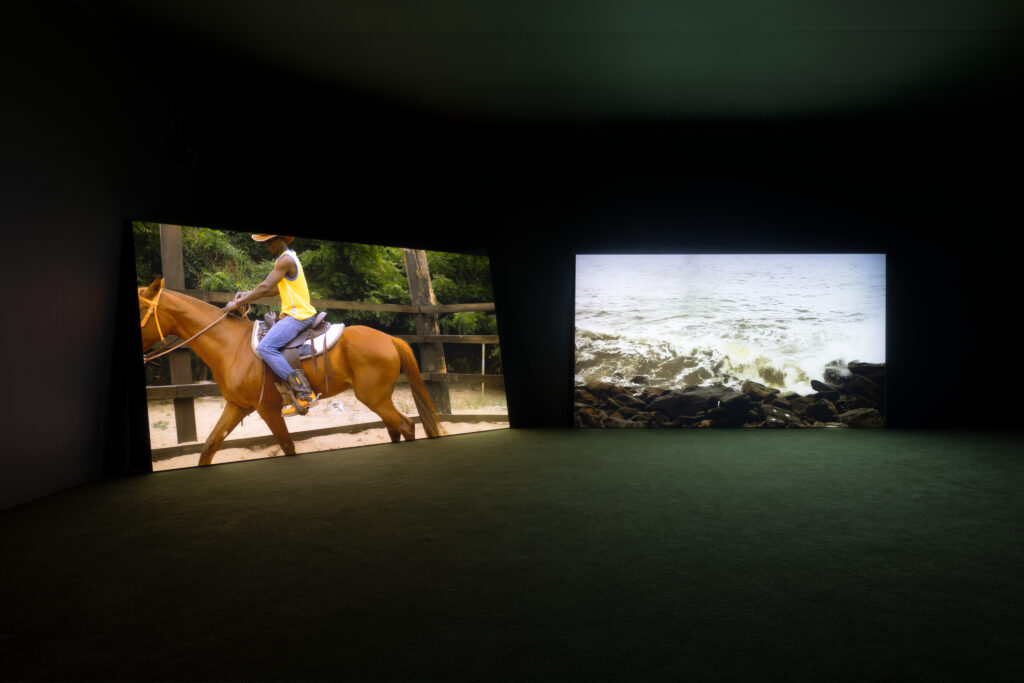
Installation view, Karimah Ashadu, Tendered, Camden Art Centre, 10 October 2025 –
22 March 2026
Credit: © Karimah Ashadu. Courtesy the Artist, Fondazione In Between Art Film,
Sadie Coles HQ, London and Camden Art Centre. Photo: Andrea Rossetti

Across your work, movement becomes a way of thinking rather than simply a way of seeing. What, at this point in your practice, still resists being fully understood, filmed, or held in form?

I always want to feel challenged. The moment I get comfortable, I pivot. That is true in my work and in my life. I want to feel like I am on the edge of something I do not fully understand.

My practice is about questioning. The work becomes an answer to those questions. Right now, I am thinking about how film can expand and influence painting and sculpture. I am working across installation, public art, and developing a feature film. I am always seeking growth. That is the point.

Credits

All images courtesy the Artist, Fondazione In Between Art Film, Sadie Coles HQ, London and Camden Art Centre.
Discover more on karimahashadu.com
(AB)NORMAL

Architecture as a living process: world-building beyond the normal

Founded in 2018 by a group of collaborators, Mattia Inselvini, Davide Masserini and Luigi Savio, driven by a fascination with obsolete technologies, gaming culture, and ephemeral atmospheres, (AB)NORMAL studio began as a shared diary of colorful renderings and narrative experiments rather than a conventional architecture firm. Over time, these graphic explorations evolved into three-dimensional environments, from temporary installations and exhibition spaces to commissioned architecture, where the virtual and the tangible, the personal and the collective, converge. NR spoke with the architectural studio to trace the origins of its practice, its interdisciplinary approach, and the evolving philosophy that positions architecture as a living, inhabitable process.

I would love to begin at the origin of your practice. When we met, you showed me your early rendering drawings, where you used color gradings to create imaginative words and utopy spaces. Your website also presents sections of sketches, graphic novels, and research projects across diverse formats. How did these explorations evolve into the construction of three-dimensional, inhabitable space, and how do you conceive interdisciplinarity within your practice, particularly the relationship between image, narrative, research, and built form?

(AB)NORMAL began in 2018 as a shared diary rather than a studio in the conventional sense. We were collecting formal obsessions and reflections on contemporary life—together with a fascination for obsolete technology, gaming culture, and a certain kind of spirituality. Producing images was almost a form of collective therapy: a way to exorcize the fantasies that tend to cling to the creative process.

Those early renderings, with their gradients and artificial atmospheres, were not meant to represent architecture. They were small world-building devices. Plants, statues, iPods, headphones, joysticks, fragments of architecture, and 3D graphic elements became protagonists of collages that were trying to capture emotions, historical moments, and personal reflections. We often used architectural representation tools inefficiently on purpose – because for us the “error,” the glitch, the excess, was part of the thinking.

Over time, what was initially graphic started to reveal a spatial potential. We realized that the narrative quality embedded in the images could become operational in three dimensions. That’s how we moved into ephemeral environments, exhibitions, fashion shows, and temporary installations: spaces conceived as portals where the boundary between the virtual and the tangible becomes softer, and where digital culture can be experienced collectively, in public space, rather than privately on a screen.

Interdisciplinarity, in our practice, is not about blending disciplines as a stylistic choice. It’s a natural condition – an open system where formats constantly translate into each other. Image generates atmospheres and iconographies; narrative gives time, causality, and social behavior; research adds friction, specificity, and a reading of contemporary cultural phenomena; and built form is where everything becomes measurable, negotiated with gravity, budgets, regulations, and bodies.

We don’t see a separation between thinking and construction, between theory and space. Architecture is not a final object for us, but a living process: a way to transform research into concrete experience, and to make the complexity of the present spatial, inhabitable, and shared.

Your work conveys an approach to architecture as the shaping of time, space, and human experience rather than the mere production of aesthetic environments. It evokes, for me, a sensibility reminiscent of Bachelard’s phenomenology, attentive to how spaces are experienced and how time is woven into them. In developing a project, do you start by asking who the space is meant for, or what it needs to feel like? Beyond these immediate considerations, do social, political, or theoretical reflections on inhabitation and identity play a role in how you conceive and compose your spaces?

I’m glad you mention Bachelard, because that attention to lived experience resonates with how we work, although we rarely start from a theoretical framework in a direct way. We begin from a more immediate question: what kind of atmosphere should this space produce, and what kinds of behaviours should it enable?

In many projects we don’t separate “who the space is for” from “what it needs to feel like.” We start by mapping a set of bodies, rhythms, and expectations,  the clients, the visitors, the workers, the public, and at the same time we try to define an atmosphere, an emotional disposition. For us, architecture is not only a form, but a temporal condition: a sequence of thresholds, pauses, intensities, and moments of orientation or disorientation. Especially in ephemeral environments, what matters is not the object, but the experience of moving through it and the way people recognize themselves inside it.

The composition of space, then, becomes a way to organize time collectively: light, sound, images, materials, and interfaces are not decorative layers, but tools to construct a shared situation. This is also where the virtual and the tangible matter to us – not as a celebration of technology, but as a way to compress distances and create a feeling of proximity between people, even when they come from different worlds.

Social and cultural reflections are always present, because we constantly observe contemporary phenomena – from gaming to streaming, from entertainment to the aesthetics of technology – and we try to translate those into spatial experiences. We are careful not to use our work as a platform for explicit political statements, but inhabitation is never neutral. Choices about openness, accessibility, visibility, and flexibility always imply a position.

So rather than starting from an ideology, we start from the reality of the present, and we try to build spaces where contemporary identities and forms of coexistence can be rehearsed, not just represented.

Looking at some of your past projects, such as your graphic-novel explorations, there seems to be a consistent interest in the interplay between narrative, spatial sequences, and materiality. How do these non-commissioned or experimental works inform your approach to commissioned architecture? Would you say these projects operate as laboratories for concepts, atmospheres, and techniques that later manifest in built spaces ? 

Narrative is central in these experiments because it forces space to unfold in time. A graphic novel, for instance, is already a spatial tool: it’s made of sequences, thresholds, cuts, pauses, and intensities, which are exactly the ingredients of architectural experience. Through these formats we can prototype how a space might be inhabited, how a body moves, what kind of attention or distraction it produces, and what kind of collective situation it enables.

Materiality also enters early, even when the work is virtual. We use digital tools not to “illustrate” a final design, but as an operational environment where we simulate light, textures, reflections, and spatial compression. In that sense, the rendering becomes a critical device — a way of thinking through material behavior before it becomes construction.

When we move into commissioned work, those experiments don’t simply provide a catalogue of aesthetics to apply. They provide a vocabulary of techniques and questions: how to build a Stimmung, how to design a space as a flexible infrastructure, how to combine physical elements with image, sound, and interfaces, how to accept the productive role of error, and how to make the experience collective rather than purely visual.

So yes, they function as laboratories, and simultaneously, as a constant training ground. They keep the practice open, and they prevent architecture from becoming a fixed style or a formula.

Materials appear as active agents in your practice, with intrinsic behaviours, textures, and narrative potential. To what extent does material research guide your design process, and in what ways is matter treated as a conceptual partner, as a vessel of memory, or as a means to articulate spatial and sensory qualities?

Material research entered our work progressively, growing in importance as our projects became more spatial and inhabitable. At first, materials were part of an image vocabulary, linked to atmosphere and iconography. Over time, we began to treat matter as an active agent within the design process. Materials carry behaviors, react to light, define acoustic conditions, age, reflect, and absorb, producing an immediate emotional and cultural reading.

Because our practice moves between the virtual and the physical, we test material atmospheres early through digital simulations. Rendering becomes an operational environment where texture, reflectivity, depth, and spatial compression can be explored through iteration and error. This allows materiality to guide decisions long before construction.

Matter also acts as a vessel of memory. Certain surfaces evoke domestic familiarity, industrial systems, or obsolete technologies, triggering recognition and affect. In this way, materials become conceptual partners in composing an atmosphere. Ultimately, material choices articulate sensory qualities such as warmth, opacity, intimacy, and exposure, shaping how time is experienced in space and how people inhabit it.

Your practice also extends to the design of objects, such as tables or other design elements. When approaching these smaller-scale pieces, how does your method differ from designing larger spatial environments? To what extent do considerations of the surrounding space, function, and human interaction inform these objects, and how does your approach engage with notions of decoration or ornament within the broader logic of the project?

We approach objects almost the same way we approach architecture. Even at a smaller scale, we design them as spatial devices rather than accessories. A table, a lamp, or a custom element is treated as a unique piece with its own presence, geometry, and narrative potential, like a small building inhabited through use.

The main difference is intimacy. Objects are experienced at close range and through contact, so function and human interaction become immediate. We think about posture, touch, weight, and how bodies gather around an object. We also consider the surrounding space. We rarely design standalone pieces. We imagine objects as part of an ecosystem for the whole space, shaping how a room is used, how circulation works, and how attention is directed.

Decoration and ornament are never applied superficially. What might appear ornamental is often structural or performative. Detail, texture, and material behavior reinforce the project logic and intensify atmosphere. An object can become a threshold, a marker, a focal point, or a small ritual.

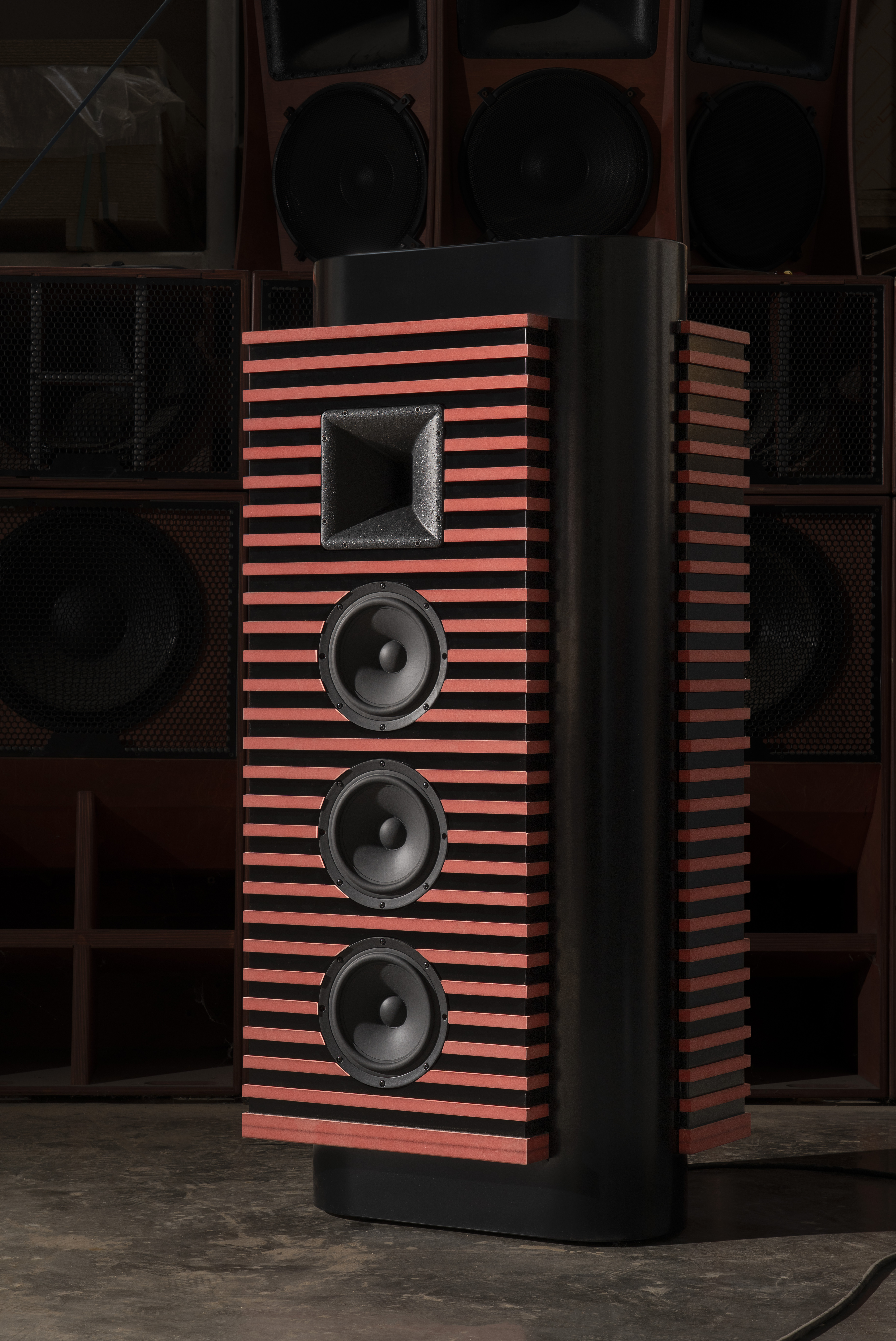
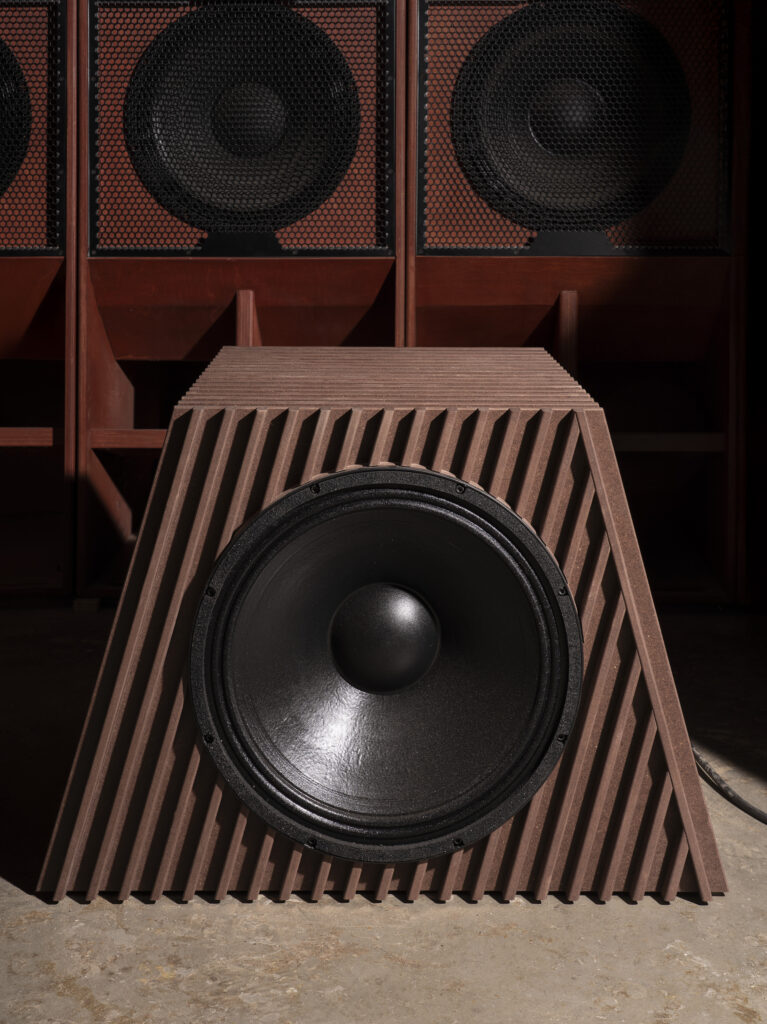
I would like to discuss your most recent project, which stands out in the portfolio of works made so far: the creation of a custom sound system for WSA NYC. How did this commission come about? Considering WSA is described as a spatial platform blending architecture, design, exhibitions, and brand-driven environments, what was the initial brief or cultural ambition behind this collaboration? Did it originate as a product-design assignment, an installation, or an attempt to rethink what a space for music, art, and social gathering could be in New York? 

The request wasn’t simply to “deliver a product,” but to develop a custom sound system that could act as an identity element and a piece of architecture in its own right. From the beginning, we understood it as a project about atmosphere, behavior, and gathering, as much as acoustics.

Rather than starting from a conventional hi-fi object, we worked as we would on an architectural commission. We considered the surrounding space, how people move, where they pause, how they socialize, and how music performs within that context. The goal was to create a system that supports different modes of inhabitation, from focused listening to informal conversation, without turning sound into background decoration.

So the project sits somewhere between product design and installation. It is a unique object, but it also reorganizes the room and amplifies the cultural ambition of WSA: to rethink the space of music, art, and social life in New York as a shared environment, where technology becomes part of the spatial narrative.

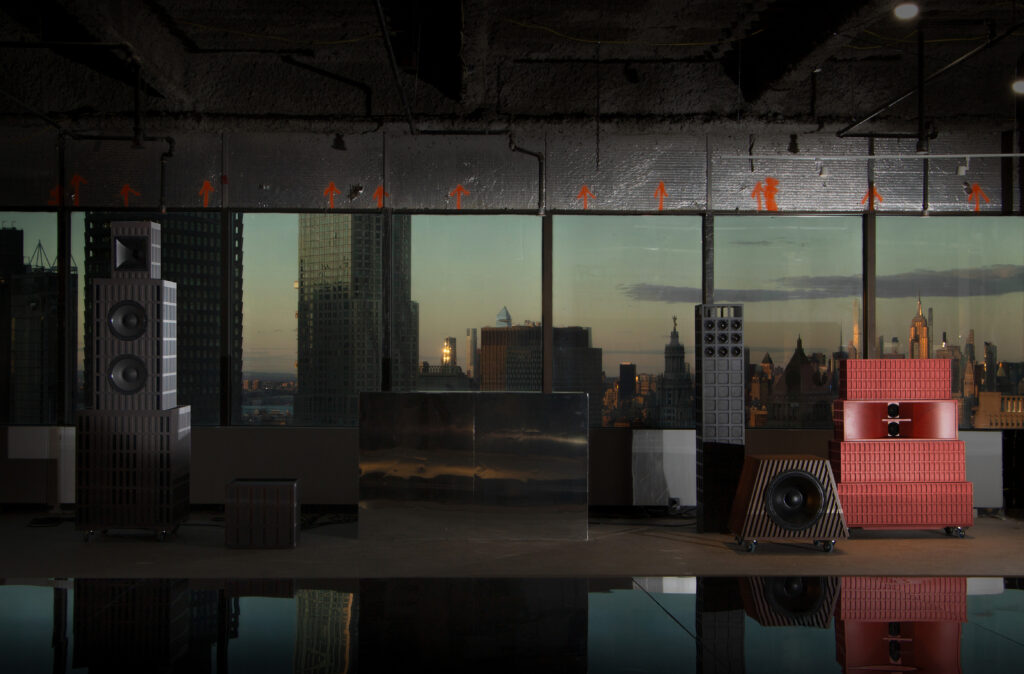
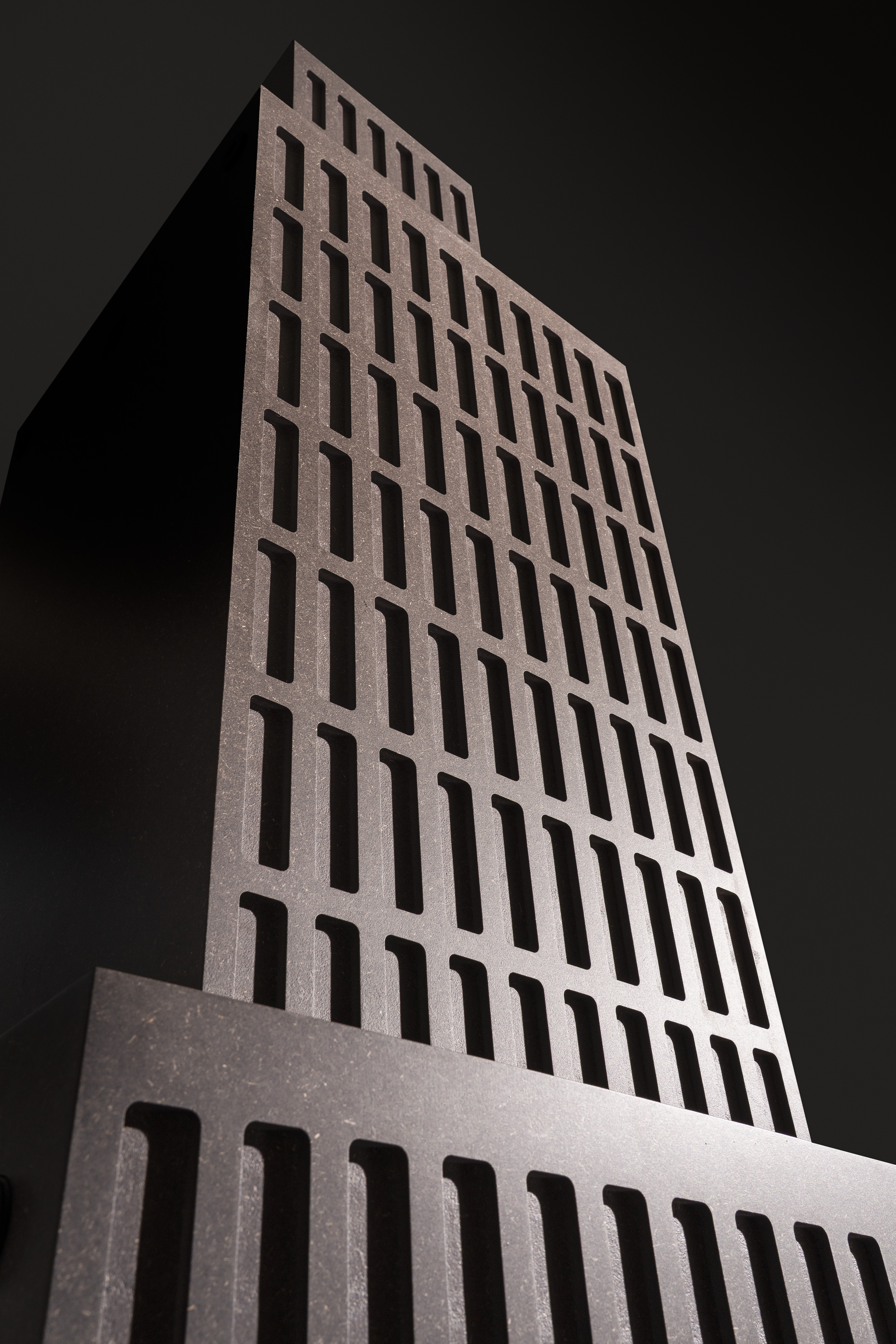
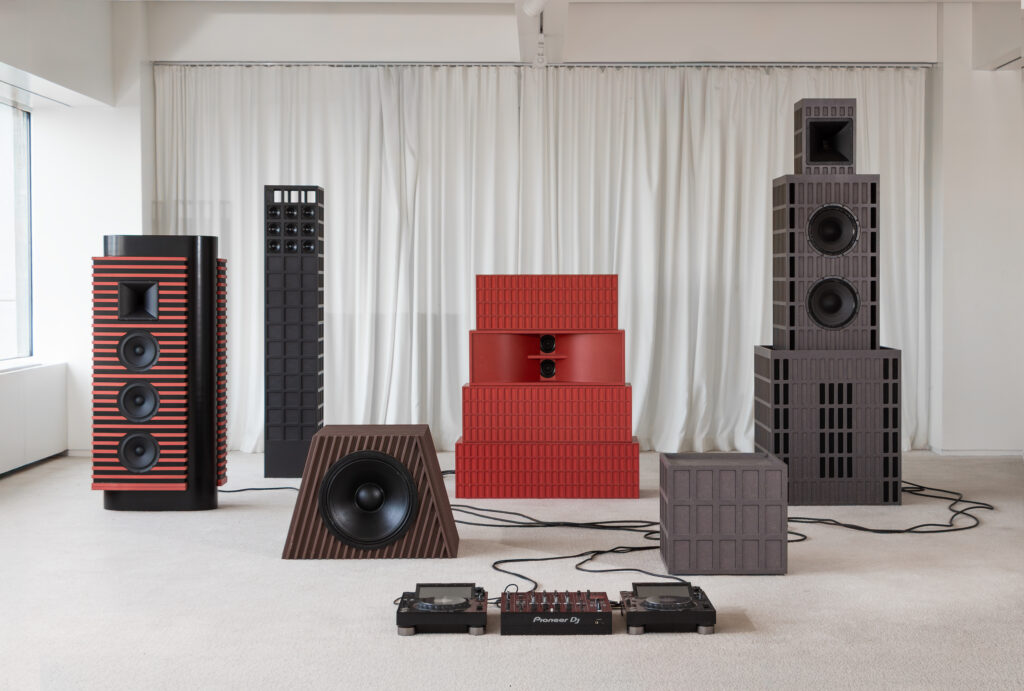
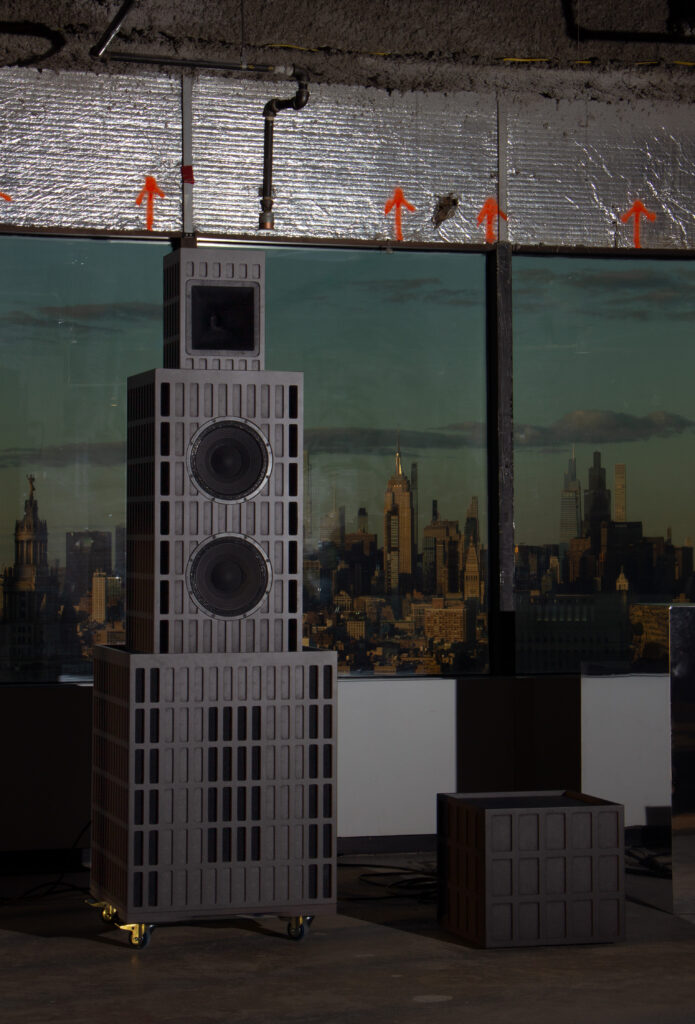
The WSA Sound system is presented not as a mere sound setup but as a sculptural constellation of speaker-towers whose modular design echoes rigid geometry and corporate aesthetics. In designing this, how did you negotiate between its identity as a functional sound system and as an architectural-sculptural installation? Explaining myself clearly: looking at it, it reads almost as a miniature city in itself, with its own carefully drafted colors and shapes. Could you use this project as an example to discuss how aesthetics, function, and conceptual intention intersect in your work? How do these dimensions inform each other in the design process?

Yes, the WSA system is a good example of how function, aesthetics, and conceptual intention intersect in our work, because we designed it as an architectural landscape rather than as audio equipment. We began from performance and presence. The system had to work acoustically, but it also had to occupy the room and become readable as a spatial structure.In our practice we manipulate the scale of objects to create spatial tension. When a speaker tower becomes as tall as a person, or when a subwoofer becomes a block, the object stops behaving like a device and starts behaving like architecture. It produces orientation, distances, and thresholds. It changes how you enter, where you stand, how you gather, and how you look. In the image, the constellation reads almost like a miniature city because the pieces have the logic of buildings. They create a skyline, bases, voids, and a rhythm of volumes distributed across the room.

This sensibility comes from our early work and from narrative formats such as the graphic novel. Working with sequences trained us to think in terms of framing and perceptual displacement. Exaggerating scale creates that displacement. It makes the familiar slightly uncanny, shifting the experience from pure utility toward something closer to an artistic encounter.

The rigid geometries and calibrated colors reinforce that dual identity. They give the system an infrastructural, corporate aura, while allowing it to function as a sculptural installation that organizes both sound and space.

Considering the diversity and conceptual depth of your work, what open territories remain for future investigation and experimentation?

We honestly don’t know, and we prefer it that way. We try not to define future territories too precisely, because the most valuable directions often arrive as surprises. What keeps the practice alive is lateral thinking: the ability to move sideways across disciplines, scales, and formats, following unexpected connections. New collaborators, new technologies, or new cultural phenomena can suddenly open territories we couldn’t have planned. Staying open to that uncertainty is what generates enthusiasm and keeps our work from becoming a fixed style or a predictable agenda.

I would like to conclude our conversation by returning to the very origin of your practice: the choice of your name. Naming a studio is never a neutral act; it often contains the initial spark that motivates its existence. After everything we’ve discussed, I am curious to hear how this origin resonates throughout your work. Why Abnormal?

Abnormal has a very literal origin, and a broader meaning that has stayed with us. The studio began as a graphic reflection on architectural representation. We were working with 3D tools and we became fascinated by the gradient of a normal map, the image that encodes surface orientation through RGB colors to simulate depth and light. That technical vocabulary, and that strange artificial “skin” of digital representation, became part of our identity. It marked the moment when our practice was more about generating worlds through images than producing buildings.

Over time, the name also became a statement about attitude. Many of the projects we do try to go beyond what is considered normal within architecture and design. We look for iconicity and uniqueness, for forms and atmospheres that feel slightly displaced, excessive, or unexpected. In that sense, “abnormal” is not about being strange for its own sake. It is about refusing a standard formula, keeping the practice open, and allowing each project to find its own language, even when it pushes beyond familiar categories.

Credits

All images courtesy of (AB)NORMAL.
Discover more on abnormalstory.com
ACN Arquitectura

Son Xotano: The Quiet Intelligence

Architecture is a register of perception; to inhabit a space is to move within its temporal
rhythm, where memory and imagination course through. A poetics of spatial experience.


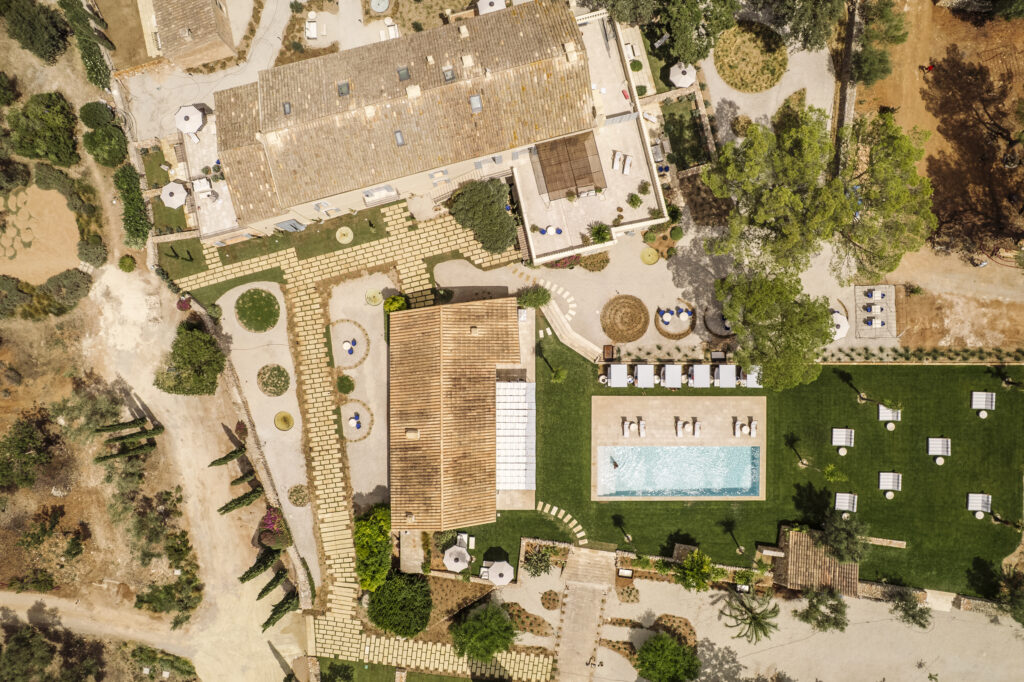

Son Xotano embodies Mallorca through silence and measured proportion. Its roots extend from the 10th to the 13th centuries, when it was known as the Alqueria de Judí, a name derived from the Arabic yuhudi—“Jewish”—hinting at possible Hebrew ownership during Mallorca’s Muslim era. A nearby landmark, the Pou de Judí, remains a quiet trace of this history. Following the conquest of Mallorca by King James I in 1229, the land passed through several families: Gastón de Bearn; Ramona Adrover; and Ferrer Girbau. By 1685, one of these holdings became the Son Xotano estate under Joan Torres, known as “Xotano,” whose name endures. Prominent Mallorcan families—the Flors, Mulets, Torrents, and later the O’Ryans—cultivated cereals, vineyards, and wine on-site. In the late 19th and early 20th centuries, ownership shifted to Granada, Crespí de Sóller, and Gestrudis Rossinyol with Lluís Zaforteza Fontes. In 1982, Pedro Ramonell Colom acquired the property, transforming it in 1993 into an agrotourism and equestrian farm while preserving its pastoral vocation.

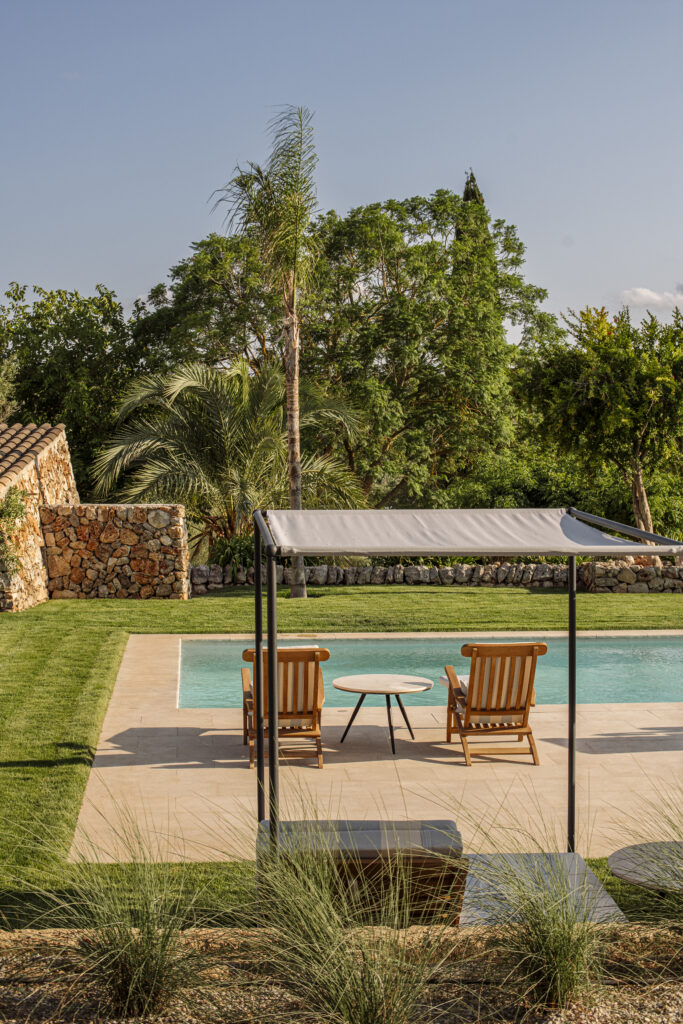
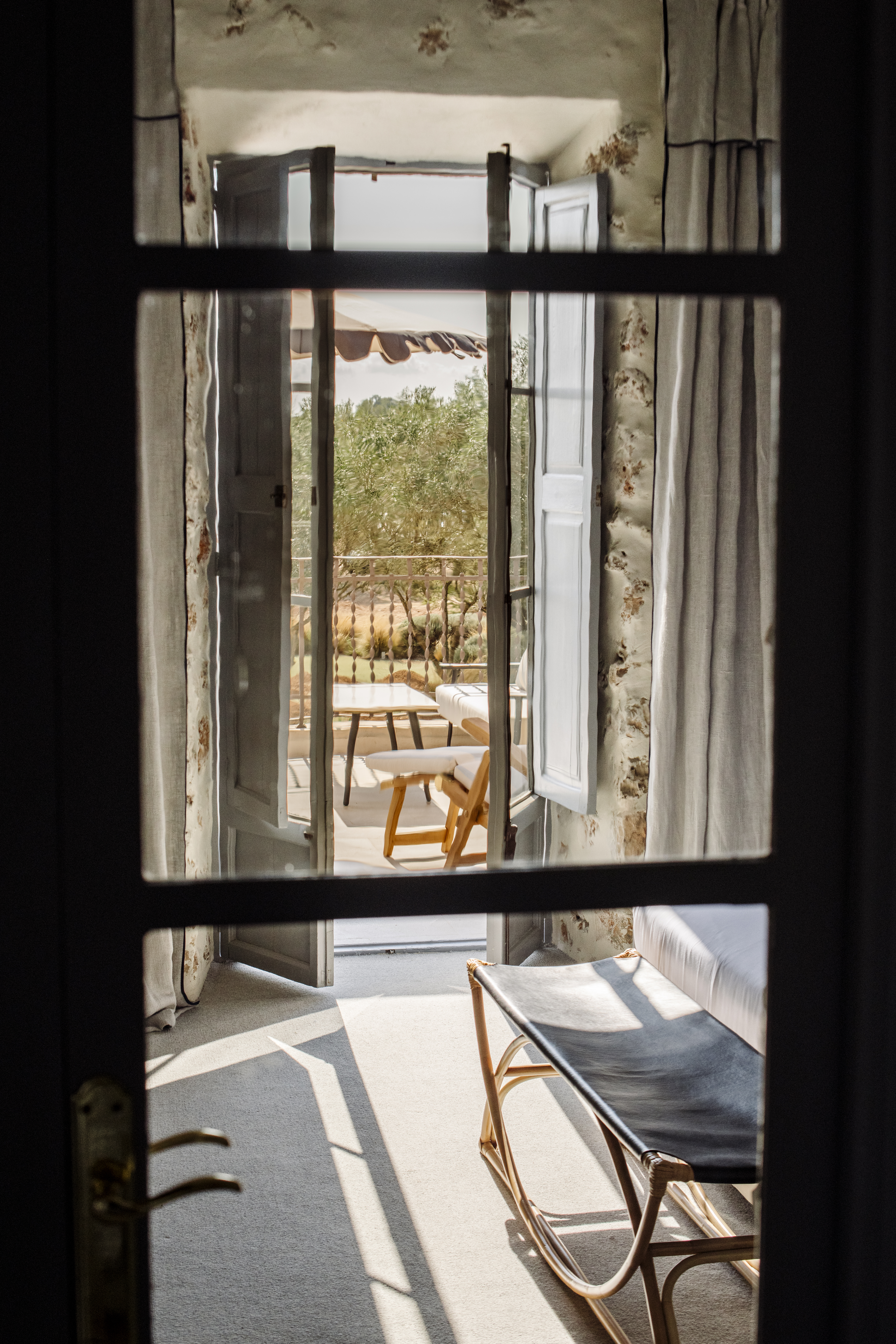
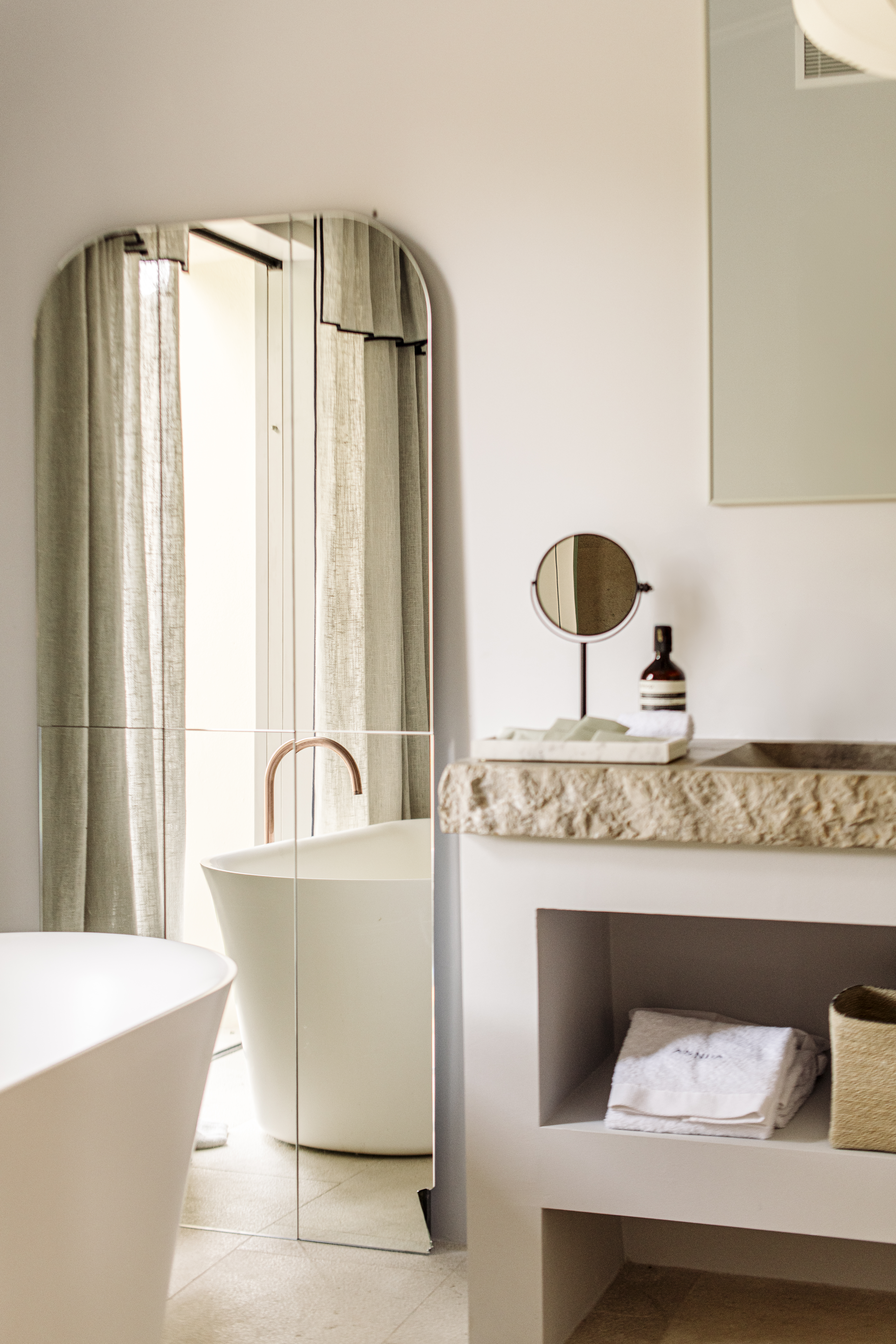
Built with stone quarried from its own lands, its walls are simple, durable, and attuned to the rhythms of rural life. A seventeenth-century sandstone arch frames the entrance, a silent witness to generations. Additions expanded organically, responding to the needs of each era. The current restoration honors the legacy: original structures have been reinforced with traditional techniques, while contemporary comforts, including lighting, bathrooms, acoustics, and climate control, have been woven in with restraint, using noble local materials such as natural lime, solid pine, reclaimed tiles, and stone floors. Handmade counters of Mallorcan mud echo artisanal practices, binding the project to place and tradition.

Walking its halls today, one senses the centuries. The restoration revealed: walls kept their rough hewn texture, timber preserved its irregularities, and rooms remained deliberately minimal. Every intervention sought to articulate the estate’s original character. Renovations began in 2018 with an extension for the kitchen, restaurant, and pool, followed by the main house. Future plans include a discreet, single-story apartment building near the estate, designed to complement. “Intervention is translation,” Pizà observes. “It’s about bringing the house into contemporary legibility without diminishing its depth or spirit.”

“The first impression,” Pizà reflects, “was a profound sense of calm and quiet. The building’s thick walls, emblematic of Majorcan construction, immerse you in centuries, yet also convey the serenity of Mediterranean proportion.” Clapés adds, “It is an important house, but never ostentatious. Even if past residents were affluent, the atmosphere is modest. Preserving that humility guided every decision in the renovation.”

Clapés and Pizà worked with an ethic of care. Dry stone walls were repaired, original beams stabilized, and the marès sandstone arch cut centuries ago from the estate’s quarry—was reinstated as a defining threshold. The approach emphasized reinforcement rather than replacement: materials retain their irregularities, and the building communicates its age through texture, proportion, and light. Architecture here I understood as clarification of what was already present. “Even modern interventions are grounded in local materials and construction systems that have endured here for centuries,” Pizà notes. Clay, stone, and timber, shaped by local carpenters and stonemasons, serve as living archives. “Guests may not immediately notice every detail, he adds, “but each window, roof, and door reflects the singularity of Son Xotano compared to other towns. Preserving that subtle uniqueness is central to the project.”

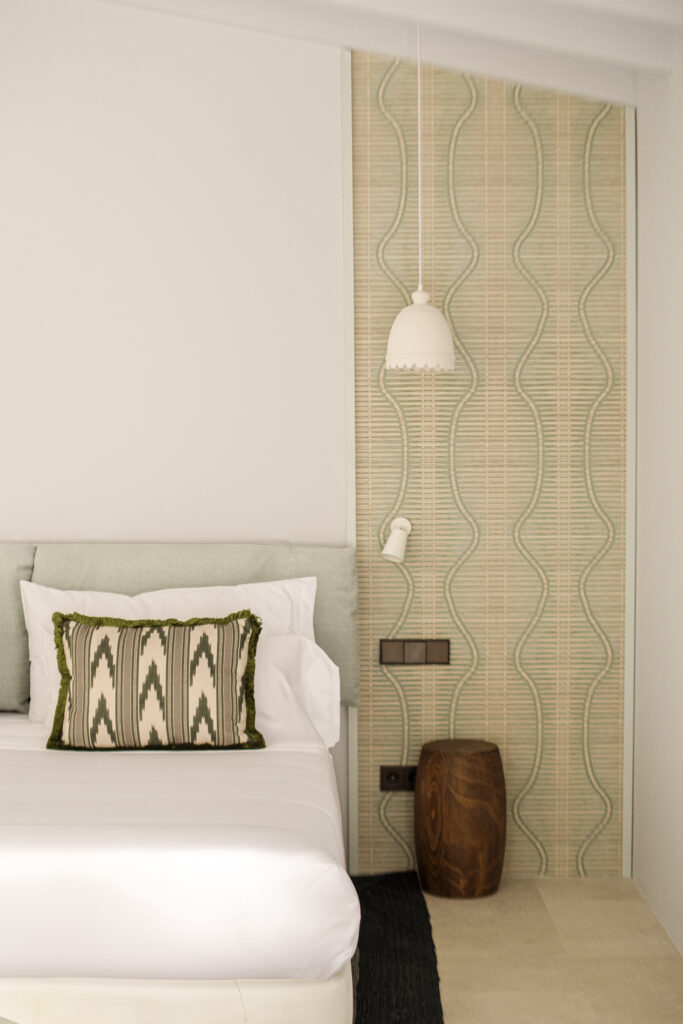
Interiors, directed by Virginia Nieto, extend this principle with measured restraint. Material choice —Mallorcan clay, raw pine, brushed metal, woven linen—are deployed for their tactility as much as for visual coherence. Whites and muted earth tones establish a calm, minimal atmosphere. Custom furniture, developed in her studio and executed by local artisans, maintains continuity between structure and use. The result, anchored in the cultural and material context of Mallorca.

Sustainability shaped the decisions too. Crossventilation and natural insulation reduce energy demand, while historic cisterns and dry-stone systems have been reactivated to manage water and regulate temperature. The gardens, designed by Nieto, follow principles of permaculture and local ecology: olive, almond, and carob trees intermingle with lavender, rosemary, and thyme. Restored terraces and channels reinstate the estate’s agricultural intelligence, ensuring its continuity as an ecological organism rather than a static site.

Generations left traces here. The subtle irregularities reveal rhythms of those who lived here, embedding presence into the fabric of the house. Today, Son Xotano endures as a field of experience. An act of imagination, bridging centuries and the present.
Architecture’s quiet, enduring intelligence.

Find out more on annuahotels.com
Special thanks to Purple PR.

Athens Epidaurus Festival 2025 

Athens is a city that resists metaphor. It does not stand in for history; it is history, unfolding in real time. To arrive here during Subset was not to attend a festival, but to step into an atmosphere dense with texture: conceptual, sonic, civic. What unfolded across the weekend was not simply a program of performances, but a series of durational states: of attunement, permeability, and ecstatic stillness.

Subset operates as a proposition, one that asks the listener to relinquish mastery, to dwell in uncertainty, to encounter sound as condition rather than content. Athens responded in kind. Its terrain, fractured, layered, and perpetually in flux, held the festival with an uncanny fluency. The city’s ambient frequencies folded into the works, becoming a porous substrate through which performance and place co-articulated. Everything felt permeable, just beneath language.

Christina Vantzou opened the weekend at the Athens Conservatoire, and in many ways it was an initiation. The space itself, solemn and precise, seemed to recognize the gravity of the moment. But it was the crowd that moved me most: a quiet density of intellect and curiosity, gathered from all corners of the world. Vantzou’s performance unfolded not in front of us, but around us. Her compositions invited a kind of listening that is almost extinct, one that demands the body.
The work stressed the pure form of existence: listening stripped of spectacle, of signal, of distraction. A reintegration of the ear not as a passive receiver, but as a site of encounter. To listen, here, was to inhabit the moment with one’s full physicality. It was a radical slowing down, a surrender to the temporal grain of sound. A rare moment of reintegration. The ear, often reduced to a passive conduit, was here reclaimed as a site of encounter, a threshold through which time, breath, and matter could converge. Hers was a poetics of embodied listening and letting presence accumulate.
At the Stavros Niarchos Foundation Cultural Center, Renzo Piano’s architectural meditation on openness and light, MONOM’s spatial sound dome emerged not as a venue, but as a vessel. Walking through the surrounding park, where olive trees serve as temporal anchors and the sea glints at the periphery, one approached the dome less as a structure than as a frequency field.

Sound moved through the spine, the chest, the base of the skull. A full collapse occurred between interior and exterior. MONOM made porous the boundaries we so carefully uphold: between self and world, between rhythm and rest. It was meditative, yes, but also deeply physical. It compelled stillness and invited motion, as if the body had momentarily forgotten where it ended and the sound began.

Suzanne Ciani’s Improvisation on Four Sequences opened with analog synthesis rendered in fluid geometries, sketching a speculative grammar of resonance. Evita Manji’s Echo(location) chamber is a refracted emotional architecture, as if longing had been spatialized and given breath. Cinna Peyghamy summoned tactility from pressure and pulse, folding ritual into modulation with almost surgical clarity. Andrea Belfi’s Above My Door, There Is Knocking activated what lay dormant just beyond the threshold. A sonic ecology that expanded the architecture of listening just slightly beyond the edge of the body. 

Where Vantzou dissolved the self and MONOM absorbed it, Ryoji Ikeda reconfigured it. His performance dealt in extremes: of data, of frequency, of form. His precision was almost surgical, excising time into units and spatializing mathematics into physical sensation.

There is a rigor to his practice that resists spectacle and yet produces awe. Frequencies carved through the space like scalpel lines. Data was not visualized; it was enacted, rendered as intensity. The room did not move. It held. The audience, silent and still, was algorithmically synchronized. There is something devotional in Ikeda’s refusal to soften, a kind of purity that exceeds expression. Pure intelligence.

Cafés became informal extensions of the program, where conversations unraveled like marginalia: speculative, embodied, unresolved. A city shaped by interruption and multiplicity, it offered not stability but resonance. In the rhythm of its streets, in the slow generosity of its pauses, Athens enacted what Subset proposed. To listen is not to extract meaning, but to remain in proximity to it.

Subset does not curate spectacle. It curates conditions. Its intelligence is not in its scale, but in its sensitivity, a careful orchestration of slowness, density, and attention. It does not speak over. It listens. And in Athens, a city fluent in dissonance and return, that listening became something more than practice. It became epistemological. It became political. Not resistance in the usual sense, but resonance as mode — as method, as ethics, as form. 

Daniel Arnold and Donna Ferrato

Dealing with the World as a Collectible Surface

Chance and love—two words that perfectly capture the encounter between photographers Donna Ferrato and Daniel Arnold. In the warmth of Donna’s NYC apartment, the two friends-photographers sit down for a candid conversation. Through the literal lens that unites them—a camera one—they reflect on their lives, the serendipity of their meeting on a summer morning walk, weaving through the intersections of love and lust, the compulsion to document, and the nature of seeing—and being seen.

Donna Ferrato Do you remember how we met? I saw the wildest couple walking down the street—the man seemed completely entranced by the woman, who had this almost ethereal glow, like a firefly in daylight, surrounded by a rainbow aura. I sat with my dear friend, Alex Paterson Jones, a brilliant designer. We were a little high, a little giddy, basking in the warm air. We spotted the man’s camera and I called out to them, Hey, photographer! Hey! I wanted to pull them in, drawn by the feeling that something was stirring, something electric. We needed them inside with us. So what did we say?

Daniel Arnold I looked up, slightly confused, and you told me to get up there! Kay and I had just been at the diner around the corner, and I was walking her to her studio a few blocks away in this totally ridiculous way, like a big cartoon strut, twisting together as I held her at the waist. 

DF I can spot someone strange miles away. And, as expected..

DA We were deep in our own rhythm when we suddenly heard a woman call down to us—”Hey photographer!” We looked up, and she said, Get up here. We were feeling impulsive with nowhere particular to be, we just looked at each other and went, Okay, okay. And so, we headed upstairs.

DF You get into the building, you know it’s a little odd, you’re going up the stairs, it’s kind of dark, there’s the woman from the fire escape calling you in the hallway. Keep coming, Come on, come on in there, one more flight. And then they get into the house, the two of them. It’s like we started dancing around each other trying to figure out where we were. 

DA The “what is this, who is that dance.”

DF You had a Leica, right? So I knew he was a photographer. I wanted you to know straight away that as soon as you stepped foot into my house, you could take pictures of anything you wanted, because I would have been taking your picture whenever I wanted. I guess that gave us a direction to follow in starting to understand each other, and that’s how it all sort of started, but still, you were very shy about it in the beginning.

DA I wouldn’t say shy, necessarily. Just.. It was all super impulsive—we walked in totally blind. I was just feeling it out, taking the temperature of the room. Not in a hesitant way, I was definitely up for it, but more like, Okay… what’s going on here? Where am I? Who is this person? Can I trust her?

At some point, I noticed more than one copy of a Donna Ferrato book lying around, and it clicked. Oh… wait. This is Donna Ferrato’s place. I knew your work—I was familiar with it—but I had no idea what you actually looked like. I mean, I live in New York, but that doesn’t mean I know everything. I just knew you were a big deal.

DF You didn’t know how friendly I was? 

DA I just had to walk up the fire escape to find out! It’s not that I found you unfriendly, I just didn’t know anything about you, the human. And now we’re old friends.

DF We had a ton of pastries, plenty of good stuff to eat, and we just settled in. Then he told me his name, and weirdly enough, I remembered an assistant I had a couple of years back mentioning him—said they were friends. That caught my attention. At the time, I didn’t really know Daniel Arnold’s work. I had looked him up once and thought, hmm… interesting, but it was totally outside what I was following back then. Over the years, though, I kept seeing more of his stuff, and we ended up following each other on Instagram, sort of orbiting each other from a distance. But in that moment, when he said his name—when I realized who he was—it suddenly hit me. Oh. This is something special.

DA Perfect coincidence. 

DF And your girlfriend, Kay, she is so whimsical. She doesn’t even realize she has so much strength, she’s like shards of glass, yet there’s something so powerful in her being. She has experienced so much in life: She’s young, but she’s also ancient, and suddenly she was there, showing me who she was. I was on my knees, I tell you. I was so humbled by her.

DA Oh, she knows. And yeah, you were clearly kind of intoxicated by the whole thing. It was great—just the energy of it, the time we spent together. I actually have pictures of you taking pictures of her. And the pictures of us—I don’t know if I ever showed you—but we had them up in the apartment for a while. I had to take them down because of some work we did, but for a time, they were hanging like a mobile from the light fixture. There was just something about them—the way you put it all together, the text on the back, the tape—it turned into this beautiful object. So we let it spin.

DF You gotta show that to me. This is what I like about you, Daniel—you’ve got this very cozy, straightforward vibe. Just a simple man, you know? No pretentious talk about photography, no blah, blah, blah—just the real thing. And I like your life, at least from what I’ve seen. Never been to your place, though. Maybe one day, who knows?

DA We met this spring, it was April, right?

DF Yes. Makes you think of how chance works. Speaking of working, I think we never speak about work, per se.

DA It’s interesting—leading up to this conversation for what, two months? I’ve been quietly, maybe a little neurotically, thinking about it—thinking about my work in relation to yours. I knew the magazine was interested in your Love & Lust series, and over the past month or two, we’ve talked a bit about intimacy—how it plays into both your work and mine. It’s been an interesting new angle, one I wouldn’t have necessarily applied to my own work if not for overthinking this conversation. It made me reflect on how love and lust show up in what I do—not just in the experience of intimacy but in the pursuit of it. And honestly, you could probably take that lens—Love, Lust, Intimacy—and use it to break down any two people, because really, what deeper common ground is there?

DF Than love? Let me tell you something: The majority of people don’t really carry the lust with whoever they love. It’s very rare.

DA Yeah, I had a long thought about this today on my way here. In my model of the world, which I am learning isn’t exactly like yours, lust is really just seeking love—whether it’s intentional or not. Lust is an avenue to love. And I think that, in a healthy, long-term way, love has to go looking for lust too. It’s like this snake consuming itself—lust leads to love, and then love needs to seek lust again. Because, you know, lust is of the body, and love, I think, ends up being more of the mind. It’s a choice, a sacrifice, an agreement. And I think part of maintaining that agreement, part of keeping it going, is that you have to go in pursuit of lust. That makes me think not only of my relationship but also of my work. It connects in a way I hadn’t fully considered before.

DF Without lust, there’s no human sexuality. 

DA But I also think that lust is not just about sexuality.

DF To me, lust equates sexual life force. That’s why women’s empowerment and liberation is extremely important. Our lust and pleasure drives are ours to balance. There was a time when men could control women’s drive. No more... Women’s desires can’t be confined and of service to men anymore. 

DA Wouldn’t you say that lust can also be expressed elsewhere? When I think about it in terms of work, I kind of see myself in it. Remember when we were talking about your dad and how he wanted—he wanted to take pictures so badly. At the end of the day, he’d stick his camera in the windows of strangers’ houses just to keep taking pictures. I totally get that, that first intense lust for taking pictures. It’s like, you need more, to have more, to capture more. And then, at some point, you move past that. Even though there’s still a muscle memory of it, you go from that intense lust—where you can’t go to bed because you need more pictures—to a place of long-term commitment, where you’ve got to search for that lust again, something that keeps you wanting to work, to keep putting your camera through the window. It’s interesting to think about how that evolution works. And funny, thinking about how the two—lust and love, work and life—fit together. 

DF We dovetail together very well. And that all, I think, comes from our fathers. Both of our fathers were brilliant men who both suffered a lot. And we, the children, have suffered too. 

DA Well, I’ve got to say, having been exposed to that in my life—in a sort of defanged, up-close, practical way—I also grew up in a world where experiencing the very high and the very low together just feels so natural to me.I think it’s kind of a more honest, more permissive relationship with the world. Yeah, of course I’m depressed sometimes; Of course, I’m having a month where I can barely drag myself out of bed. It’s part of it. And the highs can be just as extreme. You can go too far in either direction.

DF There’s a lot of conversation these days about how, especially the newer generation, seems to have less of a sex drive and a more complicated relationship with pleasure in all its forms. It’s not just about sex and desire, but also about how people relate to their extremes, whether that’s lust or pleasure. The suffering, you know, the human suffering, the cruelty, the barbarism, and the lack of empathy—it’s all killing our sex drive. Where’s the love? We don’t see it in front of us anywhere. It also ties into the relationship with one’s work and the enjoyment of it. 

DA What does making work look like for you, nowadays, Donna? What do you shoot?

DF I channel, or rather shoot, my rage through other women’s bodies, women I meet and photograph. Even with Kay’s body that day, when she just took her skirt down in the middle of the house—it’s a place where women come to express what they’re going through, their fears, their rage, and they feel comfortable doing so. It’s been like that for 30 years. But when she did that, capturing that moment—that’s what my work is all about. Being with her in that moment and witnessing it. It was incredible.

DA Was she showing you the tattoo on her back? 

DF Yes. It was the tattoo. Then she showed me what the hospitals had done during her surgeries. That was really powerful. But this is what I do all the time. I’m also working on stories about domestic violence.   I mean, if I put the word out there, inviting women who’ve been through hell to come and stay with me, they come. 

DA How does that part happen? 

DF It’s a very private and delicate process. Sometimes they come stay with me for a week or two. I want women to come here and live with me. I feel a deep kinship and trust with these women, like we’re all part of the same story. If they bring their child, that’s fine. If they bring a kitten, that’s fine. It all just flows from one thing to another. I always tell them, “From now on, you photograph me too, because I’m going through hell, and I want the world to see it—just like I’ll be photographing you.” I know I can be intense. Did I scare you a little when we met the first time?

DA No, I wasn’t scared. Maybe cautious, but that’s just how I am, despite running up the stairs. I’m observant. But not scared.

DF Good, good. So you feel safe with me. You know, we’re alike—that’s what we realized today. That’s why we were also so late for the interview. Sorry guys. 

DA We caught a spark of friendship from the jump, but we never managed to take the time to sit and swap lore. So we had to take a little extra time rolling out the good stories.

DF Family, craziness, and being honest about it is what brought us closer.

DA Gotta be honest! My idyllic Midwestern beginnings worked like a force field, something I carried with me that eventually had to be broken. I’ve never wanted blinders, but it takes a while to figure out which parts of your life are fantasy. I’ve always pursued reality, always been curious about chaos. And strangely, I think that raw, unfiltered living–though it might feel crazy–it ends up giving you a more grounded existence.

DF Does that have something to do with finding love in your life?

DA Yeah, definitely. That young, idealistic love-seeker in me had to be dismantled—not by me, though. I can’t take credit for that. I just threw myself hard against a lot of brick walls and learned the hard way that Disney life wasn’t available to me. At first, I had that naïve phase where I wanted to turn everyone into the love of my life, for the rest of my life—which, let’s be real, is a tough dream to bring to New York. Then, for seven, eight, maybe nine years, I swung completely in the other direction. I told myself, “No one can have me.” I poured everything into work, compulsively, obsessively. And it delivered. At some point, I realized I was experiencing the feeling of being in love—but alone. Not in love with myself, just in love. Chemically. I was consumed by work, by what I was putting in and getting back. It felt just like love.

DF Amazing. You know, in that way, we’re total opposites. When I came to New York, everything felt possible. I could find love easily and work like a beast at the same time—doing my own projects while hustling like a little street rat, picking up assignments with local downtown newspapers. It was all within reach. I was constantly throwing myself into relationships, wild love affairs, sneaking into the craziest clubs—Paddles, Chateau 19—dressing up, playing with men, making everything part of the experience. That’s how Love&Lust came together, all tangled together in the thrill of it. Photographing swingers, going to orgies, meeting Elizabeth and Bengt. 

DA You’re the cautionary tale! I’m kidding, but there’s such a low hanging metaphor-microcosm here, with you swinging off the fire escape inviting me, a stranger, into your home, and me coming up and being cautious, and you wondering if maybe I’m afraid!

DF Here you were, with your girlfriend, and me begging you to take pictures.

DA Think about the way we work. It’s very telling. I have a much more cautious, guarded relationship with the world. You dive in deep, right up to someone’s belly button while they’re in the middle of having sex. Meanwhile, I’m slipping by unnoticed, catching a shot on the street without anyone even realizing I’m there. I’m gone before they can say hello. And I think both approaches have their own truth. They seem, to me, opposite expressions of the same itch—just different personalities finding their own way of coping, dealing with the world as a collectible surface. What I do on the street—while it’s what I’m publicly known for—has also been my education. I had this insatiable desire to document, to collect. Coming to this city with my little Milwaukee mentality, I felt like I needed to take everything home with me. That desire propelled me through an education I didn’t even realize was happening. At first, I didn’t know how to use the camera—I just pointed it at things I wanted. But as dissatisfaction with that grew, I learned. The camera became an extension of my body; I know it inside and out now. And along with that technical evolution, there’s always been the internal work—the work around my family, my home, my relationships. Even though that’s more private, I approach it with the same intensity. Just as you shot your domestic violence work, I document my own home in that same deep, personal way.

DF You see, that’s beautiful—truly beautiful. 

DA It’s been a way to make sense of the early hiccups in a relationship, when you don’t fully know where the other person stands. My absent-minded, work-obsessed way of being could have easily felt like neglect, like not caring enough. But I had to point it out—look at how I live my life, look at the time, energy, and attention I pour into this. The three cameras on my desk next to the bed, the way I treat our existence as something worth keeping, collecting, studying. It’s not detachment—it’s devotion, just in my own language.

DF To be able to share a life with someone who understands and connects with this, it’s a beautiful thing. 

DA When I think about it in relation to your work—the sex, the domestic violence, the big headline stories like Donna Ferrato—it’s obviously a different subject matter. I’m not documenting violence or abuse, but still, thinking about it alongside what you do gives me a new perspective on my own work. I’ve cultivated this relationship with my home where I can be completely in it, fully present and lovingly invested, yet still maintain an outsider’s perspective—feels meaningful. It allows me to step back and say, this matters, we need to keep this. I had such a juicy thought about this. When we were talking before the interview—yeah, the story of your dad. She told me about her father, this compulsive, insatiable photographer, always reaching for the camera, always capturing. Sticking the lens through a window at night, photographing everything, every moment.

DF You know, sharing these things with people—especially family—creates a bond like no other. I have a relationship with my ex-husband, Johnny. He’s been through everything with my parents, my brothers, and me. The street is just the surface. Home is where everything truly unfolds, where you see the raw, unfiltered truth. That’s where the real shit happens. 

DA I don’t want to over-tell your story, but your dad experienced something profound—sitting in his home as an old man, watching his betrayed wife destroy all the work he had ever made. We call that a tragedy. A triumph for your mother, a tragedy for your father. But in that moment, I also thought—maybe it’s perfect. Because it clarifies the real core value of it all. You take away the work, and at first, it feels like erasure, like his life has been undone. But because he made that work. Because he cultivated that part of his mind and arranged his life around it. He lived in a way that can’t be erased. Those pictures existed because he saw, thought, and engaged with the world in a certain way. And that—his relationship with the world—means so much more than any legacy ever could, more than any proof ever could. It was his life. It was the world. Having all your work disappear, it’d be heartbreaking—but only for a moment. The life that created it, the experiences and state of mind behind it, can never be taken away.

DF Think of the Palisades—through the fires, through the loss. Everything is dust to dust. We’re not in control. Photographers, filmmakers, musicians—losing everything they’ve ever created. But they still have themselves.

DA It might be an insensitive time to think this, but there is a version of losing everything that might actually be a gift.

DF It’s about resistance. So many are just waiting to see what happens—but if you’ve been paying attention, you already know. We’re breathless, always bracing for the worst. Without collective action, we’ll all end up like Metropolis—faceless drones, marching back and forth, stripped of individuality. In fact, we may already be there. Resistance is all we have left. And somehow, we have to build it together.

DA Well yeah, you said something a little while ago—what can you do to be good? You be of service. You bother to see who’s around you and you do what you can to help. When we’re at risk of becoming drones, that’s a powerful guiding light, even without revolutionary upheaval. That’s one of the great things about New York, especially for photographers. You can’t help but tune into the idea that being of service is everything—it’s the way out of any darkness. Maybe that’s naive, maybe it’s not enough for what’s coming. But it feels like the right place to start, community. It connects you to your humanity in a sort of smelling salts way. Wakes you up.

DF Build relationships. In the subways, they say, Don’t be someone else’s subway story. But the truth is, I am the story. I’ve been creating and telling these stories for a long time—through my own lens, my own voice. My father used to say, If it wasn’t for you, Donna, men would still be getting away with beating their wives. You showed the world how ugly it is. You made men feel guilty—at least for a while. Who knows? Do you think New York still has its own creative language?

DA New York is a place where, no matter when you show up, you always feel like you just missed it. There’s so much I missed, that I’ve come to fetishize. But the creative language of the city—it transcends generations. I think New York does something to people. Whether it’s meaningful—-or getting better or worse, I’m not sure—but it taps into something deep.There’s an undeniable thread through hundreds of years—people who come here and fall into the same obsessive relationship with the city, trying to articulate their own special connection. When I found out Leaves of Grass was about walking around Manhattan, looking at the people, I went nuts. It’s so far back, it’s not even photography. It just feels like such profound time travel to find it all alive in myself. New York still has that essence. Being in this place, in the mess of people making their mythology—it’s like a constant. It hits people in a way that’s traceable through time, and it doesn’t change that much. You really feel impermanence pressed on your throat here. Every store, every restaurant is built on the ghost of 500 others, and you look away for a month and there’s an entirely new city. Everything is so fleeting. It makes you want to catch every face, every train, to hold onto the moment. It intensifies the instinct to value the passing moment because everything moves so fast, and you’re confronted constantly with your impermanence and your insignificance. My story is as good as anybody else’s, because I can see we’re all going to end up erased. So whatever, might as well enjoy the ride.

DF I think that’s what it is about New York—it’s always had this sense embedded in it, even before this feeling became so widespread.

DA Yeah. It’s a very New York thing that has infected the world. We shouldn’t be surprised –we’ve been trying to infect them forever.

In order of appearance

  1. Donna Ferrato, Daniel Arnold & Kay Kasparhauser, 2024 
  2. Donna Ferrato, Swingers So, CA 1999
  3. Donna Ferrato, Studio 54, 1980 
  4. Donna Ferrato, Studio 54 Poppers, 1980 
  5. Daniel Arnold
  6. Daniel Arnold
  7. Donna Ferrato, Kay Kasparhauser, 2024
  8. Donna Ferrato, Kay Kasparhauser 2024
  9. Donna Ferrato, Dad Open Heart Surgery. 2008 

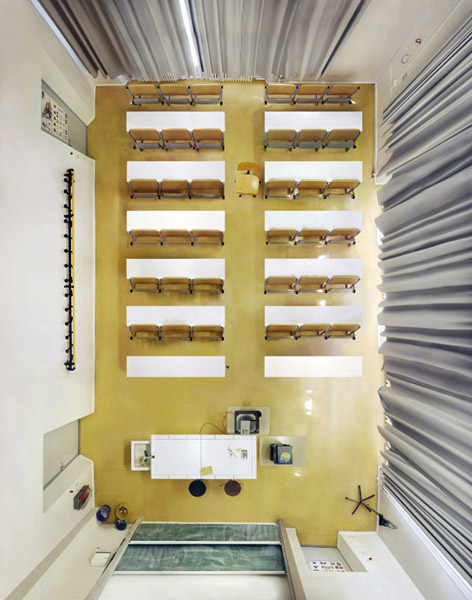
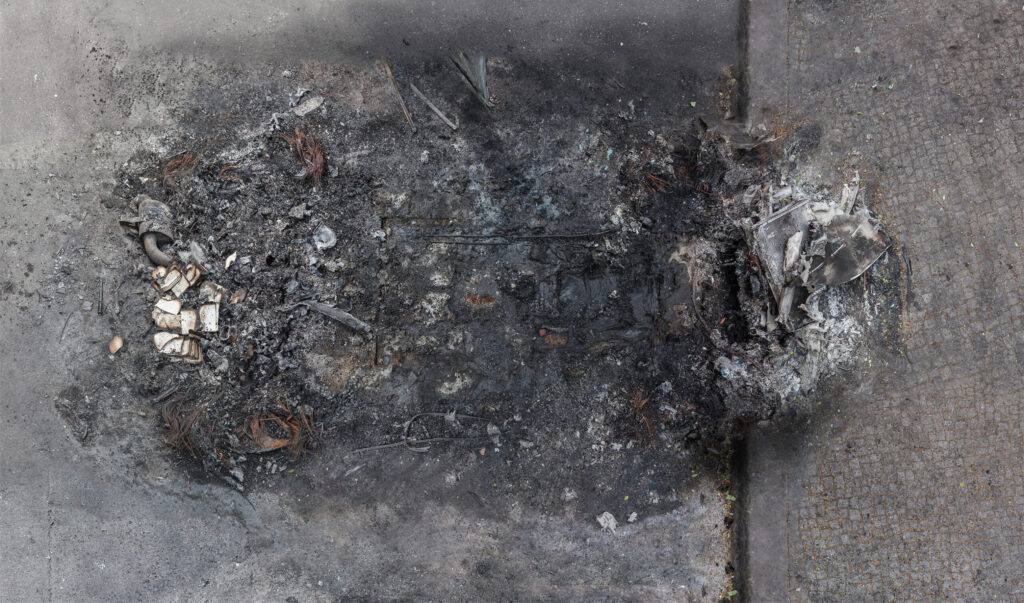
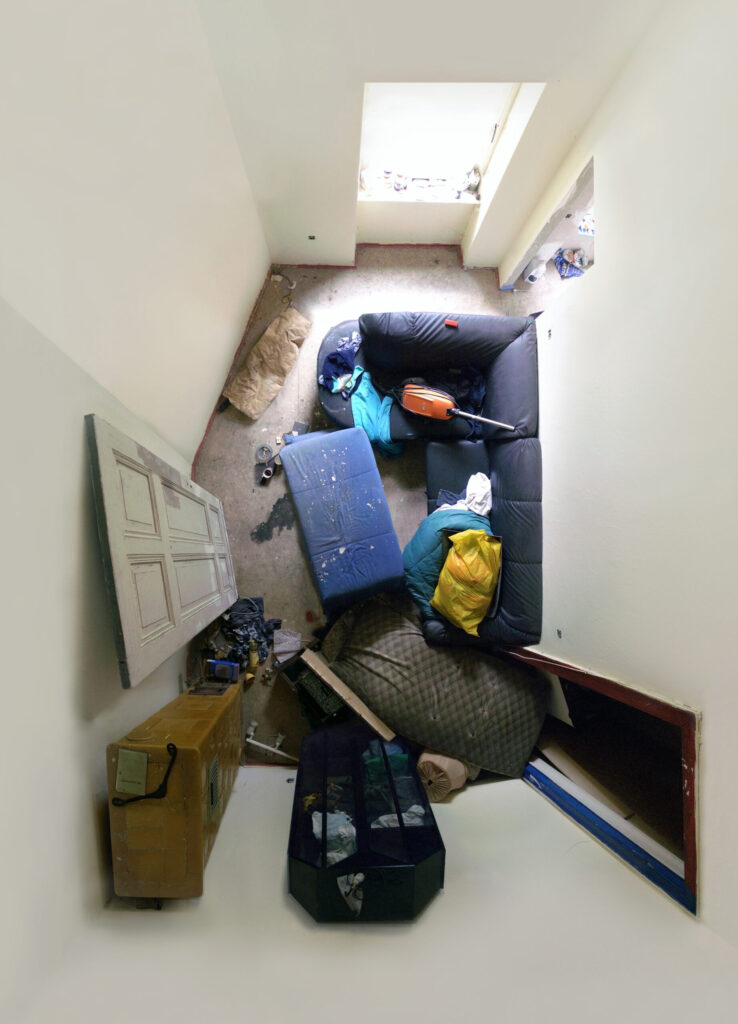
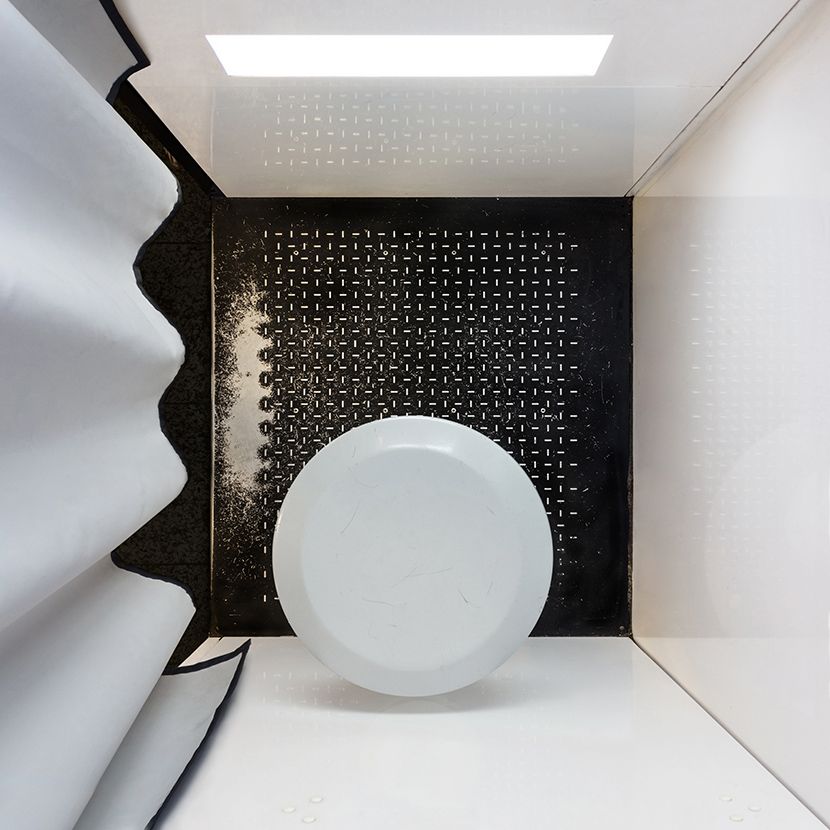
Menno Aden

In order of appearance

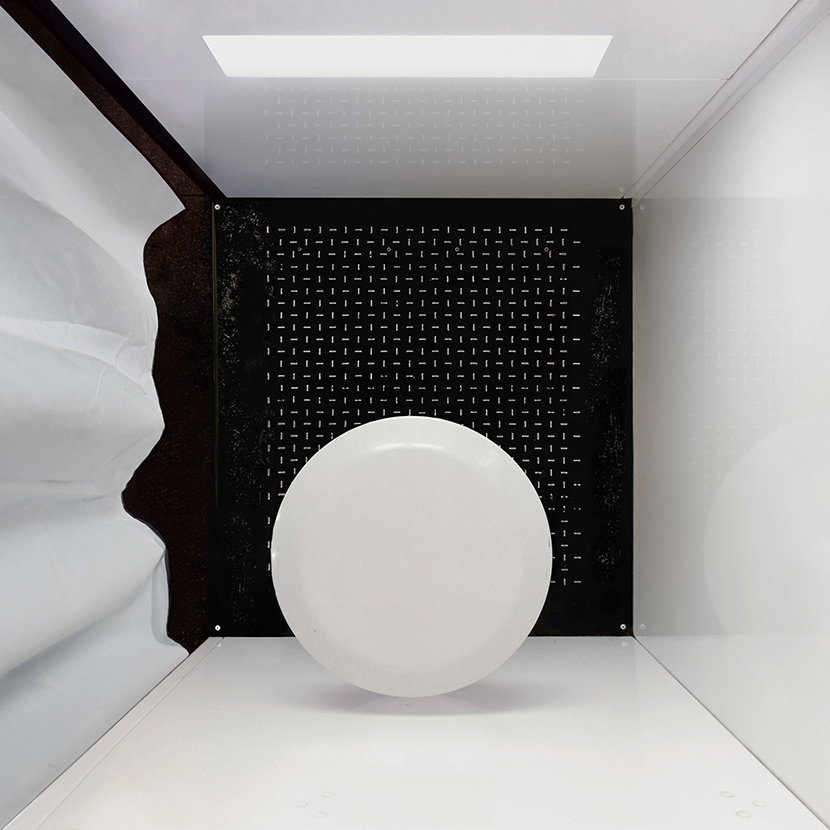
  1. Menno Aden, Untitled (Classroom), 2010
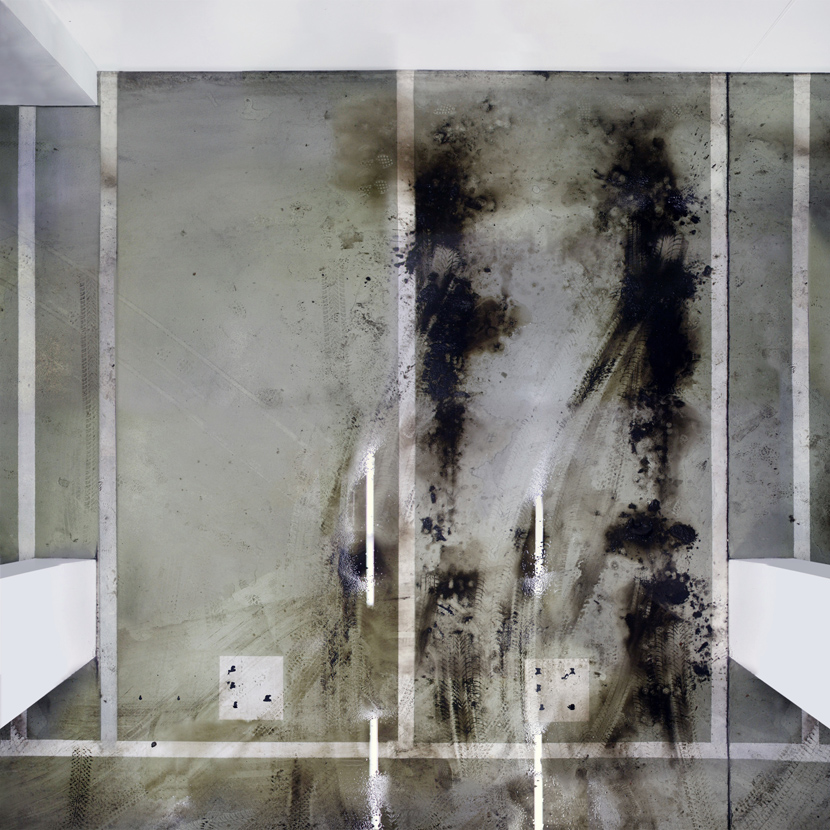
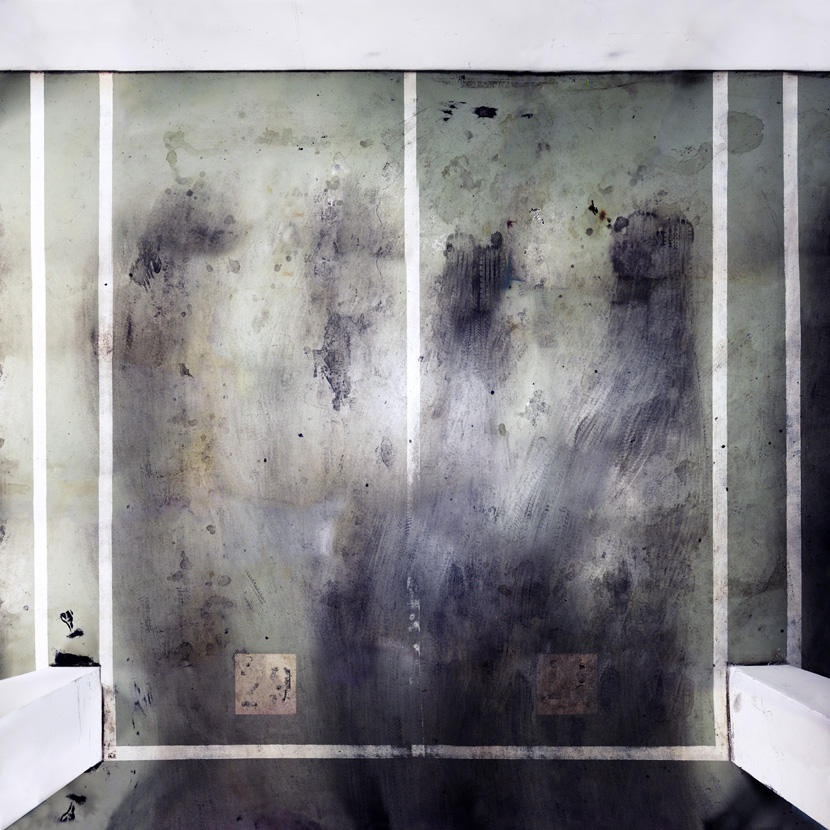
  2. Menno Aden, Untitled (Car), 2008
  3. Menno Aden, Untitled (Car III), 2018
  4. Menno Aden, Untitled, 2008
  5. Menno Aden, Untitled, 2010
  6. Menno Aden, Untitled (Box I), 2011
  7. Menno Aden, Untitled (Box VI), 2011
  8. Menno Aden, Untitled (Basement III), 2011
  9. Menno Aden, Untitled (Basement V), 2011
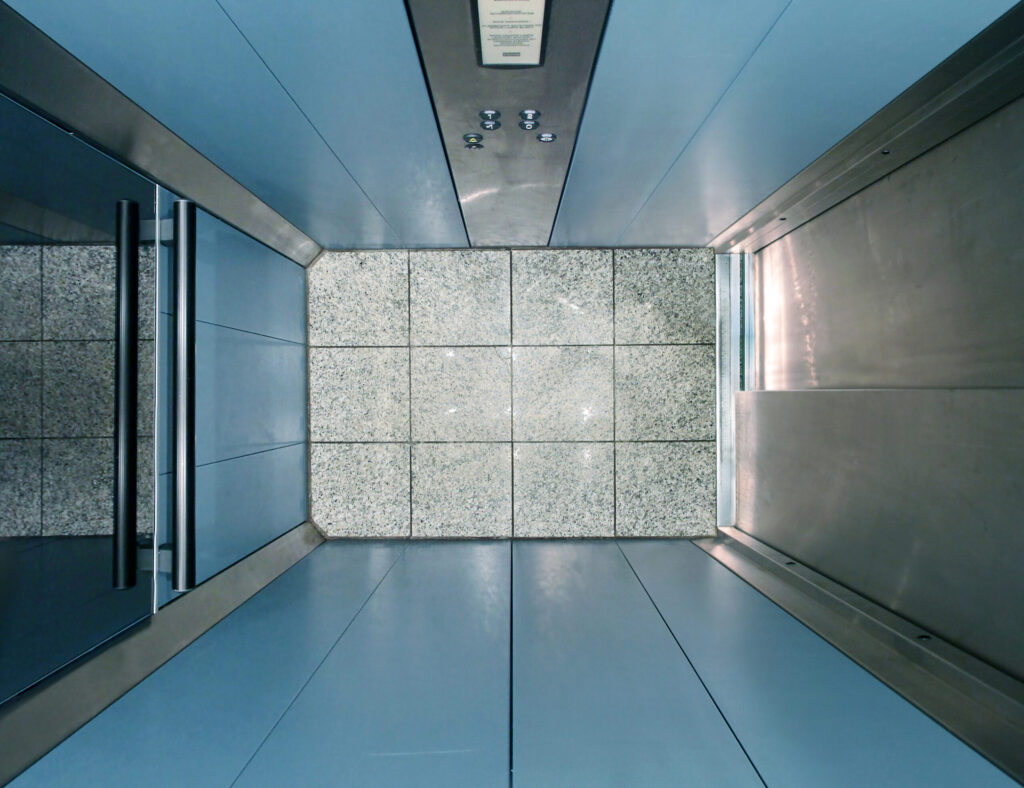
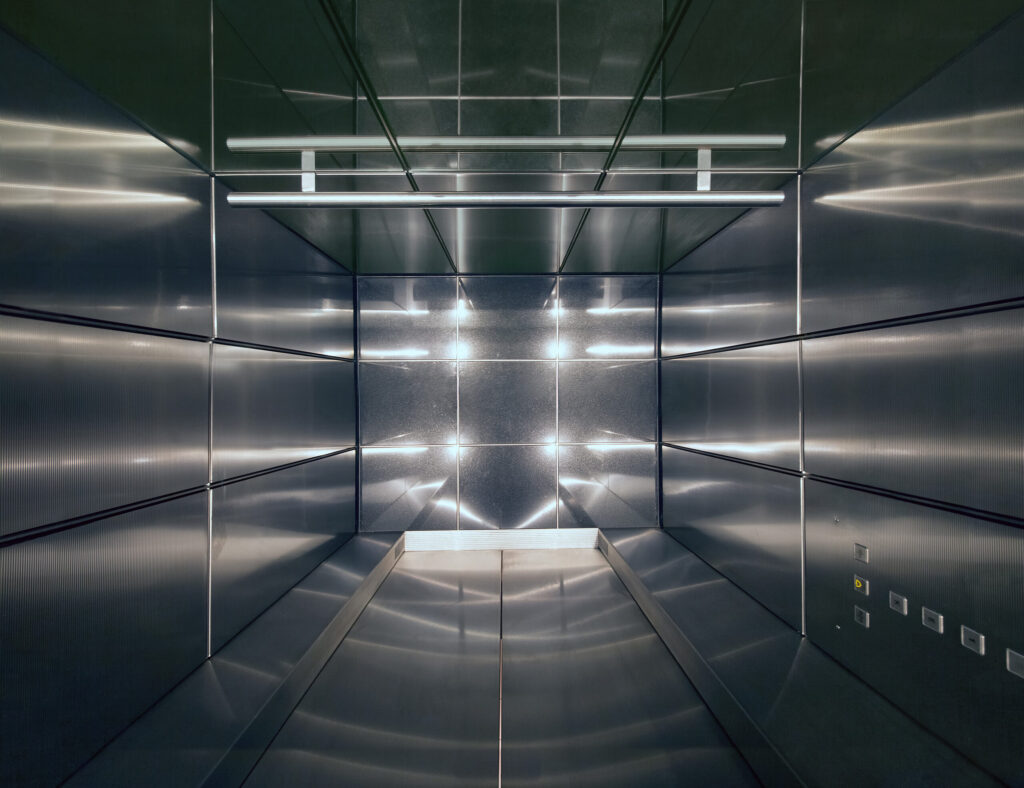
  10. Menno Aden, Untitled (Lift-III), 2011
  11. Menno Aden, Untitled (Lift V), 2017

Credits

All artworks courtesy of Menno Aden

Menno Aden (b. 1972) studied Art and Composition at Bremen University and University of the Arts Bremen in 2000. Aden lives and works in Berlin. 

Exhibitions include Museu Serralves, Deutsches Architektur Museum, Landesmuseum Emden, Kunsthaus Potsdam, The Wandsworth Museum, London, CMU Museum, Chiang Mai, Thailand, Dezer Schauhalle, Miami, Ratchadamnoen Contemporary Art Center, Bangkok, Institut Francais, Yangon, Myanmar, among others. 

Aden was awarded the German Prize for Science Photography, The International Photography Awards, The Accademia Apulia UK Photography Award, The European Award of Architectural Photography, among others. 

His work has been featured in The Guardian, Le Monde Diplomatique, Philosophie Magazine France, Der Tagesspiegel, Washington Post, Financial Times Internazionale, Dezeen, Nowness, Ignant, Deutsche Welle TV, among others. 

His work has been published in several books e.g. Berlin Raum Radar – New Architekture Photography (Hatje Cantz, 2016), European Month of Photography (Catalogue, 2016), Khao Ta Looh (KMITL Fine Art, Bangkok 2018), among others. 

Aden is represented in private collections in USA, Europe, and Asia, including Novartis Collection Basel, KPMG Collection London, Sanovis Collection Munich, Lisser Art Museum, among other national and international private collections. 


Angel D’lite

Cloud 69

NR presents Track Etymology, the textual corollary to nr.world’s exploration of contemporary soundscapes: A series of short interviews delving in the processes and backstories behind the releases premiered on nr.world’s dedicated platform.

Hello to both! Hope you had a great start of the week and thank you for doing this! The EP is sick! My first question is a pretty straightforward one, the textual equivalent of a warm-up: What brought you together on this collaborative journey?

Angel: My memory is actually a little hazy, as we started this project over a year ago, but Oli [Goddezz] had asked me if I wanted to work on something for Goddezz, and I had this idea to do a split EP with Lucy, a really good friend and an incredible producer. When our friendship was blossoming we were both in the early stages of production, always sending each other WIPS, encouraging and inspiring each other, so it’s super cute to have worked on this project together.. a full 360 moment. It’s been amazing to see and hear Lucy’s musical journey and how she’s grown as an artist and a composer, watch this space! 

LUXE: I feel as though Sadie and I have been talking about writing / working on some music together for a long while… We’ve always been close on eachothers production journeys – it feels really nostalgic and emotional to think back to our flurries of texts hyping eachother in our early days of production. Sadie was the first person to hear some of the first tracks I ever made and her infectious energy and encouragement helped me find confidence in what I was doing – I feel so grateful. Seeing her trajectory makes me so unbelievably proud and i’m so excited to see how life continues to unfold.

What were the elements of your respective sounds that you felt clicked together best and complemented each other? Additionally, what differences in your approaches did you feel add interesting twists to the tracks’ layout?

A: I LOVED working on the remix for Lucy, I loved hearing the wubby, textural sounds she used to make ‘Dance Enchantress’ . It’s really both of our worlds merging, with both the remixes and I think you can hear both of us in both remixes too! We are very different as producers and DJs, but I’d say we have a crossover of very UK bass kinda sounds within our productions and I think you can hear that in both the tracks and our remixes. 

L: I had so much fun working with Sadie’s stems, her gorgeous take on old skool nostalgia / euphoria was so refreshing to work with. I adore how both remixes turned out, I’m literally obsessed with sadie’s remix of my track!!! I love how we’ve created this common ground in our sound and production styles. 

If I were to put a label on the EP, I’d say it’s a UKG record, at least in its sonic backbone. UKG is a genre which elements are filtered into much of Y2K pop music, a current, if we can call it that, which has seen a big resurgence recently, almost to the point of saturation, as every trend deserving of that title should. Your EP strips the UKG resurgence back to the nostalgia and the pop-adjacency and brings it back to its roots: the club, dubstep influences, grimey sounds, a ravey funk. What were some of the influences behind this record?

L: Enchanted captures a really wide range of influences across the tracks, which are reflective of the ways in which mine and Sadie’s sounds crossover in our productions and sets. I honestly wanted to indulge in making something that doesn’t take itself too seriously and is a nice melding of some of my main influences, trancey and bassy with a hint of garage swing. Dance Enchantress felt like a fitting name with the alluring little vocal chop.

A: I was actually really inspired by a tune from Lobec – 5am Nostalgia, a beautiful, euphoric end of the night dancefloor tear jerker. Cloud 69 is a Poundland knock off, but it does the job I suppose! 

The remixes move the record away from familiar territory, slightly more at a distance from UK sounds, while remaining coherent with the vibe of the EP. How did you select them?

A: It was actually Oli’s [Goddezz] idea to get some remixes (I think, as I say it has been a long time in the works!) Each remix is very special in their own ways. I admire all the artists so much and I’m so grateful to have them all together on this.

I’ve been a big fan of Baraka (as people and artists) for a while now and that was really exciting for me to get them on this project, as it’s also their 1st remix! They have such a unique sound that spans sexy naughties-esque downtempo, 90s gabber, modern trance and techno, but always ravey and sexy, there’s a mindblowing Baraka track for every time of the day or night. I had no idea what they would make for us, but I really couldn’t be happier with what they’ve done! 

Both FAFF and Local group are good friends of mine, I knew FAFF would bring their silly, camp, sexy energy to this release, and it’s totally exceeded any expectations, actually becoming my favourite FAFF production, it’s all of the above, fun and funky fresh. I knew whatever Local Group would make would be a dancefloor destroyer, everything they put out is an instant bassbin hit. It means a lot to me to have them on this, we have remixed each other before, but this track is really next level. 

L: I think once we’d got the 4 tracks done of 2 originals and 2 remixes between Sadie and I we were speaking with Oli (Goddezz Daddy) and thought we may as well develop things further by curating a selection of remixes. The selection of artists was important – we thought it would be fun to cover all the sounds we love and the genres and spaces that influence us. Local group, and FAFF are close London contemporaries, incredible DJs and Producers,  who Sadie especially has known for years. Baraka we thought would be an amazing addition to the remixes, we didn’t really know what direction it would go in and it turned out to be this incredible trip-hop ethereal 90s concoction!! Mabel I was really keen to get on as I’ve been obsessed with her deep bassy psychedelic trance fueled productions and have loved seeing her trajectory. I love her flip of my original. What’s key here is that the remixes have created a perfect storm of genre mashup influences which feels very central to the whole project – the remixes made the sound world feel complete.


Last question: Are you planning some special B2B dates following the EP
release?

Keep your eyes peeled

Interview · Andrea Bratta
Pre-order the digital album here
Follow LUXE on Instagram and Soundcloud
Follow Angel D’lite on Instagram and Soundcloud
Follow GODDEZZ on Instagram and Soundcloud
Follow NR on Instagram and Soundcloud

Lauren Auder

One Vertebrae At A Time

July is usually a transitional month when one handles the last matters at hand headed for the summer break. For British-French songwriter Lauren Auder, July was a month particularly charged with meaning, as she was about to release her first LP, The Infinite Spine, crowning a 5 years process of exploration and experimentation whereby the London-based songwriter broods her distinctive sound. NR spoke with her during the last days leading to the album’s release for its Personal Investigation Issueto retrace the influences and processes behind the record and her approach to music, art, and creativity. A conversation that, much like her music, uses a given particularity to paint a not necessarily bigger, but surely broader, picture.

Andrea Bratta: First things first, congratulations are in order! Your first LP is on the way! How do you feel? how are you living these last weeks leading up to it?

Lauren Auder: It’s taken such a while. And I still feel really proud of this journey, which is telling, and I’m really happy about that. It’s my first time living with something for so long, and I still feel like I can stand behind it. It’s a great feeling.

Andrea Bratta: With 3 Eps under your belt in a 5 years span and an already very distinctive sound, how did you approach this first LP? Is it a milestone for you, the completion of a process? Is this new record a crystallization of what you’ve been, so far, as a musician?

Lauren Auder: Until recently, I wasn’t ready to commit to a full-length album. And the album format is something I’m really a fan of; that’s how I’ve always listened to music and have always kind of come to comment on music, so it is a big moment for me. And I think I spent the past few years making these EPs and kind of testing things out. When I made the first EP, I never even considered who I wanted to be as a musician. I was kind of figuring it out as I was going along. And progressively, there was experimentation and new directions over these few pieces. And specifically, with the last EP, which was one that was maybe a bit less conceptual, the focus was much more on trying out different palettes. And coming to LA really helped me to decide where exactly I wanted to sit on this record and what I wanted to bring forth from these past records, what really worked for me, and the aspects that I wanted to push further. So it feels like those three records were the building blocks to make the sound of this first LP what it is.

Andrea Bratta: You said the last record was less conceptual and mentioned you’ve been focusing on sound palettes with it. What’s your process? Does it start with images or a certain sound you have in mind? Or an experience? 

Lauren Auder: Well, for the upcoming record, I had the name of it before anything else. It appeared to me as a very striking and evocative image [The Infinite Spine.] Everything in the record revolves around it. It feels ironic to say, but I’m not necessarily a primarily musical person. I’m obsessed with music, and I listen to it all the time. But it’s not necessarily a chord, a sound, or a song that will be the inciting factor in my creative process. It’s always more of a 360 degrees multimedia thing, and it’s mostly down to words; that’s really where I get to define my path forward —as I said, I just had this image in my mind that felt so evocative, sort of ancient, some kind of Ouroboros. But it also felt very current, something out of a body horror movie, frightening and confusing. The spine is, no pun intended, the backbone of our existence. This image felt like an opening to such a fruitful path to follow down and unfold—a lot of the lyrics on the album are also quite intense and visceral, and I think the process behind them, even if you put it purely visually, is the idea of unfolding this circular, infinite spine and creating some road forward from there.

Andrea Bratta: You just referenced body horror and have a song called “Hauntology,” a term referring to Jacques Derrida, Simon Reynolds, and a specific cultural lineage in music and literature. Your music is clearly informed by literature, cinema, and all manners of influences. So now I am thinking, why music? Is there something that drew you to this particular medium? A conscious decision that made you say, “This is it.” Or was it more of a natural predisposition, and then came the realization of the reasons why you express yourself through music? 

Lauren Auder: On the one hand, I hope to explore and branch out into many different mediums over my life. Life is very long, and I doubt that music will be the only one for me. What appealed to me immediately is the collective experience that music allows. That’s a quite rare component that doesn’t exist to the same extent in other forms of expression. In cinema, potentially, you can feel that, but there’s nothing quite like experiencing music with other people in the way it’s shared. That made me feel music was the medium for my message. What I’m getting at in The Infinite Spine is some desire for collectivity. So that was the reason for it on a conceptual level, and then on a purely emotional and social level, I’ve always been around people that make music, and I’ve always lived around music, and well, I love music, simply put —that’s the other thing. It works on all those fronts, but what attracts me is the idea of a collective shared experience that I can be part of.

Andrea Bratta: Speaking of shared experiences, contemporary culture lately shifted towards an atomization of the personal experience. Following up on what you said just now, your music starts with the particular and opens up to a generalization that someone who doesn’t directly relate to your experience can latch onto. How do you deal with bearing intimacy and transform it into something that others can relate to, enjoy, and share?

Lauren Auder: I think it often comes to making work as someone who greatly appreciates and consumes music. Back of my mind, I’m always asking myself, “How do I relate to the work I consume? And what enjoyment do I get? How do I find myself hooked to a certain tune?” The smaller and more idiosyncratic the focus of a piece of art, the easier it is to relate and project onto it your personal meanings. I realized that if I wanted to talk broadly, I couldn’t do that in large strokes; the way to express this stuff is by going as deep as possible and as micro as possible. Ultimately, no matter how infinitely small or infinitely personal the experiences, people are very similar to one another, and so is the kernel of our different experiences. I’m a huge folk and country music fan, and as I listen to that music, I’m listening to someone who has an experience that is totally different from mine, and most of the time, it’s really soul-bearing and deeply personal, as you say, and yet, that is the moment that I feel the most connected to someone, it’s not when they’re trying to reach out to me, it’s when they’re letting me in. 

Andrea Bratta: Another element that I’m curious about is the broad taste in music that yours gives away. Genre-bending is imprinted in our generational ethos as listeners and, in your case, as a musician, and with a tool like the internet, one can get easily over-informed, especially if jumping between disciplines. I know I do, at least. How do you approach the myriad of information and content that we are used to engage with? Does that sometimes confuse your creative process?

Lauren Auder: It’s something I’m still trying to figure out, these bridges between all the facets of my personality and interests and all this stuff. We live in a world where everything will be inevitably textured, we’re constantly referring back to a million things; there’s no way for me to even have a conversation without doing this. My true challenge is finding a way to keep everything together coherently. But it is fun and stimulating that we’re all building maps toward our cultural heritage. And in terms of making a record, if I’m using a certain instrument or some sound or whatever, or even quoting another drum pattern or sampling, these are the things that feel exciting because they are a nod to something that other people will pick up on, all these kind of things that immediately have a cultural cache. Instead of trying to isolate myself or deny intertextuality, I like to have these clear nods to what inspired me, another way to open up and hold a handout to the listener and be like: “This is where I’m coming from.”

Andrea Bratta: As you pour your own personal universe with its stories and points of reference into your music, do you prefer to retain control while you work on your music, or do you let go and invite others into your process? Do you believe in collaboration?

Lauren Auder:  Everything very much starts alone — the first melody, the titles, the lyrical flair, or thematic ideas, I will work on them in a quiet, isolated way. But, as I was saying earlier, one of my favorite things about music is the communal aspect of it, so it’s always been exciting to inject someone else’s perspective into my work or to have someone else kind of bring part of themselves into it. I definitely have a precise vision for how I want things to sound, but that’s also informed by my peers and, you know, the people I listened to and who I’ve collaborated with in the past. Once the ball is rolling, conceptually, it feels really exciting to open the doors to others, let them into my world, and take a step back to see what I’ve been making from someone else’s perspective. I think it helps with the idea of what we were saying earlier about finding hooks for who listen to get involved.

Andrea Bratta: You’ve been described as a boundary-defying artist. Your lyricism and hybrid sound make me think of Avant-pop, a term describing music that balances experimental or avant-garde approaches with stylistic elements from popular music, probing mainstream conventions of structure or form. Are there some musical/artistic movements you see yourself ascribable to, or do you reject categorization altogether?

Lauren Auder: Everything that is avant-garde adjacent is something I relate to in terms of the things that I really enjoy, and I listen to. It is a useful descriptor. Whether or not it’s precisely accurate is a whole other question. I’m quite proud to say that I genuinely don’t think a lot about genre when I’m making music, I’m lucky to be part of a generation that has had so much exposure to so many different things, so I guess labels can come in handy, but ultimately I don’t fully believe in them.

Andrea Bratta: So what were the inspirations that guided you while making the Infinite Spine?

Lauren Auder: As I said earlier, it was a whole process that took five years for me. So there would be quite a lot to mention! It was constantly evolving, but I definitely was fixated on pretty straight pop records lately, even though those are not my natural inclination. But I knew I wanted to integrate a pop-ish angle to this record, so I tried to immerse myself in a lot of solidly written pop music. That was very useful and helpful to me, as well as going back into the things that first made me fall in love with the concept of bands and music, mostly alternative 90s rock and noise. That was another sonic element I wanted to bring more to the forefront on this record than I have in previous records.

Andrea Bratta: You mentioned that you eventually see yourself moving to other mediums. Now that this record is out, and you closed, in a way, this 5 years chapter, what are you picturing ahead for you?

Lauren Auder: I want to continue living in this record, and in this world, you know? I don’t want to move on from it, I want to be responsive. This record has been such an insular thing, even though I’ve collaborated with many people, but they were a small group of about 15 people, so I want to see how it unfolds and what it means to others. It is not a closed chapter, is what I’m saying. I want to give it a chance to exist in a way where I can be responsive to how it exists now. 

Andrea Bratta: Sort of letting it breathe. I’ve seen on your Instagram that you disclosed the recent completion of your transitioning process right after you announced your record. It’s a big synchronicity. Are these two things parallel, that they somehow brought about each other? 

Lauren Auder: I don’t think so. I don’t know, these are like the mysteries of the world. The way things coincide without apparent reason.

Andrea Bratta: I forgot to mention that the issue is titled “Personal Investigation.” Kind of fits what we talked about; that’s another coincidence for us.

Lauren Auder: Exactly. But it happens this way. That’s what I guess what we were saying about letting things breathe, you know? Letting these moments exist; that’s a very good note we can end on.

Team

Photography · James Robjant
Styling · Warren Leech
Makeup · Philippe Miletto
Hair · Hiroshi Matsushita
Special thanks to Good Machine PR

Amnesia Scanner & Freeka Tet

21st-Century Boy Band

“Maybe this is the begging of a chapter of hope” says Ville Haimala who, alongside Martti Kalliala, makes Amnesia Scanner. For the past few years they’ve been collaborating with French artist Freeka Tet on live streams, live performances, singles and now an LP. Their latest offering, STROBE.RIP, is a kind of snapshot into what could be a new era for the group.

In our zoom conversation, an internet lag causes their voices to converge in a surreal harmony that oscillates between temporal delays and shared laughter. But they don’t let it deter them. To Amnesia Scanner & Freeka Tet, technology is a tool to be tinkered with, deconstructed and recalibrated to create familiar yet uncanny results. There’s always a twist. Their live shows plunge audiences into smoke, sound and light, forcing them to partake in a ‘roided up sensory experience that fuses observer and participant.

The Amnesia Scanner project began online as cryptic videos and enigmatic songs sung by ‘oracle’ and produced by the ‘xperienz designers’. Now after almost a decade of building their labyrinth they’re knocking down the walls to reveal a harmonious exchange of ideas where even the crustiest sample plays a part in their audiovisual puzzle. The frictions of their past LPs have given way to something more rounded and smooth. The angst has been quelled and the group even go so far to envision a whimsical future as K-pop style idols.

Raudie McLeod: For most people Amnesia Scanner & Freeka Tet exist online through special URLs, streaming platforms, discord, even a local WiFi network etc. Where are you IRL?

Martti Kalliala:  Right now I’m in Berlin.

Ville Haimala: I’m in eastern Finland.

Freeka Tet: I’m in New York.

Raudie McLeod: You’ve recently played live shows in various cities around Europe and also two shows in Australia. How do you collaborate and practise when you’re in different time zones?

(The zoom called lags and FT, MK & VH all speak in unison, stop in unison, and then chuckle in unison)

Ville Haimala: This is how we collaborate… with a huge lag! Since the beginning Amnesia Scanner has never worked so much based on a traditional band or studio session format. It was a distributed project since the beginning and we’ve always worked with different people in different places. It’s quite an online native thing. I guess this is the way we also build our live shows. A lot of the work is done online before and then we convene and start putting pieces together.

Martti Kalliala:   I can confirm that. There is a group chat. There’s several group chats actually, with different collaborators and a lot of this happens asynchronously.

Ville Haimala: and a lot of chaotic folder structures of different medias.

Freeka Tet: Time for a little sponsorship with dropbox, I think….

Raudie McLeod: STROBE.RIP is a fairly stripped back version of your previous albums. It sounds as though Amnesia Scanner have been softened by the trauma of reality post-covid and the present living crisis. It’s an emo album in a way. Did you approach the songwriting differently?

Ville Haimala: Somewhat yes and somewhat no. I don’t think the songwriting approach is different other than working on some of the material together with Freeka. Songwriting for me is more like channeling. it’s not so much deciding ‘I’m going to make a song like this or I’m going to make a song like that’ it’s more so working on material and seeing where it ends up and I guess in that sense something has become more emo or more mellow. Or maybe the two previous records were so angry or loud and it felt good to have a bit of an oasis. I think STROBE.RIP is at the same time very soft but also very intense. There are sides to it. ‘Merge’ is probably the most distorted and loud song we ever made.

Freeka Tet: When we started to do music together during covid, way before the album, it was more band oriented. We spoke a lot about our beginnings when we all teenagers and started to do music. We were all in bands when we were kids. The emo came from that, the common ground of us as teenagers, so maybe it’s stuck a little bit.

Ville Haimala: Our first ever musical collaboration was a streamed performance that we did over 3 days where we arranged some of tearless and some unreleased material into literally unplugged versions and streamed them over this campfire setting. The seed for this collaboration was sown around that time.

Raudie McLeod: I’d been an amnesia scanner listener for some time, but my first introduction to Freeka Tet was the Unplugged: Part 5 performance at Terraforma 2022. The long prosthetic arm was spellbinding. You have a knack for mangling the expected, for example your piano keyboard software. How did you arrive at this point in your work?

Freeka Tet: The prosthetic animatronics is something in common with Amnesia Scanner. This absurd, almost dadaist vibe that I grew up with. I grew up watching Cunningham and Gondry. All that stuff, all the weirdness, I always liked it. As for the piano, my work in general is more performance based. I’m not a musician per se, as in writing music. I think I have always been really into making music with daily activities. My main performance before Amnesia Scanner was making music just with my face. I needed something very universal that I could play in Japan or Berlin or wherever and the reading would be the exact same. Very universal. The piano thing, there’s a performance I started to work on where I was thinking ‘I just wanna do music based on me reading and answering my emails’. They’re very mundane tasks but they could have a musical output. As for the prosthetic, I began to work with masks and stuff like that because making them is super interesting to me, the process is cool. When Amnesia Scanner asked me to join them for this performance I thought of what I could provide them. I thought back to this performance I used to do with a microphone and a remote to control my voice and the long arm was a way to hide this weird object. Also it’s a pretty iconic shadow to have a very long arm. It’s pretty easy to spot from afar.

Raudie McLeod: Your immersive live shows employ playful twists of the status quo, for example, Freeka’s microphone has a spotlight which points at the audience instead of the performer. The large screens feature fragmented text prompts and text-to-image jpegs. In the dark rooms where you perform I’m struck by the similar feeling to scrolling my phone in bed, illuminated by the screen, being presented whatever the algorithms decides. What are your thoughts on transforming viewers into participants?

Martti Kalliala:  we’ve always been very interested in taking the basic elements of a live performance, the visuals, the effects, and using them to the maximum or to the extreme. We force the audience to participate. You’re enveloped in smoke and it’s hard to orient, or you’re bombarded with strobes which have this hallucinagenic effect. In a sense we, I don’t want to say abuse the audience, but you almost have no choice.

Ville Haimala: It also seems like the music performance culture has this big pressure to be immersive and it’s fun to put it on steroids. To tweak the intensity so high that it’s like ‘Now you have the spotlight in your eyes. Now you have this bombardment of things.’

Martti Kalliala:  Amnesia Scanner started as this very online thing in the sense that we weren’t associated with it. The music only existed online. We thought it was very interesting to make the live counterpart as visceral and engaging as possible by pushing the physical impact of it to some kind of extreme. Now in some sense the live show has almost become the main medium of the project. All these different elements come together and it definitely has some primacy in our heads as the main output.

Freeka Tet: For the live shows, we’re trying to accentuate a band-feeling or a human-side of things, but when Amnesia Scanner is on stage, they have never really been in your face as people. The spotlight is pretty representative of what’s happening. It shines on the audiences’ face, and you can’t see our face. It’s not really clear what’s going on. On the other side, because it’s something that is mobile, the movement translates the human. It’s not a machine doing it. It becomes more organic, but it still anonymous. It prevents us from presenting our face.

Raudie McLeod: One of the comments in the ride film clip reads “finally, something to wake up to.” How do you feel that your new album together is giving people some reason to live in this confused post-modern society?

(silence for 5 seconds, then laughter)

Freeka Tet: We laugh about it. And all the different types of laughs you can have, the real ones, the weirder ones…

Ville Haimala: Since the previous two albums we’ve been going through some stages. There was anger, there was grief. Maybe this is the beginning of a chapter of hope.

Raudie McLeod: I read in previous interviews that creating your own music is about collecting all the sonic crumbs and making something unique from them, that your production process is kind of a secret. Is there anything you’d like to reveal about your process now that it sounds like it has changed somewhat?

Ville Haimala: It’s not that there’s some sort of secret formula. We have our ways of pushing different material through our processes and with the sausage at the other end we try to formulate something. We create sound as raw material and then sculpt something out of that. It’s always remained the same since the early days when the work was maybe a bit more collagey or less structured but I think it’s still in it’s core the same process. Now there’s maybe more of a songwriting angle to it but that’s been present since quite a long time. I personally feel it’s a natural continuum of things. As time goes by you find new tools and new ideas, but the basic process is still quite the same. There’s no secret sauce. It’s just our exchange and us bringing these different pieces to the table and planning something together.

Martti Kalliala:   All sound is equal in the process. Some crusty sample can play a part. Maybe it’s not 100% true but it’s mostly true since the beginning. In the beginning we were sampling stuff from surprising sources. I think now it’s very common. This non-hierarchy of sound is somehow the thing that has remained. 


Freeka Tet: The process is quite versatile. Sometimes a song can be really concept driven, based on the way the world around the music has been built, sometimes the music comes on its own and builds the world. It’s an eternal feedback loop. Sometimes a concept before can become music and sometimes existing music can bring more detail to the overall concept.

Ville Haimala: And that applies a lot to the project. On this album we’re working again with Jaakko Pallasvuo writing texts for us. We’ve been working together since the beginning of the project, almost 10 years. Instead of him writing particular lyrics for songs, he gave us a bunch of texts that ended up being the inspiration for a lot of visual and sonic stuff. The same with PWR studio who create a lot of our visual language, the briefs are never very clear, in that we wouldn’t go to Freeka and say ‘Hey can you build us this, or hey we need this visual’. This is maybe why the whole world can feel a bit random or incoherent at times, but that’s all really fun. A lot of stuff ends up being used in a very different way than it was intended. It’s an open project. I feel that it must be an interesting project to collaborate on contribute to because the end result is fairly open ended.

Freeka Tet: As a collaborator the way I would see it is this. Imagine walking into a teenager’s room. There’s a lot of elements. There’s visuals, there’s posters, there’s music playing. There’s a world they’ve been building. This is what Amnesia Scanner has been doing for a decade almost. You are free to look at it, take from it what you want and add to it what you want. That’s pretty much how it works. There’s a lot of freedom but the environment is set so you can’t be fully outside of it. There is already a direction.

Raudie McLeod: Back to the Ride film clip. What’s wrapped inside the black packages?

Freeka Tet: This is based on something Amnesia Scanner already did. When I started to work with them they had a lot of collaborators and a lot of details. I’m very detail oriented and there is one video they already did a long time ago which was just someone unwrapping objects and this stuck in my head. I like repurposing old stuff. I’m a big recycling guy.

Ville Haimala: Yeah it was the AS Truth mixtape video.

Raudie McLeod: I read a comment on the AS Truth video that said something like ‘this is what’s inside the ride packages’

Freeka Tet: Well I guess we will never really know what’s inside the package…

Raudie McLeod: STROBE.RIP might be the first album that lives entirely in the 21st century. Your press release states “amnesia scanner is now living in the world it built.” This world seems to possess a strange logic which sits at the limit of information and comprehension. My question is what comes next?

Ville Haimala: We have some ideas of where it’s going. Building this story with Freeka is definitely not over, there’s already quite a lot in the pipeline. As it’s been communicated somewhat, STROBE.RIP is a piece of a bigger puzzle which involves us doing a lot more performance work. We mentioned already the live streams. There are different formats which extend the project. There’s many directions.

Martti Kalliala:  Referring to the cycle of work that STROBE.RIP is part of, it’s unclear how it will end or how long it will go on.

Freeka Tet: Because we’ve been working together with the live before we recorded any music, one of the conceptual directions we had with this album was that usually you release music and then go on tour to defend it, where here we were interested in, not so much releasing the music at first and touring but building music through the live performances. One big difference was that most of the songs were sketched as band songs first. We thought instead of sampling bands, let’s build a band for each song and then sample it. The raw material was made-up bands. This could be maybe a direction… What those made-up bands were before.

Ville Haimala: The first performance we did with this material sounded like what ended up being the samples for the album. It ends up feed backing into itself over and over again. We would love to retain some kind of freedom to continue developing the material on this album or somehow and not decide on definitive versions of things.

Martti Kalliala: One of these end games that I’ve thought about is that we might start an idol franchise. Amnesia Scanner might transform into some kind of idol operation. there will be more information later.

Freeka Tet: Franchising.

Raudie McLeod: Like how Daft Punk license their helmets to imitators around the world?

Martti Kalliala:  Yeah or more like a K-pop style idol thing.

Ville Haimala: We’ve had this long running joke but also a real fantasy of having a Las Vegas style show where we could get a hold of infrastructure and do a show that runs at the same venue for a season. Maybe now that this dome has opened in Las Vegas it seems like the fitting screen for an Amnesia Scanner performance.

Freeka Tet: We could be opening for Chris Angel.

Ville Haimala: Me and Martti are Penn and Teller and you’re Chris Angel.

Team

Photography · Kristina Nagel
Special thanks to Modern Matters

Yuri Ancarani

Practicing Reality

I met Yuri on a warm morning of July in Milan, the city where we both live.

The original idea was to interview him with specific questions concerning his works, but it quickly became clear that our conversation would span way beyond the question-answer dynamic. 

Unpacking his extensive body of work means tackling a plethora of themes: from the idea of reality and imagination to the concept of truth, from language, symbols and the importance of sound to the overall theorization on aesthetics and the genre of the documentary. The core of his works lies, I believe, in his idea of reality, and the consequences that this vision entails.

In each of his films, from the oldest series Memories for Moderns (2000-2009) to his most recent work Atlantide (2021) Yuri’s depiction of the here and now is so dense in its realness that it manages to transform into its opposite: imagination.

Quoting one of his key inspirational filmmakers, Dario Argento, Yuri says that reality is the true source of horror. The horrific aspect of the everyday is, however, not always sinister.  The extreme simplicity of things, the daily life of the portrayed subjects, can be felt as scary if seen from the outside, but there is also an element of fascination, a strange allure to it.

Moreover,  instead of inserting imaginative elements from the outside, Yuri portrays things as they are, showing how it is precisely the ordinary that allows the otherness of things to emerge. Reality in itself is framed as intrinsically imbued with possibility: everyday working environments, with their specific set of rules and vocabulary, contain a certain mystery, a subtle touch of magic, which does not come from the outside but from WITHIN. 

The usual unfolding of regular practices, such as managing a marble quarry (Il Capo, 2010), the functioning of an hyperbaric room in an underwater station (Piattaforma Luna, 2011) or performative actions in a medical setting (Da Vinci, 2012) is filmed in its naked truth, each environment characterized by its specific language. The vocabulary varies, sometimes it’s gestures, sometimes it’s a list of orders, sometimes it’s silence. 

The construction of a world of symbols within the realm of the familiar is what generates this switch: a normal setting becomes fascinating, mysterious, not fully graspable. This lingering feeling is strengthened by the employment of close ups and camera shots that are carefully edited, delivering a strange dichotomy between the closeness of the subjects, whose gestures are filmed in detail, and the detachment of the viewer’s gaze, who observes as an outsider. Intimacy is suggested and denied at the same time.

In this context music and sound play a key role, carefully studied either as translations of the epiphanic moment partially reached (see the end of Piattaforma Luna, for instance, where the composition by Ben Frost represents a moment of freedom, an escape from the almost claustrophobic reality of the hyperbaric room), or as a suggestion, like the ironic employment of orchestra music in The Challenge (2016), hinting towards the classical pomposity of Hollywood Cinema. 

Some of his films, like Whipping Zombies (2017), a documentary on a dancing ritual in the tradition of a Haitian village, are entirely without dialogues. The faithful documentation of this cultural phenomenon relies entirely  on the registration of sounds and music produced by the local community. In his San Siro (2014) the stadium is filmed as a concrete entity that functions as the container of an almost mystical happening, its architecture framed in its curves and angles, inside and outside. The stadium is the protagonist, the game is never filmed. Here again the only sound is given by the footsteps and the roar of the exultant crowd, and the preparation towards the football match can be read, once more, as a ritual, punctuated by different practical steps.  

This idea of rituality, seen as a constitutional element of any society and fundamental in the construction of meaning, comes back often in Yuri’s works. 

Its most blatant form is seen in the short film Séance (2014) in which psychologist Albània Tomassini entertains a spiritual conversation with the deceased Carlo Mollino. Fulvio Ferrari, tenant of Casa Mollino, serves the dinner to the two guests, one visible and the other invisible. Through the voice of Tomassini Mollino speaks about the sense and the aim of his passed life, as well as the direction towards perfection. This agonized perfection is reached, in Mollino’s view, through the conjunction of idea and realization. The projectualization of a work and its actual form become one, in what is beauty and truth at once.

This precise correlation was at the core of Yuri’s working method in his latest film Atlantide. While talking about this idea of truth he told me about his choice of not using any script for Atlantide, the dialogues in the film consist of footage collected during the almost four years of research, in which Yuri followed the protagonists in their daily life around the Venetian lido. 

The entire creation of the film was an ongoing process, in which also practical elements such financing was collected throughout and not entirely beforehand. This experimental approach allowed for a unique challenge, in an attempt of capturing reality ‘’as it is’’, reflecting precisely Mollino’s conception of perfection in the work of art.

After our conversation I left with different thoughts in my head and the belief that a lot had remained unsaid, but the overall feeling I keep to this day is the full comprehension of Yuri’s desire:  to create a work in which truth unfolds in its totality, in a temporal frame that is both process and end. For a brief moment, entirely real. 

Credits

ATLANTIDE (2021) Video stills
THE CHALLENGE (2016) Video stills
SÉANCE (2014) Video stills
PIATTAFORMA LUNA (PLATFORM MOON) (2011) Video stills

All images courtesy of the artist.

Subscribe to our
Newsletter