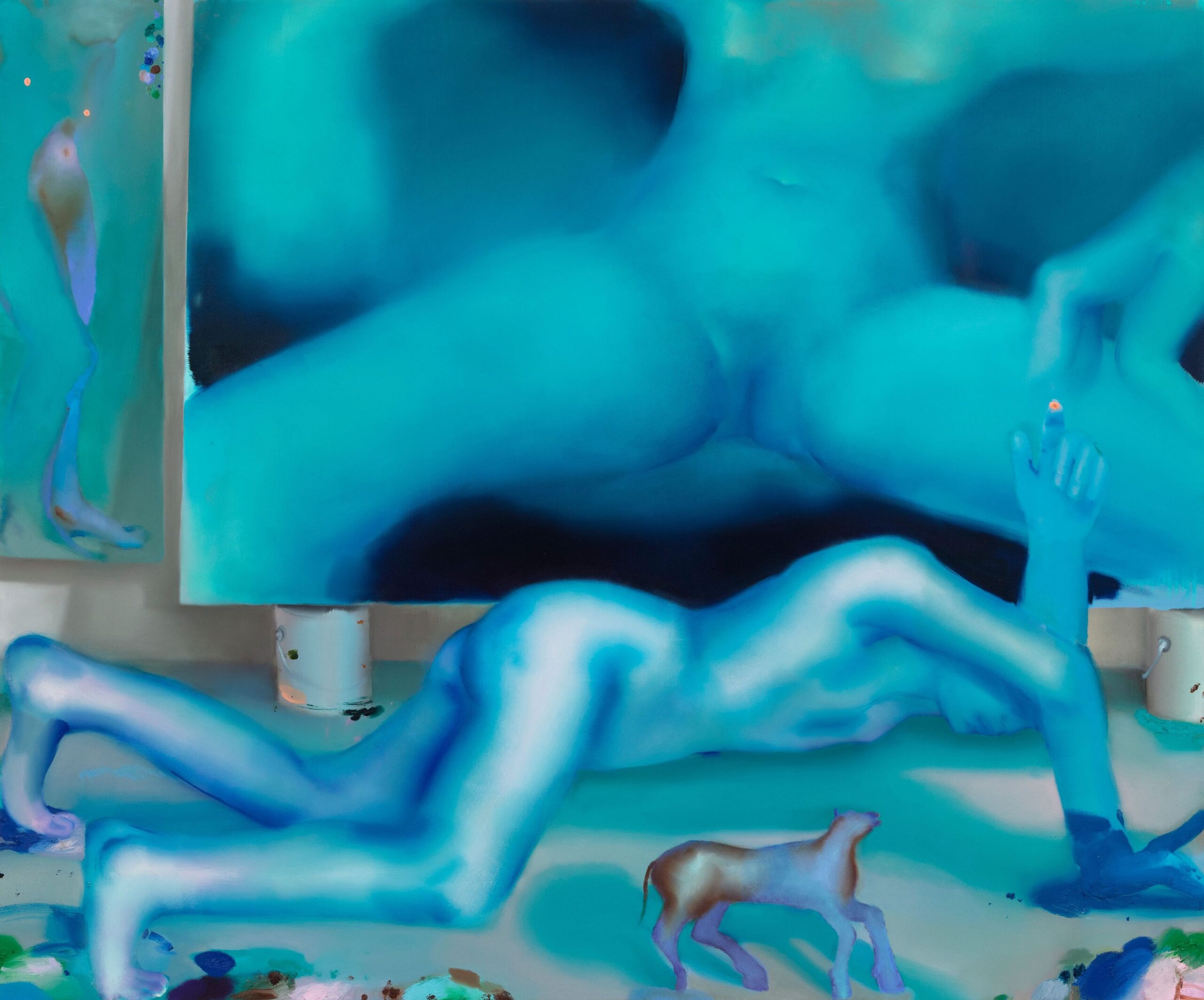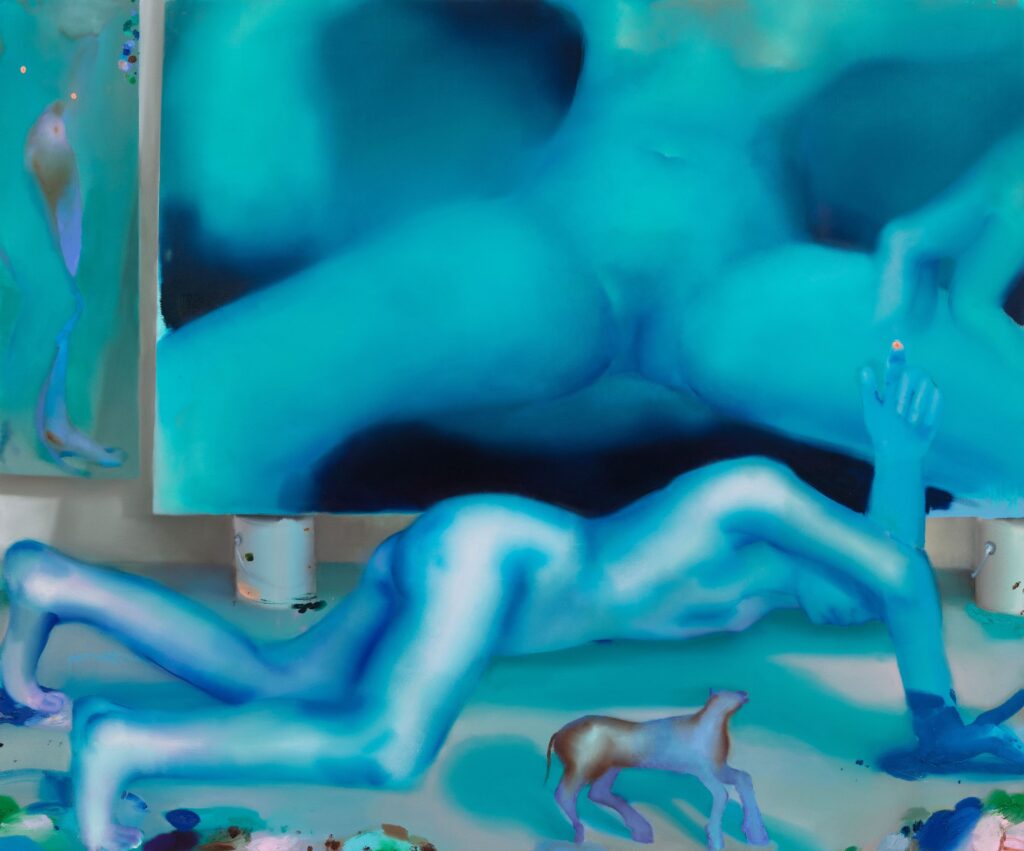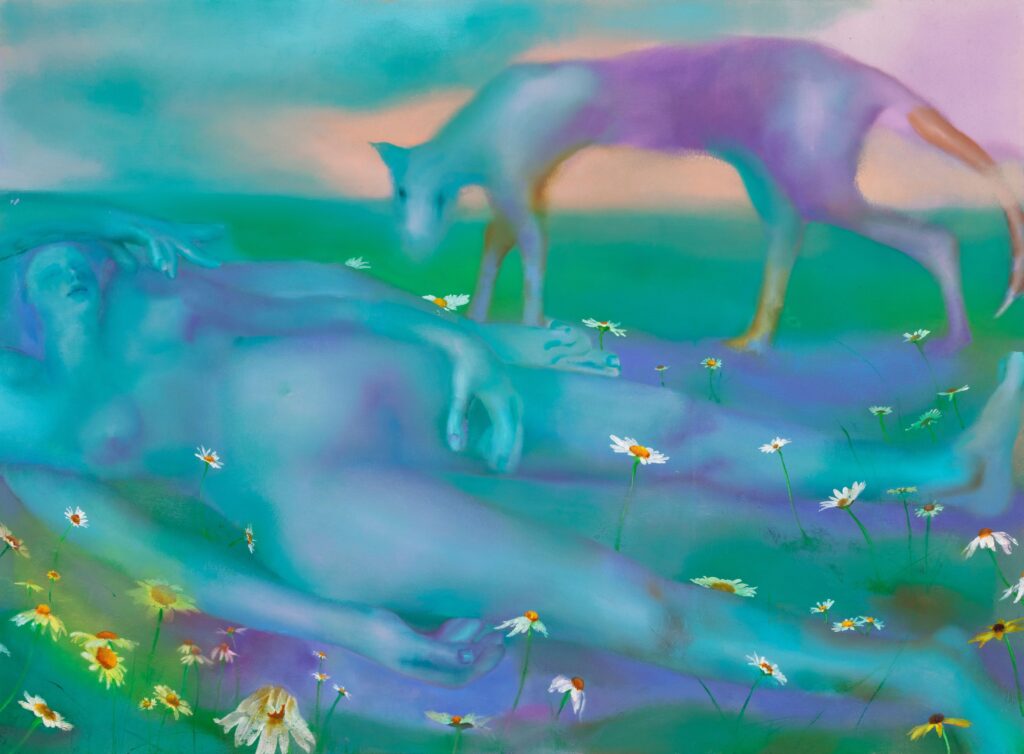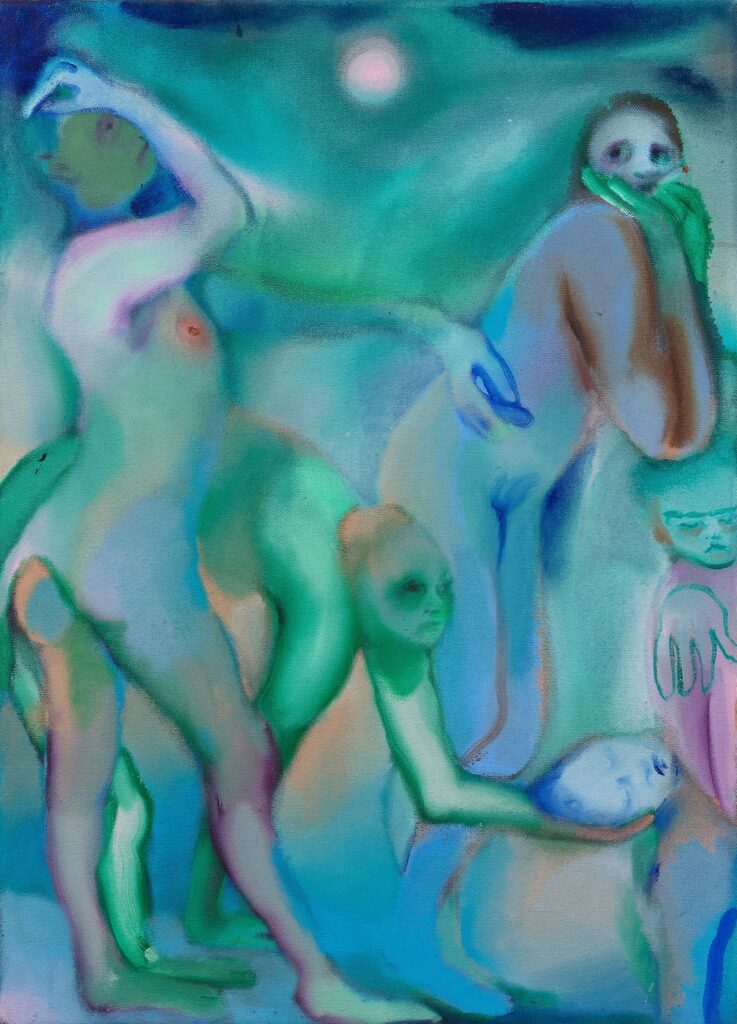
Archive page:


Kate Ahn

It’s Shock Therapy, Baby

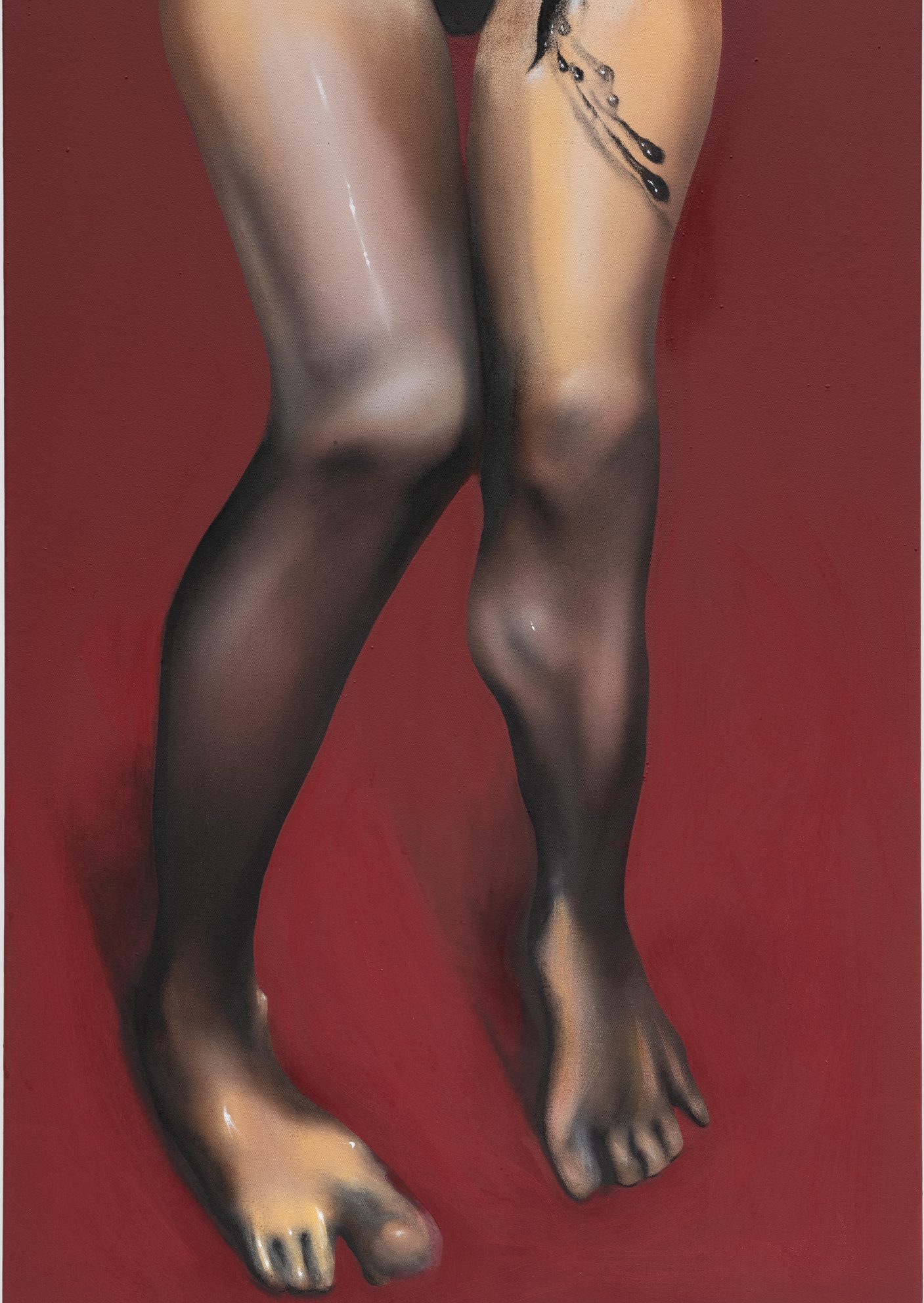
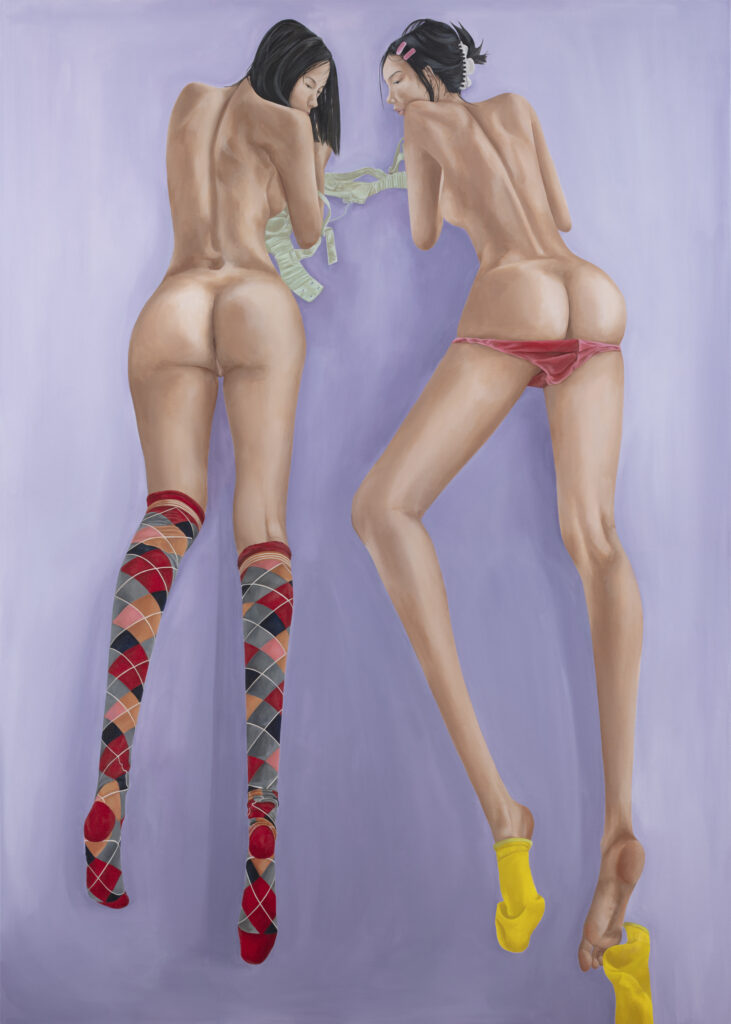
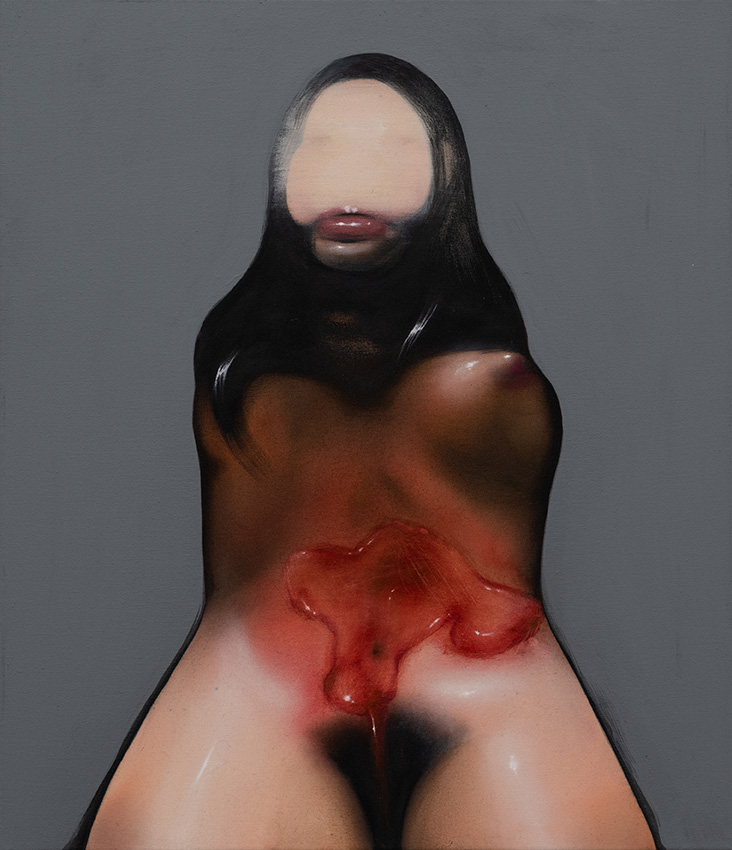
Jasper Johns once said, ‘Hollywood is forever young, forever sexy and forever swollen with abundance.’ This makes sense when looking at the figures in Kate Ahn’s paintings. 

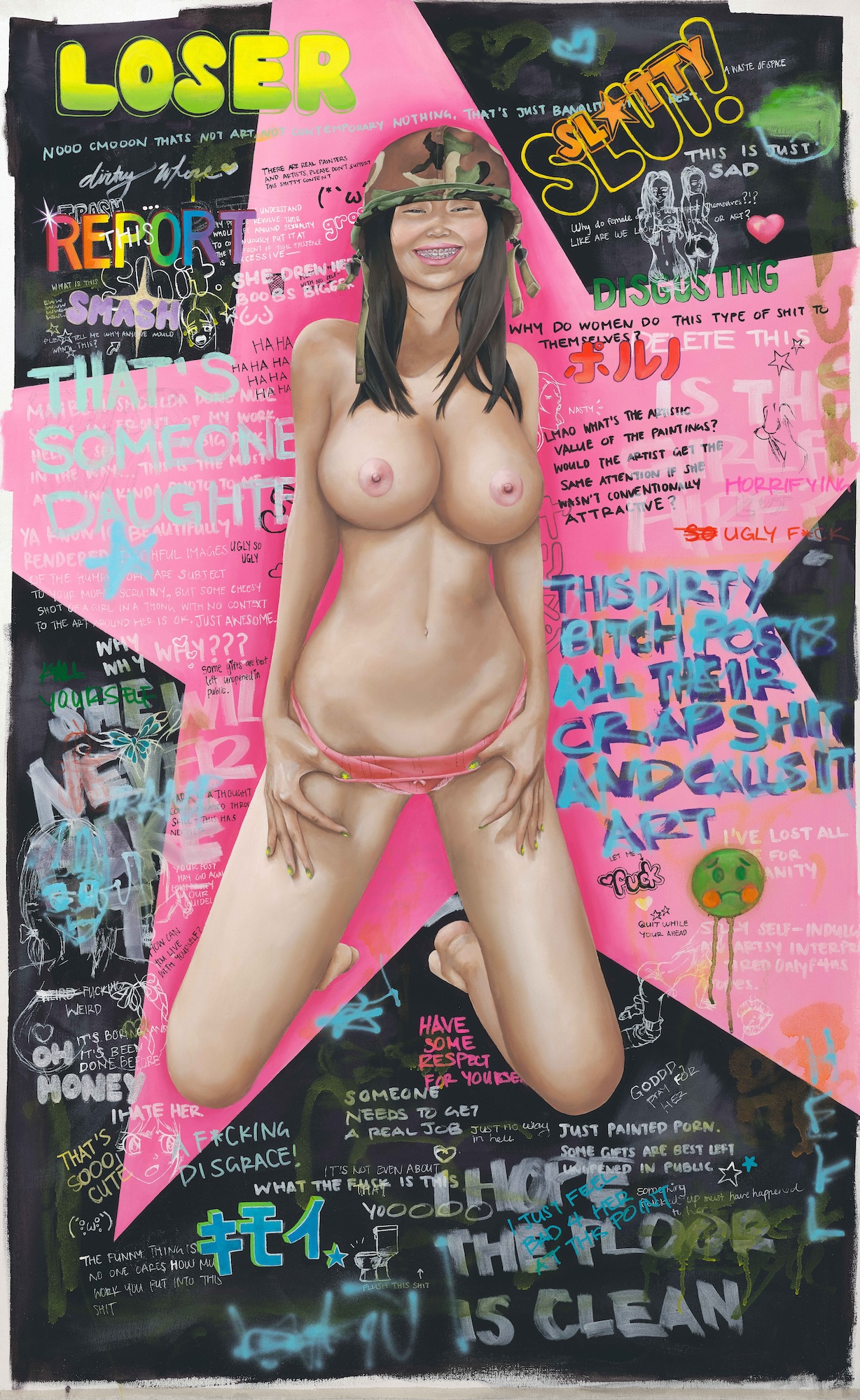

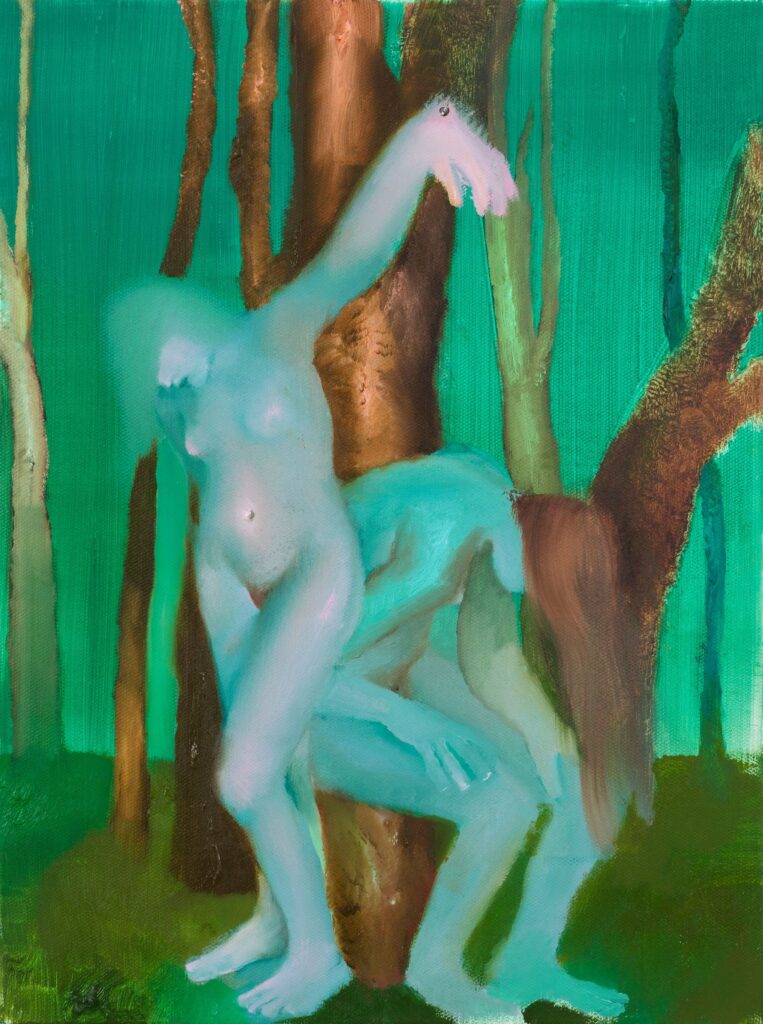
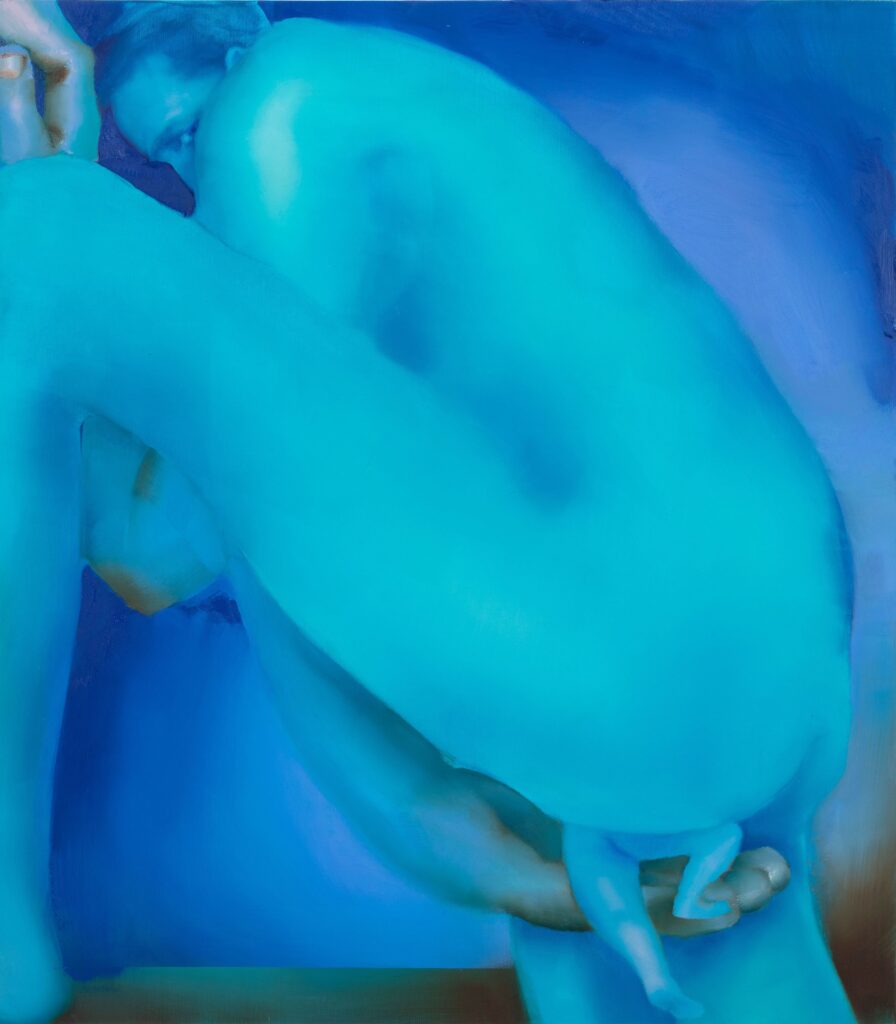
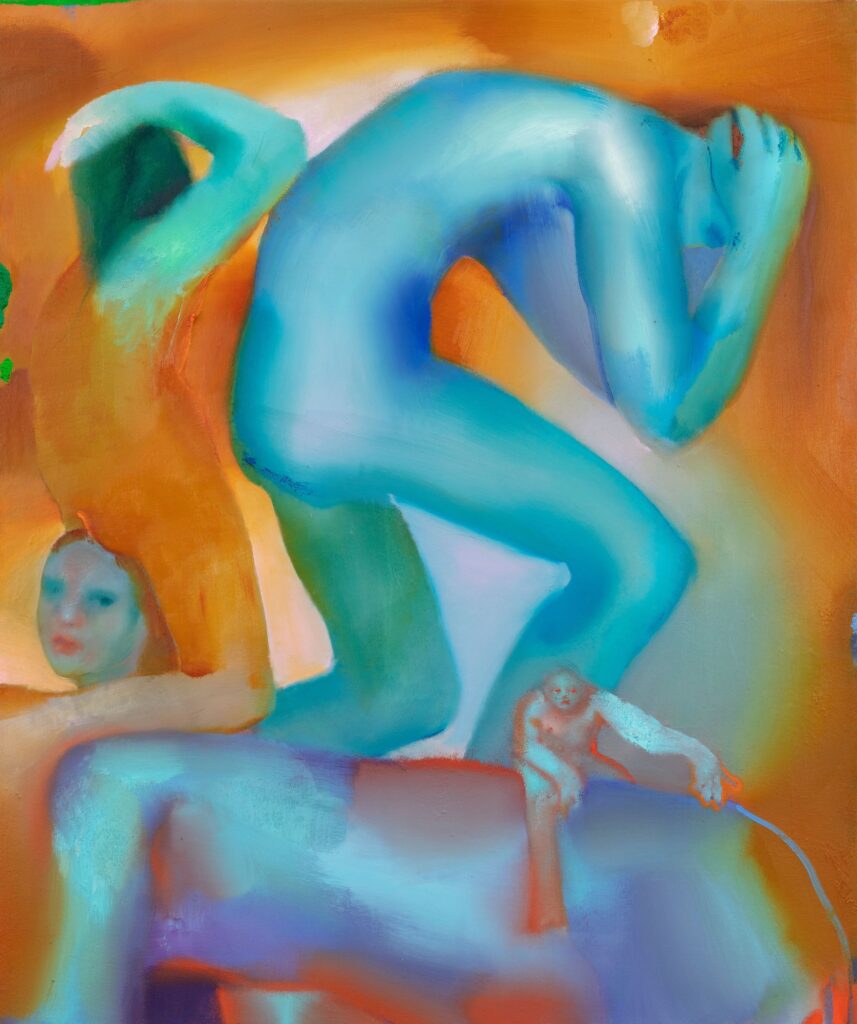
However, abundance in these works is qualified by searing faces and billowing forms stretching across the image and twisting in the frame. They are abundant in mixed yet meaningful messages, pained and charmed. Painting in series, Ahn depicts herself in varying stages of movement. Nearly always nude. The relevance of this nudity is open to interpretation. Still, Ahn’s subjects bring to life the late critic John Berger’s words, ‘Nakedness reveals itself. Nudity is placed on display. The nude is condemned to never being naked. Nudity is a form of dress.’

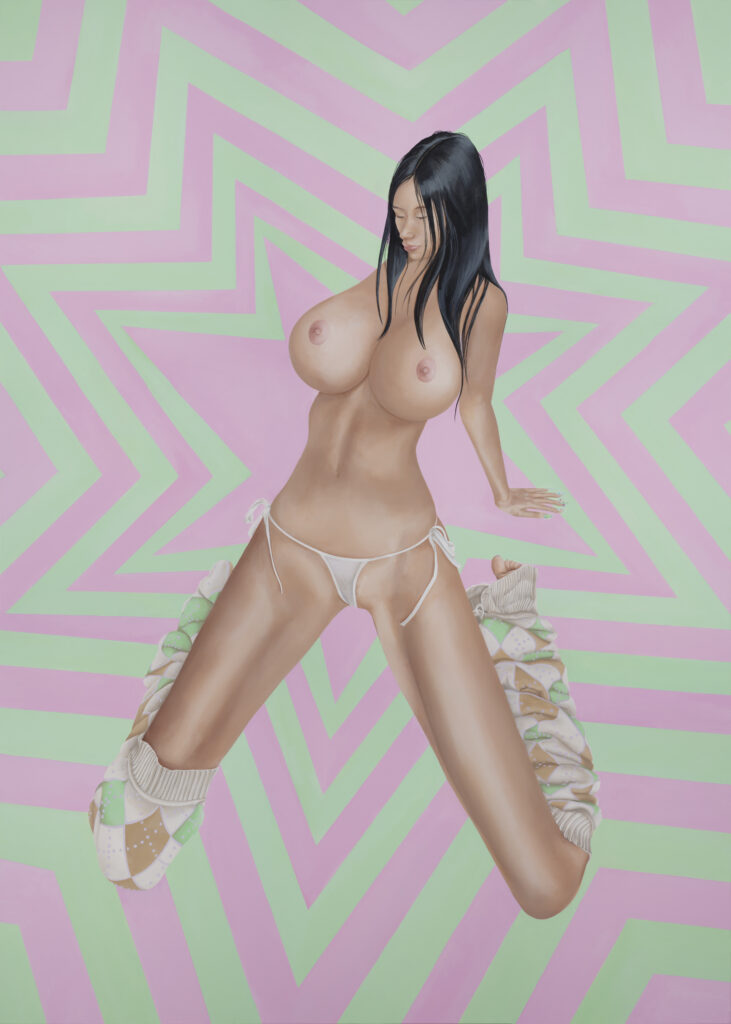
These figures are not just nude but clothed in meaning. They are overcorrections, pronounced perfectionism with an outcome of exaggerated beauty. A swagger of confidence sways on a bed, bounding between big buttcheeks and long legs, wavering between buoyant breasts and the torrential currents of bedsheet and brick wall. These forms are idealisations, idylls of what could be. They are powerful, exposed, fearless, and nuanced in nakedness, fiercely facing everything with glowing skin and stripy socks.  

Ahn is in Los Angeles. She grew up on the United States West Coast and has lived there for most of her life. In recent times, Ahn’s paintings have developed an ethereal strength. She discusses her work and artistic intentions are spread across the social and physical dermis of expressive geography. Ahn’s world is mapped around acrylic paint and produces figures that produce shock therapy that will force any white wall into submission. And they are also nude, but that’s only half the story. 

Billy De Luca: You are in LA right now. Did you just have a show there?

Kate Ahn: I had a show downtown at Gallerie Murphy — it’s an extension gallery of Terminal 27 on Beverly Blvd — and they just opened. I was there for one month, which was a great experience. It was very emotional for me because I sacrificed a lot for this show. It was almost 2 years of work, it was everything I had in me.

Billy De Luca: The commercial gallery scene can be terrifying. But having that proximity in LA must have been great. Did it get overwhelming having such access to your exhibited works?

Kate Ahn: Oh, no, I was even there after the opening a few times. I was so much a part of everything. From the paintings to the merchandise with Terminal27 and just the gallery preparation itself, I was there at every step.

Sometimes it is hard to collaborate and find people to take up your vision, but when there is synergy and trust, things always turn out beautifully. I also enjoyed being in the gallery to say hi to whoever came by.  

Billy De Luca: That can be a very personal experience. It changes the context when you see the person who painted the image before you. And how come you liked the collaborative aspect?

Kate Ahn: I like it, but I also think it can be challenging and sometimes divisive. I feel like I am also thinking about the audience and what the general public can digest each time I collaborate. As an artist, when you create your work, you can really just go all in. I don’t think about whether everyone will love it, but you have to consider that in collaborations. 

Having that restriction is also nice because It makes you think outside the box. You have to please other people and yourself; it allows me to have my art in many mediums. It isn’t just up on a wall: It can travel and transform into many different objects and forms, which is super exciting too. I try to do as much as possible within my freedom, but sometimes you can’t go completely explicit – for example, on a pair of shoes.

Billy De Luca: Finding that balance must have taken time. When did you start painting and getting into the fashion side of the arts? Did the transition help with selling your ‘ideas’ to the world?

Kate Ahn: I’ve been painting since I was  6, but I’ve also been into fashion since I was in my mother’s womb. A lot of it came from her. She’s always loved fashion and the arts and was the first person to introduce me to these worlds. From the outside, we are like complete opposites. But actually, I’d say there are more similarities than differences. I have this feeling that my mother sees me as a reflection of herself. Deep down, she’s secretly cheering me on and healing her inner child through me – even though she’ll NEVER admit to that haha. It’s like she’s looking at a mirror to see what she could’ve been (if all the rules and societal pressures didn’t alter or make her afraid of what she really wanted to do). I think I am my mother, and she is me.

But back to fashion haha. She definitely appreciates the design and artistic aspects of fashion, but I think she, just like many other people, is also attracted to the idea of class status that is prevalent in that world. This is where I’d like to think we differ: I love the art of fashion, but sometimes it can feel a little like high school. Personally, I don’t care about what’s most popular this season, who’s seated where, and what somebody is wearing at a show. Although I understand the allure, I just enjoy what makes me feel good based on my own narrative and understanding of each piece. 

Fashion has done a lot for me. It has helped me deal with the insecurities I’ve had my whole life, but it also gave me the freedom that I felt like I didn’t have. Clothing and accessories were my costumes and a mask. I wore it like armour.

Billy De Luca: That’s the beauty of being an artist, don’t you think? Fashion is in that same weird middle ground. It’s like hair. It will grow out of you and can get long enough to be another limb and part of who you are. But sometimes, it can get knotty and be a pain.

Kate Ahn: For sure. I definitely turned to painting to create these fantasies since I had such poor self-esteem (and still struggle with it). It’s how I cope to get through all of life’s bullshit. I think that’s how it is for a lot of artists. We are all struggling and trying to figure it all out. 

Billy De Luca: Do you always paint yourself? 

Kate Ahn: I have since I was 6. I remember one of my first paintings of a beach filled with all these girls, and all those girls were me. I’m not kidding. There were like 20 versions of me on that beach. But even since then, I’ve always encountered these “teachers” that did not seem to fuck with my vision! When I went to a bunch of art classes (a lot of them were Korean art classes), I had a couple of teachers who were very chill and open-minded, but I also had many teachers who were very conservative. One didn’t even offer figure drawing classes because it was ‘inappropriate’. I thought that was so crazy.

Billy De Luca: Where was this?

Kate Ahn: I grew up in Irvine — It’s a really nice area. You know, the suburbs. It’s deemed the safest city in America, with a huge Korean community. But I always hated it. I can’t think of a time when I didn’t want to leave. I feel privileged to be brought up in such a safe environment, but the environment felt so stale and mundane. One of the art classes I attended was 20 minutes away from my hometown, but the guy who ran the place was horrible. I eventually found another class that meshed better, but as much as I wanted to paint what I paint now, due to my age and environment, it really wasn’t an option. So I focused more on objects and foods that represented the female body and sexuality at the time.  It wasn’t until after college that I got to my self-portraits. 

Billy De Luca: Why was that?  Where was college?

Kate Ahn: I didn’t attempt to do my self-portraits until after college. The love that I got from my parents (after getting accepted into USC) felt too good to stray away from, especially after so many years of rebelling during my tween and teen years. So, naturally, during that time, I gave into their ways — which meant giving up art as a career. I went to school and went from art to Communication (with a minor in Finance). I told my parents — and convinced myself — that I would go into banking and make a lot of money. I thought that after that, someday I’d get back to my art…But that didn’t happen. I never did any of that besides graduating, but that’s something, right? 

I tried my best to conform, but it was just not in me. After my second year, I realised I was never going to be the person they wanted me to be, and I didn’t want it either. After graduating in 2020, I painted my first self-portrait. After my various jobs, I saved a bunch of money and said, OK, let me do what I want … I bought my first HUGE canvas. It had been my dream since I was 14 to paint on a canvas like that and to have enough time to work on such a scale. I was still shy and didn’t show my face. I marked it off. But the bodies remained. They were all me, variations of me or dreams of what it could look like. It became a fantasy.

So yeah, that was my first self-portrait, and it sold, so I thought, ‘I must be doing something right!

Billy De Luca: And how did your parents feel about that? 

Kate Ahn: They are still upset. I can sympathise with how they feel. As conservative parents, I think the subject matter alone would be difficult for them to digest. But on top of that, there is also a very real fear of their only child not having the stability that a more traditional career choice can provide. It’s not easy selling pieces, for sure. But that first piece was definitely something I took as a sign to just go for it. 

Billy De Luca: Do you think that painting is easier than the administrative and sales aspect?

Kate Ahn: Painting is way easier. It would be a dream to just paint and not worry about the selling side of the job haha. It makes me depressed sometimes, and it can feel like things are predestined in this industry. It’s so much about who you know. I ask myself a lot: Are these the things that make or break me as an artist? Do I need to be a person that can talk up my work or have someone willing to do that for me? Yes, it’s discouraging. But in the end, I can’t see myself doing anything else. I can’t stop what I’m doing, and I believe that if you really love it, you’ll find a way.  

Billy De Luca: Beforehand it was very much about the quality of the work and the consistency it bore in improving over time and being relevant in such times. Now, it is about self-marketing. You can have an agent and a Gallery, but if you don’t have a personality, then you can sell paintings all you want — but you may not be memorable. With your work, the images strike and transfer energy. Audiences have received that energy and are buying in. You can sell a painting, but you have to sell a self-portrait.

Kate Ahn: Yeah, I agree. Social media has definitely inflated and put this importance on not just your work but a person being an entire package. It’s like people themselves have become conglomerates: you’re the actor, the producer, the director, etc. Everyone has to become a multi-disciplined brand that must follow the fickle nature of social media. Like a walking billboard. It’s overwhelming, but it can be great because you can get your work out independently, cutting out the middleman like agents or galleries. But at the same time,  there’s a negative side that comes with oversaturating the avenues that lead people to not take you as seriously. I think of Andy Warhol, who essentially went for it and did it all. And unfortunately, having to deal with silly repercussions where some circles of the art world stopped taking him seriously for doing things unconventionally at the time. Fast forward to now, it’s kind of ironic how his way of doing things ended up becoming the standard today. Even now, it’s still hard to navigate what the perfect balance is between doing it all and still being taken seriously.   

And man,  there are so many days where I have wished I could paint anything else. Any object, like food or something. It’s easier to sell that as an idea. Instead, I paint really explicit self-portraits. And on that, there is a double standard. Women are in this really unjust and tough position where we are constantly objectified living in this patriarchal world, but the moment we start owning our own sexuality and our own bodies, we become lepers.  As much as my work receives a lot of love, it also receives so much hate. Even though we’ve been painting nude women for centuries, I think it is still very new for women themselves to be the ones painting our own bodies. I guess that’s too progressive even for this world haha.  

Billy De Luca: And what does that mean to you?

Kate Ahn: That’s one of the very reasons I continue to paint my self-portraits in the nude.I am fighting for my right and everyone’s right to own our sexuality and our body and control our own narrative because that’s a human fucking right. Sexuality isn’t everything, but to me, it is a representation of freedom because that was the first real restriction I faced in my life, and I think many others faced it too. I think women especially have to deal with the double standard of not being able to deal with the freedom of being a sexual being. In my work, I can own my sexuality. I can be who I want to be in my work. 

Billy De Luca: So it’s more than just you?

Kate Ahn: In a way, it is more than me. I think my work can become confusing as I am trying to fight the patriarchy, but at the same time, I am also trying to heal from my own self-esteem issues that may very well come from the male gaze. Critics could say I am just perpetuating the patriarch all over again, and I hate to say it, but maybe they would be somewhat true. But I can’t help the fact that being able to fantasise about myself in these various bodies and shapes helps me appreciate my actual body. It’s similar to how I play with clothing, I put it on like a mask and play this character enough to learn that my real self is actually not far away from my ideal self…it was just my anxiety and self-doubt clouding my brain. Maybe that’s unhealthy in some way, but I think a lot of people can relate to the journey of finding true love for yourself and that sometimes it takes unconventional ways to get there. And at the end of the day, I believe that by taking control of my own body and my own self-esteem issues, I still, in many ways, fight the patriarchy.  

Billy De Luca: Does the commentary influence you as much as it pushes you forward? 

Kate Ahn: With or without the commentary, the paintings would still be like this. But it does help my narrative. The more hate I get, the more my paintings will develop meaning. It just proves to me what I need to express in my work and why it’s important. Some people think I just paint porn…but for me, I feel like I sometimes do paint porn, and there shouldn’t be anything wrong with that. 

Billy De Luca: Is it hard to balance professional composure while being a human behind the work? 

Kate Ahn: Yah, it is difficult– at least for me, it is. I mean, being an artist to me means that you are choosing to be vulnerable. I know many artists that can keep the vulnerability strictly within their work but for me, I am, unfortunately, a person who tends to word-vomit everything I am going through within my work and outside of it too. I know it’s not the best habit. I know most people respect those who have that perfect ‘professional composure’ — characterised by a confident fearlessness, keeping their cool, even when shit is going sideways in their personal life. This might be completely delusional, but I’d still prefer to find a way to continue to be this open book and also be respected for it just because I feel like it’s so much a part of my character. 

Billy De Luca: However, having strong work which is the best thing that you put out at that time. That is what is going to be a huge driving factor. You might not sell. You might go from being very financially comfortable to financially uncomfortable. But through that ringer, one thing is still chugging along, still developing.  And that’s your painting. 

Kate Ahn: That’s right. And that’s why I’ll never stop either. The paintings are me. There’s no costume or façade or anything. It’s my soul. If I think back to where I was two years ago with my painting, it’s like…incomparable to my skill now.  So yeah, that helps me feel better. These feelings of insecurity have inspired me so far, and although I’m working on that, it does still help me produce. The emotions come out, and it makes the art worthwhile. You don’t have to be ‘healed’ to make people feel something — I think I’m just too hard on myself since the years are never easy, and there are so many constant changes. Even if it’s bad feelings, it’s feeling. If you’re feeling something, it’s art.

Billy De Luca: And what else do you see is changing?

Kate Ahn: For my new collection, I want to do more facial expressions similar to the whole 1970s erotica time period, where everyone looked so happy, vibrant, and alive. I feel like that is true for me since I’m a very smiley and happy person. I also want to continue to include more pieces of clothing and lots more socks, as that still is so much a part of me. I did do that a lot this year as I did, like… a lot of stocks.

Billy De Luca: I was going to ask about those…It reminds me of how men in the business sector ‘jazz up’ a suit with a sock. You end up being naked, showing the socks you wear, and they can be colourful and different, but they balance out the grey world of suits. It’s a stabiliser.

Kate Ahn: It’s an homage to my love of clothing…In a way that still allows me to be nude. Certain things go on when you conform to such a society. It’s so difficult to show your identity and be unique and yourself. So yeah, socks are awesome, and you can have so many cool socks. 

I’m obsessed with socks.

Billy De Luca: Besides the clothing, where do the colourful backgrounds come into it? Do the star-shaped pastels of pink and green come as afterthoughts?

Kate Ahn: The background comes later. I usually don’t know what to do for the background. That being said, I feel like it has to do with my inspiration from Japan, especially from love hotels.  Japan is just…different. I want the paintings to feel happy and alive. I learned a lot about love hotels recently. Back in the 70s, during the women’s liberation movement and just after they legalised abortion, all these love hotels popped up, and they embraced and nurtured the idea of sex and love. You can see it in the way they built these themed rooms and structures. It’s a fantasy that invites more fantasy. The beds are spinning, there’s colour everywhere, and the adult fantasy becomes a reality. And I love it. I love how it is accepting of the fact that humans are sexual beings. It’s happy and human. 

Billy De Luca: And does your subject matter and work rely on where you are geographically?  

Kate Ahn: Yah, I definitely think so. When I grew up in the suburbs, the constraints and staleness of the city definitely played a part in my work and also the person I became. That’s where you can see the rebellious nature of my work. And being that I was only an hour away from LA, it became a dream of mine from an early age to move here — which I finally did at 18. I think the environment here in LA is so nurturing to being different. It helped me gain confidence in my work. And the actual physical beauty of the city — the madness, the graffiti, I would say some of the strip clubs down here, too, have definitely inspired some of my works. 

Billy De Luca: Being in LA is historically seen as…intense. ‘Jasper Johns once said that Hollywood is forever young, forever sexy, and forever swollen with abundance.’ How do you feel about LA?

Kate Ahn: I think Jasper Johns is right. LA is forever young, sexy, and so swollen with abundance that I think it’s only natural to have this love-hate relationship with the city. You can’t be young forever. BUT maybe you can be sexy forever — depending on who’s looking — but living life in abundance will always catch up to you. That’s the thing with LA as much as it is a beautiful city, it’s also really superficial, but hey, I think you can find that just about anywhere in the world. I hate it here, but I also love it, and it will always be my home.

Billy De Luca: Last question… Does that solitude drive you to keep going? 

Kate Ahn: I don’t know if it really drives me. I think I am just so used to being alone. Being an only child basically prepared me to be an artist, you know? I think what drives me is that from a very young age, I had a dream of who I was going to be when I became a grown-up, and even though I still have ways to go, I am essentially living it. Even with all the people trying to bring me down and bet on my downfall, I will never let go of my dream. That’s what will always drive me to keep going.  

Credits

CRAP SHIT, 2023
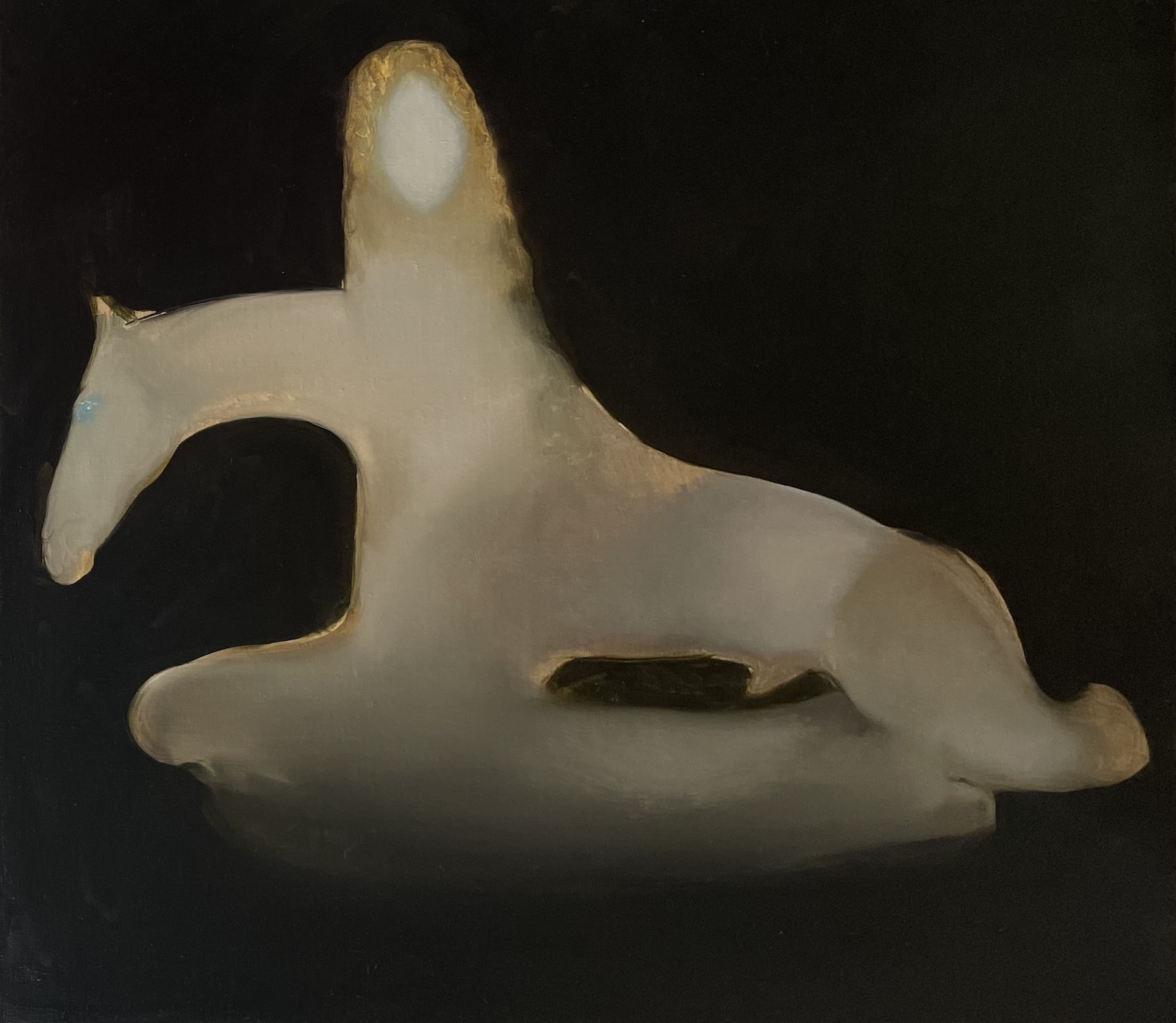
TAKE ME THERE,2022
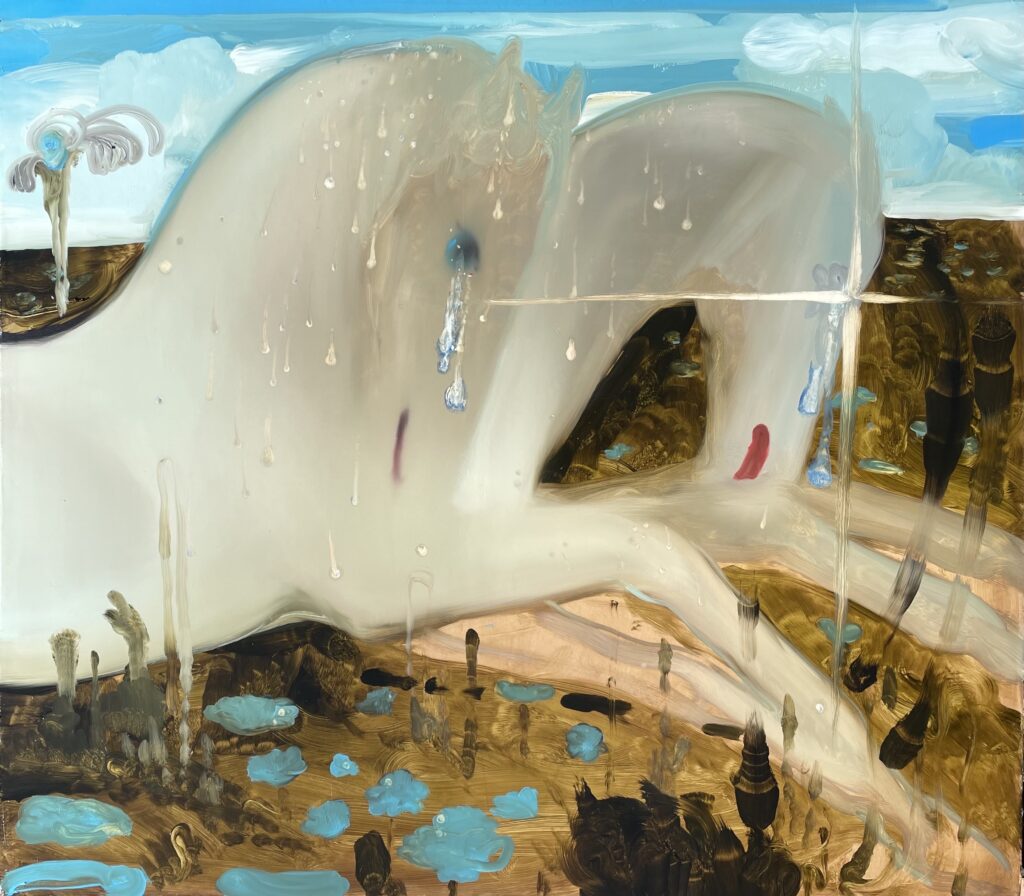
KATE #3, 2022
All Images courtesy of the artist.

Gian Maria Tosatti

On the responsibilities of the artist and the weight of history

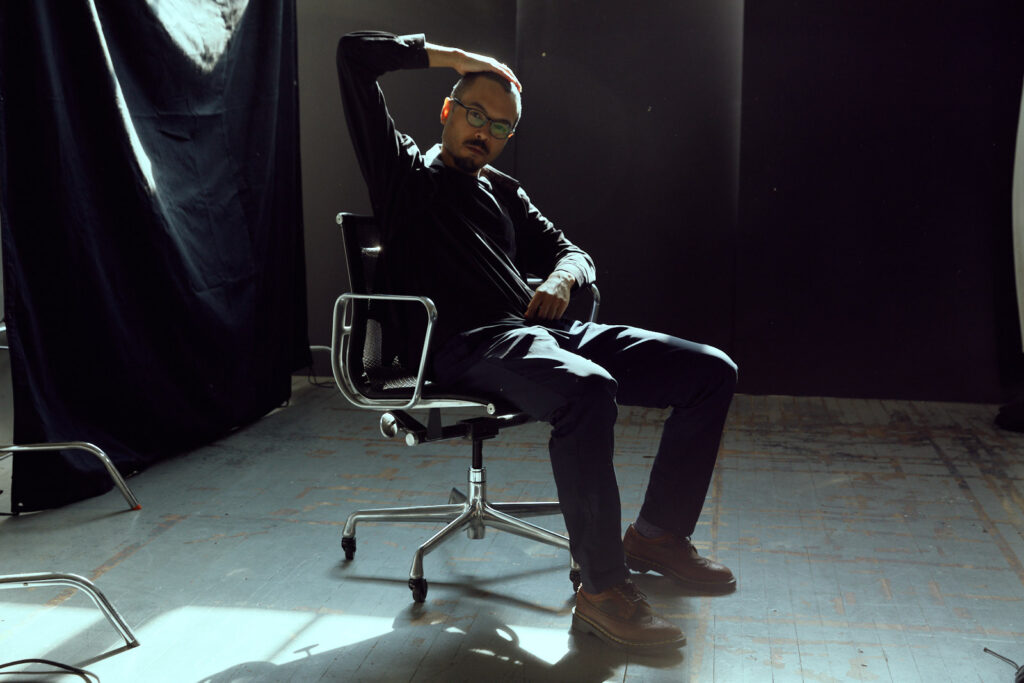
Emilio Isgrò once stated that the role of the artist is that of navigating society out of crisis. If we see in his words any validity, then, we can’t help but see Gian Maria Tosatti as one of the most distinguished and brave admirals of the fleet that is now busy trying to sail us through the stormy waters of the present. 

Don’t let his beard fool you, he’s far from a ruthless buccaneer adventuring across the seas of the art world for mere pragmatic interests. On the contrary, he seems to have embraced a mission with broad horizons and rich in dialogue, as highlighted by his work as art director of the Rome Quadriennale and even when, last year, he became the first solo artist to curate the Italian pavilion at the Venice Biennale. 

Born in the eternal city in 1980, Tosatti indeed faces the art industry with the deep knowledge and critical consciousness of a historian, or to put it in his own words as someone whose first, priceless schooling was the daily stroll to school across the decaying and majestic beauty of the Imperial Fora. 

However, Tosatti has succeeded in escaping the academic redundancy that often defines those too knowledgeable about their own field, by giving birth to a distinctive and globally-acclaimed body of work. His visual art focuses on long-term, often site-specific projects that question the state of our society and identity, equally touching upon politics and spirituality. 

Listening to him discerning about his practice makes you reconcile with art, as a discipline rather than as an industry, something that has been for way too long overshadowed by its financial, voyeuristic and gossipping side. The conversation that sparks with Tosatti acquires a profound stance, spiritual at times, for leading us to question ourselves on the role of the artist in history and on its political duties to capture the present, willing or not. 

Lorenzo Ottone: You were born and raised in Rome, now you live in Naples. How influential is the weight of the past and history, both artistically and politically, exerted by these two cities for an artist like you who investigates the present?

Gian Maria Tosatti: Actually, it is not a burden. In fact, it is the exact opposite. The strong presence of historical and cultural elements in the identity of the city in which I was born and in that of the city where I live exerts a positive and helpful influence in the interpretation of phenomena pertaining both to the present and the future. In thousands of years of their history, men have not changed. There is a beautiful work by Andrea Mastrovito entitled Le jardin des histoires du monde. It is a story in which it is not clear at what moment in history certain events take place, because they continue to happen, cyclically. Living in a city with such a great past is like having a good schooling behind you. It makes decoding reality easier.

Lorenzo Ottone: The project that in recent years has defined your artistic research the most is Il mio cuore è vuoto come uno specchio (My heart is empty like a mirror), which aims to reflect on the crisis of democracy in multiple areas of the world. Is there any willingness to trigger political thoughts and actions by capturing our zeitgeist? Or, in other words, to what extent can artists subtract themselves from their present and from the broader socio-political context?

Gian Maria Tosatti: An artist can never escape his historical present. Even ascetic figures like Morandi are imbued with the feeling of the time in which they lived. Morandi’s painting is only possible because of that specific civil and cultural context. The question is not, therefore, whether or not one wants to give one’s work a political subtext, but to accept the fact that the artist’s role is to give back, with his works, translations of the spirit of the time, which encompasses every aspect of our civilisation. I simply carry out my task, the work that was assigned to me when I decided to join an order as ancient as that of the artists.

Lorenzo Ottone: You once stated that the spark – to a certain extent a vocation – that led you to make art came from a dream. How much room is there now for the sphere of dreams in your practice and how strong, on the contrary, is the willingness to capture the present with pragmatism? And how about spirituality?

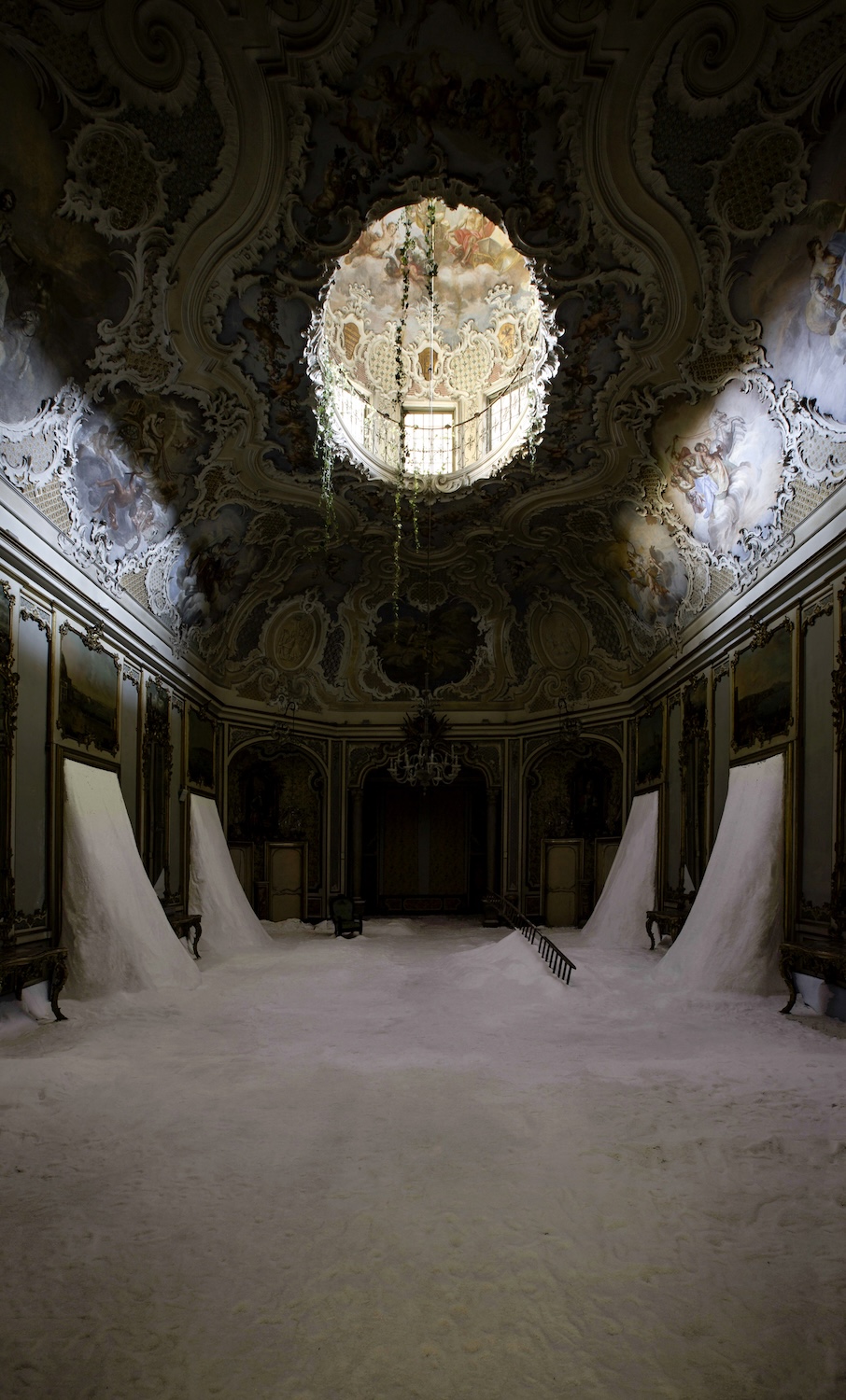
Gian Maria Tosatti: Actually, as psychoanalysis teaches us, there is a certain continuity between reality and the dream. Sometimes what we are unable to tell ourselves in the mirror, we end up addressing through another reflective surface, which is that of the dream. My work is aware of this and, as a consequence, encompasses elements retaining a strong connection with historical reality – for example, creating a work in the centre of the Kurdish quarter of Istanbul while it was being demolished by the authorities – as well as markedly visionary horizons – such as filling an entire floor of the building in which we set up that Turkish work with snow, in June.

Lorenzo Ottone: Since we live in a fragmented society, rich in micro-scenes and ‘bubbles’, each with their own influencers and micro-celebrities, can art still cater the role of simulacrum of the present? Can it still narrate universal truths able to reach a broad audience?

Gian Maria Tosatti: Art can certainly do that. What, on the other hand, is very disturbing is this disordered polyphony of voices belonging not so much to the many ‘art lovers’, but to people who understand very little about art and demonstrate this by cheering for some artists and hating others, speaking well of some and badly of others, supporting some and doing everything to discredit others. All this has profoundly changed the art world compared to past decades. In the recent golden years of Italian art, the 1960s and 1970s, one certainly preferred some artists to others, but one had respect for all of them. They were held in esteem because, even if they were far from our specific inclinations (conceptualism, figurative painting, sound-art, performance), they were recognised as having authority and mastery in their field. Today, however, artists are seen as a band of miracle workers, runaways, who owe everything to the support of some gallery owner or patron. If we esteem them, they are our ‘protégés’ (hence, inferiors anyway), if we do not esteem them, they are ‘impostors’. 

The sad thing is that this very mindset now applies not only to those who came to the art world for reasons of social status, but also to the professionals themselves. There are curators who snobbishly refuse to go and see the work of certain artists, as if those works did not deserve the attention of their gaze. Even worse, there are artists who talk about other artists as if they were thieves, without realising that, in doing so, they are discrediting their own work, because as Rilke said, even just to get a single verse out of the soul requires discipline that still deserves our respect and attention. Personally, I am happy that through Quadriennale, in this three-year period, I have brought attention to the work of many – regardless of preference – and that I have also fought to critically and financially support the work of other artists who have publicly spoken very ungenerous words against me or have taken political positions by signing petitions against me. I believe, in this way, that I have done what was right, distancing myself from an opportunistic and vulgar bourgeois art system.

Lorenzo Ottone: Over the years, you have adopted multiple techniques and chosen a range of mediums to express yourself, even touching upon music. I am thinking about the gramophones that you have also played on stage with Vinicio Capossela. How much does multidisciplinarity define your artistic identity and practice?

Gian Maria Tosatti: Italian artists have always been extremely eclectic. Think of Leonardo Da Vinci, think of Bernini, a fantastic theatre director as well as architect, painter and sculptor. Think of Michelangelo Buonarroti’s verses that we have studied together with those of the greatest poets at the turn of the 15th and 16th centuries. And then again to Pasolini, film director, playwright, poet, columnist for Corriere della Sera. It is the specificity of our cultural tradition. Since the art system has become mainly Anglo-American, we tend to compartmentalise more. I’ve got nothing against it, but I do not belong to that cultural tradition. And if we all conformed to the same model, I think we would lose almost all of what makes us rich because we are different. 

Italy has felt like a province for a long time. It is the fault of wrong choices made by our cultural industry, which self-destructed in the 1980s, and of many supposed intellectuals – I am thinking of several curators with international careers – who have been blatantly ashamed of their country, as if Italy actually was a remote province of the artistic universe. Fortunately, this is not the case. Italy has had little to no influence for forty years, it is true, but this is an insignificant amount of time if compared to the history of our civilisation. The strength of our cultural specificity is still great. And it is a good thing that today other countries or continents – I am thinking of Africa, which is working magnificently – have also raised their heads in the global cultural system, because this can lead to exciting comparisons and to writing fantastic new chapters of art history together. 

However, this is only possible if – just like the Africans – we can rediscover pride in our own specificities. Italians are cultural fantasists, because we are born immersed in millennia of stratifications. Simply think of the home-to-school route we take in the morning when children. It can be worth more than a degree at Harvard, because if every day we walk across, as was my case, the centre of Rome, eventually, we will not only get to know the Imperial Fora stone by stone, but all that knowledge will be inseparable from what we are. Of course, one has to have that interest. If one wants to be a footballer, perhaps, they will walk straight across temples, head down, as if they lived in Texas.

Lorenzo Ottone: Speaking of the requirements an artist must have, in recent years your career has been enhanced by the appointment as artistic director of the Quadriennale di Roma. How does Tosatti, the artistic director and curator, differ from Tosatti the artist? 

Gian Maria Tosatti: When I was a boy I had a particular regard for a great poet, T. S. Eliot. As publishing director of Faber & Faber he played a pivotal role in shaping Anglophone literature in the first half of the 20th century. The same can be said of Calvino, who played the same role at Einaudi. But in the 20th century, there were hundreds of artists who took on managerial roles within the cultural system. And thank goodness for that! Pirandello was the director of the Teatro degli Artisti in Rome. And the Quadriennale was founded by an artist, the only one, by the way, to have directed it, in its entire history. Today, the idea of an artist taking on such a role sounds like heresy to many. Instead, anyone who knows a little about art history knows how important the theoretical contributions of artists are. 

I do not want to go as far quoting illustrious figures such as Vasari or Leon Battista Alberti, the manifestos of the 20th century avant-gardes or a book such as The Art of the Novel by Milan Kundera, to make us realise that a world in which artists are confined to their henhouse, brooding over an egg only for critics and dealers to pick up, makes a poor and weak art system. Exactly like the one in which we are immersed today. I do not believe that my strong and stubborn commitment in the contrary direction will change much, but I am simply not willing to be a simple code, good for an infantilised society.

Lorenzo Ottone: To draw a conclusion to our chat, how is the heart of Gian Maria Tosatti today? Still empty like a mirror or full?

Gian Maria Tosatti: As many have said, from Fellini to Boetti – even Totò in a magnificent interview for [Italian state television] RAI, which can be easily found on YouTube -, in every artist there are two people. There is the actual artist and then there is the other, the one who takes him around. Fellini used to say that he would accompany Federico to the places he wanted to go and watch him do things that he would never do. I have learned these things over the years, reading their memoirs, but since I was a kid I have always said that I push Gian Maria’s wheelchair, I take him where he asks me to. Only as an adult, though, I understood what I exactly meant since then. At forty-three, I am an intellectual, a public figure who takes a stand in the newspapers, a cultural manager who knows how to renovate an institution, who has a strong sense of ethics and politics, whose heart is full of fantastic relationships with other intellectuals or people from the street whom I have always helped and supported as an activist. On the other hand, He, the other, is an artist, a man whom I do not understand, whom I do not want to understand, whose ethics are paradoxical, dark and crystalline, whose heart is always empty, ravenous and devoured at the same time. He is thin, very thin. I am attached to him and my duty is not to abandon him. 
Credits

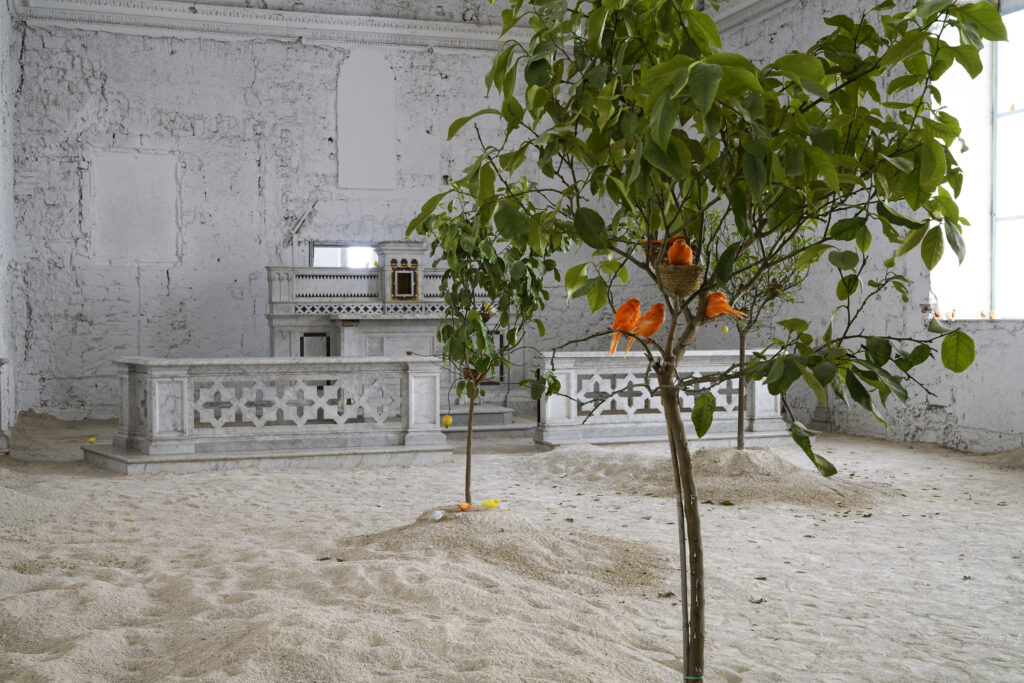
Terra dell’ultimo cielo, 2016. Site specific installation.
My dreams, they’ll never surrender, 2014. Site specific installation.
Il mio cuore è vuoto come uno specchio – Episodio di Catania, 2018.  Site specific installation.

All images courtesy of Galleria Lia Rumma, Milan/Naples


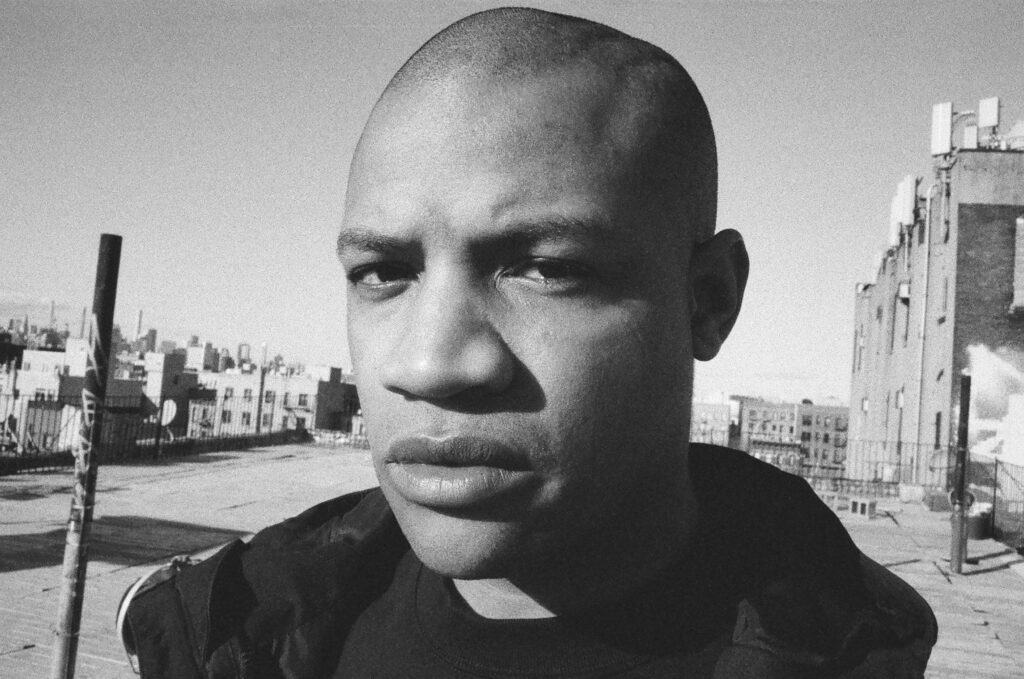
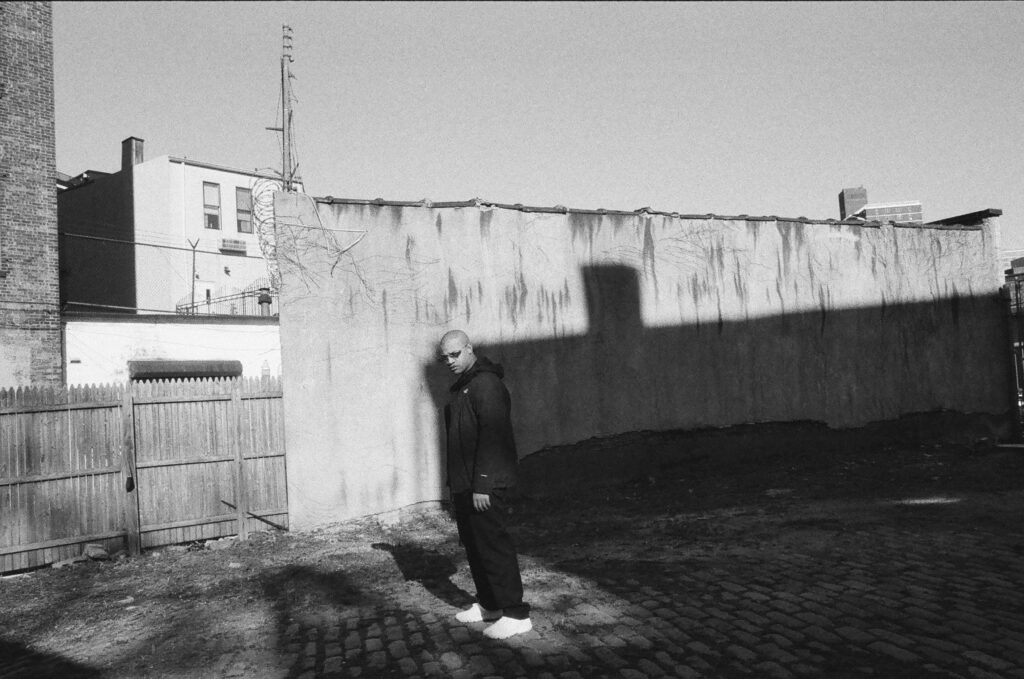
Galcher Lustwerk

Abstract Universe

Galcher Lustwerk wants you to know he can do it all. The DJ and producer came from attending DIY punk shows in Cleveland  and noise festivals in Providence before settling in Brooklyn’s dance music zeitgeist. His 100% GALCHER mix, made of all originals, propelled him to prominence in 2013, and his multi-layered approach to house music has solidified him as one of the city’s mainstays, becoming a regular at the likes of Bossa Nova Civic Club, Paragon, Nowadays, and Good Room.
But the artist, born Chris Sherron, is more than Galcher Lustwerk. With a plethora of side projects that ranges from post-rock to techno body horror to ambient driving music, he proves he can do it all.

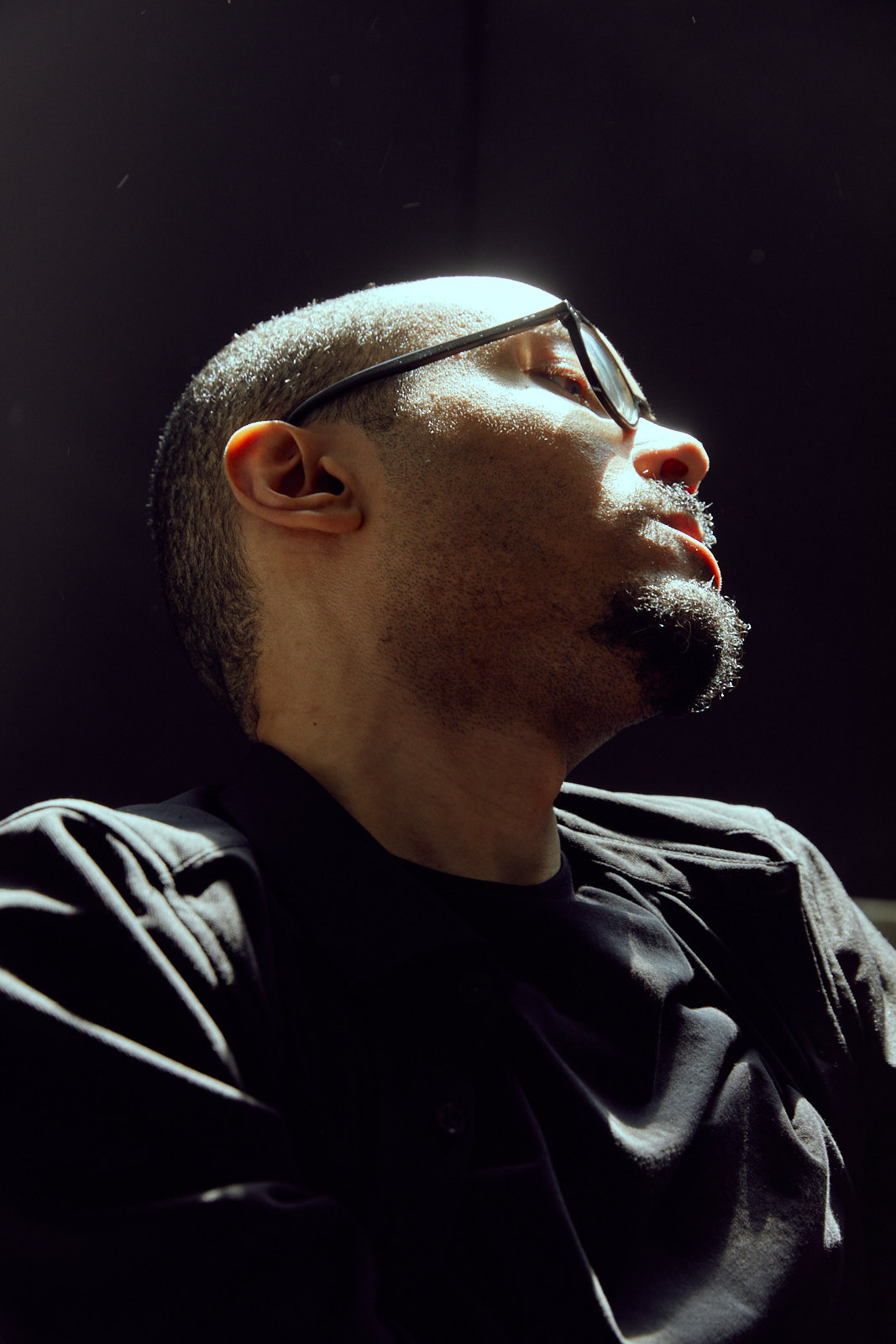
Weeks after the release of his latest Ghostly International project, LUSTWERK II, Galcher Lustwerk speaks to Arielle Lana LeJarde for a wide-ranging conversation about comic books, social media, and why the U.S. hosts the best dance music scene in the world.

Arielle Lana LeJarde: I know you started making music in middle school with Fruity Loops and then got Ableton in 2003, but I’m curious—aside from wanting to find Black music that didn’t have the parental advisory sticker on it—what drew you to electronic music?

Galcher Lustwerk: Looking back on it, I think I was sort of just into the, the, the sort of, I mean, like, the futuristic like science fiction-ness of it. Especially around that time that drum and bass and these sort of more heady genres were just getting a little heavier and more instrumental. It felt like I could absorb music in a more ambient way. It kind of felt emotional and I related to the way that there was no words or anything. I just connected to that on this abstract, futuristic, and emotional viewpoint. Also with regards to the artworks, the CDsm and the packaging, I was just super into that it. 
Around the same time, I was into going to comic book stores. That kind of tie kind of ties into that stuff being anime and robots. That was the zeitgeist [of electronic music], at least in the late 90s or early 2000s. Everyone was hooked on if they’re into like, electronic music, comics, and even skateboarding.

Arielle Lana LeJarde: What comics or manga did you read?

Galcher Lustwerk: I was into Batman at first. There was this corner store that I would  go to that had a comic stand and I started the darker stuff like Batman, Spawn, and all the weird ones. The weirdest drawings, I would be attracted to. Later on, I would drive to the comic store with my parents and that’s how I found out about Akira. That kind started making me like shift my focus towards manga. I think manga was on another level. 

I was I was also drawing a lot and had aspirations of doing comics at one point. Seeing the magnitude and the amount of craft that went into stuff like that was was really cool. It just interested me from a media standpoint.

Arielle Lana LeJarde: If you could create your own comic what would it be about?

Galcher Lustwerk: The narratives that I’m into are surveillance heists, mystery-type spy stories and secret agents. So I’m sure I’d have some to do with that. It would have an international feel—a globe-trotting jet set vibe. Kind of the same vibe I’m trying to do with music. I would try and make it feel substantial like Akira. Akira was huge! It had volumes. There’s something that’s cool about having that much of a world packed into into like a solid object.

Arielle Lana LeJarde: Iif you were to say that you’re like creating a world with your music, what does that world look like?

Galcher Lustwerk: It just looks like the world like the world as it is, but maybe with an omniscient, detached, vouyeristic point of view. It would have a focus on perception, space and light. I have a lot of visual reference images and a lot of them have to do with being in golden hour, when the sun is setting and everything’s kind of hazy. I’m always sort of thinking about in the back of my mind, in a synesthetic way, it’s what I see by default.

Arielle Lana LeJarde: It’s interesting that you mention being a voyeur and futuristic stuff, but you’ve said in the past you’ve been shy about social media.

Galcher Lustwerk: I think I’m frustrated with how much time and like energy it expends. It’s hard to put a marketing hat on all of a sudden, and then focus on this whole other goal. With music, I’m just trying to finish tracks and put out the tracks. With DJing, I’m trying to get people to dance. And with social media, I’m just getting people actually pay attention to what I’m trying to say, period. So it’s like a frustration more than anything. I’m trying. At least now, I’m trying. I stopped using Twitter so with TikTok and Instagram, I can focus more. I do enjoy using TikTok and viewing TikToks. It’s a workflow thing and habit thing. 

I’m really like dragging my feet getting accustomed to everything, I guess. But when I think about making music and the artists that I do appreciate, they don’t really use social media either. But at the end of the day, I just want people as many people to hear what I’m putting out. So it’s not worth nothing.

Arielle Lana LeJarde: What’s on your “for you” page?

Galcher Lustwerk: It’s been like real messed up lately. I think it was cool in Berlin, but as soon as I got back to the States, it’s been really political and chatty. Which I like sometimes, but I prefer cute animal videos that I can send to my wife that we can watch and laugh together.

Arielle Lana LeJarde: Did you see that viral TikTok of those girls getting rejected from Basement?

Galcher Lustwerk: No, I haven’t yet.

Arielle Lana LeJarde: It’s deleted now, but I saw it posted on Twitter and now I think about it all the time.

Galcher Lustwerk: That’s funny. I can’t tell you how that benefits basement. Or if it does or not.

Arielle Lana LeJarde: Everyone was just shitting on it. Shitting on the girls. Shitting on Basement calling it a budget Berghain.

Galcher Lustwerk: I prefer Basement over Berghain any day, honestly. Once they got the studio in there, it’s been awesome.

Arielle Lana LeJarde: Do you think people would be mad at you for saying that?

Galcher Lustwerk: I don’t know. I don’t care. I feel like they’re losing the power they used to hold. There’s a lot of other Berlin-based clubs that have popped up that are just as good and easier to get into. That vibe can be found elsewhere now. Berlin specifically has got the whole city behind it. It’s part of their tourism, so I think it’ll always be hyped up which is cool. I mean, it’s cool to have a place like that.

Arielle Lana LeJarde: Do you think New York City is that place in the U.S.? A lot of artists have been saying they think NYC is actually the best city for dance music in the world, actually.

Galcher Lustwerk: I would agree with that. I think there are way more exciting things happening here than in Europe, at least for what’s on my radar. The youth culture in New York is just so huge. After pandemic, I’ve definitely felt like there’s a younger crowd that’s so psyched—they see what they like and they just do it. 

[In New York], there’s no trending thing necessarily. Yes, right now we’re into really fast techno, but our scene also has this South African influence. There’s club, there’s drill, there’s garage—and it’s all being played at the same time, which is sick. Berlin is just fast techno or trance. You’re gonna you’re gonna get the same genre for the whole night. But in New York, it’s always a surprise.

Arielle Lana LeJarde: Back to your music, how does your recent release, LUSTWERK II, fit into your catalog?

Galcher Lustwerk: I wanted to call it LUSTWERK II because it’s a cheeky—in a way different—reality that would have been my second release after the mix. It was basically what I was working on right after the mix, the original 100% GALCHER mix. I had put some of them on the Resident Advisor Podcast and then a few of them were on vinyl. At the time, I was like really taken aback by the amount of attention that was going on and  just like not not knowing what to do. So to me, I’m kind of cleaning out the closet a little bit and bringing attention back to these tracks because they were never on Spotify or Bandcamp or anything. I do have like a bunch of stuff I’m trying to get out by the end of the year. 

Arielle Lana LeJarde: Do you read reviews of your own music?

Galcher Lustwerk: Yeah, I have to read them all. Just to make sure there’s no like errors or anything.

Arielle Lana LeJarde: Do you think it affects you in any way or do you actually care what people think?

Galcher Lustwerk: I like reading the reviews, but I also feel like reviews have lost their significance a lot in the past few years. To me reviews are almost a comfort because you’re being validated and it’s not like the consequence of whether enough people like caught it or not.  There are so many so many releases that aren’t being reviewed and more people listen to them than the releases that get reviewed. It’s weird. The review doesn’t matter anymore, I think. I mean, it matters a little bit, but in terms of helping people make decisions on buying music, it’s it doesn’t really make a difference anymore.

Arielle Lana LeJarde: Is there anything else you want people to know about you, or is anything you think people get wrong about you that you want to correct?

Galcher Lustwerk: I’m comfortable in saying I’m just really multifaceted. Some people may see one side and not the other. There’s a lot of detail that I put into my work that if you pay attention to it, it’s rewarding. And that’s what I what and what makes me happy as an artist, is being able to put all of these abstract ideas into into a media object. 

Also, I got like a lot of side projects that are all separate concepts as well. Just to run them down. There’s like Macchiatto, which is kind of my post-rock thing. There’s Power User, which is a video game music-themed project. Then there’s this project called The Fock, which is my techno body horror project. I got another project called Road Hog, which is like music for driving. I have all those separate projects that I think people would people would fuck with.

Oh, also I feel like the United States has the best DJs and the best producers. I’m not patriotic, but I favor us in terms of just like how this music is an American thing and a Black American innovation. I feel. So I’m definitely pro- that.

Credits

 Photography · Collin Hughes

Shubostar

Between ‘Altered Egos’ and Virtual Realities

In the neon-lit alleys of Berlin’s music scene, Shubostar is a name that resonates like a pulsating beat. From the pixelated realms of computer games to the rhythmic cadences of cosmic disco, her journey is a symphony of contrasts. But what’s the thread that ties her gaming roots to her musical prowess?

Dive deep into Shubostar’s past, and you’ll find a young game designer from South Korea, exploring the world accompanied by the sound of early computer games. With just one guitar, one kick, and one snare – oh, Cakewalk, you beautiful music crafting beast – she produced tunes that echoed the minimalistic charm of MS-DOS classics and latter. Her favorite games? Princess Maker and World of Warcraft. Fast forward, and while her music has evolved towards cosmic disco, that simplicity remains. It’s not about complex configurations; it’s about a melody that lingers. Shubostar’s journey from a game designer in South Korea to a Berlin-based music sensation is a tale of two worlds: reality and virtuality. At the heart of it lies the concept of the ‘altered ego’. Altering the ego to be with peers and friends; altering your self-perception when entering the virtual environment of a second life promising game or an experience-engaging rave; but never altering her minimalist street style in fashion, that she lately embraced with the newest fashion collab of A Better Mistake and Telekom Electronic Beats: Altered Ego. 

Marcus Boxler: I am very happy to talk to you again, Shubostar, after we met in Montenegro during the Summer of Joy” festival by Electronic Beats. Last time we did not have a chance to dive deeper into your roots: computer games. You graduated in computer game programming and created music for virtuality. How would you describe the music you produced back then? 

Shubostar: Ooof, that was already 20 years ago! Maybe you remember the first computer games, their design, the feeling. The music was only one simple melody. 

Marcus Boxler: Does this have an impact on your musical style today? 

Shubostar: Probably yes, now that you mention it. Even today, I am way more interested in creating a melody, rather than a complex configuration. Even for the sound. Nowadays, I use a pre-set, when I create music. But, I often change it, because I know how it works. So the roots in computer game programming left their mark, haha. 

Marcus Boxler: Do you still play video games?  

Shubostar: Nooo, I had to stop! It was too dangerous for me! I had been so into computer games, it became like a drug for me. I nearly dropped out of university, because I was missing some lectures. 

Marcus Boxler: Ok! We will talk about derivatives for being addicted a little bit later, but before I want to dig deeper into the connection between computer games and your approach to producing music today. 

Shubostar: When you’re gaming you’re alone in the physical world. Of course, there are multiplayer games and even gaming rooms or tournaments. But mostly, you are playing alone. You’re alone on your laptop, but you are not alone in the virtual world. You are connected to others. It’s like being in control of a different reality, where the connection to others surpasses the physical reality. That’s the idea I pursue with my music. To expand the connection between people on an unspoken level – virtually. 

Marcus Boxler: Did you know that the term ‘virtuality’ actually comes from theology? When Christians talked about virtuality, they meant a non-physical environment that you can only reach via preaching or meditation. 

Shubostar: I know this state! I sometimes go into this state shortly before I fall asleep. It’s like trance. 

Marcus Boxler: Blending the virtual with the real. Speaking of blending, your music combines italo disco and electronic synthesizer sound in a very unique way. For your inspiration you mentioned the likes of Daft Punk, Air but also Alexander Robotnick and Daniele Baldelli in earlier interviews. Tell us more about that.

Shubostar: I’ve always been intrigued by things that feel real but aren’t present. Like space. It’s there, but we don’t really feel it. The universe is expanding every second we exist, but we don’t feel any of it. At least, not in a way we can articulate, yet. It’s a reality, but it’s not tangible.

Marcus Boxler: And the Italo Disco influence? 

Shubostar: It comes with the synthesizer. It’s danceable, it’s uplifting. It came naturally…

Marcus Boxler: Speaking of things that come naturally: You are also the founder of a record label: uju records. Can you tell us the story of how you became a record label owner? 

Shubostar: Yes, I founded “uju Records.” It’s Korean and it means ‘cosmic’. However, the journey is way less impressive than you probably think. When I used to live in Mexico, I produced an abundance of music. Like, really a lot! The one percent of my favorite record labels that I reached out to and that – at least – replied, did not want any of the music. During that time I was living with my best friend who advised me to found my own record label and release the music myself. Easier, faster. He helped me with the logo and artworks and this is how the romantic story goes. 

Marcus Boxler: Is there a greater goal to the label? Do you want to sign other artists maybe? 

Shubostar: It’s all about me (laughs). The label was really just an entity to release my own music and not be dependent on another label. Also, I don’t want to put too many different artists into one shape, being the label. What I do consider, is to do a cosmic disco compilation. That would be with other artists as well. 

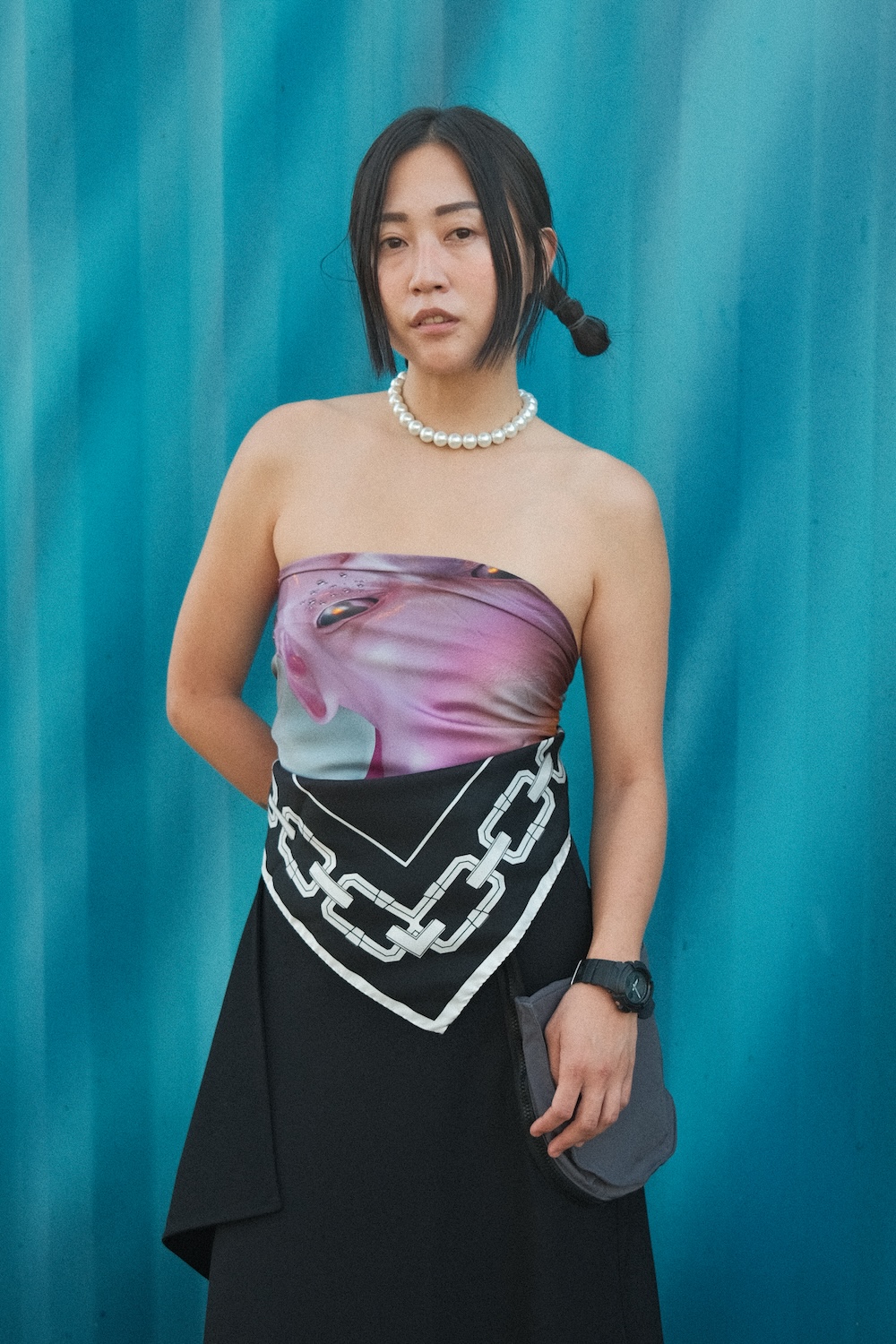
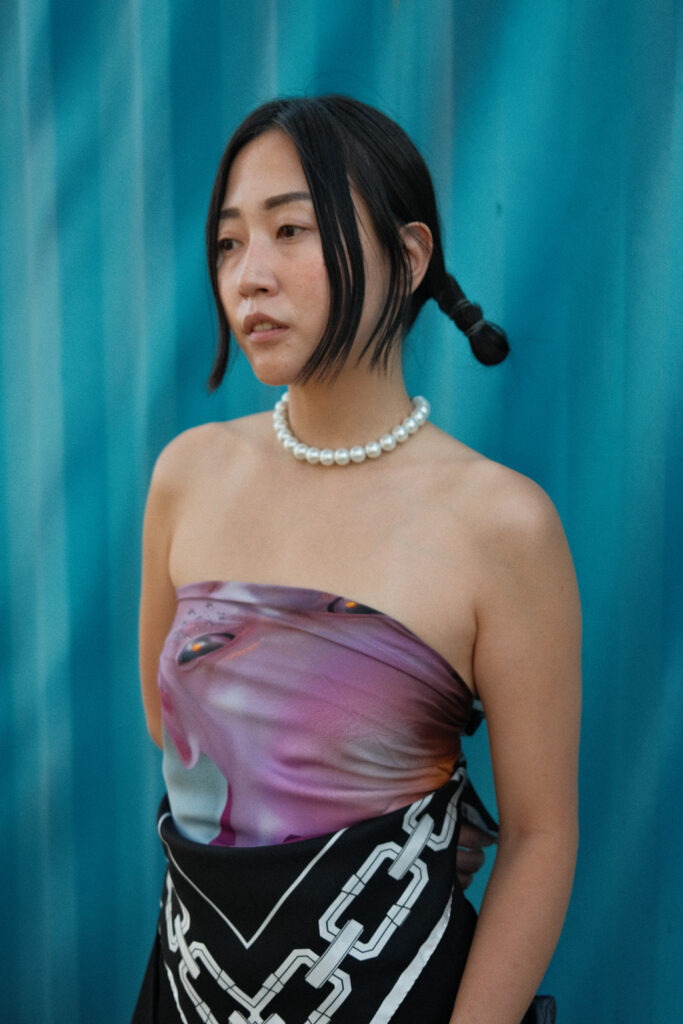
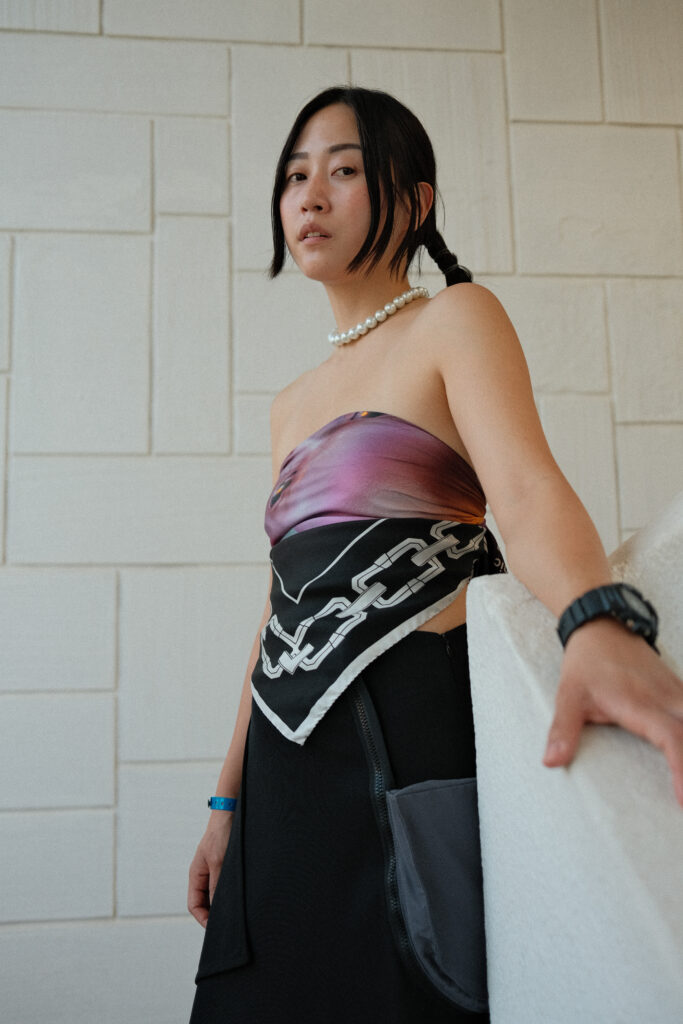
Marcus Boxler: Your style isn’t just limited to music. Your fashion sense is quite iconic. Last time we met, you were wearing a bandana top, wrapped around your body, combined with a – Id call it – mediterranean pearl look. What drives your style choices?

Shubostar: Yeees, I remember that look. It was a piece from the newest collection collab of A Better Mistake and Electronic Beats. It’s called: Altered Ego. I believe in expressing myself fully, whether it’s through music, art, or fashion. Usually, I love street style. But at the same time, I can say with a certainty of 100 percent: That I’m minimalist. 

Marcus Boxler: Really?!

Shubostar: Absolutely. I don’t like to buy many clothes. But whenever I choose something, I need it to be wearable for a week and not have it feel boring. That’s my measurement. It has to feel comfortable and I have to be able to wear it for a show or if I go to the supermarket. Wear it for ten years and exchange it, only if it’s ‘broken’.

Marcus Boxler: That is the core of Minimalism. I think we grasped a little bit of the real Shubostar”. Is there also an altered ego of yours, that you would like to share about? 

Shubostar: Altered me? I think every version of me is altered as soon as I leave the doorstep and interact with other people. No? 

Marcus Boxler: Indeed, but its the same you. Or, are you changing your behavior in the presence of other people? 

Shubostar: Freaking, yes! Don’t you? I mean I love to socialize with my peers and I love to bring an uplifting vibe and happy mode to the group. But sometimes, after a few days of interacting, I need some time alone. To recharge the battery. And then run the game again. 

Identity is representation, transforming communication into community. Picking up the phone with a colleague or with a friend sets a completely different tone, and therefore creates different narratives throughout all social entities. Though alone at her computer, Shubostar was always part of vast communities. Either online or on the dance floor. This duality of being physically alone but virtually connected influenced her style and sound. 

In essence, Shubostar’s music is where her real self meets her ‘altered ego’, creating tracks that resonate both in clubs and in the hearts of those who listen. 

Credits

Photography · Marvin Jockschat for Telekom Electronic Beats 
Shubostar is wearing Telekom Electronic Beats x  A Better Mistake 


Miriam Cahn

Miriam Cahn, Aus der wuste, 2016
Oil on canvas, 145 x 190 cm
Photo: Oliver Roura. Courtesy Private collection.

The compelling and ethereal paintings of Miriam Cahn: seeing the unbearable and revisiting rules 

Miriam Cahn (born 1949 in Basel, Switzerland) started her career in the 1970s and initiated painting at the age of 45 in the 1990s in Switzerland. Awarded the 14th Rubens Prize of the City of Siegen (previously obtained by Cy Twombly and Francis Bacon) on June, 26th, 2022, an honour combined with a solo exhibition at the Museum für Gegenwartskunst Siegen, Cahn is one of the most highly regarded artists in Switzerland. Having her work exhibited in numerous international shows and exhibitions, including documenta 7 and 14, Kassel (1982 and 2017), the Venice Biennale (1984), Kunsthalle Basel (1983), Museum of Modern Art, New York (1984), Fundación La Caixa, Madrid (2003), Neue Nationalgalerie, Berlin (2004), Badischer Kunstverein (2014) and Kunsthalle zu Kiel (2016) and many diverse exhibitions across Europe in 2019. When I first discovered her work at the Institute of Contemporary Art in Milan (2022), at the GEZEICHNET exhibition (curated by Alberto Salvadori and Luigi Fassi) I was instantly taken aback by her use of the sometimes garish colours in her oil paintings. Cahn though initiated with black and white charcoal drawings. She states her method of painting and drawing was back then similar to a performance whether it was on the floor until her back could not take it any longer, or on tables, or standing up with the canvas against the wall as she proceeds now, with oil painting. With a more diversified use of colours, Cahn was able to monumentally picture real scenarios.

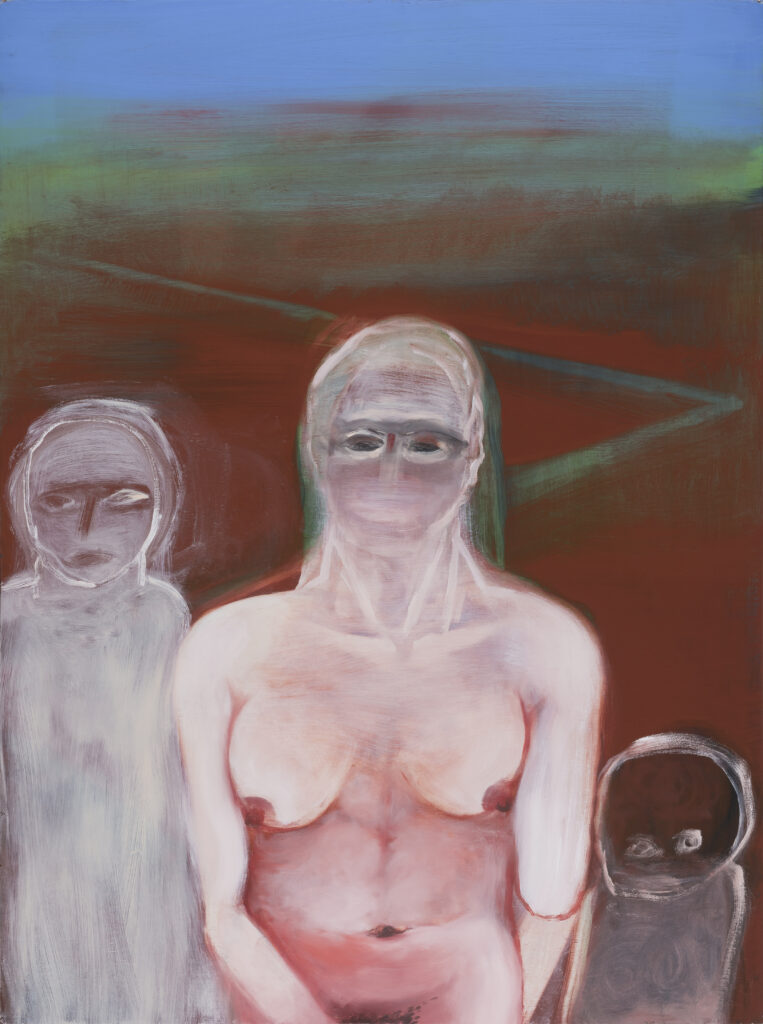
Miriam Cahn, Mutter kind kind, 2016 + 19.03.2017 Oil on wood, 118 x 88 cm
Photo: François Doury
Courtesy of the artist

Ghostly bodies form compelling and ethereal paintings which in turn express the incredible vulnerability of human beings, the uncertainty of life and death, the fragility of nature and what humanity in this day and age is. Womanhood, fecundity, strength, sex, intimacy, violence, war, refugee crisis, oppression are some of the recurring themes in Cahn’s artworks. It is exactly because Cahn is human that she explores these thematics. As the Swiss artist puts it, “everything is influence” for her practice. Flora, fauna coexist with mutilated bodies and brutal sex forming an absurd quasi monstrous but deeply emotive complexity which is mankind not her “invention as she explains. 

Miriam Cahn, Blutungsarbeit, 10.11.1994
Chalk on paper, 54 x 77 cm
Courtesy Private collection, Switzerland

Cahn’ works from the last five decades show her artistic development as well as the evolution of our world and its contradictions, engaging the viewer in seeing the unbearable from genocides, war, displacement, and discrimination ultimately shaping human nature. One may remember Stephan Chorover’s book ‘From Genesis to Genocide: The Meaning of Human Nature and the Power of Behaviour Control’ (1979) in which he explores the blurred lines between psychology and politics, between meaning and power. Chorover stated that theories of human nature linked with society’s efforts to solve serious social issues could be seen as powerful instruments of behaviour control.

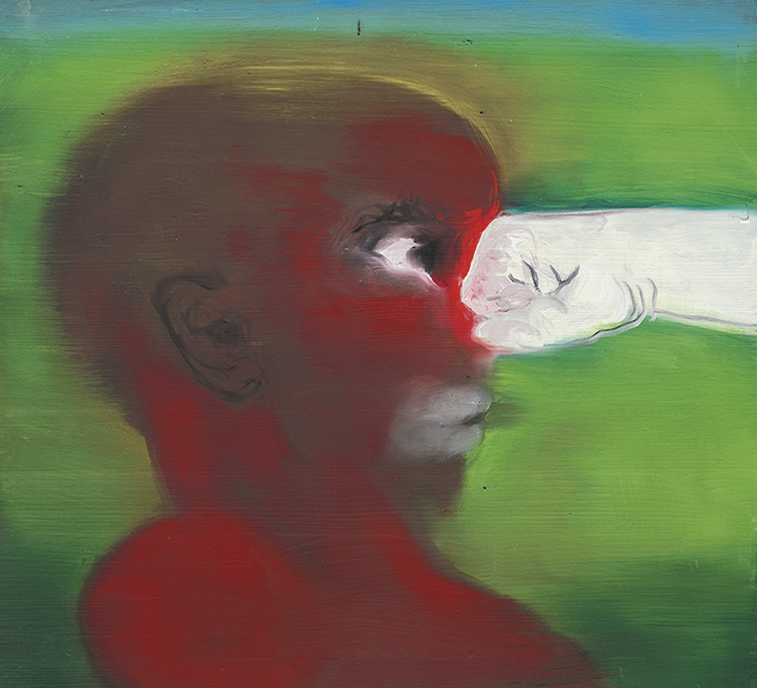
Miriam Cahn, Weiss schlägt schwarz, 22.07.2018
Oil on wood, 50 x 54 cm
Photo: Markus Tretter
Courtesy Private collection.

A step into learning from our mistakes to be able to make progress as with Cahn’s paintings, we are invited to reflect on the horrors of the past and the violence suffered. Endless possibilities are left to explore in Cahn’ canvases in the aim of revising rules already established by societal norms trying to conform us.

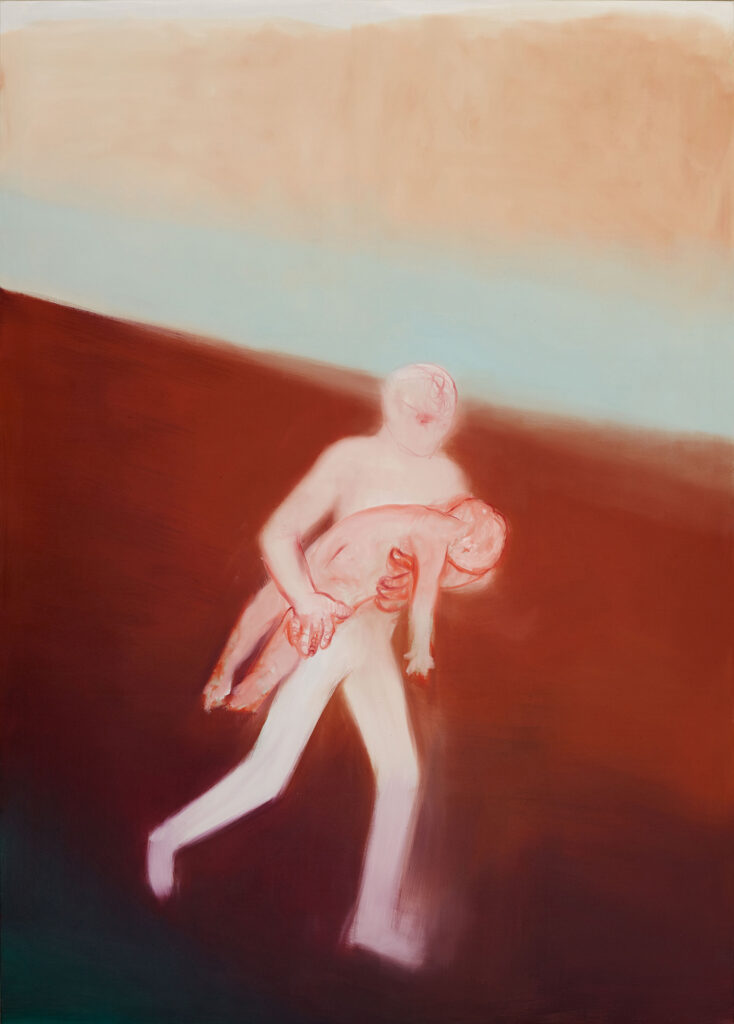
Miriam Cahn, Rennen, 2013
Oil on canvas, 280 x 200 cm
Photo: Reto Pedrini
Courtesy Galerie Jocelyn Wolff, and Meyer Riegger, Berlin/Karlsruhe

As human, Cahn succeeds in portraying everything that attracts us and repulses us and delivering a contemporary take on the world as it is now. When asked her opinion on the world as it is now, Miriam Cahn states “the classical: NO COMMENT!”

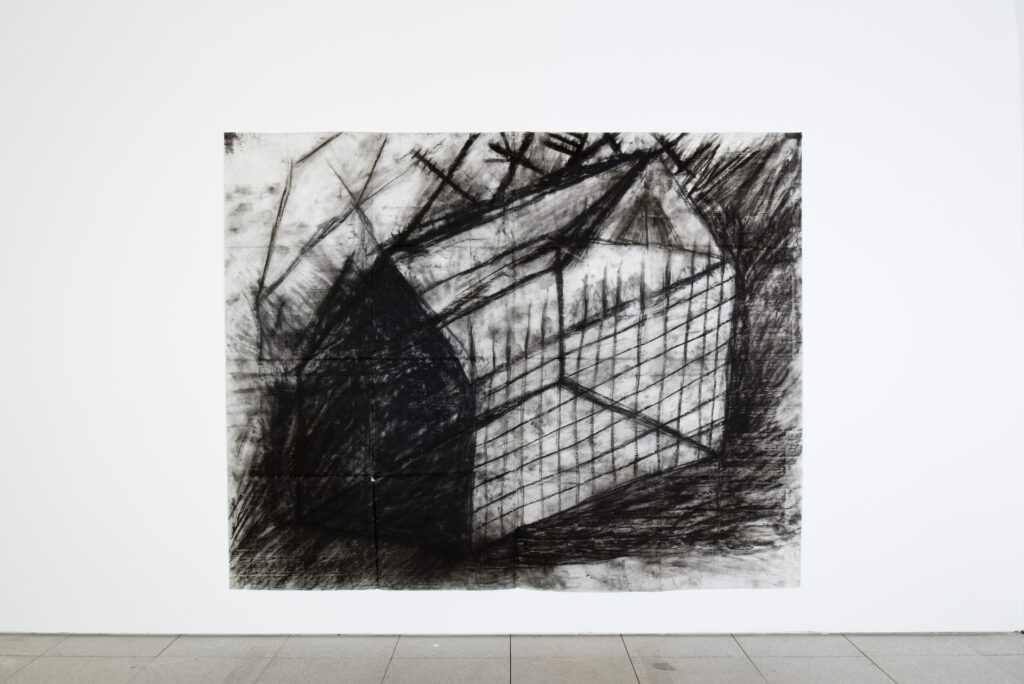
Miriam Cahn, Gitterhaus, 1982
Chalk on paper, 210 x 245 cm
Photo: Oliver Roura
Courtesy Galerie Jocelyn Wolff

Credits

Paintings · Courtesy of Miriam Cahn, Private collections and Galerie Jocelyn Wolff, and Meyer Riegger, Berlin/ Karlsruhe

Elizabeth Glaessner

Elizabeth Glaessner, Ocean Halo, 2021

Therapeutic gateways to an inner world, Elizabeth Glaessner uncovers the realms of the psyche conjuring up a surreal universe in a constant state of metamorphosis.

Elizabeth Glaessner (born 1984 in Palo Alto, California) is an American painter and artist whose work express meanings beyond the figures she paints. Inspired by heroes of symbolism such as Edvard Munch, Odilon Redon, personal memories and art history, Glaessner places the visible at the service of the subconscious and re-contextualise mythological elements in her dream-like paintings. With her distinct use of colour, such as the recurrent visceral acid green as well as her technique of dispersing pure pigments with acrylics, oil and water, Glaessner creates visually striking works that tap into our primordial unconscious, opening a world where surroundings and people are intuitively blurred. There is a sense of fluidity and openness in Glaessner’s work, inspired from her childhood memories and an understanding that the world as it is today cannot be limited by binary thinking. Glaessner thus pushes the conventional societal boundaries and moral codes, and uncovers the realms of her psyche conjuring up a surreal universe in a constant state of metamorphosis. 

Therapeutic gateways to an inner world, Glaessner’s paintings are indirectly a reflection of our time and a window to possible futures.

When did you start painting? Were there family influences at all? 

My mom studied and taught art, so I started drawing and painting at a young age. Her dad  was an art lover as was my grandmother on my dad’s side. Her twin brother Friedreich was a textile designer and my great aunt Mitzi was a watercolor painter. 

Elizabeth Glaessner, War in the Middle Ages, 2022

You are originally from Houston, Texas but moved to New York. How have those two distinct landscapes influenced your practice? 

I grew up in Houston, my parents moved there from California when I was 3, and I moved to New York in 2007.  Houston is a large sprawling city with lots of space. It’s hot and humid and the vegetation and landscape is pretty swampy. It also flooded a lot so it’s a pretty wet climate on the east side of Texas. Lots of frogs and lizards. I’m not sure how much has changed over the years with all the new development. New York is much more fast-paced. Everything is compact and efficient. I love being able to commute without a car and my community is very important here. I’ve gained so much from being able to visit friends’ studios and having access to so many galleries and museums. But it’s very different working here than in a place like Houston and it’s getting more difficult with out of control rent and limited space. There’s always a tradeoff.

Elizabeth Glaessner, Earth Bound, 2022

There is always a sense of fluidity and openness in your work, on different levels, pushing away moral codes and societal limitations. Bodies and genders are interchanged and intertwined. Why those particular thematics?

I grew up in a pretty chaotic environment. When my parents divorced, my mom met an ex nun who moved in with her. The nun was obviously very religious and used fear tactics and violence to maintain power and control. We grew up in two very different realities. My dad’s parents were Jewish and escaped the Holocaust from Vienna so he grew up agnostic and didn’t impose religion on us. Eventually the nun left, I remember feeling overwhelmed with a sense of freedom. So I learned pretty early on the destructive effects of imposed morality, fear and repression and also became aware of our incredible ability to adapt and change.

“I also quickly became aware that we’re quite complicated and can’t thrive in a world limited by binary thinking.”

Elizabeth Glaessner,
Professional Mourners, 2020

Your work feels like an invite into your psyche and dystopian spaces in which the subconscious and conscious coexist together. Do you see your practice as a therapeutic tool and thus liberatory? 

Yes, initially painting was a way for me to escape but also try and understand a surreal and oppressive childhood full of contradiction. I started seeing a therapist at a young age but couldn’t talk about anything.

“Drawing and painting was a tool to deal with experiences in a non-literal way that I wasn’t ready to communicate verbally.”

It’s a survival tool for many people. I’m lucky that I had that.

Elizabeth Glaessner, Misfortunes of the City, 2022

You have cited Edvard Munch, Odilon Redon as references. Who/What else inspired your style?

The first works of art that I spent time with as a kid in the museum of fine arts in Houston were Bougereau’s the elder sister (but just for the feet), Derain’s landscapes with red trees and Turrell’s tunnel. These aren’t artists that I look at now but I think the effect that they had on me at a time when I was forming memories is relevant to subconscious decision making in painting now. I have looked at and continue to look at so much art throughout history – it plays a large role in how I conceive of my paintings so it’s very difficult to just name a few. I look at different artists for different reasons. For example, Cranach the Elder and Carroll Dunham because of how far they are able to take one idea or theme and stretch it with subtle formal variations. Or someone like Chris Ofili or Francesco Clemente for color or feeling, Birgit Jurgenssen for the body and so on.

Elizabeth Glaessner, Escapism, 2022

Some of your favourite readings? What is something/someone you have recently discovered and has marked you?

I’m currently reading Klara and the Sun by Kazuo Ishiguro. I think he’s a brilliant writer. I also loved Never Let me Go. Haruki Murakami is one of my favorites. I’ve recently been thinking about Audre Lorde’s Sister Outsider, especially “uses of the erotic: the erotic as power” and how she writes about language in “Poetry is not a Luxury”. And my friend Aisling Hamrogue recently suggested I read a chapter in A Thousand Plateaus by Deleuze and Guattari called “One or several Wolves” discussing the body without organs which made an impression.

The colours used in your paintings offer such vibrant hues. Where does this palette come from?

It’s incredible how personal and associative color is. I have visceral reactions to certain color combinations. It’s often the thing that causes me to repaint a painting – if the color isn’t working with the content, I’ll start over with a different palette. Usually the under color shifts the tone of whatever is on top which can lead to unexpected combinations. There’s an element of intuition but I also think about symbolic associations of color – both my own which have been developed through repetition as well as learned associations. 

Elizabeth Glaessner, Charley Horse, 2022

Some colours are more recurring than others, such as acid green. There is something really appealing to it but it also feels like a warning. Why that green in particular?

I’ve been drawn to that green since I was a kid. I’m sure it comes from many places. Houston is a swampy green city and I was always outside. I was very close with my grandmother who introduced me to painters such as Klimt and Kirchner who also use that green. It’s a color that I feel comfortable with.

“That acidic quality oozes an uneasiness which I think is reflective of what it feels like to be alive.”

Elizabeth Glaessner, Heat Map, 2022

Which mediums other than painting would you like to explore with? 

There is an endless amount of learning I still have to do within painting. I’ve done silk painting – which is something I’d like to do again at some point. I’d also like to explore paper making, priming my surfaces in different ways, experimenting with different mediums when I’m pouring paint. I’d like to do some monotypes in a print studio and try different printmaking techniques. I’d love to play around with clay more but painting is keeping me pretty occupied at the moment. 

Elizabeth Glaessner, Sphinx and Friends, 2022

Could you tell us about the process you go through when you create? 

I usually start with several works on paper that are done pretty intuitively. Some drawing, some ink and gouache. First I pour and then use the color fields to find forms which I meld with preconceived ideas so there’s a balance of control and freedom. I look at these works on paper as I’m making paintings on canvas on linen, whether it’s the color and theme, or just the composition or energy. The surface of the larger paintings is often pretty built up because I change so much as I’m working. Sometimes the composition will work on a smaller scale but doesn’t feel right when I’m working large. I usually get to a point about halfway through where I feel like I’ve completely lost the painting and then have to make some big move to totally change it and dig my way out. But I’ve learned that that is just part of how it’s made so I trust it.

What are you working on at the moment?

I just finished my solo show “Dead Leg” which opens September 3rd at Perrotin in Paris. I had a pretty busy year so I’m looking forward to traveling a bit, taking some time to set up my studio again, finishing some books I started, doing some color exercises and starting a new series of works on paper. 

The theme of this issue is IN OUR WORLD. Are your paintings a reflection of our time or are they a window to the future you envision?

I think they’re both. 

“Definitely a reflection of our time which wouldn’t exist without the past and which hints at possible futures.”

Credits

Artworks · Courtesy of Elizabeth Glaessner and Perrotin

Blackhaine

Blackhaine’ poetic yet brutal investigation of reality with unique soundscapes, choreography and cinematographic visuals.

Tom Heyes, also known by his artistic moniker Blackhaine is a rapper, poet and choreographer from Lancashire, UK. Known by many for his projects with Kanye West (Donda 1 and 2) and more, the multidisciplinary artist has forged for himself a solid path, establishing his own unique artistry. Chicago drill, industrial, ambient, experimental hip hop are some of the genres combined within Heyes’ unique soundscapes. With producer Rainy Miller, Heyes worked on delivering visceral releases first Armour, then And Salford Falls Apart. Released in June 2022, Armour II follows the trail of the two earlier bleak releases, perhaps an ending, nonetheless part of the bigger journey the audience embarks on when listening to Heyes. With tracks featuring the likes of Blood Orange, Iceboy Violet, Moseley, Richie Culver and Space Africa, Heyes is also giving space for other artists to enter his universe. Re-contextualising his anger, Heyes delivers poetic yet brutal narratives which juxtaposed with cinematographic visuals, immerse the viewer into Heyes’ inner world. Choreography plays a pivotal part in his practice as he continues to investigate reality. 

Here photographed in London by Berlin-based photographer Joseph Kadow, we witness an artist in his element, creating as he breathes, once again narrating a story of his own. Heyes talks through his genesis, the process and inspirations behind his body of work, spanning across choreography, music, spatial design. 

When and how did you start? 

I’ve been interested in film since I was young, from there I started to learn about sound and movement.

I held an interest in art and between jobs managed to make some decent pieces and work on other’s people’s visions for quick cash. 

During the pandemic I started creating my own film and sound pieces, releasing my first track Moors – and some film projects I created + a project named Armour made in collaboration with Rainy. 

Blackhaine is a node to the French cult classic La Haine on violence and inequality in the suburbs of Paris. You come from Lancashire, UK. How has the landscape of living on the margins and of social and regional inequality, influenced your practice? 

I’ve always felt detached from the current sound, I think being in isolated yet restricted places; Blackpool, Blackburn ect you have no expectations of being accepted by a mainstream crowd. This gives room for experimentation. 

I read Passing Time by Michel Butor recently and was inspired by the detail he created in his idealised Manchester, taking monuments/icons of the city and glitching them. It’s what I had been doing to Lancashire. 

Darker versions of locations feature in my work such as the M6 or the Moors, Rawtape and I used scans of Blackburn high street and Blackpool tower to create a world in Hotel. In my writing I talked about experiences here in tracks like Saddleworth or Stained Materials. 

“Using ultra realistic scenes that verge on boredom and taping a bleak-psychedelic lens to the camera was a huge influence in building the Blackhaine world.”

How is Manchester’s cultural environment and how is it influencing your writing? 

The environment is too self contained, and concerned with itself and it’s history when what we should be doing is looking outwards and ahead. There’s not much interesting happening here at the moment because there’s too many people left over from the 10s. 

The city hasn’t impacted my writing aside from being influenced by Joy Division. 

Drill, experimental hip-hop, ambient, industrial and electronic are genres part of your soundscapes. Are you more influenced by Chicago Drill or Brooklyn Drill? What are some of your musical influences? 

I’ve been into Chicago Drill since the start, however it was UK Drill that got me into writing.
I would say the industrial sound was an influence but the earlier post-punk side, not as much what’s happening there now.
At the moment I’ve been listening to Carti, Zone 2 and some more experimental stuff whilst I
work on my album. 


First Armour, then And Salford Falls Apart. How does Armour II succeed to these? 

There’s the obvious narrative link.

“Sonically I used a softer palette and wrote about a contracted hate that became inverted by gradual unease and paranoia.”

I put more focus on working with melody and traditional songwriting before my album. 

Armour II is death of Blackhaine before a burial. 

How do you usually work with producer and composer Rainy Miller? 

I write alone and with the ideas Rainy sent, before we sent parts back and forth online but with Armour II we started renting a studio together with Space Afrika so we could spend time in there. 

You showcase a unique choreography rooting itself from an extreme creative process. Could you talk more about this? Who are some of your favourite choreographers or a contemporary dance piece that moves you? 

My choreographic style is rooted in perversion and deconstruction of traditional technique, not an anti-technical statement but a separatist practice. I utilise improvisation and sculptural design in the process instead of overt unison structure, and when the work features this form of choreography it’s effect is exhaustion and depletion to the body/mind of the performer, allowing accessibility into new realms.

Choreography a subliminal art, the same modes I work in with writing and sound. The narrative structure of Armour II leading from my previous work is a context for myself and the listener however it is no anchor, this is world building with intent to suture between and deconstruct inside of reality, whilst considering base reality and boredom, hence the exhaustive features within my work. I was initially more interested in examples of choreography I could find in day to day life, the way the bodies on top deck moved whilst the bus turned a corner, a drunk body or the result of excessive strain on specific muscle in the arm.
Pre-tense is naturally prevalent in choreography.

“I think embodiment kills honest movement to a degree and my service as an artist is to
investigate reality within abstract art.”

My favourite choreographer is Tatsumi Hijikata, I developed my practice whilst watching Butoh videos and abusing drugs in my room and hotel apartments, around the time of the Manchester spice epidemic.
I’m watching a lot Gisèle Vienne, Louise Vanneste, studying Sun Ra’s relationship with dance and sound. I would say Philippe Grandrieux’s use of movement in his work as well as Steve McQueen’s in Shame has impacted my choreography also. 


How do you envision the live shows and how do you feel about finally being able to perform gigs in front of physical crowds? Visceral stage performances, atmospheric, intimate and raw sets are some of the comments from people who have already been to your live shows. How do you want the listening experience to be? How do you approach the spatial design situation too?

It’s great, during the first tour I worked intensively with spatial and atmospheric design.

“I want every show to be different, switching between shows of an exhaustive release for the audience and myself and shows that focus more on subtleties with performance and design.”

I work with heat and scent a lot, as well disorientation from lighting source. Playing drill between harsh noise/drone, these are elements that I work with impulsively, so I live edit the lighting, track list and other utilities whilst on stage with my team.

I don’t believe that playing all the hits equals satisfaction for the audience I want to create a journey for people to follow, experiencing the themes within my work physically and mentally having to endure moments discomfort before being allowed to feel gratification by silence or melody.

The feedback I have had has been great, everyone I have spoke too has had a different experience I’m grateful for everyone who comes to a Blackhaine show to experience. Thank you.

How did your collaboration with Blood Orange and Icebox Violet for ‘Prayer’ unfold?

I had the ideas of the track for a while, I was sent a rough loop from Rainy that triggered something in me. I kept revisiting the narrative and developing this film scene I had in mind, even down to the shots I wanted in the film that was made.

In And Salford Falls Apart and previous releases I didn’t work with other voices. A design focus of Armour II was to curate outside artists and let them inhabit my narrative, even to allow this to influence and lead me at times. I wrote to Iceboy Violet and Blood Orange to ask them to feature on the track and they delivered these beautiful verses back.

The theme of this issue is IN OUR WORLD, in your mind, what does England mean to you?

“Apathy.”

Now that Armour II is out for everyone to experience, what is next for you? 

I am building an infrastructure named Hain. This will act as a container for future work/curation and ideas beyond Blackhaine and an investment in culture.

Team

Talent · Tom Heyes (Blackhaine)
Photography · Joseph Kadow
Creative Direction · Jade Removille
Fashion · Azazel
Grooming · Linus Johansson
Photography Assistant · Masamba Ceesay
Fashion Assistant · Olivia Abadian

Ramla Ali

Ramla Ali’s enlightening fight in and outside the ring 

Professional boxer Ramla Ali (born in Mogadishu, Somalia) is definitely one of the forces of change of our generation. The featherweight boxer became a voice for refugees as she herself had to seek refuge with her family in the United Kingdom, from war-torn Mogadishu in Somalia in the late 1990s. Having earned a first-class law degree at the respected SOAS University of London, and delving further into her successful professional boxing career, Ali is forging for herself and others a trailblazing path ever since the undefeated boxer (7-0 in her professional career including two knock-outs)  won the English title in 2020. Making history at the Tokyo Olympics by earning a bronze medal and thus becoming the first Somali women to compete in boxing, at the Olympics, Ali is showing through the years, her perseverance despite what she has been through, and her determination in changing the game. Earlier this August, Ali performed a career stepping fight against García Nova in Saudi Arabia, as the undercard on the Anthony Joshua and Olexandr Usyk fight. Her career in fashion as a model and public figure has also been a way to provide representation for young women. As a Unicef ambassador and having funded the non-profit organisation Sisters Club, in 2018 in London, providing a safe space and free sport classes to women, Ali’s activism serves an amplifier for social causes, more specifically women’s rights and equality.

Ramla it is such a pleasure and honour to have you as one of our cover stars for this issue. 

Firstly, I wanted to congratulate you for your recent wins on your fights against Agustina Rojas at the o2 in London and against García Nova in Saudi Arabia. How are you feeling now? 

Honestly, A little tired. I had two back to back camps with little time to give my body any rest. But I wouldn’t change it for the world.

“I love boxing, I love being in the ring. It’s the only thing that gives me purpose and the only thing that allows me to feel brave.”

A career stepping stone recently was your now historic fight in Saudi Arabia earlier in August against García Nova, as the undercard on the Anthony Joshua and Olexandr Usyk fight. How was the preparation leading up to it? 

This fight itself was the most important of my career and throughout the training camp there was a pressure to perform and showcase women’s boxing, as I wasn’t just representing myself but also all women in combat sports. So the world can see that we deserve the same platform and opportunities as our male counterparts. My training was located in Southgate, adjacent to Compton in Los Angeles under the guidance of legendary coach Manny Robles who has been responsible for a number of world champions. It’s not an easy regime with Manny and I’ve chosen one of the hardest gyms in the world to train at but with this, comes the experience of being alongside some of the greatest talents in the sport today.

“My life has never been easy so I naturally have chosen the hard path to get prepared. “

It has only been since 2012 that Saudi women were able to compete at the Olympics in boxing. Your presence there is also a step towards equality in the country. What was it like, as a Muslim woman to be able to fight professionally in your holy land? And how do you wish this impact the future generations?

2012 was when women were first allowed to compete in the Olympics but Saudi Arabia as a country only allowed the participation of women in combats even more recently than this, my fight recently being the first professional female fight in history there. The hardest part though as I had the support of the promoters, and the region was really trying to educate people on why we choose to do this.

“My goal has always been to break down barriers for women and this competition allowed us to continue pushing for greater equality and inclusion in our sport.”

I was also fortunate enough to perform Umrah whilst in Saudi, which was an incredible experience getting to visit Mecca for the first time in my life.

How do you usually work with your coach and how was it to train under the supervision of the legendary Manny Robles? 

Working with Manny has opened my eyes to the very elite level of boxing training. Whilst in Los Angeles, I train twice a day, six days a week. Followed by one additional remedial session, two sports massages and one physiotherapy session (dry needling, cupping etc) and a further 2-3 sessions spent in a Hyperbaric Oxygen chamber. I do two sprint track sessions a week and one long run. I spar three days a week, followed by further boxing sessions for either technique or conditioning and then I also employ world famous strength and conditioning coach Mattias Erbin from Argentina who looks after all my strength, conditioning and recovery work. Mattias has worked with Lucas Matthysse, Jorge Linares, Brian Castano, Jamal Herring, Vergil Ortiz to name a few.

Do you have a favourite match of yours and what was so special about that fight?

In terms of amateur fights, it would have to be my African Zone Title gold medal in Botswana in 2019. The whole experience was just amazing, it was my first time at a championship in Africa which is the opposite of competitions in Europe or further a far. The fighters are tough and don’t stop but there is a real warmth and friendship between the countries and the teams which I loved. In terms of my favourite pro fight in boxing it would have to be Saudi because of the importance of the occasion and the fashion in which I won.

With each of your fights, it must be a constant progression and constant learning path. How was your journey to the Tokyo Olympics? 

The journey to Tokyo over the last previous five years was a real adventure with my husband/manager Richard, who was also my coach at the time during my amateur days. From getting lost at 2am in West African ghettos trying to find our hotel with signal and not being able to speak the language, to desperately finding cheap place’s to wash our clothes in the slums of New Delhi before catching a flight to another tournament somewhere else in the world. Experiencing an Olympics Games during Covid. There was a lot of up’s and downs. I don’t feel like I got the full Olympic experience, but im so glad to have competed.

What have been the biggest challenges you have had to go through and overcome? 

One of the biggest challenges like most female athletes in a male dominated support, is simply being a woman.

The biggest challenge for me initially was the lack of funding and support I received when competing for my native Somalia around the world. If people think it’s hard to compete as a woman in sport, it’s even harder as an African. I honestly don’t know how a lot of these incredible east African runner’s do it. I’m often told that women’s boxing is booming now and more opportunities are coming. Which to some degree is true but until more women tune in and support female athlete’s its hard to command pay and opportunity equality when our viewership is so much smaller than males.

When I fist started boxing, female boxers were so far and few that I didn’t even have a changing room in my local club. I either had to wait for each boy/man to get changed or walk home wet and sweaty.

Who/what has inspired you? 

I’m inspired by so many. Jackie Robinson because of what he had to endure on his journey. Venus and Serena have done so much for women of colour in sport. Ilwad Elman in Somalia is a hero of mine. 

You founded the non-profit organisation Sisters Club in 2018, in London which focuses on providing women with access to different sport disciplines including football, boxing and more.  Could you talk more about it and why you have created it? 

Sisters Club is a charity I founded in January 2018 which has recently taken on funding support from Nike & Lululemon which provides free weekly boxing classes to up to 300 women across London in four locations. The classes are specifically aimed at religious and ethnic minorities and those that have suffered domestic abuse to learn self-defense through the sport of boxing. But it is an inclusive class that welcomes all women from all background, races and beliefs. We have recently started hosting events across other sports including rowing, running, basketball and football as well to give our ‘sisters’ the chance to experience others disciplines. My hope is to expand the initiative to the U.S, Africa and the Middle East with the help of future partners. I started it out of the need to ensure women who look like me and have shared experiences are not left behind due to their background or their financial situations. It was born out of a need to create a community and platform that provided the opportunities I felt I never had growing up.

Do you have any future initiatives planned in your native Somalia?

I do hope to have the chance of expanding Sisters Club into Somalia at some stage.

You have mentioned before that the career of a boxer is a short one. Have you already envisaged what you would like to do after?

I do live day by day and try to appreciate the experiences and opportunities that come to me in the present but yes I have already begun to lay the foundation for what I hope to be doing for the next twenty years post sport.

The theme of this issue is IN OUR WORLD. Which impact would you like to make in this world? 

A quote that the great Mohammed Ali once said really resonates with me ‘your service to others is the rent you pay for your room here on earth’.

“For me, of course I’d love to be known for being an incredible boxer, but more than that, I want to be remembered for how much I helped others.”

Team

Talent · Ramla Ali at IMG
Photography · Dafy Hagai
Fashion ·  Clara Mary Joy
Makeup · Megumi Matsuno using Dior Capture Totale super potent serum and Dior Forever
Hair · Joe Burwin
Set Design · Haleimah Darwish
Photography Assistant · James Clothier
Fashion Assistant · Diana Scarpignato
Special thanks to Richard Moore

Designers

  1. Coat MM6 MAISON MARGIELA, head scarf vintage RICK OWENS, boots Vintage and bracelet Stylist’s own
  2. Jacket ADAM POULTER, skirt and shoes DIOR and ring CARTIER
  3. Jacket and shoes DIOR, shirt Stylist’s own, shorts vintage and ring CARTIER

Lila Steinkampf

Lila Steinkampf’ jelly cakes form an edible sensual experience that becomes a part of one’s body

Jelly cakes as objects of desire prelude a sensual dessert experience that cake artist and food stylist Lila Steinkampf makes. She works with jelly as a temporary sculptural medium that can be consumed while infusing a pure sensual experience, swinging between the art of sweets and the pleasure they give. She tells NR that the fact is that jelly cakes can be eaten and therefore becomes a part of your body, making them an accessible artwork. “It makes you stop for a second, try to grasp what you have in front of you. It makes you talk about the future of food,” she says. The kinship her consumers have with her jelly cakes moves beyond the visible form of food. The slow slide of the knife’s hilt onto the gelatinous surface sends an electric buzz on the skin. A shiver follows as the lilac whip cream and glossy tapioca pearls drip gradually. A slice of Steinkmapf’s treat invites the consumer to take the plate to their room and ravish the dessert at a languid pace, alone.

Steinkampf trained as a communication designer and worked as a research-based graphic designer and visual journalist before shifting toward cake making and designing. Jelly comes through as her go-to medium since she believes it toys with her creativity and allows her to explore her visual storytelling. “I could not find this space in art institutions and in my practice before. I feel free to fully express myself now, even if it is commissioned work,” she says. She adds that she can get analytical in the way she prepares and designs her jelly cakes, and the symmetry and intentional decorations of her works testify to her statement. Metaphors and allegories bond with her edible sculptures through her use of flowers, pieces of jewelry, feathers, olives, fruit, and soft colors.

Each cake she designs takes several hours to produce. “I am working in steps, but the cooling process interrupts the design process. Before that, the development of the concept and flower selection takes place. Every piece is a custom design, a personal exploration of a new technique, or color research,” she says. The versatility of her material means she can reheat and cast it again in any shape and form. She molds the jelly and twists it to her benefit, unlike baked chiffon cakes that might not fold under her desired shape and outcome. Ingredients-wise, nothing becomes discarded as Steinkampdf repurposes the leftover materials from her previous cakes – such as the fruit and flowers – to design a new one, and shares them with the people close to her. 

When she says she wants to explore the depth of her visual storytelling, she means well. Two golden cherries top her two green, rounded jelly cakes for her commissioned work with Adidas. Petals of flowers scatter around the presentation, adding up to the soft and striking features of her creation. For another order, she sculpts a rose from a red-hued jelly, injects a real rose in the middle, and places everything inside a heart-shaped, transparent cake. When sliced, the cake displays a broken heart with uneven cut lines, jagged by the knife. Sometimes, she fills the inside with strands of blonde hair, and once, she planted a curvy phallus-like design in the center of a whipped-covered cake. Steinkampf needs no words to describe why she does what she does. A glimpse of her creations is enough to flirt with the viewer’s imagination. What follows next are the salivating mouths these cakes are poised to feed.

Since her works are also through collaborations and commissions, brands and clients give her the freedom to translate their briefs and requests, and Steinkampf oozes excitement as she brainstorms what visuals she can make out of the verbal and written words. “It pushes me to go out of my comfort zone and risk developing a new visual language. There are times I feel nervous about the end product and how it is going to be perceived by the client, but until now it always turned out in the best way I could have imagined. This is the best way I can think of working – there is a balance between my own approach in tryouts as well as freedom in commissioned work,” she says.

The surroundings of Steinkampf growing up influence the flowers present in her design oeuvre. Her grandmother grew her own flowers in her garden and would pluck the bloomed ones to decorate the community church every Saturday. Steinkampf would join to assist her grandmother, and they would prepare huge bouquets inside the church, especially the altar. “By doing this, she taught me a lot about color composition and set design with the altar as the stage,” she says. Turning to her parents, both are gardeners who fostered Steinkampf’s curiosity over gardening. The cake artist and stylist owes her green sensitivity to the spacious garden her family had while growing up. She learned to identify what they needed to grow in their garden and how to let them bloom, acting as her parents’ novice gardener. 

Today, Steinkampf is far from being called a novice in the floral department. Working with flowers so closely for her cakes has made the artist and stylist aware of the natural crevices, waves, and bents of the florals, allowing her to marvel at the detailed structures found in every bloom. “It never fails to amaze me every time I spend time with them. I started deconstructing the blooms to see how their expression changed. This is what defines the detailed look of my cakes today,” she says, who adds that living in an urban environment now and being dependent on flower shops changes and informs her approach. “The geographical trading routes of the cut flowers market are determined by exploitative working conditions which we should be aware of while working with flowers.”

When Steinkampf started making cakes for private birthdays, she soon realized it formed a bond between her, the person who commissioned the work, and the people who received her cakes as presents. An element that freely runs in her work ethic today lies in how she treats what she makes as a personal token to gift and share. At the same time, her desserts spring as a genre of deconstruction to which she eventually adds layers visually. “This is a beautiful image for me. The consistency of the jelly forces you to invent something new if you want to share. The basic elements connect you with the other people on the table, but every served dessert turns into its own world. Jelly gets this magical shine when it is cut, and the light finds its way through. Combined with flowers and fruits, it starts to tell its own story staged in a small bowl,” she says.

Opting out for a less-subdued, more-pronounced body of work, Steinkampf diverts the attention of her consumers from looking at cakes solely as sweet treats to fulfill their cravings. Her instinctive and technical details turn her jelly cakes into luxurious souvenirs that stimulate the senses through their color, texture, flavor, and sparkle. “These are exactly what I am working towards to,” she says. For every mouth-ready cake designs she makes, Lila Steinkampf motivates the consumers to slow down – maybe take a picture for social media – scrutinize the design, mentally and/or physically applaud the artist behind the creations, and dig in for pleasure without thinking twice. 

Team

Photography · Adrian Escu
Cake artist and food stylist · Lila Steinkampf at Future Rep
Set Design Assistant · Tra Ma Nguyen

Amia Yokoyama

Amia Yokoyama, Słow Moon Sink
Ceramic

What the immaterial creates, the material makes

The lack of contentment governs the persistence of Amia Yokoyama to unfold the transaction between permanence and impermanence, fragility and strength. She tells NR about the void she desires to fill with whatever gnaws at her at the time she falls under its spell. She always seeks something, always on the hunt to uncover more, the reason she keeps sculpting and producing videos and animations. Somewhere between these works of art, she finds the depth of herself, the truth she owns that lies within the realms of her material and immaterial creativity. When she describes her practice, she lends her audience a piece of herself, and they soon realize the fidelity she upholds, questioning the elements of the Earth, the states of matter, the spaces that live within the physical and the memories, and the existence of layers in the digital world.

Whatever theme she touches upon, she borrows from other cultures, such as the prowess of Anime in Asia, to magnify, and sometimes distort, her objects, videos, and installations. In one work, viewers can find two naked feminine figures in euphoria as one caresses the skin of the other, beneath her breasts. In another work, a talk show occurs, hosted by two tech-driven figures who look the same. The Japanese-American artist gravitates towards pyschedelic approach to her practice, offering drugs to satiate the high-maintenance affairs of her viewers towards modernized, digitized, and sensual art. For NR, she taps into the poetess in her, layering the narratives about her art, self, and beliefs in a nature that reflects what she creates.

Amia, how has your journey been so far with your work? Was it easy achieving the creative process you have today?

It has been long, unruly, twisty, and unpredictably slippery at times, but I would not have it any other way. My process has been guided through searching for moments that trigger my creative spirit. These moments are the catalyst for my motivation. I get excited when these senses are tickled simultaneously like intellect, feelings, sensory, emotions, beauty, and tension, to name a few. When all of these are activated as I work, I know I am on the right path. If they are not, I keep searching.

“This journey means reaching for a visual language that can sing when lyrics alone do not quite cut it.”

Amia Yokoyama, Untitled (red) Ed 1, 2022

Having a Japanese-American profile, in what ways do your cultural background and upbringing influence your art and the way you make it?

I think that my early acknowledgement of my childhood and the feeling of not belonging encouraged a propensity to imagine and create worlds where I did feel I belonged.

“Inside my head, it was much more exciting, nurturing, and generous than my external social world.”

I began to develop my own relationship with my environment rather than a relationship that was heralded by my parents, teachers, or peers. 

I grew up in a multicultural household isolated within a vast sea of homogeneity, so differences, misunderstandings, and uncertainties were regular companions. This gave way to always feeling and knowing I was sutured of diverse and often disparate parts that do not fit into the ways the world told me they should.

“This understanding left the needle and thread in my hand to sew, take away, and ultimately give permission to myself to be something of my own desire.”

Amia Yokoyama, Slow moon sink, 2021
Ceramic

When the world told me that I did not make sense, I began the process of liberating myself from their idea of this ‘sense’ and allowed myself to expand the rules of existence.

“The childhood process of building sanctuary within my inner world has propelled me into my practice as if art were the overflow.”

Do you see the world – in general – as a symbiosis of humanity or dependent on self? Are you dependent on anything, artistically speaking?

Neither, or both, plus everything else. Humanity suggests a human-centric understanding of interdependency. I feel dependent on everything, all the spectrums of living and non-living things. I also know that the division between those two categories are not so exacting.

Amia Yokoyama, Slow mon sink, 2021
Ceramic

I see that you have this penchant for constant movement in all directions. Where does the affinity for this concept stem from? What is your opinion about those who map out their lifeline up to its finest details (go to college, find a job, earn money, buy a house, have a family, etc.)?

I have never experienced life as something linear. My experience in life moves in all directions, so I know nothing other than that. Being alive is ecstatic and chaotic with so many forces at play. I sometimes imagine it as a hurricane or a tornado whose energy needs humidity, dryness, coolness, and warmth, all happening at the same time.

Amia Yokoyama, In Our Embrace Eternal, 2021
Porcelain and glaze

The energy that I conjure feels like all those factors. They need to happen to create the core force that pulls things into the center.

“This movement, the tension between the core and the outer winds, is ultimately what gives the tornado its visible form, a form that can build and grow in this energy or dissipate just as easily.”

The idea I am trying to embody might be located at the center – in that stillness in the middle, the eye of the storm – but I may never arrive there. And if I do, it might only be moments before I am thrown back out again into the chaos of the surrounding energies at play.   

Amia Yokoyama, Biding Time For Enrapt Demise, 2021

You have mentioned that when it comes to your art, you are not interested in judgment and relation. Could you elaborate more on that?

I believe you mean that I am interested in relation. Judgment is arrival, a fixed point, a decision, something definitive. Whereas relation is something that is more wayward and present, something interstitial. For me, that is the intriguing part.

Amia Yokoyama, Deliquesced in the Valley of Heaven, 2021
Porcelain and glaze

A sense of femininity and feminine prowess is present in your sculptures. The softness and hardness of the edges complement, an overview of Yin and Yang. How do these concepts influence your life as an individual? What other themes do you convey in your sculptures?

With clay, there is a loud and constant negotiation between permanence and impermanence, fragility and strength. There are moments of transformation that happen throughout the process, when earth and water come together, when the air hits the water, and when the fire hits the earth. This flow between states of matter or the shapeshifting of material identities is something I feel connected with.

With my video and animation practice, it swings between dimensions, materializing and dematerializing from 3D to 2D space, back into 3D, sliding into 2D again, and back and forth.So much of my existence resonates with this multi-dimensional translation. When these various modes of existence play out at the same time, and this back-and-forth is engaged, there is an illusory or almost binaural experience where the mind simulates something that is obviously not there in a physical sense.

“This is the space where the alternative forms of being are born. This is the place I seek.”

Amia Yokoyama, Harbinger (Tengu), 2022
Ceramic

“I am interested in another layer of existence which is the dematerialized, the digital, and the fragmented projections of the self.”

The characters in my work come from notions of digitally rendered, animated, non-human figures bearing feminine shapes. They are Anime-inspired erotic and aesthetic objects that can traverse existence between the physical (clay) to the digital (dematerialized).

Anime is one of the most visually distinctive, largest exported and consumed contemporary media from East Asia. They embody borderless beings who increase their collective life force through rhizomatic reproduction. They are an amalgamation of bodies, fluid, and overflowing desire and excess.

“The portion of their bodies seduces by promising ecstasy and ultimately death.”

They are literal and abstracted in their philosophical underpinnings and poetic in their materiality.

Going through your video installations, your works engage the meeting between utopia and dystopia. How do you conceive these realms? Are they based on personal or external experiences?

I would say they are based on both my internal and external experience and perhaps even more so where those distinctions begin to overlap. I do not think of the concepts of dystopia or utopia when I am conceiving of these realms. I think of them more as personal mythology.

“Utopia connotes perfection, and perfection has no place here. Dystopia connotes something harmful or undesirable.”

That being said, I do like the literal translation of utopia – “no place” – as if it were a space of refusal.

Amia Yokoyama, Measure Wants the Seam, 2021
Porcelain and glaze

How is your artistic world unfolding these days? Is there anything missing that you want to look for? Also, how would you like your art to influence the world?

There is always something missing, always something I am looking for, always more to uncover, which is why I keep making. I like to keep the carrot on the string and the garden growing within the trampled ground beneath me, you know?

Credits

Sculptures · Courtesy of Amia Yokoyama and Sebastian Gladstone

Subscribe to our
Newsletter